Anesthesia Epochs
About this film
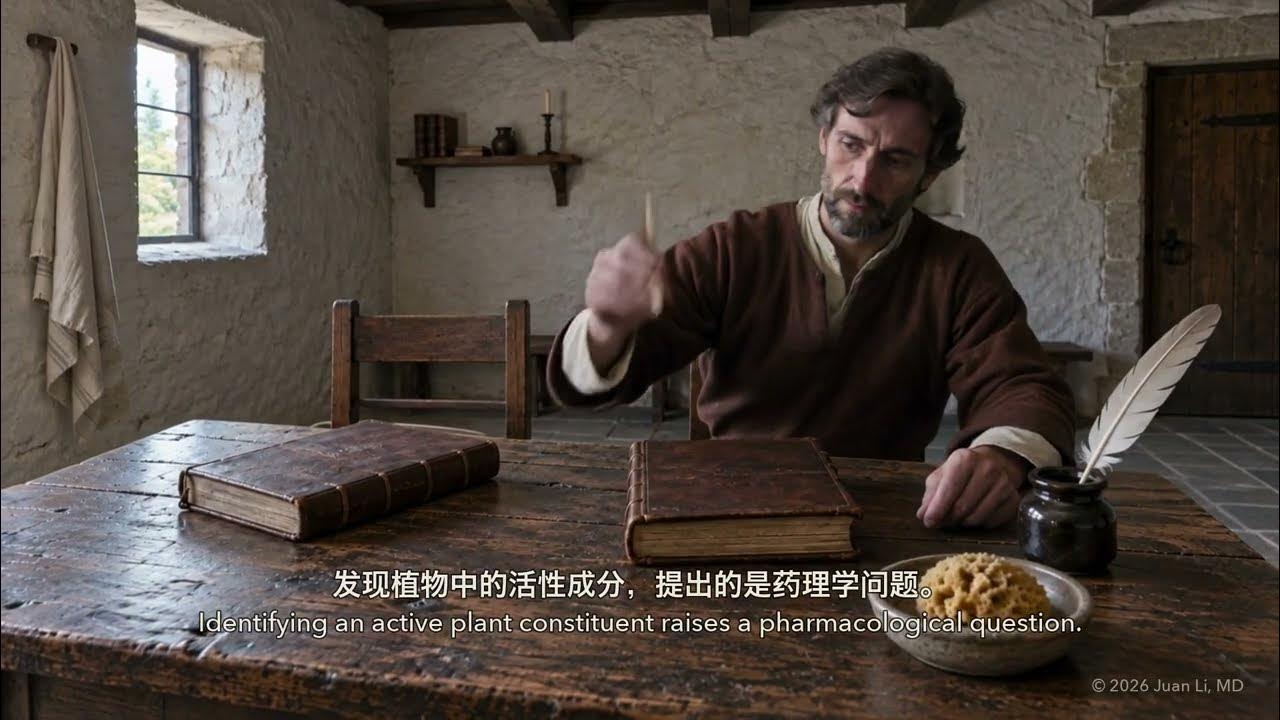
A recipe promises sleep, but what can a surviving prescription tell us about a patient's experience? Medieval soporific sponge traditions preserve an intention to lessen operative pain. Their wording, intended route of administration, and evidence of clinical outcome require separate reading. This film follows those distinctions through later scholarship, resisting the temptation to turn a collection of preparations into a series of successfully anesthetized patients. A recorded recipe is evidence of a therapeutic intention, not proof of dependable anesthesia.
Read the companion essay · c. 1250: The Soporific Sponge, a Recipe Not a Proven Anesthetic
Scientific takeaway
Prescription, intended route, and demonstrated clinical outcome are distinct forms of evidence.
Sources
- Luft D. Medieval Welsh Medical Texts: Volume One: The Recipes. Cardiff: University of Wales Press; 2020. Read this edition — NCBI Bookshelf
- Cavalloro V, et al. Teodorico Borgognoni’s Formulary for Thirteenth Century Anesthetic Preparations. Life.2023;13:1913. doi: 10.3390/life13091913. Read the article
- Hunter EK. ‘To Cause Sleepe Safe and Shure’: Dangerous Substances, Sleep Medicine and Poison Theories in Early Modern England. Soc Hist Med. 2022;35(2):473–493. doi: 10.1093/shm/hkab064. Read the article
Notes on reconstruction
Scenes are reconstructed and evidence cards use modern typesetting; no surviving recipe is presented as proof of a verified anesthetic outcome.
Read beyond the film
c. 1250: The Soporific Sponge, a Recipe Not a Proven Anesthetic
Explore the longer account, original references, reading limitations and connected stories.