In Book One of the Canon, written before 1015, Avicenna lists snow and ice-cold water among stupefacient materials, but places them in a discussion that weighs quick relief of pain against the harm it may cause.
Reading Library · Anesthesia Epochs · 中文版
Watch the companion film
Before 1015: Avicenna’s Canon · Watch on YouTube
Historical anchor: 1015. Date details and source qualifications are explained below.
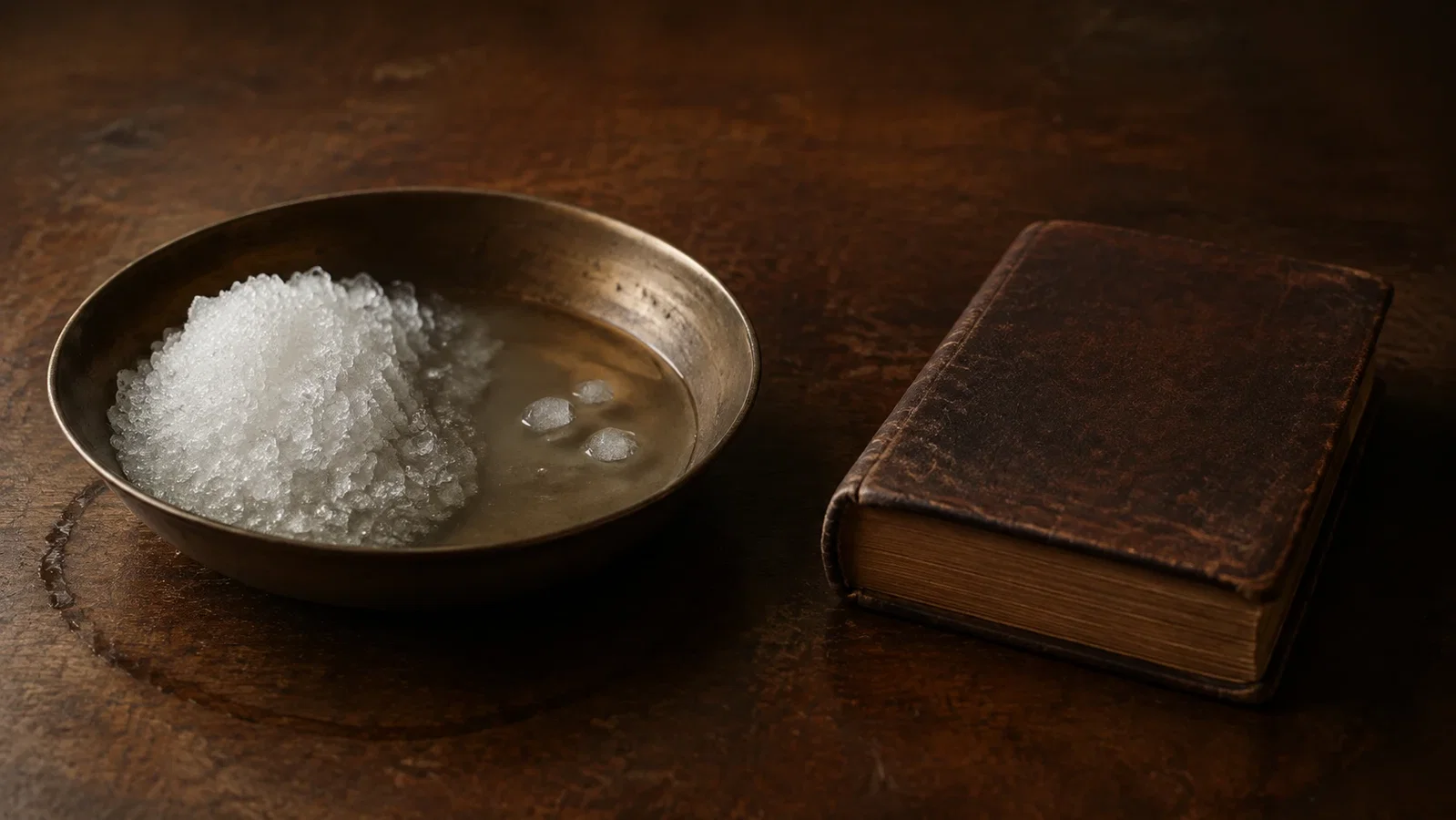
Cold beside a text. This original retrospective illustration is not a documented medieval apparatus or evidence that an anesthetic was administered in this way.[1]
The difficult part is not finding a remedy. It is deciding what its relief might cost.
Near the end of Book One of Avicenna's Canon, the physician faces an uncomfortable choice. An intervention directed at the supposed cause of pain may take time. Blunting sensation can bring relief sooner, but it may also produce another injury. The text asks which danger matters more: allowing the pain to continue, or causing harm through the attempt to stop it.[1]
This is the discussion in section 1078 of O. Cameron Gruner's English rendering. Only a few paragraphs earlier comes a list that includes snow and ice-cold water. Read in isolation, that list lends itself to a triumphant history of early cryoanesthesia. Read with its neighbors, it belongs to a more demanding account of pain, sensation and judgment.
A choice rather than a promise
The chapter does not offer one uniformly desirable result called pain relief. It distinguishes ways of obtaining relief and asks the reader to consider what else each action might do. Rapidly making a painful part insensible could avert one danger while creating trouble elsewhere. The physician is asked to judge between alternatives, not merely to choose the fastest apparent response.[1]
There are no comparative event rates in this passage. It does not establish a modern benefit-risk calculation, much less supply one that could guide treatment now. Its force is textual and historical: a discussion that permits intervention also makes room for its costs. The possibility of relief does not erase the possibility of harm.
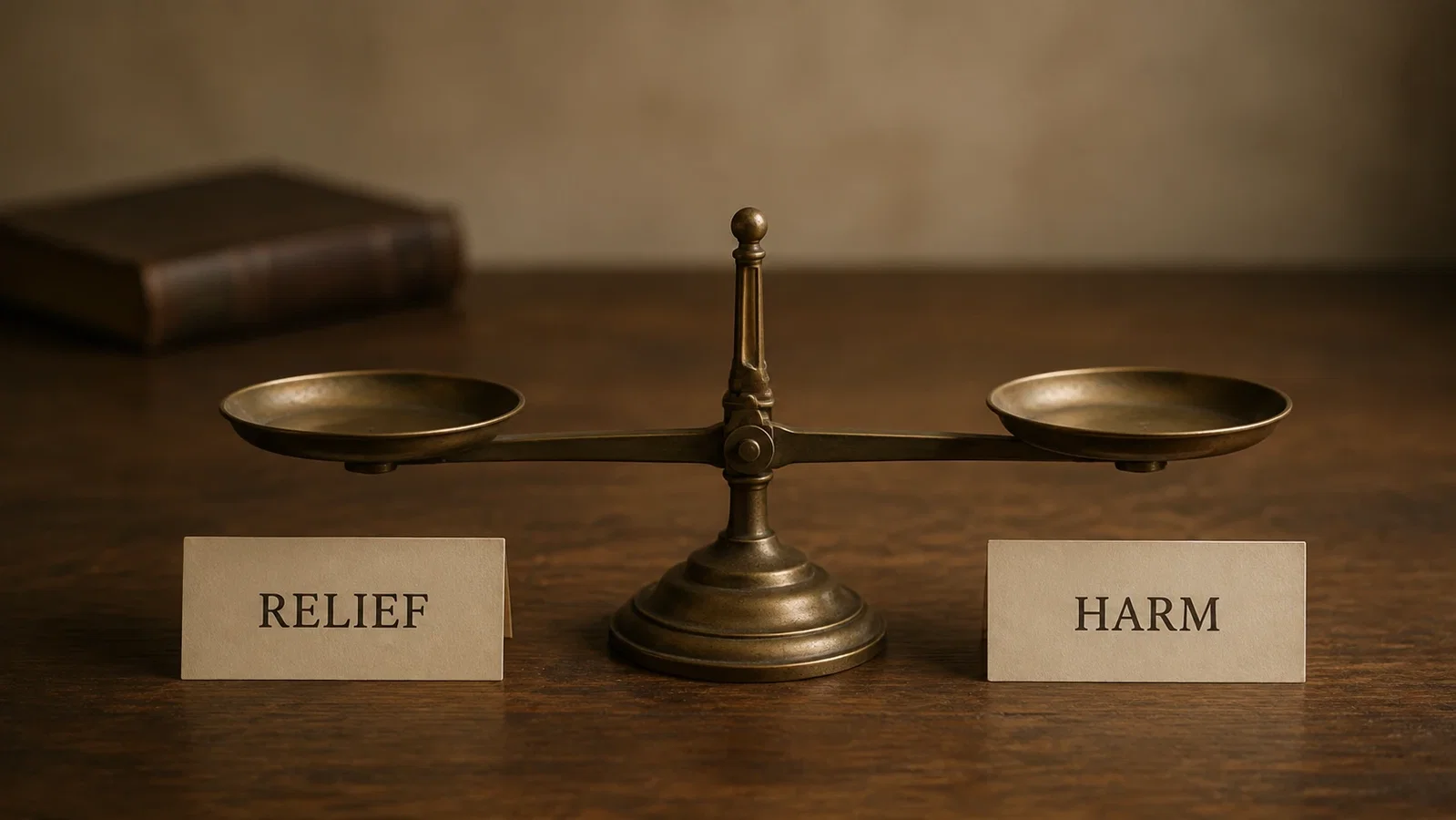
A demand for judgment, not a measurement. The balance is an editorial metaphor. Empty pans and a level beam do not mean equal probabilities, equal harms or clinical equipoise.[1]
That qualification changes how the cold materials should be understood. They are not being handed to the reader with a guarantee. They occupy a place in an argument about what might change pain and why the choice could remain difficult.
Three questions that should not collapse into one
Earlier in Book One, section 435 groups means of alleviating pain in several ways. Some oppose what the author considers its cause. Others soothe, promote sleep or reduce the activity of sensation. Another group acts through cooling and dulling the painful part. Later, section 1074 again distinguishes changing the underlying condition from producing insensibility.[1]
These are historical categories. The discussion belongs to a framework of humors, temperaments and faculties. Section 1073 describes pain through sudden changes of temperament or loss of bodily continuity. It would be misleading to replace each term with a receptor, an ion channel or a contemporary diagnosis and announce that the modern explanation had already arrived.[1,2]
Nevertheless, the categories prevent a simple equation: making pain less perceptible is not necessarily the same thing as removing its cause. Section 1079 also distinguishes a local narcotic effect from a final cure in its historical example. The text gives the reader more than one question to ask about an intervention.[1]
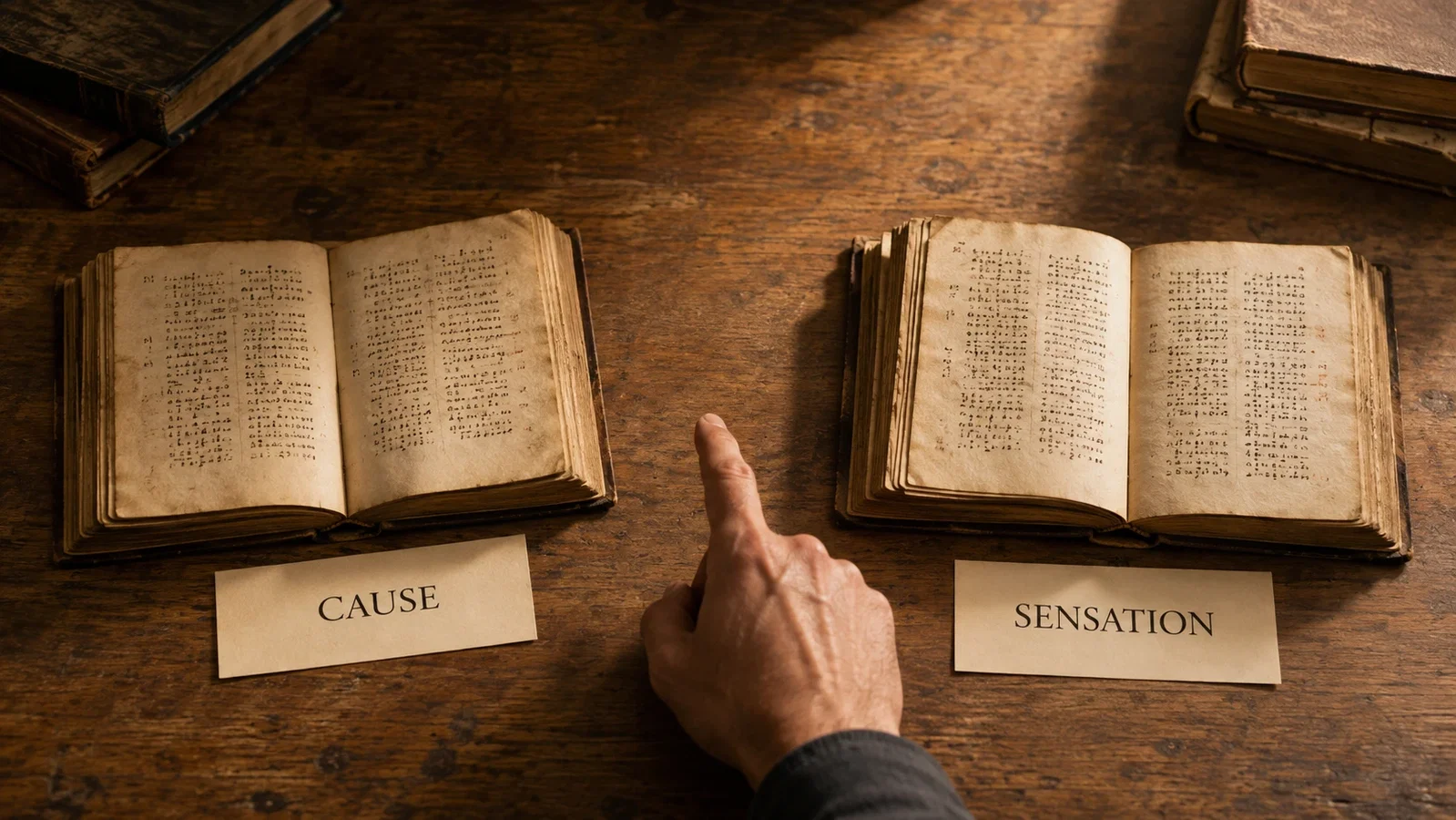
Two questions on the desk. The books, comparing gesture and labels are a retrospective construction, not authentic chapter headings, translated pages or a diagram of neural mechanisms.[1]
The distinction is recognizable without being identical to present practice. Historical writing becomes less interesting when every useful observation must be declared an anticipation of a later specialty. Here the task is to understand how the questions were arranged within their own explanatory system.
What the snow actually supports
Section 1075, on printed page 527 of Gruner's volume, includes “snow and ice-cold water” among stupefacient materials. Cold is therefore not an object added by an illustrator to make the story more vivid. There is a specific textual landing for it.[1]
But two meanings must be kept apart. Snow and chilled water are material things. Elsewhere in the same discussion, cold is also a quality within humoral theory, including a way of characterizing substances. Not every use of the word describes a temperature that could simply be read from a thermometer. A single modern freezing mechanism cannot explain the historical list on its own terms.[1,2]
The next section names external cold among possible causes of pain. The juxtaposition matters: the same broad category can appear in an account of relief and in an account of suffering. The text does not license the conclusion that more cold necessarily means a better result.[1]
Nor does this passage document a particular ice-block operation. In the passage itself, there is no named patient, operative date, application site, exposure duration or outcome record. Those missing elements cannot be supplied by placing a tranquil surgical patient in a reconstruction. This is evidence of a written therapeutic concept, not evidence of the pictured clinical success.
Sleep requires similar care. Section 1080 describes it as one contributor to relief. That does not make sleep, diminished pain and loss of consciousness interchangeable states. Translating the historical words into today's anesthetic endpoints would require evidence the passage does not provide.[1,2]
Which Canon is on the desk?
The Canon has five books, with general principles in Book One. Musallam's scholarly account dates the composition of that book to before 1015 and places the work within an established Arabic medical tradition. This article therefore uses an upper bound, not a precise year for the invention of an ice technique.[2,3]
The directly inspected passages come from Gruner's 1930 London publication, accessed in a scan of its 1973 AMS reprint. The printed edition statement and Wellcome's catalogue identify these two publication layers. A new printing is not a new medieval witness.[1,4]
There is another layer between the English and the Arabic tradition. Musallam identifies Gruner's dependence on Gerard of Cremona's Latin translation. Gruner's own preface describes an edited work combining a Book One translation with his study: the anatomy section was omitted, other material substituted, and larger type used to distinguish the translation. The pain passages examined here are in that larger type.[1,3]
These qualifications do not make the volume unusable. They make accurate attribution possible. We can say what appears in a specified English rendering, with a page and section number. We cannot describe that work as the entire five-book Canon, an unmediated autograph or an Arabic text independently established by this site.
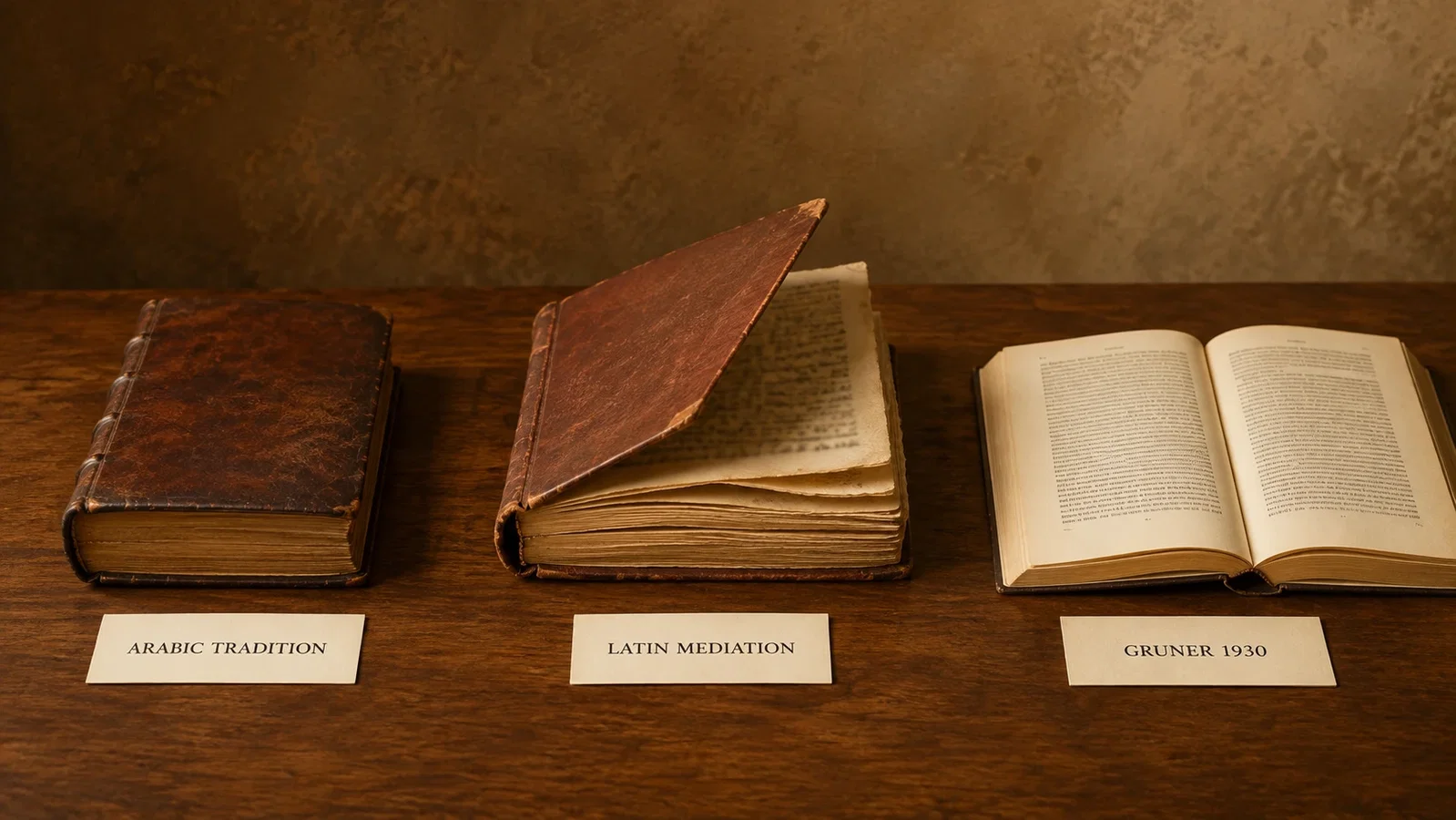
A route of transmission. These are illustrative book objects, not identified surviving manuscripts or a complete textual stemma. The Latin mediation of the 1930 English rendering remains visible.[1,3,4]
Later studies have their own routes through the text. Tashani and Johnson's 2010 historical analysis works with a 1593 Rome Arabic printed edition. Its statement about ice in Book Five cites Aziz and colleagues' 2000 paper. The former was read in full for this article; the latter's full text is not covered. Reading one does not amount to directly checking the other, or to independently reading Book Five.[2]
Mahdizadeh and colleagues'2015 descriptive review states that it drew on a 1988 Persian translation. Only its first three pages, covering identity, introduction and methods, were read here; the subsequent long drug table was not audited. These are useful records of different reading paths, not multiple independent demonstrations of the clinical efficacy of a historical remedy.[5]
A place in anesthesia history without an invented operation
Removing a claim of first successful cryoanesthesia does not leave the article empty. It leaves a more precise historical contribution: cold materials appear within a discussion that distinguishes causes from sensations and asks what harm the pursuit of relief might bring.
The caution is not a modern disclaimer pasted onto a triumphant story. It is present in the neighboring passages themselves. The list and the dilemma belong together. Detaching one from the other would make the account simpler while losing part of the thinking it was meant to preserve.
For a history of anesthesia, that is enough to warrant attention. Not every important entry has to supply a new apparatus, a first patient or a direct causal line to a present procedure. Some preserve an explicit question about intervention. Here, the question is what the physician owes to suffering when the means of relieving it can also cause harm.
The snow deserves its place in the picture. So does the judgment that follows it in the book.
Sources and reading limits
- Gruner OC. A treatise on the Canon of medicine of Avicenna, incorporating a translation of the first book. London: Luzac, 1930; scan of AMS 1973 reprint. Complete 641-page PDF; PDF pp. 2–4, 268, 551–554 actually inspected, including the preface, section 435 and the complete Relief of Pain chapter, sections 1073–1084. This is not a whole-book reading or independent Arabic collation. The public mirror is not a Wellcome digital edition.
- Tashani OA, Johnson MI. Avicenna's concept of pain. Libyan J Med. 2010;5:5253. DOI:10.3402/ljm.v5i0.5253. All four pages, table, references and page images read. Its Aziz 2000 reference was not independently obtained in full.
- Musallam B. AVICENNA x. Medicine and Biology. Encyclopaedia Iranica. 1987; Vol. III, Fasc. 1, pp. 94–99; webpage updated 2017. Introduction, Canon and relevant bibliography paragraphs read.
- Wellcome Collection. Catalogue of Gruner's 1930 translation. Original HTML; edition, publication city, translator and extent read.
- Mahdizadeh S, Khaleghi Ghadiri M, Gorji A. Avicenna's Canon of Medicine: a review of analgesics and anti-inflammatory substances. Avicenna J Phytomed. 2015;5(3):182–202. Complete PDF; only the first three pages used and read, not the entire table.
Historical discussion, not advice to use ice or old remedies. The year 1015 is the scholarly upper bound for the composition of Book One and is qualified as “before”. Sources and reading limits are stated above. Illustrations are labelled as original source images or AI-made. Historical accounts are educational; they are not current treatment instructions.
Continue exploring
Related reading connects shared questions and contexts; it does not by itself establish historical influence.
- c. 1250: The Soporific Sponge, a Recipe Not a Proven Anesthetic
- 1884: Koller Brings Cocaine to the Surface of the Eye
Anesthesia Epochs · The Source Room · About & Editorial Method