In September 1884 Brettauer presented Koller's cocaine eye experiments at Heidelberg; Koller's October report described about 7–10 minutes of complete surface anesthesia, with some sensation still possible during deeper steps.
Reading Library · Anesthesia Epochs · 中文版
Watch the companion film
1884: Koller and Ocular Local Anesthesia · Watch on YouTube
An illustrative consultation, not a portrait of Koller, an identified patient or an authenticated room or bottle. No administration or operation is depicted. The conscious patient represents the distinction between a local sensory effect and loss of consciousness.
The person who demonstrated Koller's experiments at the Heidelberg meeting was not Koller. It was Brettauer, a physician from Trieste, who brought the communication before the ophthalmologists assembled there on 15–16 September 1884.[1,p 91]
That detail changes the familiar opening scene. Instead of a solitary inventor standing beside a first patient, there is a report travelling through a colleague. There is an audience able to hear about an effect and see experiments. And there is a subsequent account in which the author explains what had been accomplished, what was observed and what remained uncertain.
The primary text used here is itself another stage in that circulation: Boerne Bettman's English translation, printed in the Chicago Medical Journal and Examiner in February 1885. Its first page identifies a paper read before the Vienna Society of Physicians on 17 October 1884. The Heidelberg communication, the Vienna reading and this printed translation are distinct events. None supplies a reason to turn one September calendar day into an exact, universal moment of discovery.[1,p 91]
A report can travel farther than its author
The account locates Koller's work in Vienna, where Koller was a house physician at the General Hospital. It describes experiments in Stricker's laboratory and subsequent clinical opportunities provided by von Reuss and colleagues. Heidelberg is the public-communication anchor for this article, not the location of every experiment or operation described in it.[1,pp 91–92,96]

An editorial chronology, not a first-experiment date or a verified route followed by a particular manuscript. The contemporary translation names Brettauer's role, the meeting range and the October reading; the journal establishes the 1885 publication.[1,p 91]
The translation matters for another reason. A later English version cannot silently become a German autograph, and Bettman cannot be exchanged for the translator of a different publication. Reading the ten printed pages makes those distinctions visible before the historical narrative starts to accumulate more certainty than its documents contain.[1,p 91]
This does not make the clinical achievement smaller. It gives the achievement a route into view. Koller reported that colleagues elsewhere had repeated and confirmed the experiments, but this statement is Koller's account of reception, not a measured census of adoption. Communication and widespread implementation remain different things.[1,p 91]
A narrower question than “who invented anesthesia?”
Koller did not begin by claiming that nobody had noticed cocaine's effects on sensation. The report discussed earlier observations of numbness of the tongue, existing ocular use and changes in the pupil. It also acknowledged an earlier suggestion of a possible local anesthetic application. Koller's own question followed from that background: might an agent affecting sensation in the tongue's mucosa act on the cornea and conjunctiva?[1,pp 91–92]
Koller credited Freud's work with drawing attention to cocaine. That acknowledgment should not be inflated into a documented instruction to invent ocular anesthesia. In a 2024 historical correspondence, Wildsmith disputed such direct attribution and argued for attention to contemporary evidence. Wildsmith's argument is a later historian's intervention, not an additional clinical observation from 1884, and the manuscripts it describes are not drawn on here.[1,p92;2]
The question worth following through Koller's report is therefore practical but not a modern recipe: which sensations changed, in which tissues, and with what consequences for a patient? It is narrower than a claim to have discovered every local effect of cocaine. It is also more informative.
Koller's early observations included animals, then Koller's own eye, the eyes of colleagues and other people. The report does not provide one complete human cohort denominator. Nor does it describe a uniformly pleasant transition into insensibility. Initial burning and tearing were followed by altered surface sensation and other changes, including a feeling of dryness. Those early reactions belong in the account, even where the author later reports no subsequent irritation.[1,pp 93–95]
Insensible was not the same as blind
Pain, touch, temperature responses and reflex activity at the cornea and conjunctiva were affected. That did not mean the patient's visual experience had vanished. Koller separately discussed pupil dilation, accommodation and vascular changes; these had their own timing and qualifications. A change in one ocular function was not evidence that every function had stopped.[1,pp 94–95]
The distinction from unconsciousness was equally important. The clinical possibility was to alter local sensation while leaving a person able to respond and report an experience. But a report that the surface had become insensitive could not answer every question about deeper manipulation.
In the animal work, involvement of the iris still elicited pain responses, and Koller acknowledged the difficulty of interpreting sensation in animals. In a woman's cataract operation, the corneoscleral incision was not felt, yet grasping and excising iris tissue produced sensation and slight pain. The result was not a single switch labelled “the eye.”[1,pp 93,99]
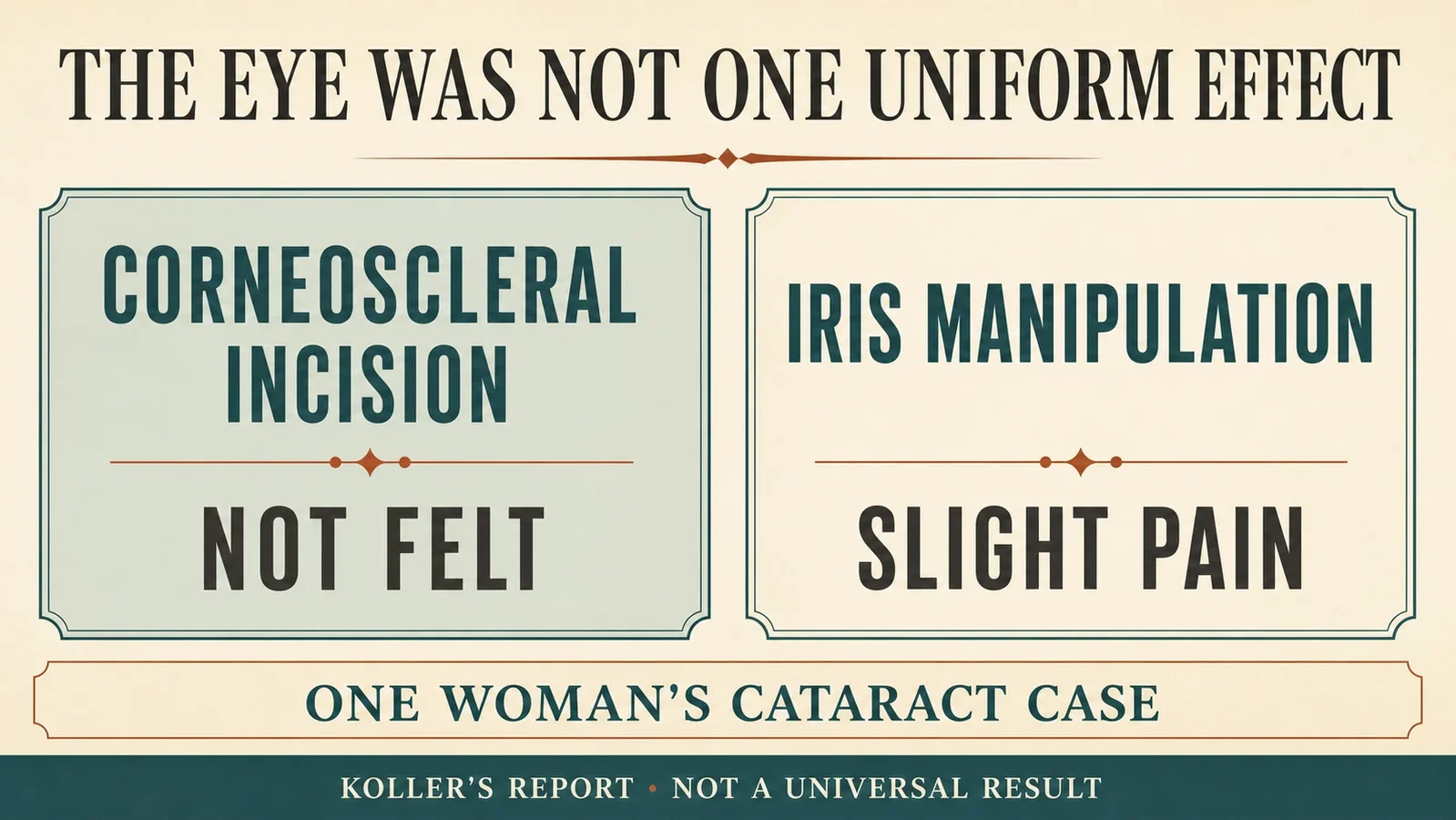
A reading guide to one reported case, not an anatomical map, a universal result or instructions for performing an operation. Other patients and procedures did not necessarily reproduce the same pattern.[1,p 99]
That residual pain is not a trivial qualification added after the important discovery. It helps define what had been discovered. Particular steps could become tolerable without general unconsciousness, while another step still required attention to what the patient felt. Removing that distinction would replace a clinical observation with a slogan.
Koller's characterization of the anesthetic action as local also needs its surrounding sentences. The discussion includes absorption and effects in more remote tissues. “Local” identifies an observed pattern of anesthesia; it does not establish absence of absorption, systemic toxicity or every other adverse effect. A short historical report cannot provide the safety assurance that such a reading would demand.[1,pp 95–96]
Two numbers that cannot be substituted
Duration is another place where a convenient summary can distort the report. Koller described complete human ocular-surface anesthesia lasting about 7–10 minutes, followed by a longer period of diminished sensibility. Repeated applications were discussed under different conditions. They cannot simply be counted as the duration of one application.[1,pp 95–96]
Later, Koller described relief of pain and photophobia associated with eye disease, with symptoms returning after 2–3 hours. That is a different observation and a different endpoint. It does not establish several hours of complete surgical anesthesia.[1,p 97]
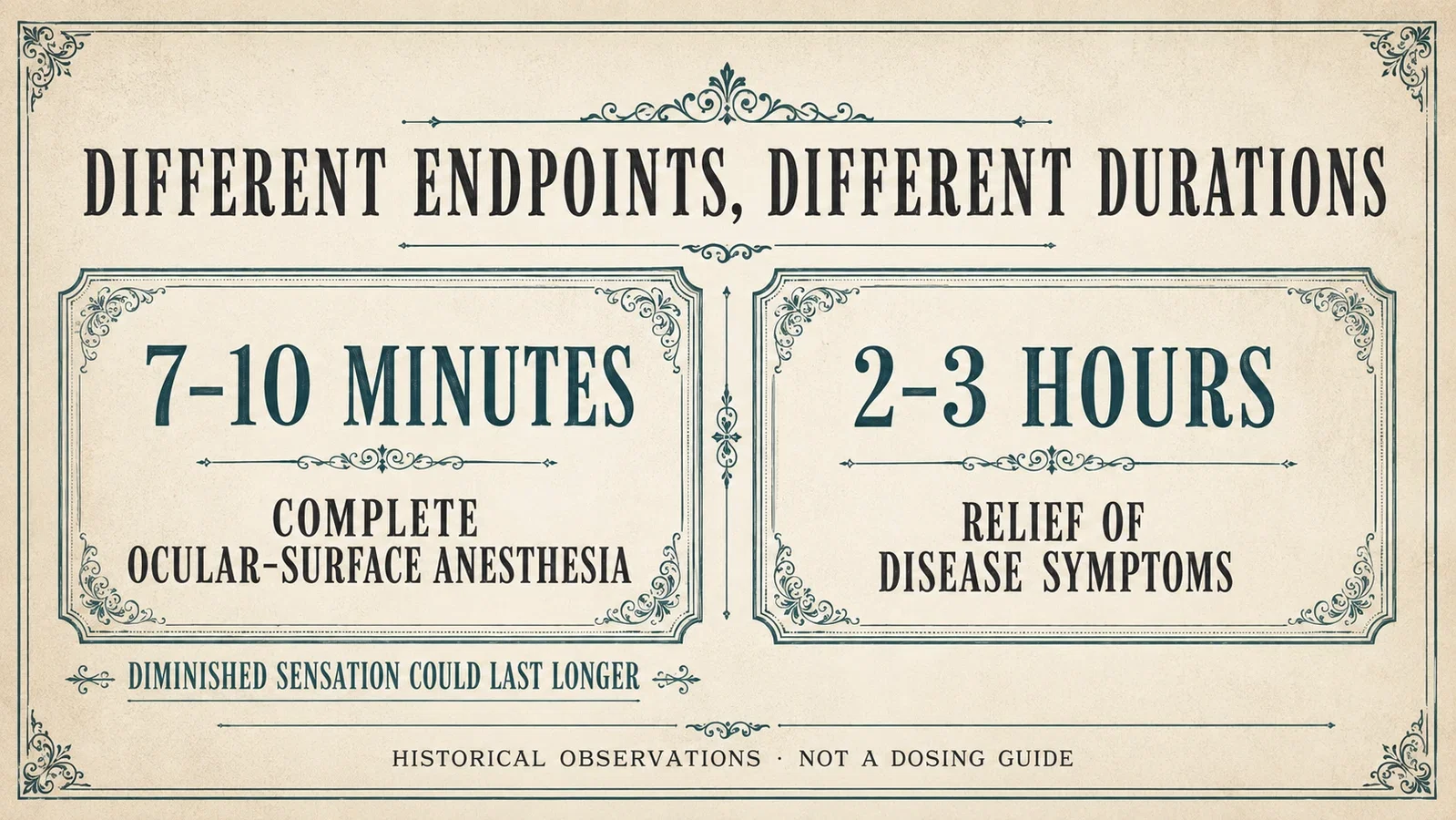
The durations are neither interchangeable nor additive. The period of diminished sensation following complete surface anesthesia belongs to the left-hand observation; it is not a guaranteed extension of symptom relief. No current dosing or treatment interval is supplied.[1,pp 95–97]
This distinction is easy to lose because both passages concern how people felt after exposure to the same substance. Yet relief from ongoing disease symptoms and the absence of sensation during a surgical stimulus are not equivalent tests. A long interval in one cannot be borrowed to make the other look more durable.
The clinic supplied exceptions as well as examples
Koller separated two intended uses: easing painful eye disease and providing anesthesia for operations. Koller thanked von Reuss for clinical access and named Bochner and Dimmer among those helping with the observations. The report was not the record of a lone investigator encountering a succession of identical eyes.[1,p 96]
Some accounts were strikingly favorable. In the foreign-body removal passage, Koller described treating the great majority of the affected individuals, a group put at about 30 cases, and reported that they remained still and felt nothing. The number belongs to that clinical subgroup. It is not the denominator of the whole paper, and it cannot become the sample size of a randomized study that was never described.[1,p 98]
Other experiences were less consistent. Pain returned early in some circumstances. One woman reported pain that was less severe but lasted longer. Experience with another local treatment was limited and contradictory. For iridectomy and cataract procedures, the author described results varying with the conditions under which the agent was used.[1,pp 97–99]
These differences are part of the evidence, not noise to be tidied away. They prevent the success of foreign-body removal from automatically proving success in every deeper operation. They also make the woman's residual iris pain intelligible as one observation within a variable clinical field.
A man with bilateral pupillary occlusion provided a memorable comparison near the end of the report. The left eye was operated on with cocaine. A week later, the other eye underwent surgery without anesthesia. Koller contrasted the patient's experience and movement during the two procedures.[1,pp 99–100]
It is a forceful anecdote, but the order was fixed and the eyes were different. The account does not separate the effects of eye, disease, sequence or expectation through randomization or blinding. Calling it a clinical comparison preserves what the author observed. Calling it a controlled trial would give it safeguards that the report does not contain.
Some proposed benefits had not reached even that stage. The discussion of continuing treatment for painful conditions and possible additional uses explicitly included expectations not yet tested. A promising avenue is a reason to investigate, not a completed result. The report's future tense should survive its retelling.[1,p 97]
Keep the opening, and keep its edges
The Library of Congress collection offers a further archival route into Koller's life and work. Only its collection description is used here; no notebook or letter from that collection is drawn on. An archive's existence identifies where another investigation might begin, not what unread pages have already proved.[3]
The ten contemporary printed pages are sufficient for a bounded account of this article. They show a local effect pursued through experiment, discussed through colleagues, brought into clinical work and reported with variation. They also show why an awake patient is not simply a patient from whom every relevant sensation has been removed.
The achievement is most persuasive at that scale. One part of an operation could become unfelt while another still hurt. Some symptoms could improve longer than complete surface anesthesia lasted. Colleagues could demonstrate a result before a later translation carried its details to another readership. Keeping these distinctions does not turn discovery into failure. It lets the discovery remain a clinical claim that other people could examine.[1]
Sources and reading limits
Read: Bettman's 1885 English translation of Koller's paper, all ten pages (pp. 91–100); Wildsmith's 2024 correspondence in Brain; the Library of Congress description of the Carl Koller Papers.
Not covered: the German original, the manuscripts and letters in the Library of Congress collection, and later secondary accounts.
- Koller K. The application of cocaine to the eye as an anæsthetic. Bettman B, translator. Chic Med J Exam. 1885 Feb;50(2):91–100. Available from: PMC9876140
- Wildsmith JAW. Who identified cocaine as a local anaesthetic? Brain. 2024;147(9):e62–e63. doi:10.1093/brain/awae171
- Library of Congress, Manuscript Division. Carl Koller papers, MSS82987 [Internet]. Washington (DC): Library of Congress. Available from: findingaids.loc.gov
Sources and reading limits are stated above. Illustrations are labelled as original source images or AI-made. Historical accounts are educational; they are not current treatment instructions.
Continue exploring
Related reading connects shared questions and contexts; it does not by itself establish historical influence.
- c. 1015: Cold in Avicenna's Canon, Relief Versus Safety
- 1853: Wood and Pravaz, Similar Instruments for Different Questions
- 1884: Halsted and Hall Report a Jaw Nerve Block in a Postscript
- 1885: Corning's Anesthetic Effect and a Disputed Location
- 1942: Griffith and Johnson Use Curare in Twenty-Five Patients
Anesthesia Epochs · The Source Room · About & Editorial Method