Two injection histories meet in 1853, but relief of neuralgia and experimental arterial coagulation were not the same clinical achievement.
Reading Library · Anesthesia Epochs · 中文版
Watch the companion film
1853: Wood and Pravaz · Watch on YouTube
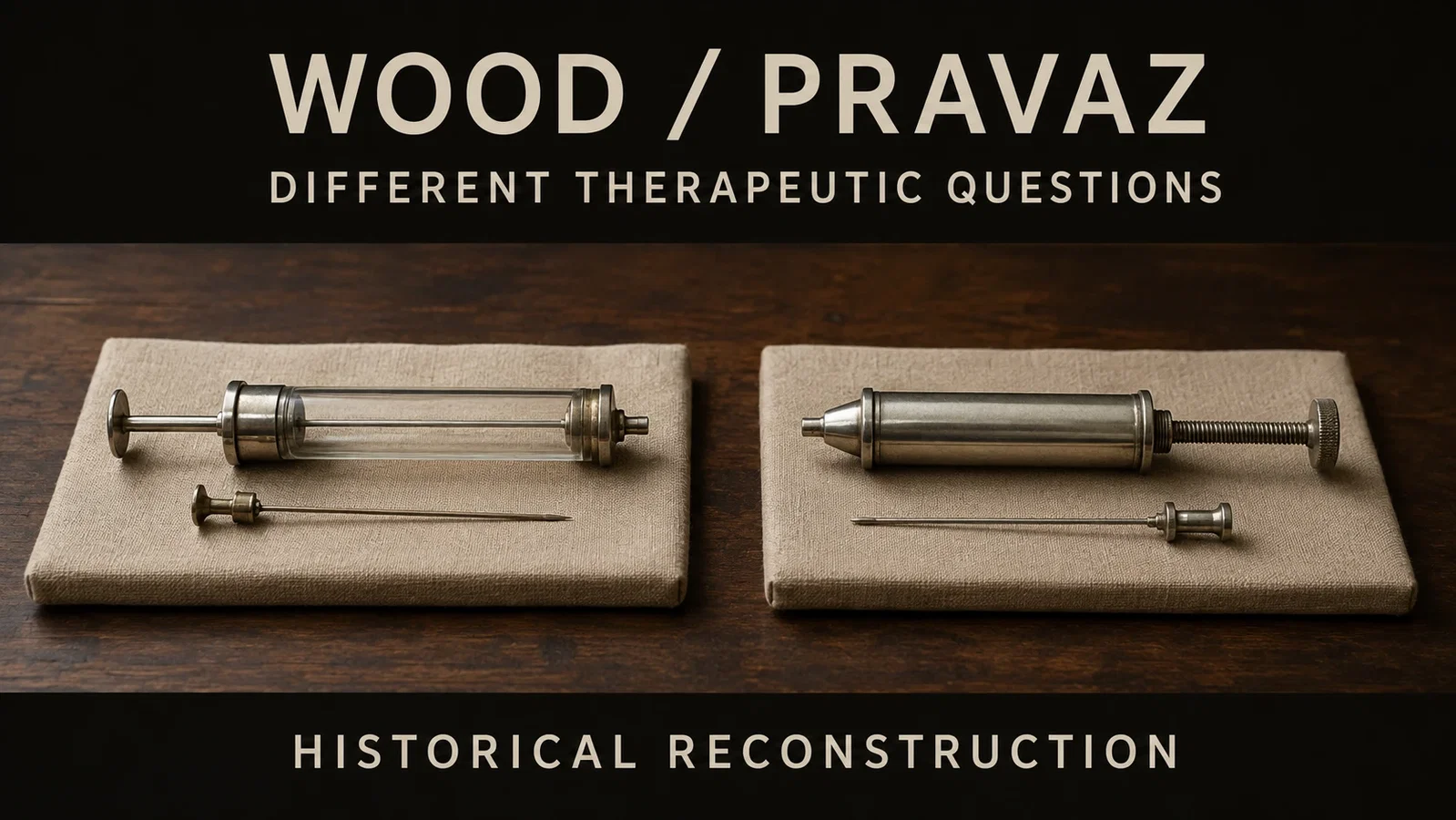
The final page of the French report makes a distinction that a short invention story can easily lose. These were experimental observations. Applying the method to a human aneurysm would require a different arrangement.[2,p 90]
That qualification matters because the report concerned a syringe. An instrument can look familiar enough to make its history seem inevitable: a barrel, a piston, a route into the body. But familiarity with the object does not tell us what its operator was trying to do, which body supplied the evidence, or what counted as success.
In 1853, the report associated with Charles Gabriel Pravaz described arterial coagulation in animals. Alexander Wood's account of work beginning around the end of that year concerned neuralgia in people. They were not two versions of one successful pain treatment.[1,p 7;2,pp 88–90]
Begin with the animals, not the invention label
The French contribution appeared in volume 36 of the Comptes rendus, on pages 88–90. Its heading identifies Pravaz of Lyon, but the publication is an extract from a letter sent by Lallemand to Rayer. Preserving that form matters: this is a contemporary account transmitted through a letter, not a modern clinical-trial report carrying a familiar author line.[2,p 88]
The therapeutic ambition was to find a means of treating aneurysms by making blood coagulate. The report describes iron perchloride, a fine trocar and a syringe with a screw-driven piston. The screw was intended to deliver liquid smoothly and in controlled quantities. Morphine analgesia was not the question under investigation.[2,pp 88–89]
At the Lyon Veterinary School, the reported observations involved one sheep and two horses. The text follows clot formation in carotid arteries over different intervals, with later changes in hardening and clot formation in the third experiment. It does not describe three patients whose aneurysms were cured.[2,p 89]
Only after those observations does the report turn toward proposed human use. That is where the final-page qualification belongs: the animal experiments and the clinical ambition must remain distinguishable. The report's own language gives us reason not to transform an observed clot into a demonstrated human cure.[2,p 90]
A different problem in Edinburgh
Wood wanted to address neuralgia by applying narcotic medicine near painful points. Wood's account discusses the varying origins attributed to neuralgia, earlier local treatments and the painful-point approach behind the reasoning. It is a historical therapeutic argument, not a modern diagnostic account of all neuropathic pain.[1,pp 5–7]
The instrument Wood obtained was not initially described as a dedicated neuralgia device. Around the end of 1853, Wood procured a small syringe from Mr Ferguson in Giltspur Street, London, intended for treating a naevus with iron perchloride. Wood repurposed it for a different therapeutic question.[1,p 7]
This is a useful corrective to the isolated-inventor portrait. Obtaining, adapting and using a device are meaningful acts without requiring us to attribute every component to the clinician who wrote about it. Wood's own text names a maker and describes a change of purpose.
It also names a subsequent change of apparatus. In the preface to the 1855 pamphlet, Wood says the earlier instrument has been abandoned for a simpler form made by Mr Young in Edinburgh, involving a cannula and a small glass syringe. Cost and reduced need for repair are presented as advantages. Those are the author's assessments of a later form, not comparative-trial results and not a precise image of the instrument used in the first case.[1,preface iv]
The modern reconstruction above therefore deliberately compares device concepts from different dated descriptions. It does not silently label the later glass form “Wood's original 1853 syringe.”
Relief did not erase the rest of the case
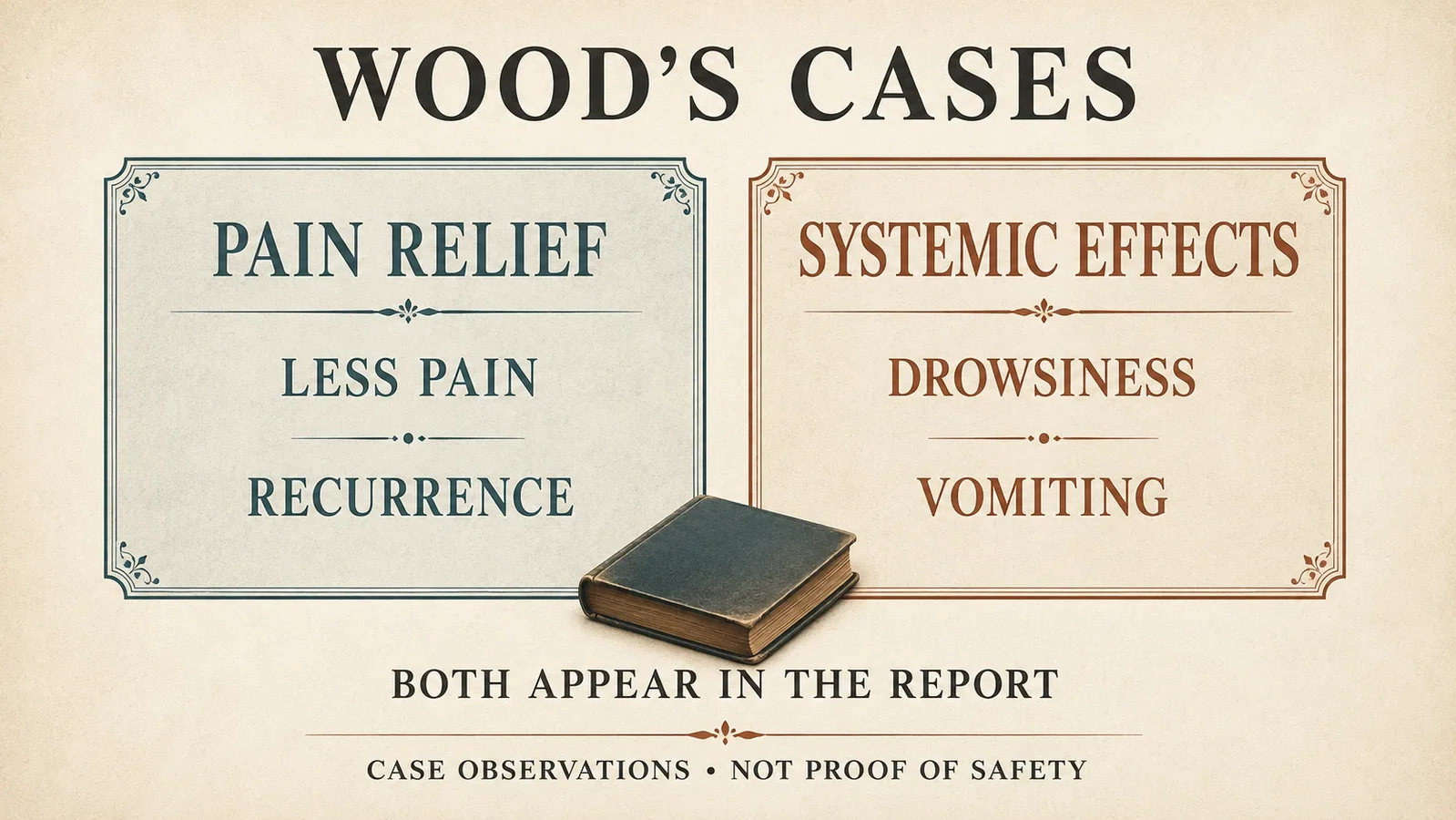
Wood's first detailed case concerned an unnamed older woman with cervico-brachial neuralgia and difficulty tolerating oral opiates. On a November evening Wood injected a morphia salt preparation. The patient became giddy and confused; after roughly half an hour, the pain was less.[1,pp 7–8]
The record does not end there. At eleven the following morning the patient had not awakened. Wood noted somewhat deep breathing and difficulty rousing the patient, followed by recovery. The account supports neither an invented death nor a reassuring story of uncomplicated sleep. It records relief and a substantial change in responsiveness in the same patient.[1,p 8]
Other cases make the pattern less tidy still. Relief could be followed by recurrence, accompanied by vomiting, or leave residual pain and functional difficulty. In the fourth case, severe vomiting and shivering occurred without the anticipated relief; pain was worse and subsequent follow-up was lost.[1,pp 8–13]
There are nine numbered Wood narratives followed by two separately numbered cases from Thomas Wright, undertaken at Wood's suggestion. Eleven detailed narratives are not necessarily eleven patients constituting a complete, consistently assessed treatment cohort. The text mentions additional unnumbered observations, and the cases differ in treatment, concomitant care and follow-up. Turning them into a single efficacy percentage would manufacture a study design that is not on the page.[1,pp 7–14,21]
Wood did not confine every effect to the needle's destination
It would be equally misleading to simplify Wood's theory into a belief that injected medicine acted only where it was placed. The 1855 discussion explicitly considers local and remote effects. In the concluding propositions, Wood describes narcotics acting at painful points and reaching the brain through the venous circulation.[1,pp 21–22]
Wood's physiology is not a substitute for modern pharmacology. Nevertheless, the historical text already recognizes systemic action. A story in which Wood knew only local effects and somebody later introduced the possibility of absorption would flatten the actual argument.
Nor does a route that avoids swallowing establish freedom from systemic adverse effects or dependence. The preface expresses hopes about treating pain and limiting the burdens of oral opium use. The concluding confidence in a safe, easy method is Wood's judgment; the uncontrolled observations and adverse experiences remain visible limits on what that judgment can prove.[1,preface iii–iv,pp 7–14,22]
For a history of anaesthesia and pain, this tension is more informative than a perfect first success. The route of administration, the desired effect and the undesired effects have become separate things that can be described in the same clinical account.
Why 1853 is an anchor, not a universal birthday
The device dates require the same care as the clinical claims. The French Ministry of Culture's POP/Joconde record attributes a Pravaz instrument to 1852 and identifies Charrière as its manufacturer. It also notes that some needles now in the case are not original. A museum catalogue can establish what is attributed to a particular object without settling every worldwide priority claim about needles or syringes.[3]
The 2010 historical article by Lépine and Voinot includes a photograph and a physical description of the Lyon museum instrument. Its screw rod and associated components help explain the structural idea. Specific dimensions or calibration statements describe a particular account or object, however; they should not be generalized to every version. Conflicting dating and calibration details are not silently combined into a universal specification.[4,p 51]
Wood's publication belongs to 1855. The complete primary text read for this article is the Edinburgh pamphlet. A bibliographic record also identifies a journal publication in April 1855, volume 82, issue 203, pages 265–281. The pamphlet is the text used here; it is not treated as the journal version.[1,title;5]
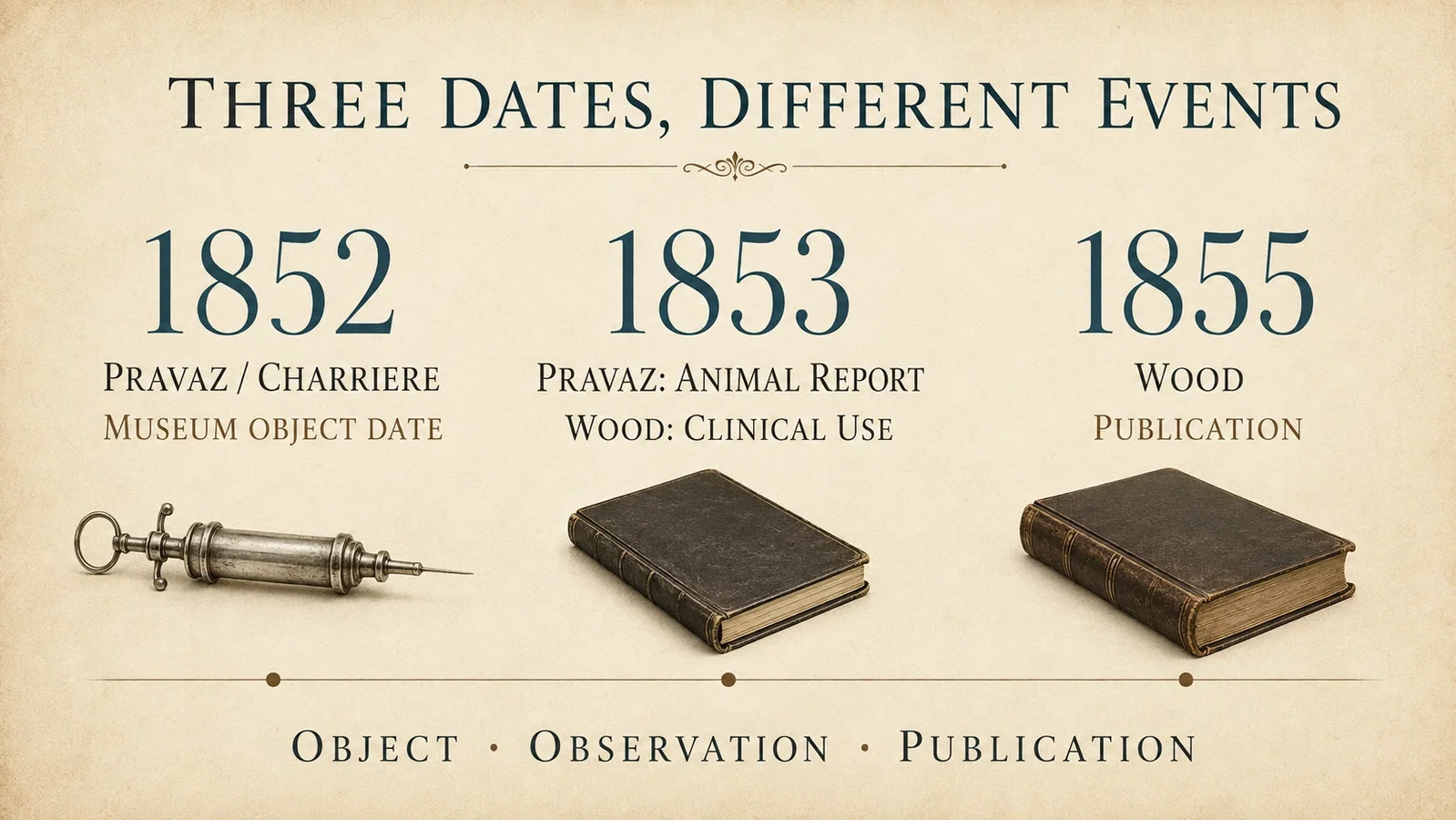
This leaves 1853 as a useful meeting point between two histories, while retaining 1852 for the catalogued object and 1855 for Wood's publication. It avoids forcing manufacture, use, report and later modification into one birthday.
What the instrument made possible, and what it did not settle
A syringe could make a new intervention possible. The screw-driven apparatus made controlled advancement part of Pravaz's experimental description; Wood's repurposed instrument brought a new route into the attempts to treat neuralgia. Neither fact settled the clinical outcome by itself.[1;2]
The two accounts become more useful when we keep their questions distinct. In one, animal coagulation was observed and human treatment proposed. In the other, patients described less pain while the records also showed systemic effects, recurrences and failures. Device capability, therapeutic effect and evidence of safety remained different achievements.
That is not a diminished invention story. It is a history with room for the makers, the changing apparatus, the people and animals supplying the observations, and the conclusions the records had not yet earned.
Sources and reading limits
Read: Wood's 1855 pamphlet in full; the Pravaz report in Comptes rendus 1853;36:88–90; the POP/Joconde museum record; Lépine and Voinot's 2010 article in full; the bibliographic record of Wood's 1855 journal article.
Not covered: the journal version of Wood's text; the photographs and provenance letters cited by the museum record; worldwide priority claims about needles or syringes.
- Wood A. On a New Method of Treating Neuralgia by the Direct Application of Opiates to the Painful Points. Edinburgh:Maclachlan and Stewart;1855. Internet Archive.
- Report of Pravaz's experiments in an extract of Lallemand's letter to Rayer. Comptes rendus.1853;36:88–90. Gallica-derived primary-scan mirror.
- French Ministry of Culture, POP/Joconde. Pravaz syringe, record M1039002181.
- Lépine P,Voinot J. Une brève histoire de la seringue. Histoire des sciences médicales.2010;44(1):49–53. Full PDF.
- Europe PMC bibliographic record for Wood's 1855 journal article. PMID 30332200;82(203):265–281.
Continue exploring
Related reading connects shared questions and contexts; it does not by itself establish historical influence.
- 1656: Wren Opens a Route into the Blood
- 1847: Snow Makes Ether a Question of Observation and Control
- 1884: Halsted and Hall Report a Jaw Nerve Block in a Postscript
- 1884: Koller Brings Cocaine to the Surface of the Eye
Anesthesia Epochs · The Source Room · About & Editorial Method
Sources and reading limits are stated above. Illustrations are labelled as original source images or AI-made. Historical accounts are educational; they are not current treatment instructions.