In late 1884 R. J. Hall reported cocaine injections near nerves made with Halsted, including an upper-incisor filling by Nash and, in a dated postscript, lower-jaw sensory trials.
Reading Library · Anesthesia Epochs · 中文版
Watch the companion film
1884: Halsted, Hall, and Nerve Blocks · Watch on YouTube
The tooth could be filled without pain. A wedge pressing against another part of the gum still hurt. Both observations belonged to Hall's account of the same dental visit in 1884.[1, pp.643–644]
That awkward detail is worth keeping. The emerging possibility was not that a person would become insensible to everything, but that sensation could change within a particular territory. Its boundaries mattered.
So did the dentist's name. Nash treated Hall's upper incisor. Halsted's lower-jaw experiments appeared later in the letter, in a dated postscript.[1, pp.643–644]
Three dates inside one report
Hall's Hydrochlorate of Cocaine appeared in the December 6,1884 issue of the New York Medical Journal. Its brevity can be deceptive: different episodes, people and purposes sit close together on the page.[1]
The body of the letter is dated November 26. Hall explains that the aim was to use cocaine in small operations at the Roosevelt Hospital Out-door Department, and that the first experiments were self-experiments. Hall's upper-incisor filling took place that afternoon. After Hall's signature comes a postscript dated December 1, describing further experiments by Halsted on the medical student Locke and on Hall.[1, pp.643–644]
December 6 is therefore a publication date, not the date of every experiment. Nor should November 26 be applied to everything in the postscript. Its reference to that evening places Hall's own lower-jaw episode within the December 1 account; it does not date every earlier subject's experience.
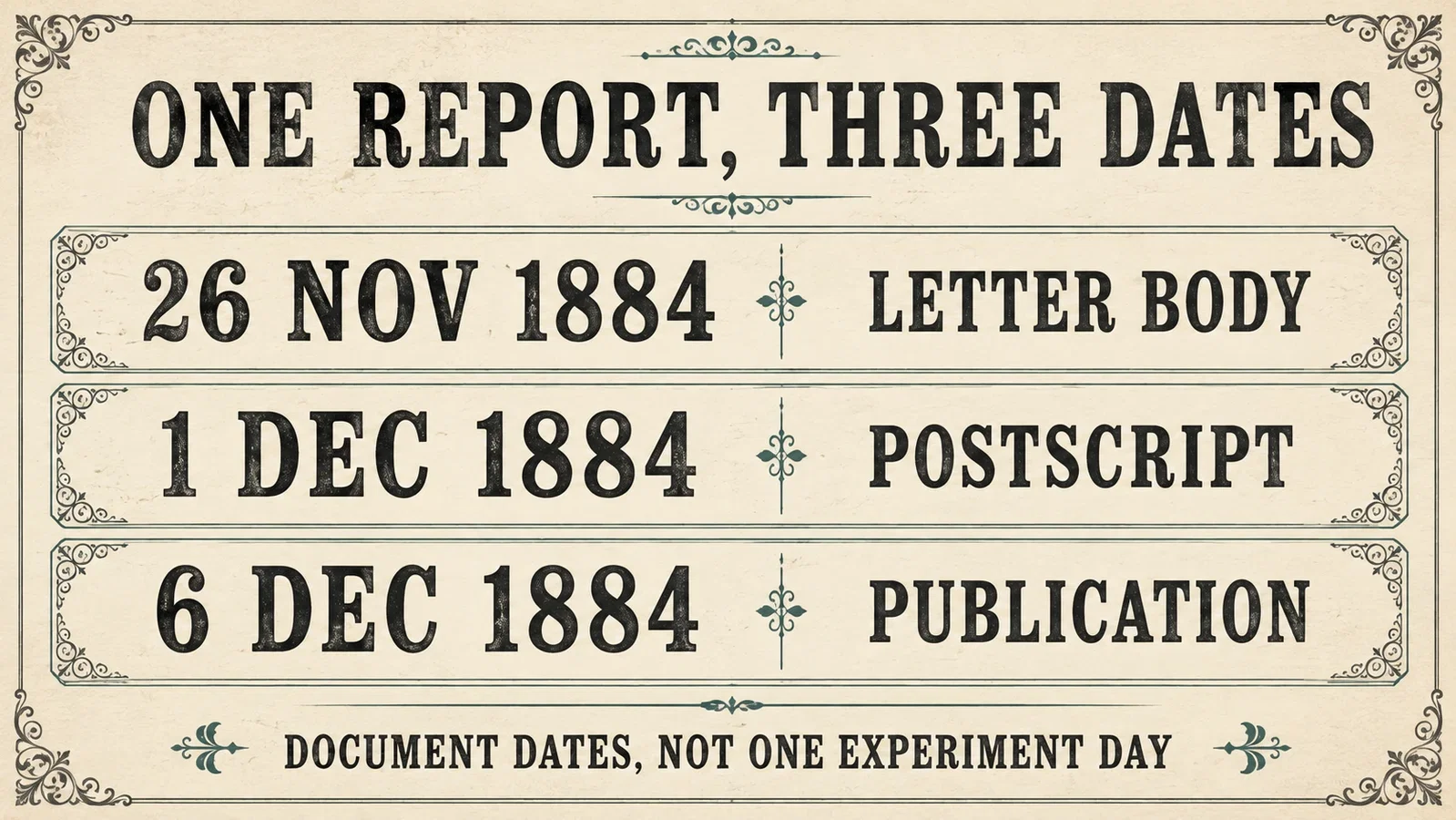
Three documentary dates, not three inventions or a complete schedule of all the reported experiments.[1, pp.643–644]
Once the dates are separated, the division of work becomes clearer. Hall wrote the report and was both observer and subject. Halsted participated in nerve-related experiments. Nash carried out the upper dental treatment. A brief attribution to Halsted and Hall cannot stand in for those distinctions.
Where sensation changed
The early observations extended beyond the mouth. Hall described work with Halsted on the leg and forearm, exploring how the territory of altered sensation related to nerves rather than simply to the place where the drug was deposited.[1, p.643]
The responses were uneven. One attempt involving Hall's left ulnar nerve had no effect; a right-sided attempt produced sensory changes. Some findings fitted the investigators' expectations, while others lay in areas they did not expect. Skin at an injection site could retain sensation even when another region became insensitive.[1, p.643]
The question was shifting from where a drug was placed to where its effects could be observed. But these were early descriptions, not proof that each injection had accurately isolated a structure identifiable on a modern anatomical diagram.
The same page describes a small operation in the supraorbital region. Its initial steps were not felt, but the procedure was prolonged by adhesions and other difficulties; the anesthetic effect had substantially diminished before it was finished. An effect useful for part of an operation was not yet a solution to every part of that operation.[1, p.643]
A filling was not a lower-jaw experiment
For Hall's November 26 dental treatment, Hall asked Nash to try cocaine. Sensation changed in the upper lip, cheek and portions of the gum. Hall admitted that, from the dental chair, not every boundary could be established precisely.[1, p.643]
The wedge still caused pain when it pressed against unaffected posterior gum tissue. Work on the cavity and the filling then proceeded without sensation. This was neither uniform numbness throughout the mouth nor a tooth extraction. The report preserves different responses to different actions.[1, p.644]
In the December 1 postscript, Halsted tried to approach the structure called the inferior dental nerve in the original report—the inferior alveolar nerve discussed here. Locke's account included changes involving the tongue, gums, teeth and other areas. It did not go on to describe a dental operation performed on Locke.[1, p.644]
In four or five other attempts, the authors thought the effect lay closer to the lingual nerve. The tongue was affected before the gums, and posterior and anterior gum regions did not respond identically. Hall's own experiment that evening likewise distinguished lower-lip, gum and tooth responses from a small affected area at the edge of the tongue.[1, p.644]
“Jaw nerve block” must not become shorthand for a whole nerve, half a face or half a mouth reliably becoming numb together. These accounts explored sensory territories; they did not establish the selectivity, consistency or coverage of a standardized modern technique.
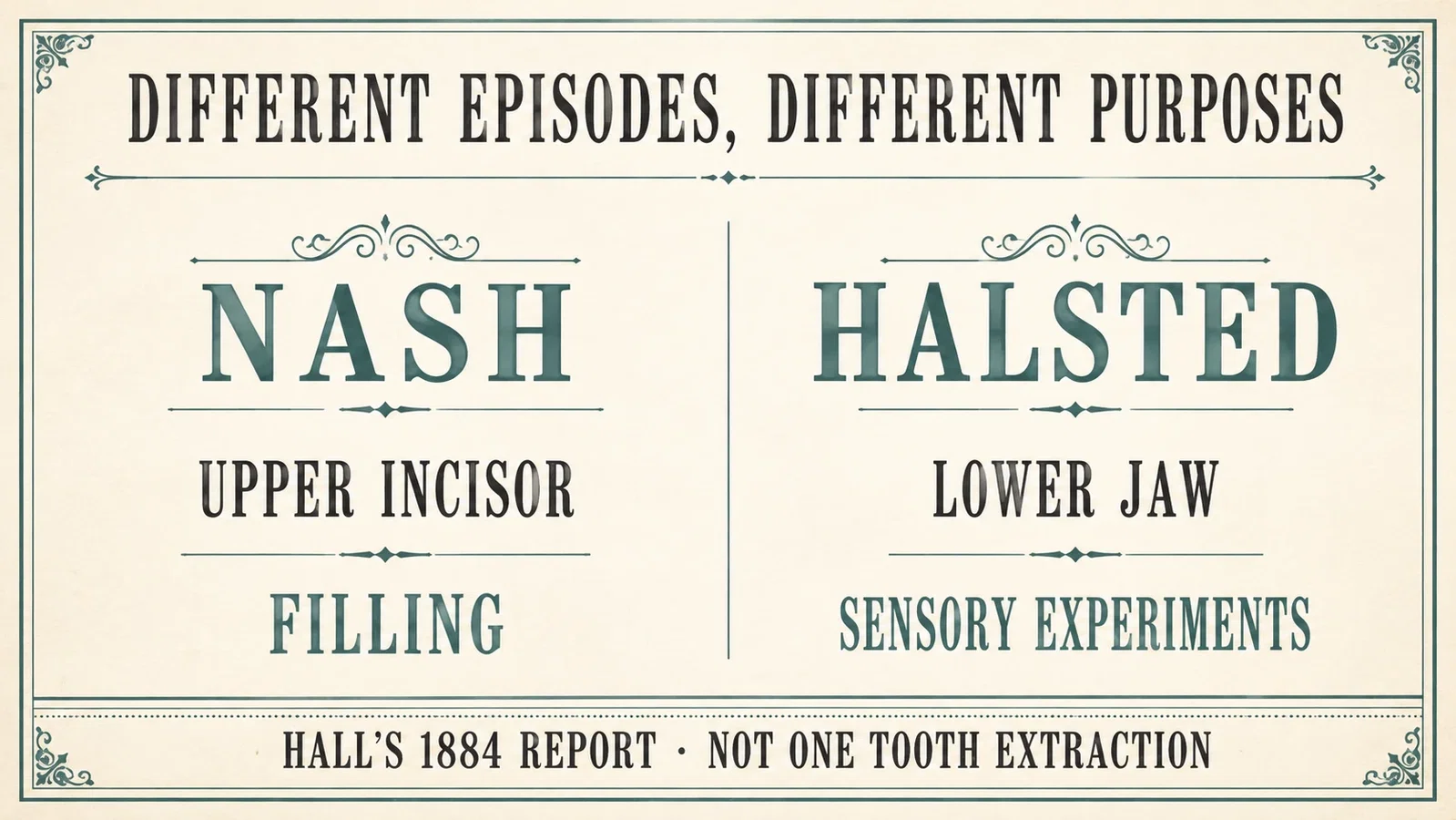
A modern reading guide, not an anatomical diagram. Operators, sites and purposes belong to different episodes. The absence of a dental operation in the lower-jaw passage does not claim that the investigators never performed such operations elsewhere or later.[1, pp.643–644]
Returning sensation had more than one endpoint
In the upper dental episode, complete anesthesia lasted until twenty-six minutes after injection, followed by another ten to fifteen minutes of markedly diminished sensibility. Adding those periods would not produce forty-odd minutes of complete anesthesia. Twenty-six minutes was not the length of the filling procedure either.[1, p.644]
Hall's lower-jaw experiment used different language. Some sensation began to return at about twenty-five minutes. Five minutes later, no area remained completely anesthetized. That does not mean every kind of sensation, in every area, had returned to normal at thirty minutes.[1, p.644]
Beginning to recover, ceasing to be completely anesthetized, and having normal sensation restored are not interchangeable endpoints. Preserving the distinction tells us more than assigning the method a single convenient duration.
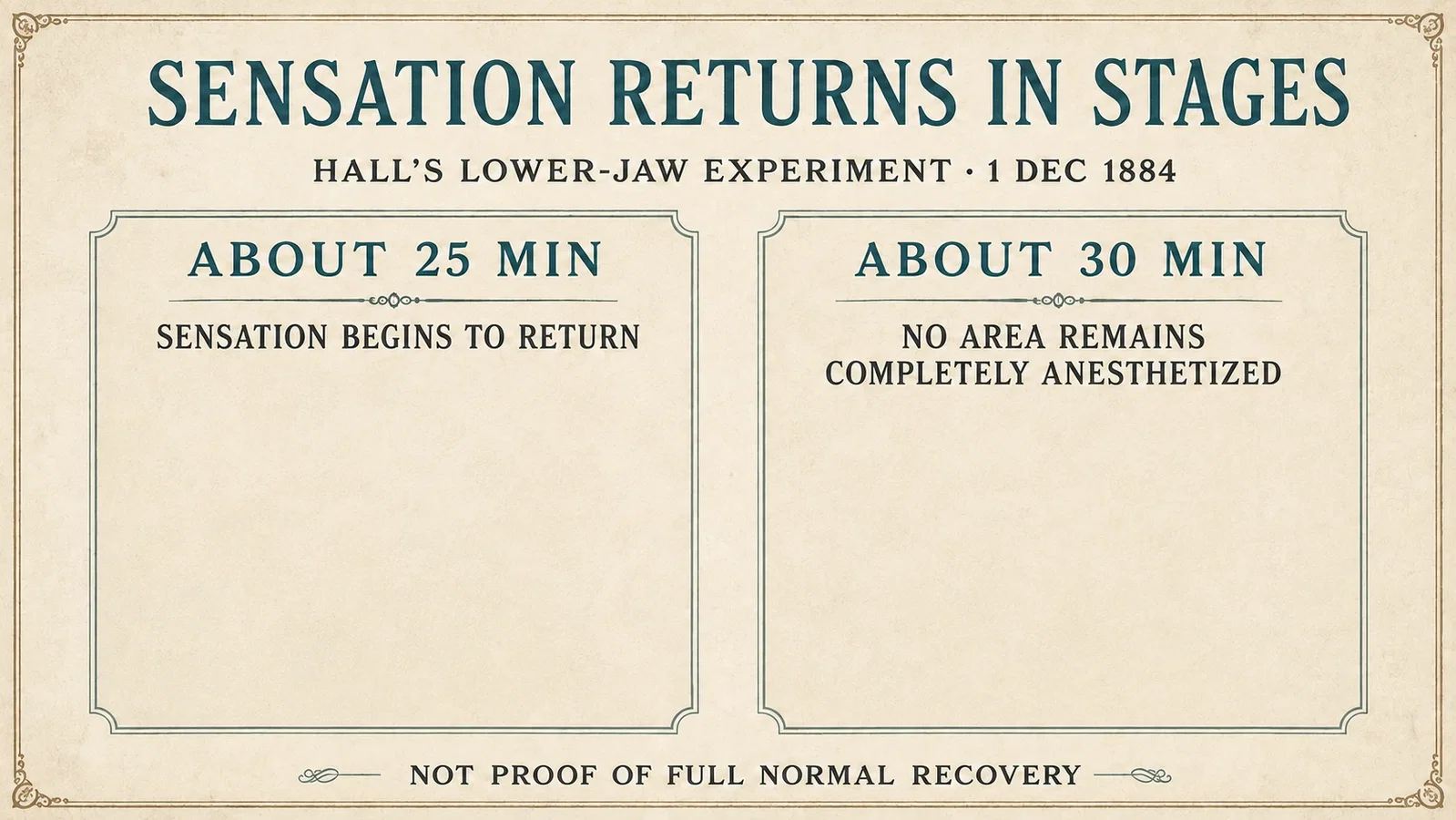
Only Hall's own historical observation in the December 1 postscript. This is not a promised duration, a complete recovery curve or a contemporary dosing schedule.[1, p.644]
Local effects did not exclude systemic symptoms
After the right-sided ulnar experiment, Hall described dizziness severe enough to impair walking, nausea, cold perspiration and dilated pupils. At the end of the postscript, Hall also reported milder constitutional symptoms in two or three lower-jaw-related cases.[1, pp.643–644]
The report does not supply a clear enough denominator to calculate an incidence. Nor should a modern diagnosis be retrospectively asserted as certain. What the observations do rule out is the assumption that targeting a local territory automatically leaves the rest of the body unaffected.
Hall had not declared the safety problem solved. The letter anticipated wider applications once safety limits had been determined. The idea that effects extended along a nerve or its sheath was a proposed explanation, while a further orbital use was a suggestion. Observation, interpretation and anticipation shared the letter, but they were not the same kind of evidence.[1, p.644]
An important step without an oversized priority claim
The Wood Library-Museum's timeline places Halsted's jaw-related block in 1884. Returning to the contemporary report expands that concise milestone into its component observations; it should not expand it into an unrestricted claim to every form of nerve block.[3]
A week before Hall's publication, the same journal had carried Burke's letter describing two injections with nerve-related and local components before minor surgery. This was not a lower-jaw dental block, nor proof of an isolated selective block. It is a contemporary reminder that adjudicating the first nerve block of every kind would require a much larger inquiry.[2, pp.616–617]
Hall's account was subsequently reproduced in a manufacturer's compilation, now available through the National Library of Medicine. That reprint documents circulation of the account, not a second independent group of patients. A modern dental-history article provided additional leads, but only its abstract and bibliography were accessible here; its unseen body has not been used to fill gaps in the primary record.[4–5]
The value of the Halsted and Hall work does not depend on a flawless catalogue of successes. Numbness was becoming a clinical question about territory, duration and bodily consequences. The variations and discomfort recorded in the letter were not extraneous to that history. They were part of what made the new possibility observable.[1]
Sources and reading limits
Read: Hall's letter in the New York Medical Journal (pp. 643–644), including the December 1 postscript; Burke's letter in the same volume (pp. 616–617); the 1884 entries of the Wood Library-Museum timeline; the title page and the Hall reprint in the Parke, Davis compilation; and the abstract, key points and references of López-Valverde and colleagues.
Not covered: the rest of the Parke, Davis compilation, the body of the López-Valverde article, and the ebooks linked from the Wood Library-Museum timeline.
- Hall RJ. Hydrochlorate of cocaine. N Y Med J. 1884 Dec 6;40:643–4. Available from: archive.org
- Burke WC Jr. Hydrochlorate of cocaine in minor surgery. N Y Med J. 1884 Nov 29;40:616–7. Available from: archive.org
- Wood Library-Museum of Anesthesiology. History of anesthesia [Internet]. Schaumburg (IL): Wood Library-Museum of Anesthesiology; [cited 2026 Oct 27]. Available from: woodlibrarymuseum.org
- Parke, Davis & Company, Scientific Department, editor. Coca erythroxylon and its derivatives. Detroit: Parke, Davis & Co.; [1885?]. Available from: NLM Digital Collections
- López-Valverde A, De Vicente J, Cutando A. The surgeons Halsted and Hall, cocaine and the discovery of dental anaesthesia by nerve blocking. Br Dent J. 2011;211(10):485–7. doi:10.1038/sj.bdj.2011.961
Sources and reading limits are stated above. Illustrations are labelled as original source images or AI-made. Historical accounts are educational; they are not current treatment instructions.
Continue exploring
Related reading connects shared questions and contexts; it does not by itself establish historical influence.
- 1853: Wood and Pravaz, Similar Instruments for Different Questions
- 1884: Koller Brings Cocaine to the Surface of the Eye
- 1885: Corning's Anesthetic Effect and a Disputed Location
- 1905: Einhorn's Novocain Is Put to Clinical Tests
Anesthesia Epochs · The Source Room · About & Editorial Method