Heinrich Braun's 1905 report on Alfred Einhorn's Novocain tested a new local anaesthetic against four practical requirements, kept its patent dates apart from its clinical record, and left mucosal and spinal use undecided.
Reading Library · Anesthesia Epochs · 中文版
Watch the companion film
1905: Einhorn, Braun, and Novocain · Watch on YouTube
Historical anchor: 1905. Date details and source qualifications are explained below.
The patent and the clinical report ask different questions.
Alfred Einhorn's American patent describes a family of chemical compounds and their properties. Braun's account asks what a new local anesthetic must do once it leaves that description: work without unacceptable tissue effects, remain usable in solution, cooperate with an adjunct, and suit the intended application. The history of Novocain, now known as procaine, becomes more revealing when those questions remain separate.[1,2]
This article is anchored to Braun's 1905 report. The contemporary document read here is its Novocain selection in the September 1906 Buffalo Medical Journal. The translation identifies the German source as the 1905 journal's issue 42, then explicitly limits its coverage to Novocain. It is not the entire German article on three new anesthetics. Nor is the translation's publication date the date of the molecule's first synthesis.[1]
What the patent can establish
US812554 names Einhorn of Munich and an assignment to the Farbwerke company at Höchst. Its subject is alkamin esters of para-aminobenzoic acid. It distinguishes the base from its salts and describes water-soluble salts and local anesthetic properties. Those claims tell us what was being presented as an invention; they are not an independently controlled clinical demonstration.[2]
The dates on the original sheet are unambiguous: application filed on November 8, 1905; patented on February 13, 1906. This American document does not establish a first-synthesis day in 1904, and it does not print the brand name Novocain. A patent application, a grant, a chemical discovery and a clinical report are different events.[2]
Braun's selection supplies another part of the record. It credits Einhorn with the discovery, identifies the Farbwerke as the supplier, and describes Novocain as the hydrochloride of the named ester. The chemical investigator, the manufacturer and the clinical evaluator appear in distinct roles. The story need not collapse them into a single inventor doing everything.[1]
Four requirements, followed by a question of application
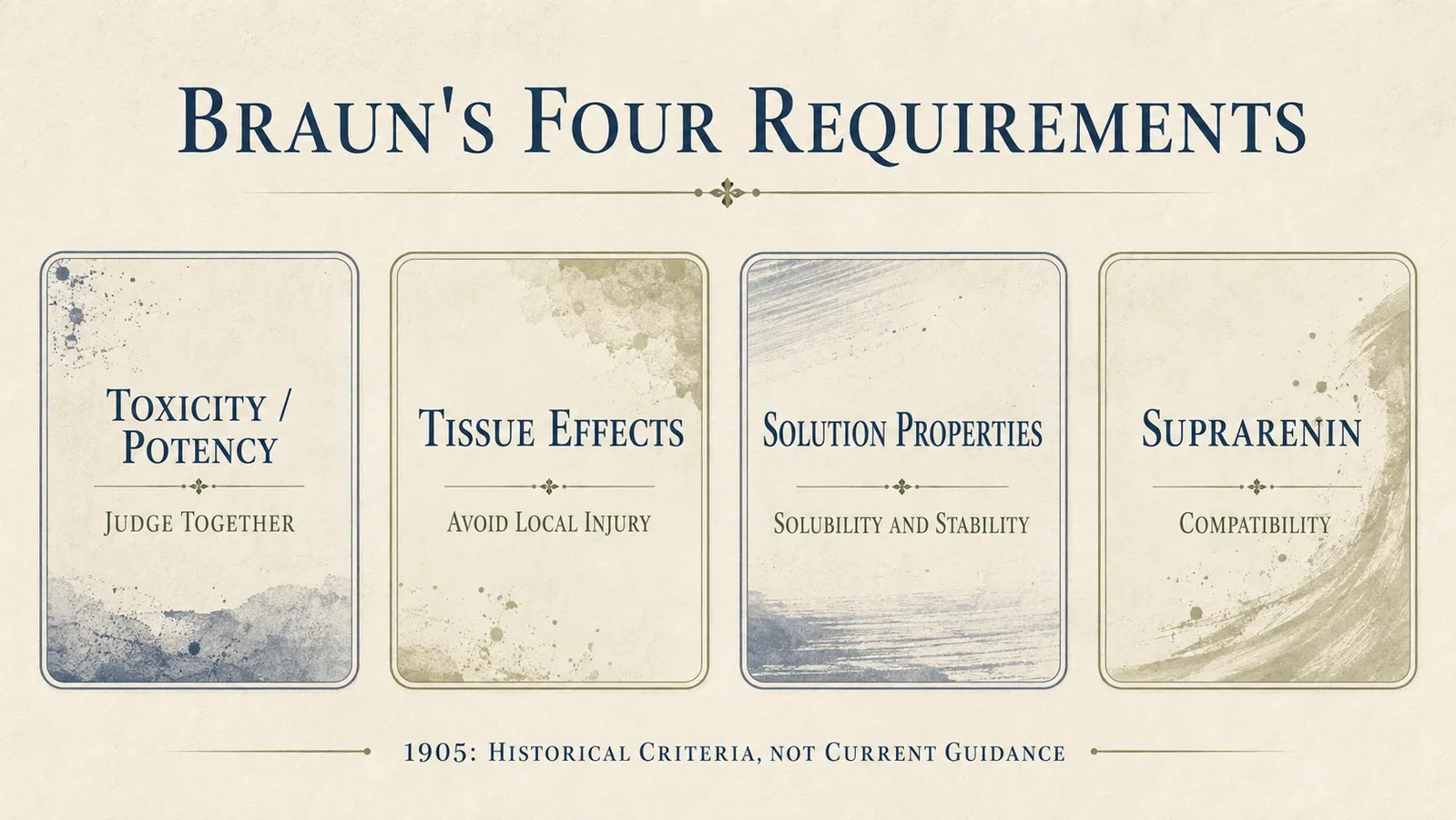
Braun numbered four general requirements for a useful local anesthetic.[1]
Toxicity had to be considered relative to anesthetic potency. A proposed substitute could be less toxic in an absolute comparison but also so much weaker as an anesthetic that the practical advantage disappeared. Merely describing a substance as less toxic did not settle its value.
Tissue effects mattered in their own right. An agent that reduced sensation but left inflammation or injury at the site would fail another part of the test. What happened after administration mattered alongside what the subject felt during it.
The solution also had to be usable: water solubility, reasonable stability and the desirability of straightforward sterilization were practical requirements, not incidental chemistry.
Finally, the anesthetic had to be compatible with Suprarenin, the adrenaline preparation, without impairing the latter's vasoconstrictor action.[1]
After those four numbered requirements, Braun discussed additional considerations for particular applications. A mucosal anesthetic had to penetrate the relevant surface. Spinal effects and unwanted effects were still insufficiently understood. These paragraphs prevent a tempting simplification: a drug suitable for one route had not thereby been shown suitable for all routes.[1]
The questions are historically interesting without making every assumption behind them acceptable today. Braun's confidence in self-experimentation and in carrying animal toxicity relationships directly over to humans should remain features of his account, not recommendations to its present reader.
The combination changed the observation
The English selection presents nine numbered experimental conditions. They are not nine patients, and they do not form nine randomized treatment groups.[1]
Braun describes relatively short-lived local effects with Novocain alone and longer effects after adding Suprarenin in the conditions he tested. These observations made the combination an important part of his assessment. They do not supply a single standardized comparison from which to calculate a universal multiplication of duration: concentrations, sites and observed endpoints varied.[1]
Nor are all the observations free of symptoms. There was slight irritation under one concentrated condition and after-pain following another combination test. Removing those details would turn an uneven experimental record into a cleaner claim than the source warrants.[1]
The clinical question was becoming more specific than whether a chemical could make tissue numb. Could the effect last for the task, and what accompanied that effect?
A series with a stated scope
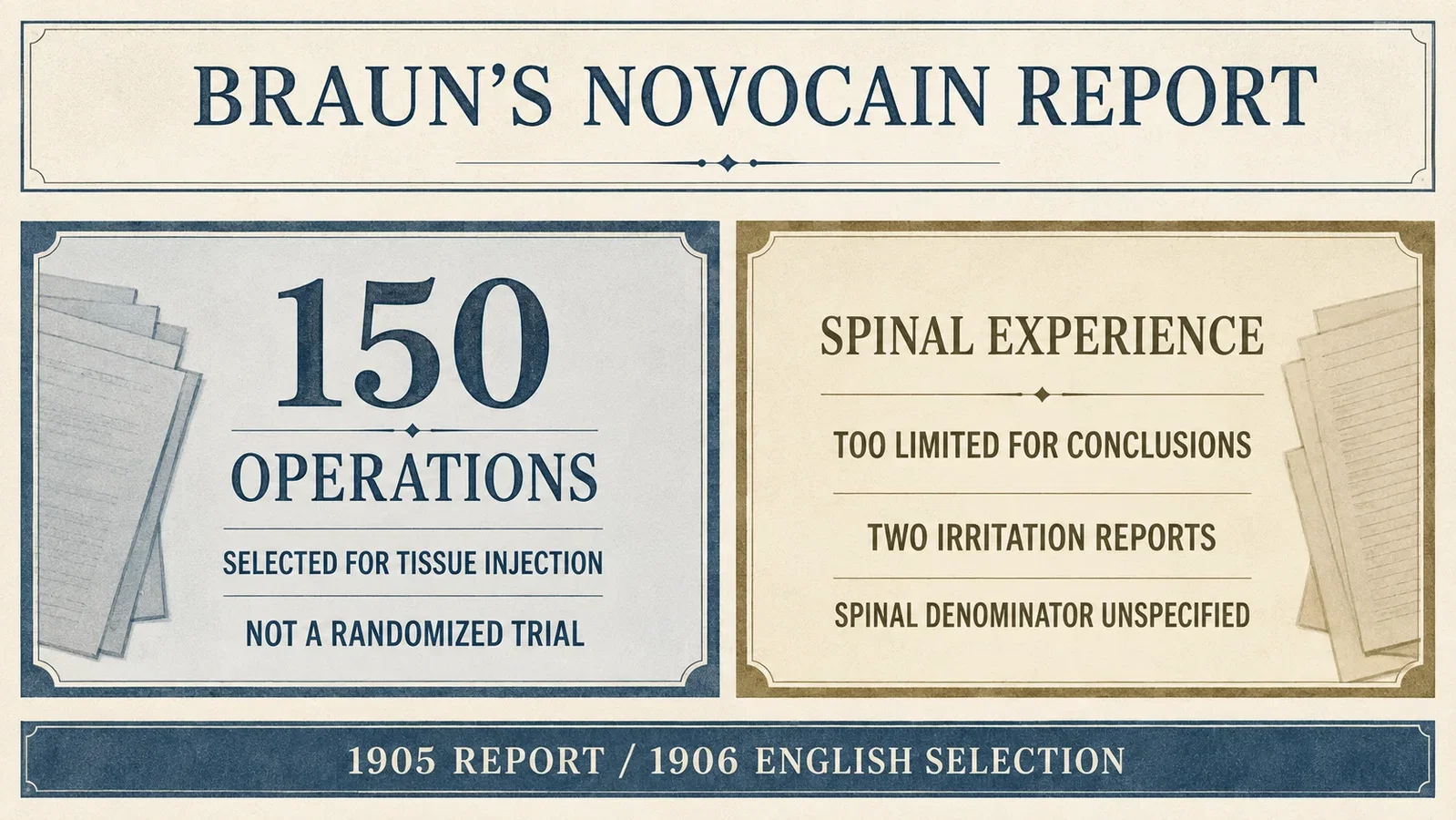
Braun reports using Novocain in 150 operations in cases considered suitable for tissue injections. Most involved hands and fingers; he also lists other procedures and dental extractions. The number describes his selected operative experience. It is not a count of 150 randomized patients, 150 spinal anesthetics, or 150 successes under a prespecified trial definition.[1]
One passage provides a concrete comparison with this site's earlier Halsted/Hall article. Braun says anesthesia of the inferior alveolar and lingual nerves succeeded with Novocain as with cocaine. Hall's December 1884 publication had recorded Halsted's inferior dental nerve attempts and variable changes in sensation around the tongue, gums and teeth.[1,4]
The shared clinical target makes the two accounts useful to read together. It does not prove that Braun derived his work directly from Hall's letter, and it is not a controlled comparison between identical techniques. This site therefore records a specific association, not an invented causal chain.
Braun's confidence also has a boundary within his own report. His experience with mucosal and spinal use, he says, was too limited for conclusions. The ending mentions two spinal cases with slight meningeal irritation and tentatively attributes this to Suprarenin. The attribution is not demonstrated causation. The number of spinal attempts is not given in a form that licenses dividing those two events by the 150 operations.[1]
Likewise, his statement that he had not observed toxic collateral effects in his operative experience must not become a claim that the drug was incapable of toxicity.
The chemistry continued
The opening of a 1909 paper by Einhorn, Karl Fiedler, Carl Ladisch and Emil Uhlfelder places Novocain on the other side of the comparison. Its favorable physiological properties were already known; the investigators went on to prepare related compounds and compare their pharmacological action. They report that the alternatives discussed did not offer advantages over Novocain.[3]
The first two printed pages of this original were read for that framing. The remaining synthetic analyses were not read in full. The opening is neither a modern clinical equivalence study nor direct proof of a precise first-synthesis date several years earlier.
This is a more useful ending than a claim of effortless replacement. Chemical research supplied candidates. Clinical work examined what happened when a candidate was put into a solution, a tissue and a particular application. Neither a patent nor a favorable series answered every question. The limits left on Braun's final page belong in the history as much as the promising observations.
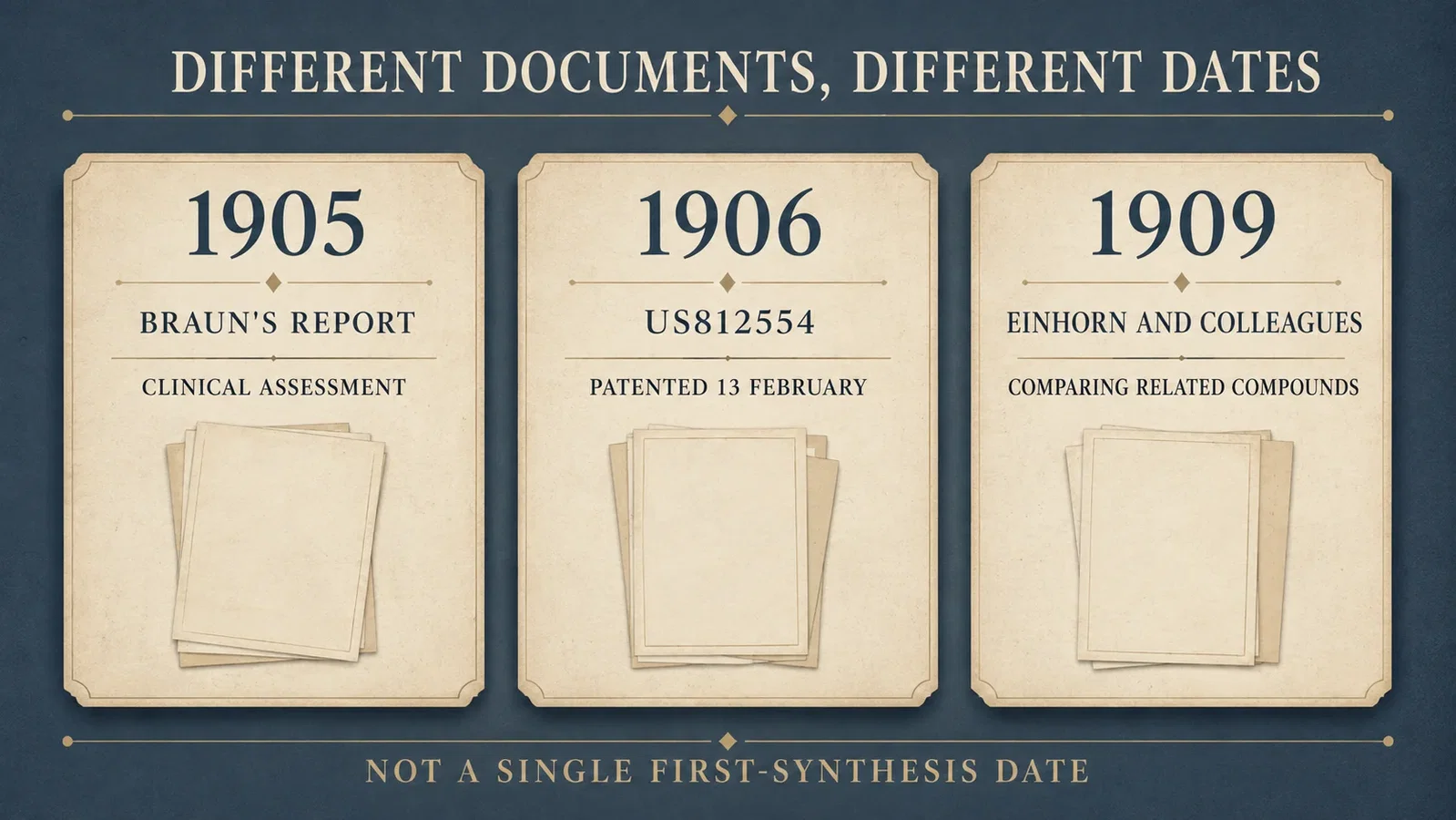
Image note: all four images are AI-generated editorial illustrations, not authenticated packaging, patent facsimiles, portraits or photographs of historical procedures. A generic vial identifies the subject without demonstrating preparation or injection. The Wood Library-Museum's later kit is not evidence for a 1904 scene; its catalog's American patent year differs from the original document, whose date is used here.[2,5]
This is medical history, not current advice on drug administration, compounding, self-experimentation or anesthesia.
Sources and reading limits
- Braun H. On Some New Local Anesthetics. Buffalo Medical Journal. 1906 Sep;62(2):83–87. Complete five-page contemporary English selection read, with bound-volume and issue headers checked: original journal scan. German source: Dtsch Med Wochenschr. 1905;31(42):1667–1671, publisher record; German full-text reading is not claimed.
- Einhorn A. US812554: Alkamin esters of para-aminobenzoic acid. 1906. Entire single-page government patent read: original. The German 179627 scan is not covered; secondary dates are not used to adjudicate synthesis priority.
- Einhorn A, Fiedler K, Ladisch C, Uhlfelder E. Ueber p-Aminobenzoësäurealkaminester. Justus Liebig's Annalen der Chemie. 1909;371(2):142–161. Opening pp. 142–143 read: original, DOI.
- Hall RJ. Hydrochlorate of Cocaine. New York Medical Journal. 1884 Dec 6;40:643–644. Complete original read for the earlier article; printed page 644 read here: 1884: Halsted and Hall Report a Jaw Nerve Block in a Postscript.
- Wood Library-Museum of Anesthesiology. Novocain. Complete institutional history/catalog body read: catalog · Archived copy.
Continue exploring
Related reading connects shared questions and contexts; it does not by itself establish historical influence.
- 1884: Halsted and Hall Report a Jaw Nerve Block in a Postscript
- 1932: Tetracaine Moves from a Modified Molecule to the Eye Clinic
- 1943: Lidocaine Moves from LL30 to Recorded Clinical Testing
Anesthesia Epochs · The Source Room · About & Editorial Method
Sources and reading limits are stated above. Illustrations are labelled as original source images or AI-made. Historical accounts are educational; they are not current treatment instructions.