A 1943 development anchor and the work of making a usable preparation.
Reading Library · Anesthesia Epochs · 中文版
Watch the companion film
1943: Lidocaine—From LL30 to Clinical Testing · Watch on YouTube
Historical anchor: 1943. Date details and source qualifications are explained below.
The printed account of Xylocain does not end where its main PDF ends. On page 9, Torsten Gordh's 1949 paper directs the reader to page 21. There, between another article and a notice to subscribers, he returns to a practical problem: keeping an adrenaline-containing preparation stable.[1]
That continuation belongs to the history of lidocaine as much as the familiar discovery date. The compound had to be identified, tested and made into usable preparations. Gordh's paper preserves contributions from chemists, a pharmaceutical laboratory and clinicians, alongside observations that complicated his favorable assessment.[1]

An editorial illustration. The people are not portraits, and the room does not reconstruct a documented experiment.
What the year 1943 can support
Gordh attributed the production of a series of basic anilides in 1943 to Nils Löfgren and Bengt Lundqvist in Stockholm. He identified one compound by its chemical name and linked it to the designation LL30 and the name Xylocain. The Swedish National Archives' later biography also places the synthesis of LL30 in 1943 and identifies it with lidocaine.[1,p.4;3]
A second original record gives the date a different meaning. The US patent Alkyl Glycinanilides, bearing the names of Löfgren and Lundqvist, lists Sweden, 15 July 1943, on its first page. The US application followed on 12 July 1944; the grant came on 11 May 1948. Filing and grant dates document the patent process, not an exact day of first synthesis.[2]
There is a disagreement in the later records. The Wood Library-Museum dates discovery to 1942, while the National Archives biography gives 1943. The article retains 1943 as a documented development anchor, supported by Gordh's account and the patent. It does not present that year as an uncontested answer to every question about discovery.[1–4]
Gordh reported that clinical testing at Karolinska Hospital had begun in 1944. Commercial introduction came later: the National Archives biography gives 1948 for Sweden and 1949 for the United States. These retrospective market dates should remain distinct from the patent's dates.[1,p.4;3]
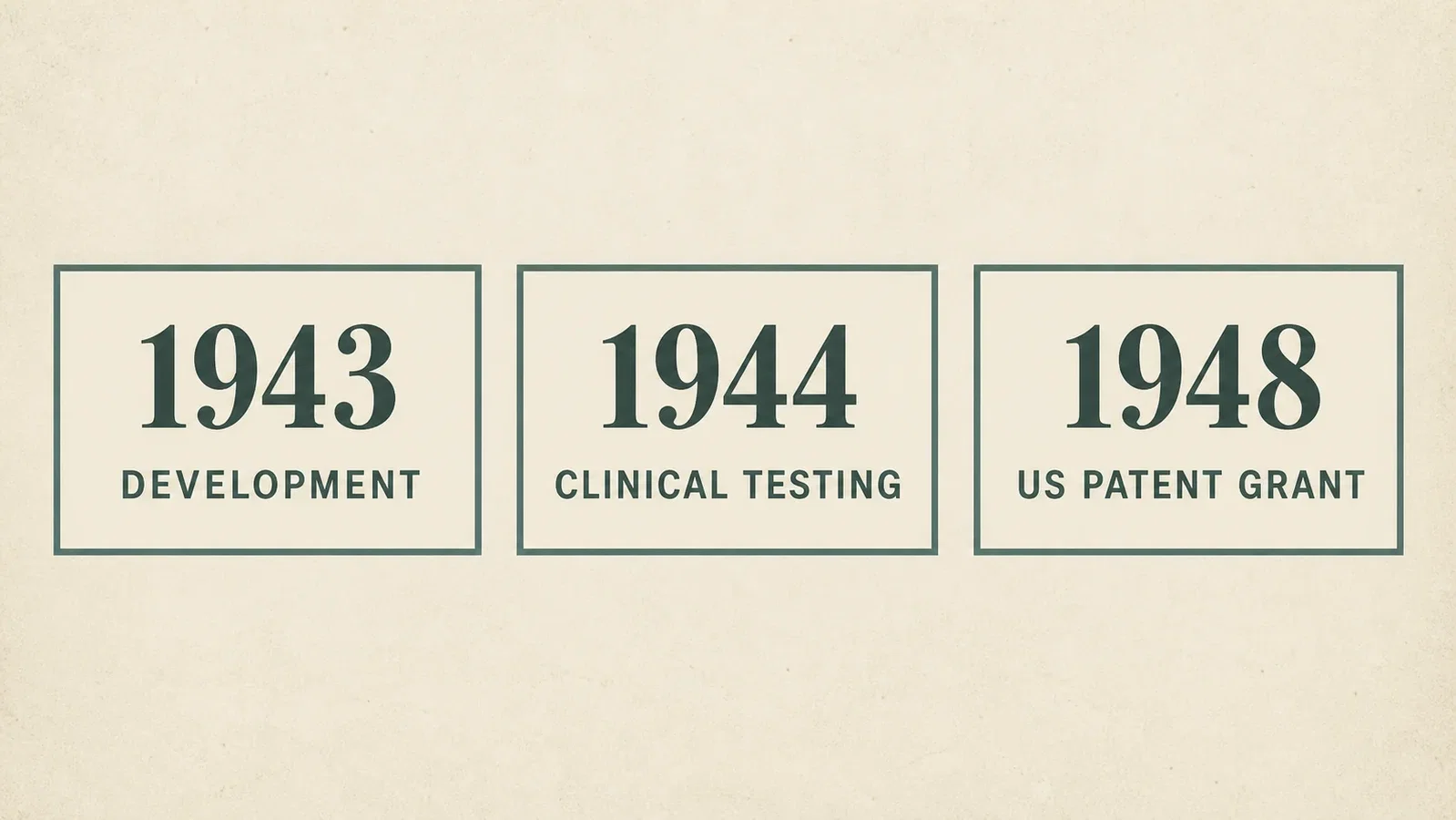
The dates refer to different events. The 1943 card marks development, the 1944 card the hospital testing described by Gordh, and the 1948 card the US patent grant.
A chemical identity and a clinical comparator
The patent covered a family of compounds. Its first example and first claim identify the compound whose chemical name appears in Gordh's opening page. That match connects a chemical specification to LL30 and Xylocain; it does not make every substance described in the patent another name for lidocaine.[1–2]
Procaine supplied a concrete comparison. Einhorn's earlier patent described esters of para-aminobenzoic acid. Löfgren and Lundqvist's document described anilide compounds with an amide linkage. Gordh compared the newer preparation with procaine in terms of onset, duration and stability. This combination of chemical records and explicit clinical comparisons supports reading the two historical articles together. It does not establish a direct personal line of influence or universal superiority.[1–2,5]
In Gordh's account, further development passed to Astra's central laboratory toward the end of 1943. Goldberg conducted pharmacological and toxicological investigations at the Karolinska Institute. At Karolinska Hospital, records followed onset and duration, the preparation used, local reactions, injection pain, pulse, blood pressure and whether analgesia was satisfactory.[1,p.4]
The change from a promising compound to a preparation under clinical observation therefore involved several kinds of work. A patent could identify a substance and state its proposed advantages; the hospital records asked how it performed in particular uses.[1–2]
The numbered bottles were only one part of the study
Gordh began his clinical investigation with skin wheal tests. Numbered bottles concealed their contents from the operator. Different solutions were tested on the same subject at the same time, and their positions were varied. The tables report means from 25 determinations at each concentration. They do not identify 25 distinct participants or describe a method of random allocation.[1,pp.5–7]
The operation records were different evidence. In the emergency department, Gordh reported 400 operations using preparations without adrenaline. Eleven were recorded as having unsatisfactory analgesia, and one involved pain on injection. He separately described 405 surgical-department cases using a preparation with adrenaline. These observations should not become an 805-patient randomized trial, or a single pooled success rate.[1,p.5]
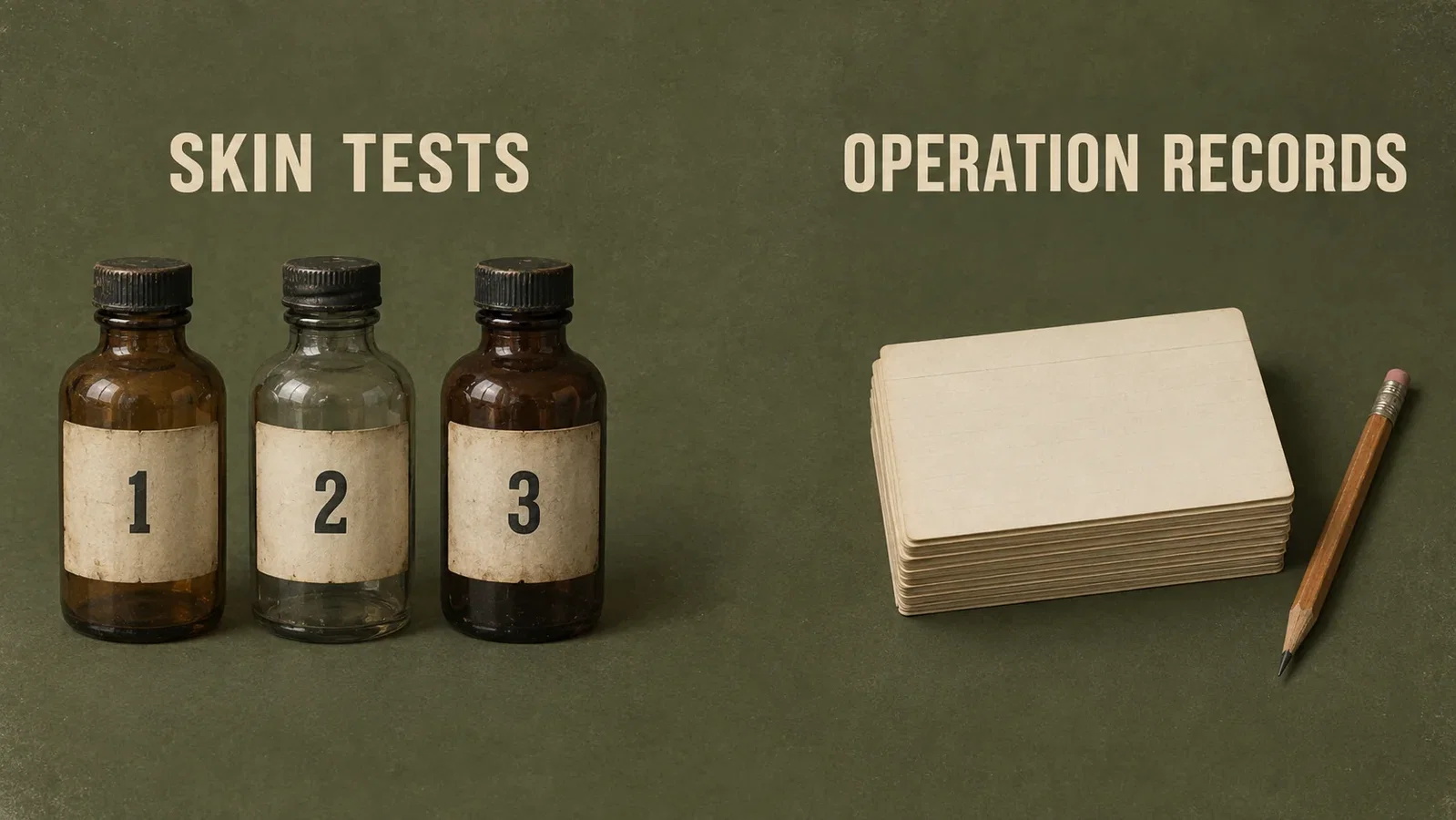
Concealed bottle contents describe the skin tests. The separate records panel does not imply randomization or blinding of the operative series.
Gordh judged the onset rapid and the duration favorable, but the reported duration varied with the preparation, amount and clinical use. The paper provides a history of testing and accumulated experience, rather than one effect estimate transferable to every application.[1,pp.5–7]
The adverse observations belong in the account
Two case narratives describe toxic reactions that Gordh attributed to overdose. Both patients developed impaired consciousness and convulsive symptoms and subsequently recovered. The paper does not supply a sufficiently defined common denominator for turning those cases into an overall toxicity rate.[1,p.8]
Gordh also discussed a safety coefficient that considered potency, duration, extent of analgesia and lethal dose. This historical construct was not a measured reduction in human complications. The animal toxicity table varied by concentration and species; it did not support a simple statement that the newer drug was always less toxic than procaine.[1,pp.7–8]
The observations help explain the drug's promise while limiting what can be claimed for it. Favorable results, recovery after toxicity, and anecdotes of tolerance after reactions to other drugs do not establish absence of toxicity or allergy.[1,pp.8–9]
The work hidden on page 21
The continuation explains why stability of the anesthetic compound did not settle the stability of a combined preparation. Gordh described adrenaline's sensitivity to oxidation, heat and pH. He credited Karlsson and Sjögren with work on preparation and sterilization, whose methods he said would be published separately.[1,p.21]
Generic editorial objects, not replicas of a 1943 commercial package or instructions for present preparation and storage.
Reading that final section restores a less visible part of the development story. The patent records a chemical identity; the clinical paper records comparisons, operative experience and adverse reactions; its conclusion records the work required to make a usable preparation. Together they give the 1943 milestone a history extending beyond a single name and date.[1–3]
Sources and reading limits
- Gordh T. Xylocain—A New Local Analgesic. Anaesthesia. 1949;4:4–9,21. Original main article; scan containing the conclusion on page 21. The seven pages and all three tables were read. The second PDF is catalogued as Helliwell and Hutton's Analgesia in Obstetrics; only the separate Gordh conclusion on its fourth page belongs to this citation. Publisher metadata lists March, while PubMed lists January; the reference retains year precision.
- Löfgren NM, Lundqvist BJ. Alkyl Glycinanilides. US Patent 2,441,498. Original four-page patent. Sweden: 15 July 1943; US application: 12 July 1944; grant: 11 May 1948. Entire document read, including six claims. A technical record, not a clinical trial.
- Winberg H. Nils M Löfgren. Svenskt biografiskt lexikon. Vol. 24, 1982–1984, p.515. Swedish National Archives biography. Biographical text and publication list read as a retrospective source, not a laboratory record from 1943.
- Wood Library-Museum of Anesthesiology. Lidocaine · Archived copy. Catalogue body read, including the conflicting 1942 discovery account and the much later dates of the displayed packages. Object photographs were not used as evidence for a 1943 scene.
- Einhorn A. Alkamin Esters of Para-Aminobenzoic Acid. US Patent 812,554. Filed 8 November 1905; granted 13 February 1906. Original patent. The single page and both claims were read in an archived copy. Used for a chemical comparison, not a claim of direct personal influence.
Continue exploring
Related reading connects shared questions and contexts; it does not by itself establish historical influence.
- 1905: Einhorn's Novocain Is Put to Clinical Tests
- 1957: Bupivacaine Appears as Compound No. 11 in a Chemistry Paper
Anesthesia Epochs · The Source Room · About & Editorial Method
Sources and reading limits are stated above. Illustrations are labelled as original source images or AI-made. Historical accounts are educational; they are not current treatment instructions.