In October 1885 Corning reported cocaine injected between the lower dorsal spines of a dog and a man: the dog’s hind legs became unco-ordinated, the man’s legs lost sensation, and the drug’s final location stayed uncertain.
Reading Library · Anesthesia Epochs · 中文版
Watch the companion film
1885: Corning’s Neuraxial Cocaine · Watch on YouTube
The dog's hind limbs became uncoordinated. In the human experiment, the legs felt “sleepy”, but the observer could detect no motor impairment in the man's gait. Both findings appeared in Corning's 1885 report. They should not be combined into a single, uniform picture of lower-body anesthesia.[1,pp.484–485]
The paper was called Spinal Anaesthesia and Local Medication of the Cord. Its title was confident. The question it leaves us is less settled: does observing an anesthetic effect establish where the drug was delivered?[1]

A conceptual period scene, not an authenticated portrait of Corning or a reconstruction of an experiment. The room, cityscape, closed bottle and papers are illustrative props; the title is modern editorial lettering. No administration or experimental procedure is depicted.[1]
Three pages and two documentary dates
Corning's article appeared in the October 31,1885 issue of the New York Medical Journal, volume42, pages483–485. The closing dateline is October27, with a West47thStreet address. October31 is therefore this article's publication anchor, not the date of both experiments. Their precise calendar dates are not supplied.[1,pp.483,485]
At the outset, Corning distinguished the physiological reasoning from the phenomena observed. That distinction remains useful. An explanation can motivate an experiment without being established by its results.[1,p.483]
Corning proposed that cocaine placed near the spine could be absorbed through small vessels and carried by venous blood toward the cord. The report also explained why Corning had not intended to place a needle beneath the cord's membranes. Corning’s stated intention and anatomical reasoning are historical evidence of what Corning sought to do, not direct confirmation of the needle's final position.[1,p.484]
The dog's movements were not the man's movements
Experiment I involved a young dog. About five minutes after injection, Corning saw hind-limb incoordination, followed a few minutes later by weakness. The front legs did not show the same weakness. Responses to stimulation differed too, although Corning noted an exception: the strongest electrical currents still elicited a hind-limb response.[1,p.484]
Traces of incoordination remained at two hours. At about four hours the dog appeared to have regained its usual health and walked without difficulty. That recovery observation belongs to the dog. It cannot supply a recovery time for the man.[1,p.484]
Experiment II involved a man with longstanding complaints. The primary account does not justify describing the man as an unqualified healthy volunteer, and it was not Corning's self-experiment. Its obsolete diagnostic language and attribution of symptoms should not be adopted as modern medical conclusions.[1,pp.484–485]
Six or eight minutes after the first injection, Corning had found no altered sensation. Corning injected again. About ten minutes after that second injection, the patient reported that the legs felt “sleepy”. Compressing this sequence into a ten-minute onset would erase the initial absence of change and move the starting point.[1,p.485]
Sensory impairment subsequently intensified, principally in the legs, lumbar region and genital area. A later suggestion of upper-limb change was explicitly tentative. The patient became dizzy when standing with eyes closed, but Corning detected no gait incoordination or motor impairment. Pressure discrimination seemed preserved; temperature sensation was not tested.[1,p.485]
The animal's motor findings cannot stand in for the human examination. Nor can reduced responses to selected stimuli establish loss of every form of sensation.
An effect did not locate the needle
Corning interpreted the different front- and hind-limb responses as evidence of predominantly local action near the relevant portion of the cord. Yet Corning also doubted whether absolute localization was possible. The observation, Corning’s explanation and the reservation all belong in the account.[1,p.484]
Later interpretations differ. Marx's 1994 abstract concluded that the injection was extradural; only the abstract of Marx’s paper is used here. Tobinick's 2016 paper argues for a perispinal location posterior to the spinal canal. These are retrospective readings, not direct observation of the 1885 needle tip.[2–3]
The apparatus illustration reproduced by Tobinick dates from1888, not1885. Tobinick’s paper also discloses relevant patents and clinical-practice interests. Those interests are recorded, not treated as automatic disproof; neither the later apparatus nor the paper's modern therapeutic claims are imported into this historical scene.[2,pp.474,477]
Corning's complete report does not describe cerebrospinal-fluid return. Absence of that description is not certainty that a dural puncture never occurred. This article therefore does not certify an intrathecal, epidural or perispinal endpoint.[1–3]
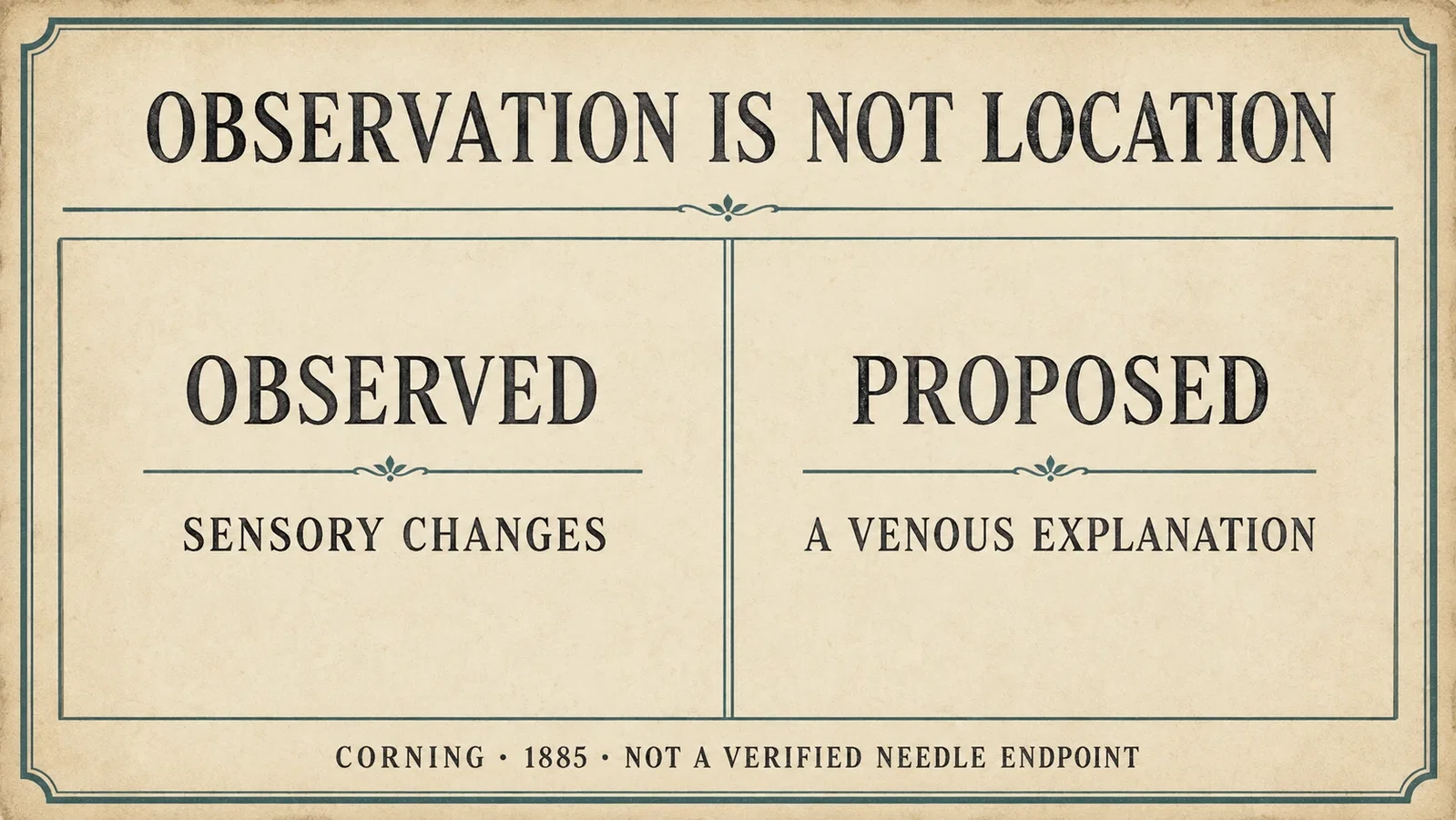
A modern reading guide, not an original chart or a verified drug-transport diagram. A proposed venous explanation does not directly establish either the route taken by the drug or the needle's final location.[1,p.484]
Leaving the office was not full recovery
When the patient left an hour or more after the injections, sensation remained substantially impaired and patellar reflexes were absent. The report's otherwise reassuring impression cannot be isolated from those findings and turned into a statement of complete neurological recovery.[1,p.485]
The next morning, the man reported that tingling and numbness had lasted until nightfall. That was the man’s recollection of the preceding evening. Corning's next-day examination then found normal sensibility in the areas tested, and instrumentation again caused discomfort. These observations do not yield one exact time at which every function returned.[1,p.485]
Dry mouth and throat, mental exhilaration, headache and slight vertigo also appear in the report. Hearing no account of cardiac disturbance was not systematic cardiovascular monitoring. Descriptive observations in one dog and one man did not establish a general safety profile.[1,p.485]
Surgery remained the closing question
The human account included urethral instrumentation and sensory testing. It did not proceed to describe a completed operation. An altered pain response could invite further investigation without demonstrating dependable surgical anesthesia.[1,p.485]
Corning preserved that distinction. The closing question was whether the method might replace ether in genitourinary or other surgery. Further experience, Corning wrote, would have to provide the answer. An envisaged application was not yet an application established by this report.[1,p.485]
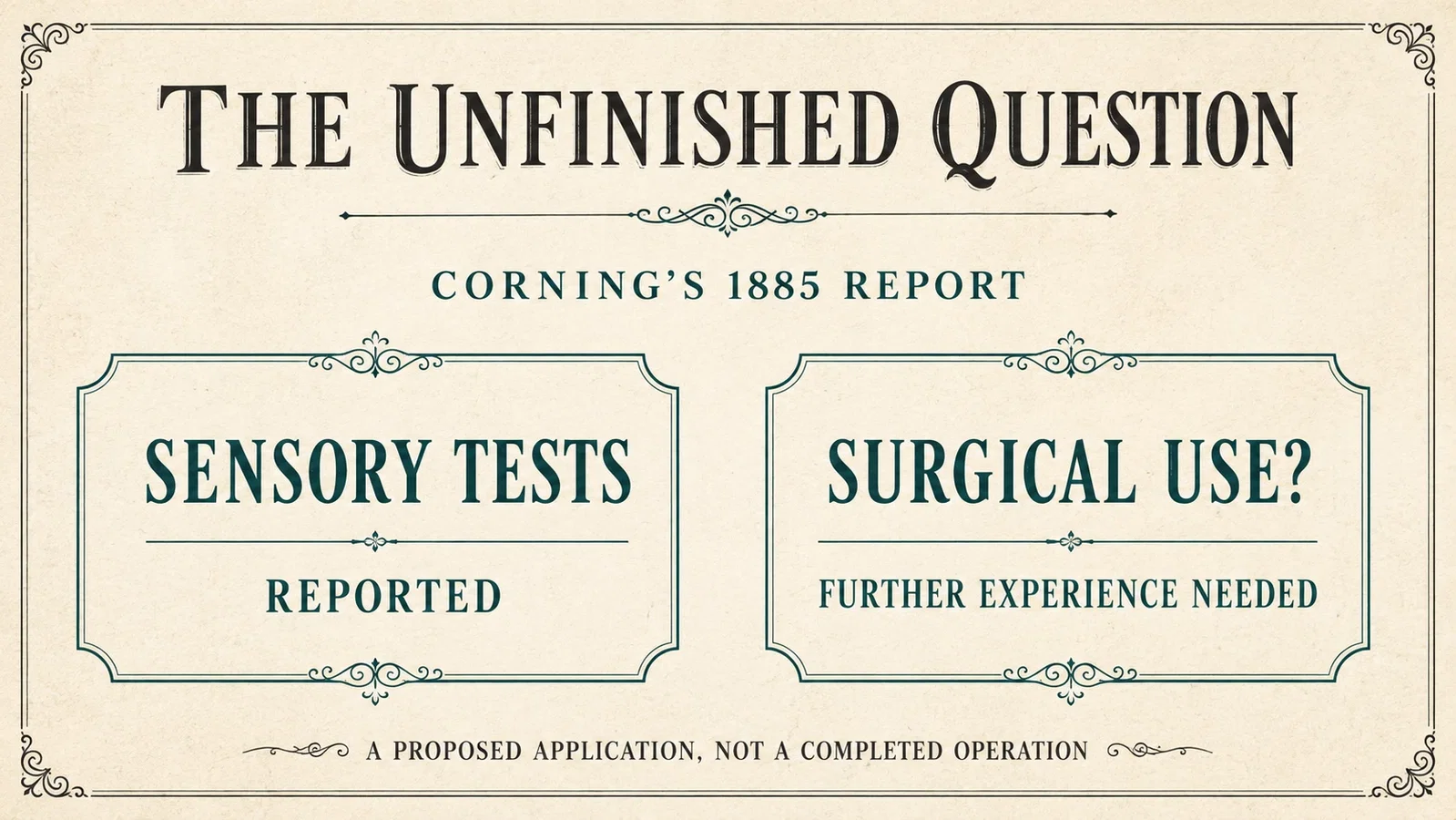
The question belongs to this1885report, not to the subsequent history of regional anesthesia. It separates reported tests from a proposed surgical use; it is not a treatment comparison or clinical recommendation.[1,p.485]
The Wood Library-Museum's timeline places Corning in the prehistory of epidural anesthesia and lists Bier's spinal-anesthesia milestone in1898. Such a timeline helps locate the episode. Reading the original reveals what was still unfinished inside the milestone.[4]
Corning's contribution need not become a fully formed modern anesthetic to remain significant. Corning’s paper brought together a local-medication hypothesis, different animal and human responses, a recovery record and unanswered questions. The effect was worth recording. How it arose, and what it could support, were questions worth keeping open.[1]
Sources and reading limits
Read: Corning’s complete article in the New York Medical Journal (pp. 483–485); the historical section, figure caption, disclosures and relevant references of Tobinick 2016; the abstract of Marx 1994; the 1898 and 1901 entries of the Wood Library-Museum timeline.
Not covered: the full text of Marx 1994; the modern-efficacy sections of Tobinick 2016; the ebooks linked from the Wood Library-Museum timeline.
- Corning JL. Spinal anaesthesia and local medication of the cord. N Y Med J. 1885 Oct 31;42:483–5. Available from: archive.org
- Tobinick EL. Perispinal delivery of CNS drugs. CNS Drugs. 2016;30:469–80. doi:10.1007/s40263-016-0339-2. Available from: link.springer.com
- Marx GF. The first spinal anesthesia. Who deserves the laurels? Reg Anesth. 1994 Nov–Dec;19(6):429–30. PMID: 7848956. Available from: PubMed
- Wood Library-Museum of Anesthesiology. History of anesthesia [Internet]. Schaumburg (IL): Wood Library-Museum of Anesthesiology; [cited 2026 Oct 27]. Available from: woodlibrarymuseum.org
Sources and reading limits are stated above. Illustrations are labelled as original source images or AI-made. Historical accounts are educational; they are not current treatment instructions.
Continue exploring
Related reading connects shared questions and contexts; it does not by itself establish historical influence.
- 1884: Koller Brings Cocaine to the Surface of the Eye
- 1884: Halsted and Hall Report a Jaw Nerve Block in a Postscript
- 1898: Bier's Spinal Analgesia and Its Aftermath
Anesthesia Epochs · The Source Room · About & Editorial Method