
In August 1898 in Kiel, August Bier gave cocaine through lumbar puncture for six operations and, with Hildebrandt, tried it on each other; the 1899 report also records the headaches and other effects that followed.
Reading Library · Anesthesia Epochs · 中文版
Watch the companion film
1898: Bier’s Spinal Anesthesia · Watch on YouTube
On August 16, 1898, a 34-year-old worker underwent resection of a tuberculous ankle joint in Kiel. Previous unpleasant experiences after general anesthesia had made the worker reluctant to face it again. August Bier tried a different route: cocaine delivered into the cerebrospinal-fluid space through lumbar puncture.[1, p.362]
The patient moaned but remained still. Afterward, the patient reported no pain, although aware of an intervention. Relief from pain did not necessarily remove awareness of what was happening.[1, p.362]
The operation is memorable. But Bier's paper did not end with the assurance that surgery had now become safely painless.
Six cases, with different kinds of evidence
Published in 1899, Versuche über Cocainisirung des Rückenmarkes described six surgical patients. The procedures belonged to 1898; publication came the following year. Those are separate milestones.[1]
The first patient subsequently experienced vomiting and headache. Other experiences differed. The fourth patient described a scratching sensation at the skin incision. More troubling for a simple success narrative is the third case: a 14-year-old boy said that it hurt. Bier thought otherwise because the boy had not resisted; Bier also stated that sensory testing could not be performed.[1, pp.362–364]
The child’s experience cannot now be reconstructed, nor block failure certified in retrospect; the child’s report and the surgeon’s inference remain separate evidence. Six descriptions do not amount to six uniformly measured demonstrations of complete freedom from pain.
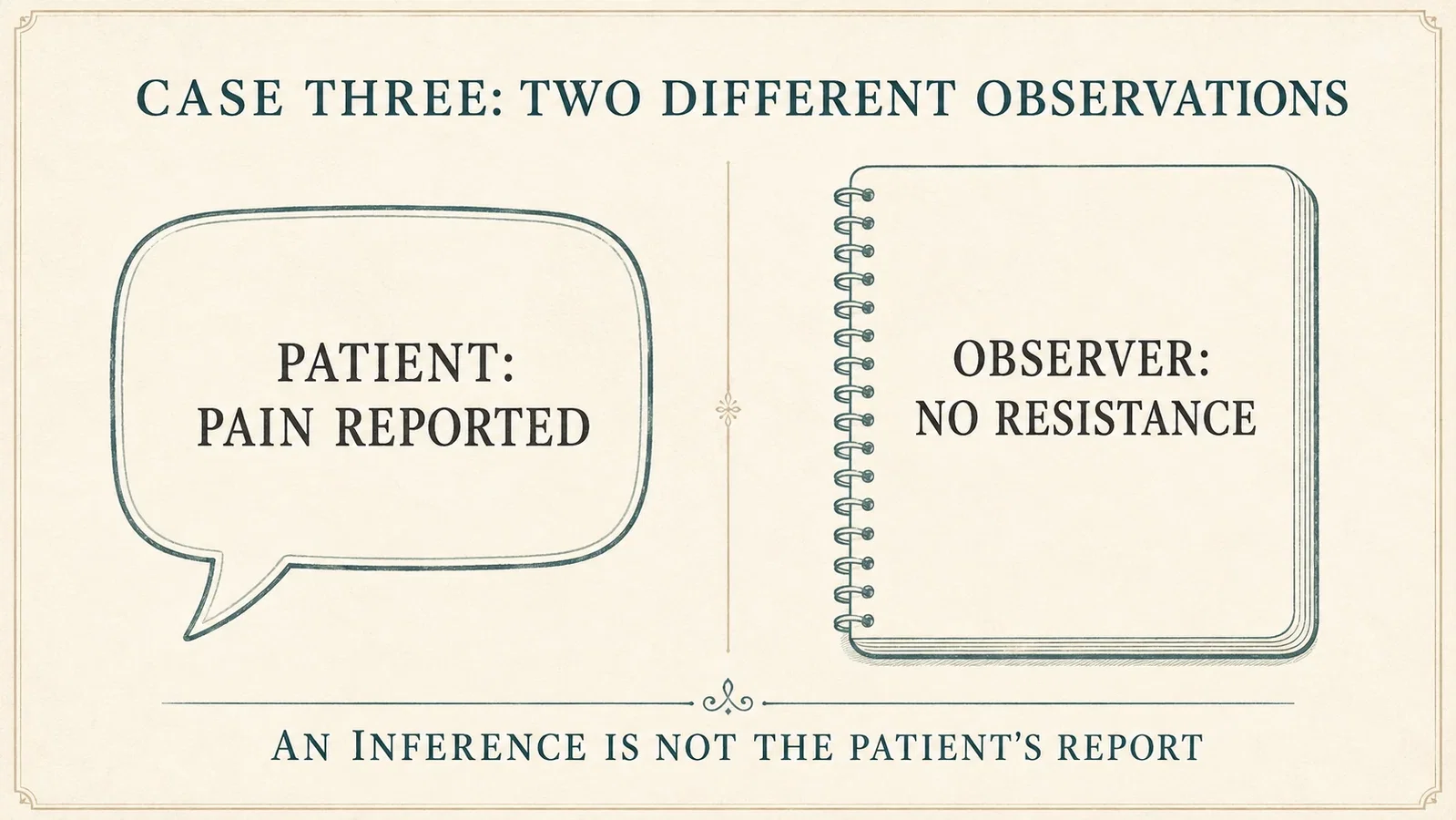
A reading guide to case three. Reporting pain and not resisting are different observations. The wording is an editorial paraphrase, not a quotation or a retrospective diagnosis.[1, p.363]
Two attempts, not two successful blocks
On August 24, Bier asked Dr Hildebrandt to perform lumbar puncture on Bier. The syringe would not fit the needle. Cerebrospinal fluid escaped, and most of the intended cocaine was lost. Bier explicitly reported that no insensibility resulted.[1, pp.364–365]
Hildebrandt then volunteered. Bier’s block of Hildebrandt worked, and the paper records a sequence of sensation tests. Some involved damaging stimuli; the later account includes bruising and pain in the legs. These are historical observations, not a ritual of bravery to reproduce.[1, pp.365–367]
The familiar shorthand that the two men successfully anesthetized one another obscures the asymmetry. Bier did not obtain analgesia; Hildebrandt did. In Hildebrandt's experiment, touch could still be felt and localized while pain was suppressed. Different aspects of sensation had not disappeared together.[1, pp.365–366]
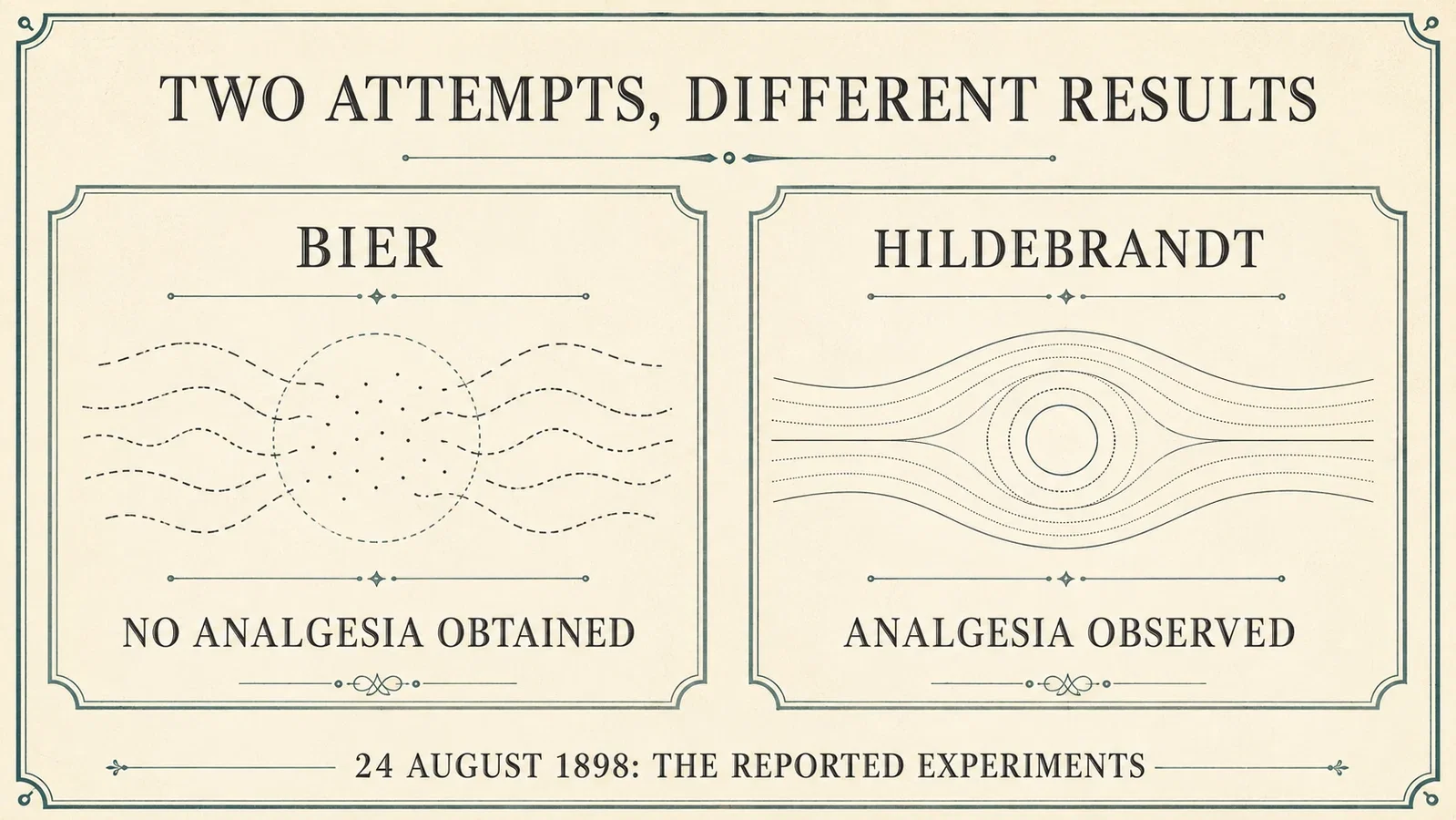
These panels describe only the two reported attempts. Lines are abstract motifs, not anatomy or a map of drug spread. They do not imply identical adverse effects or predict the performance of a modern anesthetic technique.[1]
The chronology also needs care. Bier placed the self-experiment narrative after the six case descriptions, but dated it August 24. The sixth patient’s operation was August 27. The order in which a paper tells its story is not necessarily the order in which events happened.[1, p.364]
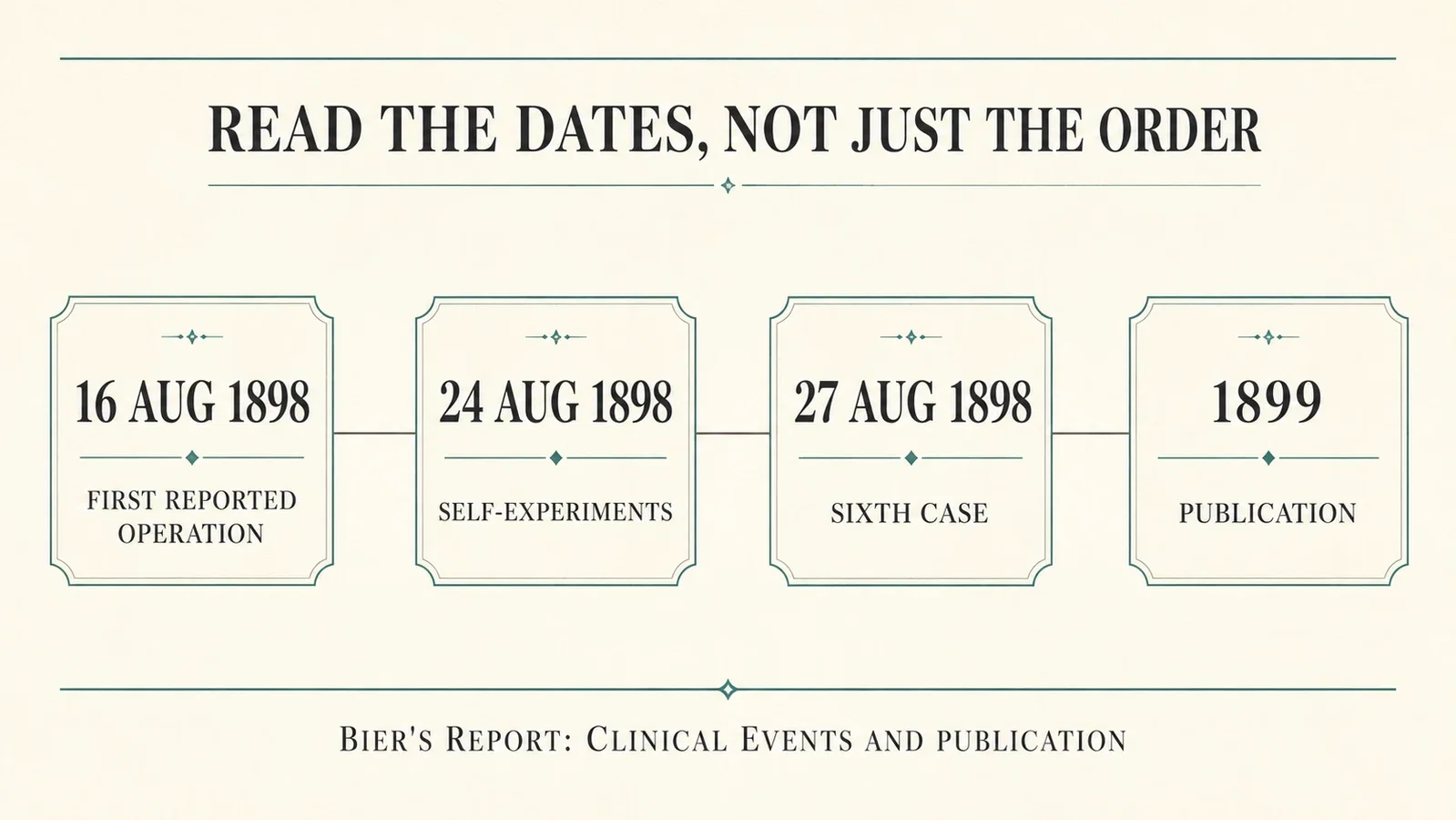
Dates from the original report: first reported operation, self-experiments, sixth case, then publication. Spacing is not to scale. This is not an exhaustive timeline adjudicating worldwide priority.[1]
What happened afterward
Bier's unsuccessful block did not spare Bier subsequent symptoms. Bier described headache, pressure in the head and dizziness that worsened on rising and abated when lying horizontally, with a prolonged period of bed confinement. Hildebrandt also suffered severe headache, vomiting and further malaise, but the two men had different courses and different interruptions to work.[1, pp.366–367]
Their experiences raised a question about cause. Was the aftermath attributable to cocaine, the puncture, loss of cerebrospinal fluid, or other factors? Bier used the failed self-experiment in the argument: Bier had received little, if any, cocaine, yet experienced prolonged symptoms. Bier considered several explanations and specifically discussed fluid loss.[1, p.368]
This was reasoning from observations, not a controlled demonstration of every mechanism now associated with post-puncture headache. Bier’s circulatory explanations and advice about bed rest remain historical claims, not current patient guidance.
The conclusion was not a simple endorsement or rejection. After an additional disappointing experiment with tropacocaine, Bier wrote that further experiments on people did not seem justified and suggested animal work. On the same final page, however, Bier entertained selective clinical use when general anesthesia appeared hazardous.[1, p.369]
Bier had shown a clinical possibility without settling its acceptability. Completing an operation did not by itself answer questions about harm, selection or tolerability.
A comparison with Corning, not a proven chain of influence
Corning's 1885 paper had described changes following cocaine injections near the spine in a dog and a man with longstanding symptoms. It did not describe cerebrospinal-fluid return. Whether the method could replace ether for surgery remained an explicitly prospective question.[2, pp.483–485]
Bier, by contrast, named Quincke's lumbar puncture, described cerebrospinal fluid and reported surgical cases. These are identifiable differences between two original records. Reis Jr's historical review also compares the men, discussing uncertainty about Corning's injection site and the resulting priority debate.[1–3]
These differences do not prove a direct Corning-to-Bier transmission of the idea. The Association of Anaesthetists' museum biography offers useful orientation, but its compressed account of painless cases and mutual anesthetics should be expanded against the original, not substituted for it.[4]
What survives in Bier's paper is more than a commemorative date. It preserves analgesic effects, uneven patient testimony and discomfort that continued after the procedure. Reading all three together shows what this clinical experiment made possible—and what remained unresolved.
Sources and reading limits
Read: Bier’s 1899 paper in full, with its page images; Corning’s 1885 contribution in full; Reis Jr 2008, title, summary, the English spinal block section and references; the Association of Anaesthetists’ museum biography of Bier.
Not covered: the rest of Reis Jr’s bilingual article, whose details of the cases differ from the original and are not adopted here; Wulf’s 1998 article. Corning’s injection site cannot be fixed in modern terms. The museum biography is an institutional summary, not an independent record of the six cases.
- Bier A. Versuche über Cocainisirung des Rückenmarkes. Dtsch Z Chir. 1899;51:361–369. DOI 10.1007/BF02792160. Zenodo.
- Corning JL. Spinal Anaesthesia and Local Medication of the Cord. N Y Med J. 1885 Oct 31;42:483–485. Columbia library scan.
- Reis Jr A. Eulogy to August Karl Gustav Bier on the 100th Anniversary of Intravenous Regional Block and the 110th Anniversary of the Spinal Block. Rev Bras Anestesiol. 2008;58(4):409–424. DOI 10.1590/S0034-70942008000400012. Official 16-page journal PDF.
- Association of Anaesthetists, Museum of Anaesthesia. August Bier (1861–1949).
Continue exploring
Related reading connects shared questions and contexts; it does not by itself establish historical influence.
- 1885: Corning's Anesthetic Effect and a Disputed Location
- 1901: Sicard and Cathelin Find an Epidural Route, Not Yet an Anesthetic
- 1960: Gormley's Blood-Patch Report of Seven Cases
- 1981: Brownridge's Combined-Block Report Keeps a Route Open
Anesthesia Epochs · The Source Room · About & Editorial Method
Sources and reading limits are stated above. Illustrations are labelled as original source images or AI-made. Historical accounts are educational; they are not current treatment instructions.