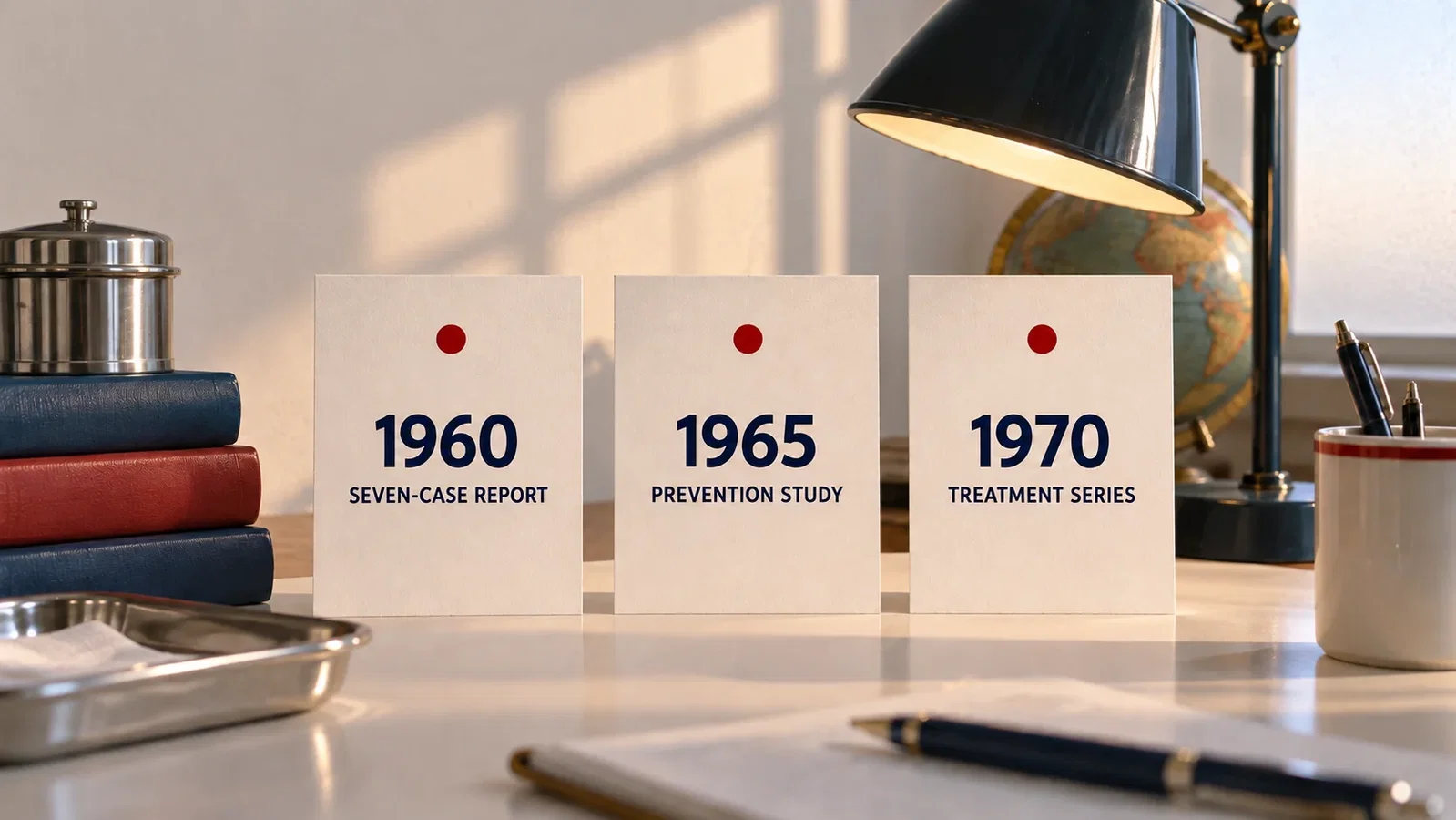
A case report, a prevention study and a treatment series.
Reading Library · Anesthesia Epochs · 中文版
Watch the companion film
1960: Gormley’s Blood Patch — Different Questions · Watch on YouTube
Historical anchor: 1960. Date details and source qualifications are explained below.
The early blood-patch literature asks several different questions. Could blood relieve an established postpuncture headache? Could a clot prevent a headache that had not yet appeared? Would an encouraging small series withstand a more systematic test? Keeping those questions separate makes Gormley’s 1960 report easier to understand.[1–3]

There is a source limit at the beginning of this account. The full 1960 Current Comment column is not covered in this article. Gormley’s seven cases are described through the explicit historical account in DiGiovanni and Dunbar’s original 1970 paper, checked against Harrington’s later historical study. This is an attributed account of the earlier report, not a claim to have read or quoted its original text.[1,3]
Those sources describe Gormley using the patient’s own blood to address postpuncture headache. One clinical impression behind the idea was that a bloody puncture seemed less likely to cause headache. Yet DiGiovanni and Dunbar immediately noted that an earlier controlled study had not supported that impression.[1,3] A useful therapeutic hypothesis and the observation that inspires it can have different evidentiary futures. Reported relief in seven cases invites investigation; it supplies no universal success rate.
In 1965, Ozdil and Powell investigated a preventive approach. Their original paper moved from a water-bag model and a canine preparation to two groups undergoing spinal anesthesia. No headaches were reported among 100 patients receiving a clot intervention, compared with 15 among 100 controls. The participants included surgical and obstetric patients.[2]
This was prevention, so the result cannot become “100 headaches cured.” The paper did not describe random allocation or blinding. Its historical clot technique also differed from the later epidural use of unclotted autologous blood. A model showing closure of a hole, a clinical comparison reporting symptoms, and adequate long-term safety evidence answer different questions. Harrington’s account adds that Ozdil began independently and encountered Gormley’s publication while preparing the paper.[2,3] Chronological order alone therefore does not establish a direct chain of instruction.
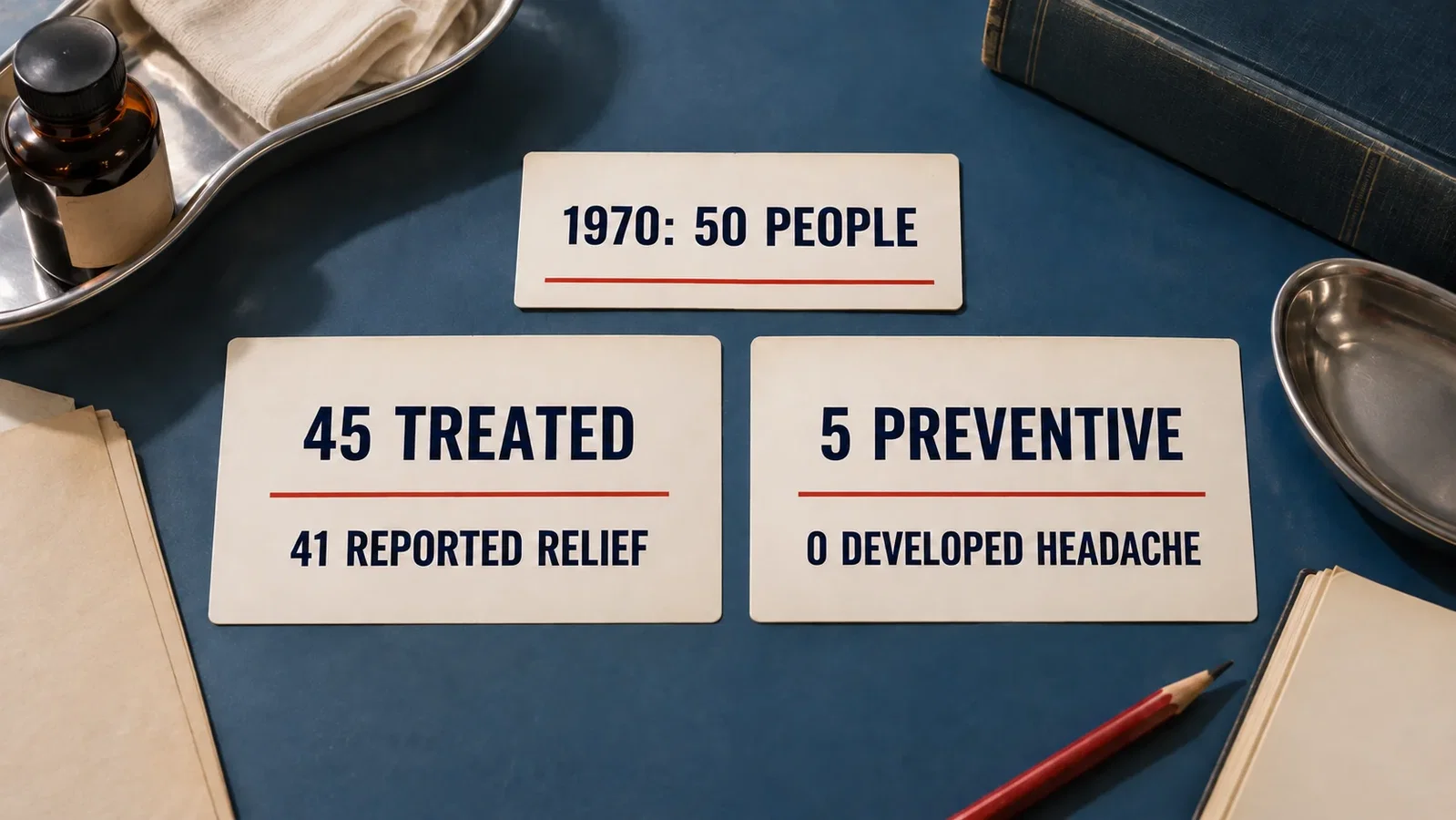
The 1970 report deserves equally careful denominators. DiGiovanni and Dunbar described 50 people: 45 treated for headache and five receiving a prophylactic procedure. They reported immediate relief without recurrence in 41 of the 45 treated patients; none of the separate five developed headache.[1] Counting 41 successes among all 50 would mix a treatment outcome with prevention. Describing all 50 as cured would misstate both the result and the population.
The case narratives complicate any simple success percentage. Repeat procedures occurred. Preliminary conservative treatment changed during the series, and the paper did not specify a uniform long-term follow-up period.[1] Its reported outcome should therefore stay within its own clinical context. It cannot be relabeled a rigorously established first-procedure success rate, lifelong freedom from recurrence, or proof of universal safety.
An older original supplies a concrete historical comparison. On page 366 of his 1899 paper, Bier described headache and pressure or dizziness on standing after his puncture, with relief on lying down.[4] The later studies addressed the possibility of closing a persistent leak.[1,2] That comparison explains this article’s relationship to Bier. It does not establish that Gormley learned the blood-patch method from him.

Read together, these papers preserve a more useful history than a single invention-and-triumph story. The seven-case report, a preventive clot study, and a subsequent treatment series each occupy a different place in the evidence. Their differences help explain what investigators were trying to learn, while keeping historical procedures separate from present clinical advice.[1–3]
Reading and image note: Both four-page original research papers from 1965 and 1970 were read in full. Harrington was read only at the selected pages specified below; Bier’s original p. 366 was read for this comparison. The 1960 item is located within Cullen’s Current Comment column, Anesthesiology 21(5):564–567, at pp. 565–566. Its column DOI record provides metadata, not the missing full text. All four illustrations are interpretive editorial images, not archival photographs.
Sources and reading limits
- DiGiovanni AJ, Dunbar BS. Epidural injections of autologous blood for postlumbar-puncture headache. Anesth Analg. 1970;49(2):268–271. DOI. Full original, including its historical account of Gormley on p. 271.
- Ozdil T, Powell WF. Post lumbar puncture headache: an effective method of prevention. Anesth Analg. 1965;44:542–545. PMID 5890386. Full original.
- Harrington BE. Postdural puncture headache and the development of the epidural blood patch. Reg Anesth Pain Med. 2004;29:136–163. DOI. Selected historical sections: pp. 136, 145–149.
- Bier A. Versuche über Cocainisirung des Rückenmarkes. Dtsch Z Chir. 1899;51:361–369. Original scan. Original p. 366 read for this comparison.
Continue exploring
Related reading connects shared questions and contexts; it does not by itself establish historical influence.
The Source Room · About & Editorial Method
Sources and reading limits are stated above. Illustrations are labelled as original source images or AI-made. Historical accounts are educational; they are not current treatment instructions.