A two-interspace method and the limits of a one-page report.
Reading Library · Anesthesia Epochs · 中文版
Watch the companion film
1981: Brownridge — Combined Spinal-Epidural for Caesarean Section · Watch on YouTube
Historical anchor: 1981. Date details and source qualifications are explained below.

In a one-page letter published in January 1981, Peter Brownridge considered elective Caesarean section. He accepted that epidural analgesia alone could provide good operating conditions. His concerns were the wait and the quantity of local anaesthetic required. He reported using spinal and epidural techniques together over the preceding three years, with experience in nearly 200 cases.[1] The publication anchors this article; it does not date the invention or establish an exact day of first use.
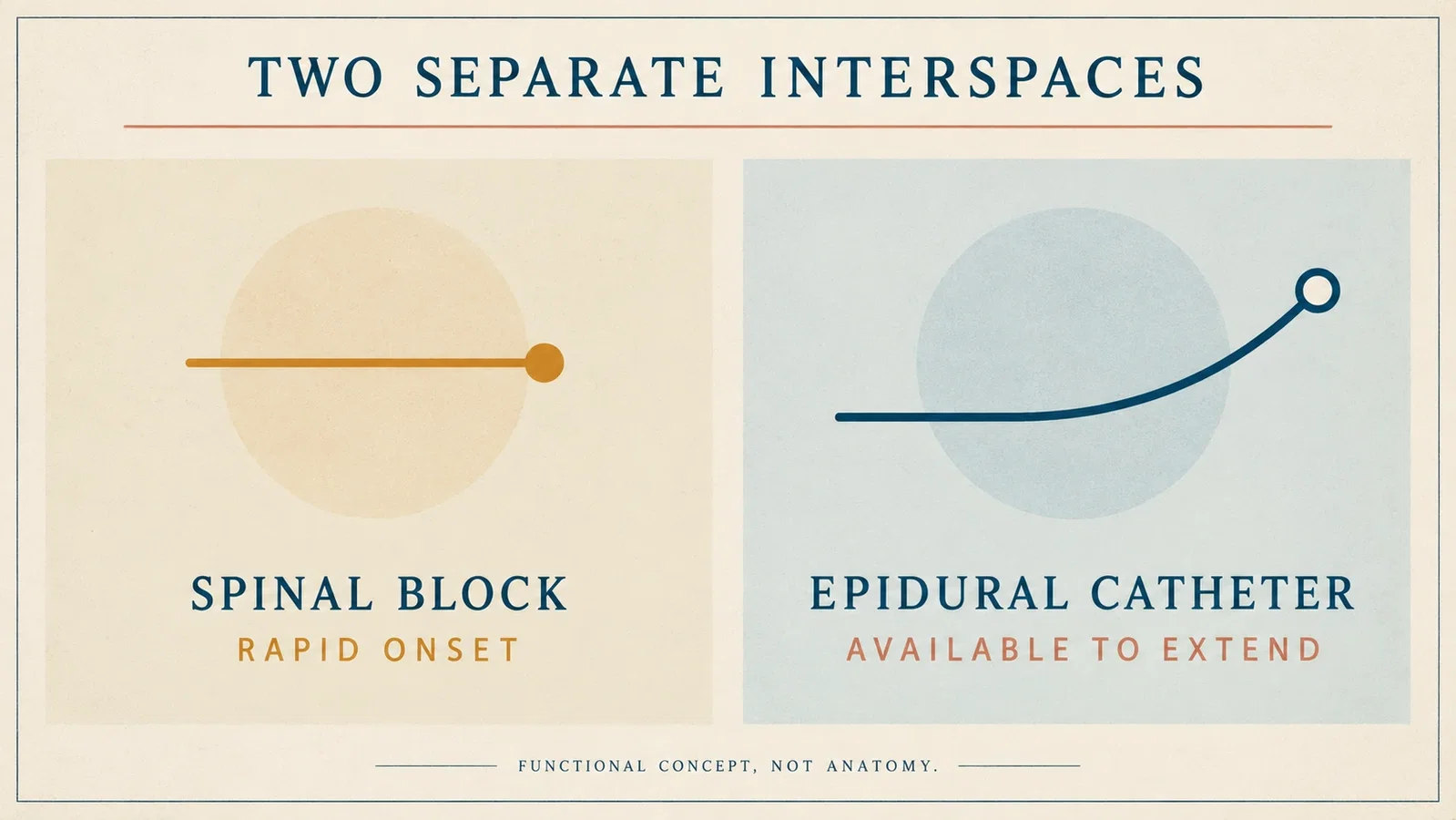
The arrangement matters. An epidural catheter was placed at one lumbar interspace and a spinal block performed at another. The spinal component provided rapid onset, while the catheter remained available to supplement or extend the block and to provide postoperative analgesia.[1] This was a two-interspace technique. A later single-interspace, needle-through-needle device would misrepresent the method described in this letter.
Brownridge wrote that the block usually became adequate within a few minutes, with roughly 10% of cases needing supplementation through the catheter. About ten women who had previously undergone Caesarean section with an epidural alone found the combined approach more comfortable.[1] These observations belong to an experience report. They do not amount to a randomized comparison with systematic follow-up, and nearly 200 should not become an exact study denominator of 200.
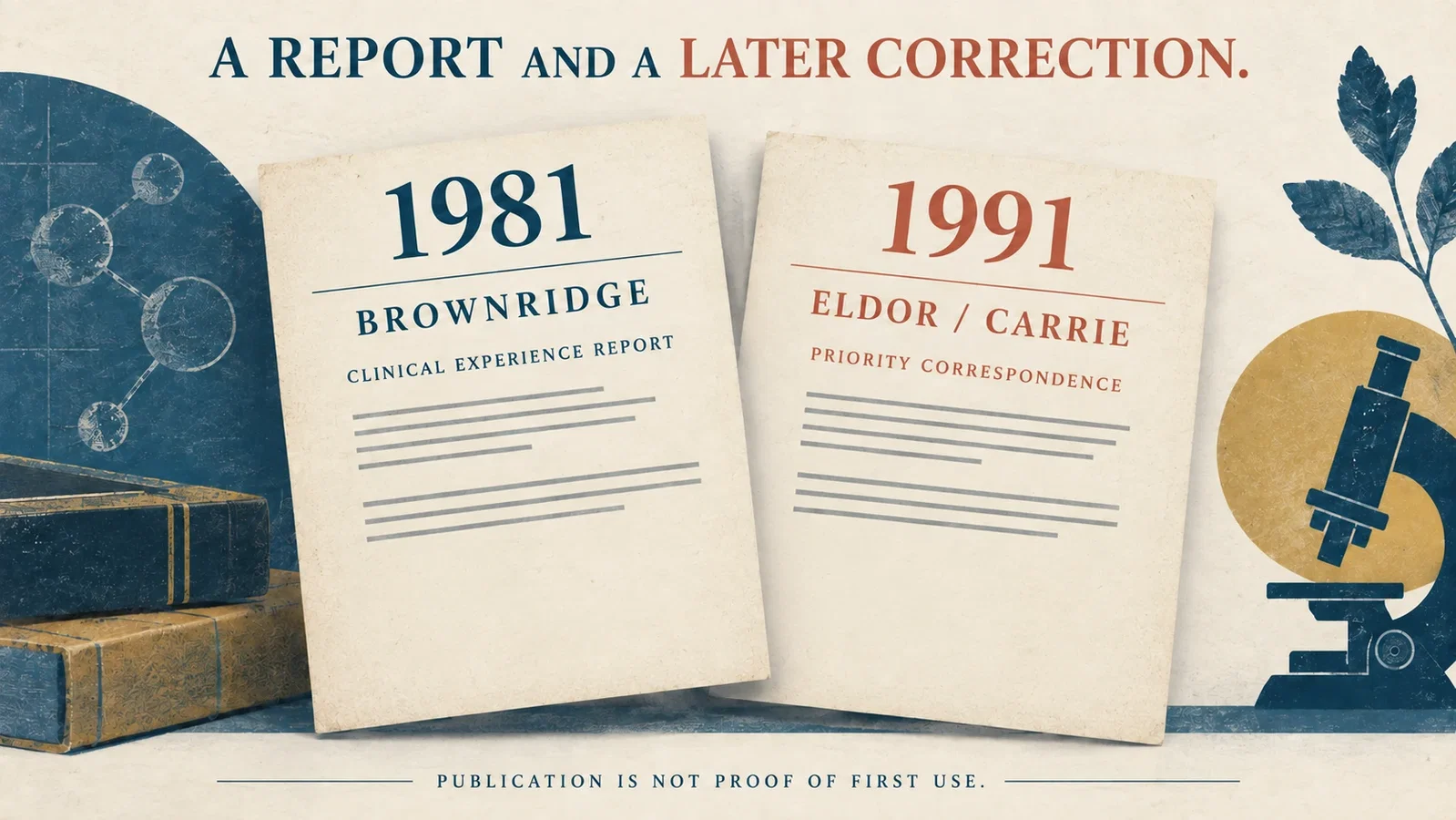
The priority story changed in subsequent correspondence. In 1991, Eldor acknowledged that he too had credited Brownridge with first use, then argued that recognition belonged to Curelaru's 1979 report.[2] Carrie agreed about publication priority for the technique using two separate lumbar interspaces. His reply also distinguished an earlier method that advanced one needle through two spaces from later needle-through-needle and other arrangements.[3] The shared name covered several constructions. These letters challenge an unqualified global-first claim for Brownridge. The earlier papers they cite were not independently read for this article.
The letter's safety language requires similar care. Brownridge reported that he had not yet encountered headache, and suggested that a small needle or the use of an epidural catheter for postoperative analgesia might explain this.[1] An absence of observed events does not establish an absence of risk. The suggested explanations were not tested in a controlled comparison within the letter, and its reassurance about high block and circulatory instability should not be adopted as proof of comparative safety.
Bier's earlier account offers a precise comparison. In 1899, he recorded pain sensation beginning to return at about 45 minutes during an experiment. He also described his own headache worsening when upright and improving when he lay flat.[4, p.366] Brownridge incorporated a catheter that could extend analgesia, while headache after puncture remained a question. Reading these accounts together connects duration of analgesia with the recording of adverse effects. It does not establish direct influence from Bier, or permit a safety comparison across the two reports.

The one-page report brought rapid onset, an extendable route and postoperative analgesia into one clinical proposal. Its historical value survives a more careful account of priority and evidence. What the author observed, what he proposed and what a comparison could establish remain separate parts of the story.
Image note: all four images are modern editorial illustrations, not original photographs, device replicas, anatomy or procedural instructions. The two-route diagram denotes different lumbar interspaces and purposes without depicting needle paths, levels or drug administration. The chronology confers no global-first status, and the numerical illustration creates neither an exact cohort nor a zero-risk conclusion.
Sources and reading limits
- Brownridge P. Epidural and subarachnoid analgesia for elective Caesarean section. Anaesthesia. 1981;36(1):70. Original publisher page. DOI:10.1111/j.1365-2044.1981.tb08614.x. PMID 7468971. Complete letter read in the publisher's original-page viewer.
- Eldor J. First use of combined spinal-extradural anaesthesia. Br J Anaesth. 1991;67:666. Original correspondence. DOI:10.1093/bja/67.5.666-a. Complete letter and references read in the publisher PDF.
- Carrie LES. First use of combined spinal-extradural anaesthesia. Br J Anaesth. 1991;67:667. Original reply. DOI:10.1093/bja/67.5.667. Complete reply and references read. Earlier papers cited by these two correspondents were not independently read for this article.
- Bier A. Versuche über Cocainisirung des Rückenmarkes. Deutsche Zeitschrift für Chirurgie. 1899;51:361–369. Original article; archived scan. Page366 reread for return of pain sensation and Bier's account of headache. The other eight pages were not reread for this article.
Continue exploring
Related reading connects shared questions and contexts; it does not by itself establish historical influence.
The Source Room · About & Editorial Method
Sources and reading limits are stated above. Illustrations are labelled as original source images or AI-made. Historical accounts are educational; they are not current treatment instructions.