In April 1901 Sicard and Cathelin, in separate communications, reported injecting cocaine into the space outside the dura through the sacral canal; Sicard’s nine patients gained pain relief without skin analgesia, and Cathelin’s four hernia patients lost too little sensation for a major operation.
Reading Library · Anesthesia Epochs · 中文版
Watch the companion film
1901: Sicard, Cathelin, and the Caudal Route · Watch on YouTube
The most consequential sentence in Cathelin's 1901 report was not its announcement of a new route. It was the admission that the human results were insufficient.
Four patients with inguinal hernias had experienced reduced sensation, Cathelin wrote, but not enough to attempt a major operation.[2, p.453] Read beside Sicard's report from the previous week, that sentence changes the familiar discovery story. Access to a space, relief of pain and anesthesia adequate for surgery were different achievements.
What the two April reports actually dated
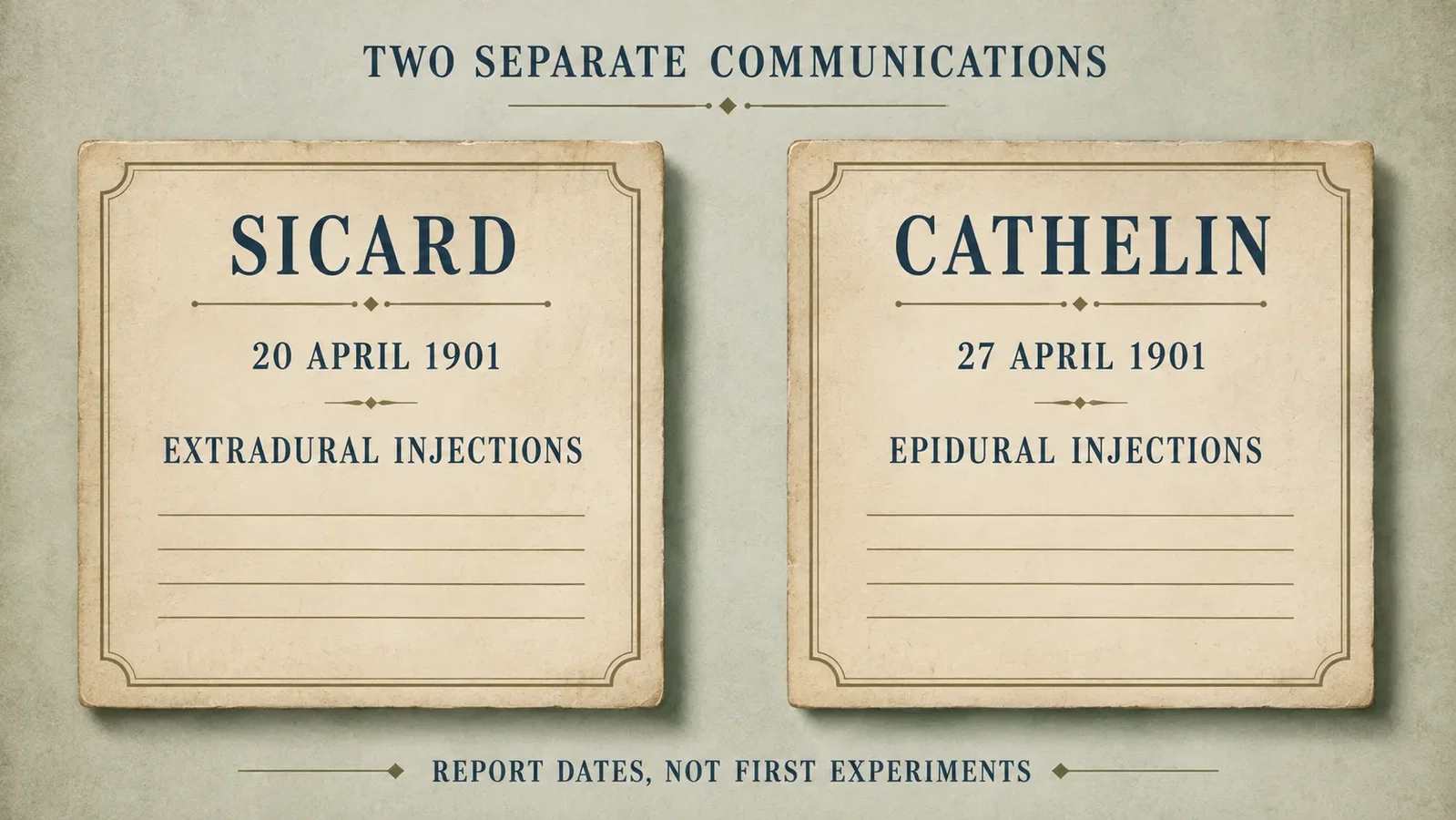
Sicard presented an account of extradural medicinal injections by the sacrococcygeal route on April 20, 1901. Cathelin's communication followed on April 27. They were separate papers, not a jointly authored announcement.[1–2]
Cathelin opened by acknowledging Sicard's report at the preceding meeting. Cathelin described the two sets of experiments as simultaneous and independent. Cathelin’s own chronology reached back to dog experiments in January and human attempts in Lejars's service at the Hôpital Tenon on February 5.[2, pp.452–453] The April dates identify communications, not the first day either man conducted an experiment.
Nor does the 1901 wording settle every later priority claim. In a 1903 book, Cathelin argued forcefully for precedence over Sicard.[3, pp.26–27] The book is a participant’s account written two years later.
The question of location
Sicard discussed earlier subarachnoid injections, referring to Bier and subsequent work. Headaches could persist for two or three days, sometimes accompanied by nausea and vomiting. Sicard sought an alternative: the space between the dura and the surrounding bony canal.[1, pp.396–398]
Bier's 1899 original described lumbar entry into the dural sac and discussed headache, vomiting and Bier’s interpretation involving cerebrospinal-fluid loss.[4, pp.361, 368–369]
An anatomical claim still needed evidence of where the fluid had gone. Sicard described colored-fluid experiments in dogs and injections in cadavers. Cathelin described injecting India ink in an experimental dog and later examining its distribution at dissection: black staining in the extradural space contrasted with unstained subarachnoid spaces.[1, p.397; 2, p.453]
This showed where the fluid went in those experiments; it did not show that every later injection would reach the same space.
The human injections described in both reports used cocaine solutions.[1, p.398; 2, p.453]
Two human reports, two different questions
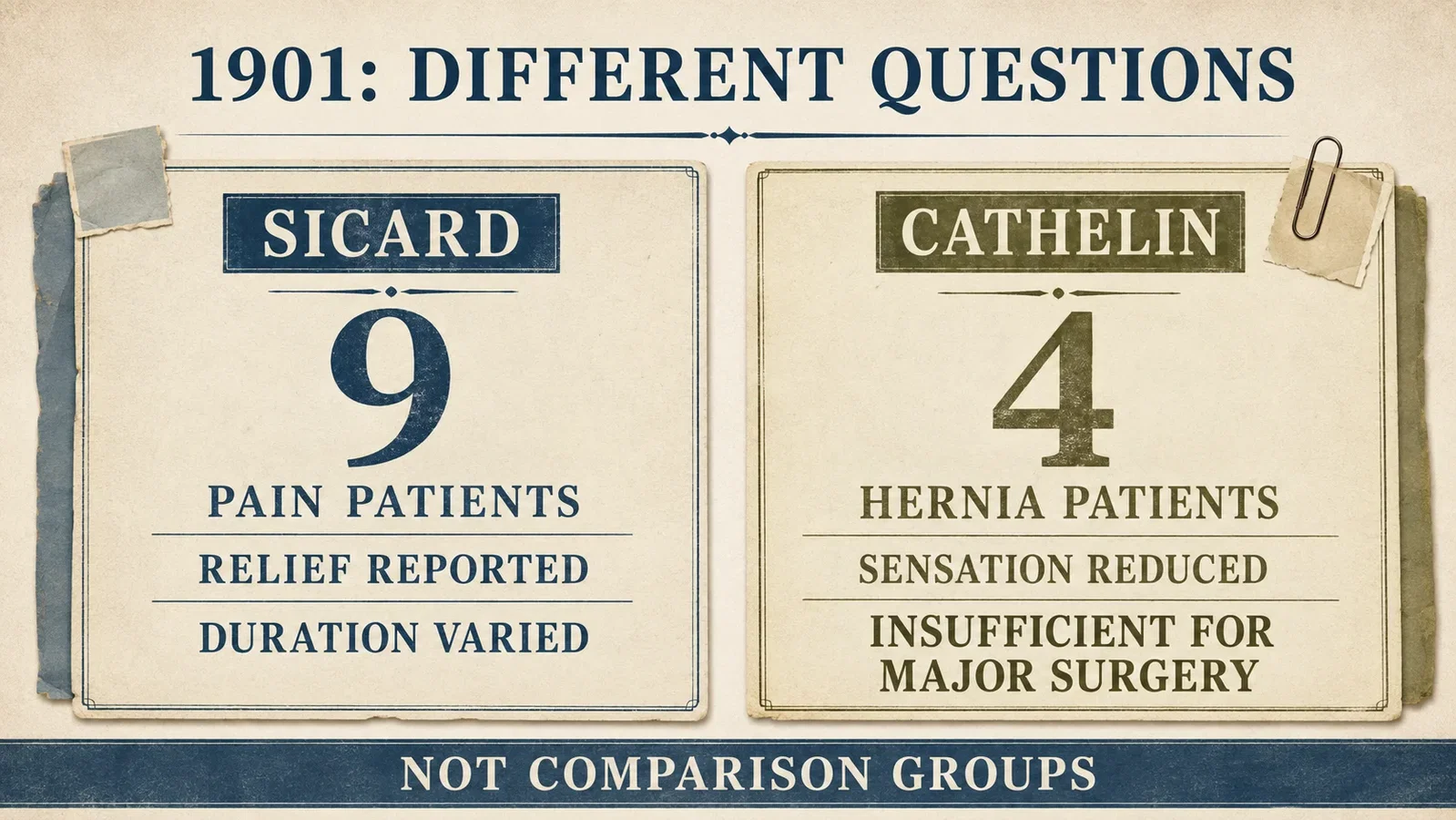
Sicard's nine patients were being treated for pain: two had tabetic lancinating pains, three had lumbago and four had refractory sciatica. Sicard reported immediate relief in all nine, but the duration varied.[1, p.398]
For the two tabetic patients, the disappearance of pain lasted twelve to twenty hours. The later description of lasting relief, or relief with each repeated injection, names only two of the three lumbago patients.
Sicard also acknowledged that cutaneous analgesia had not generally appeared, while describing one localized exception. Reducing a patient's pain complaint had not yet become dependable operative anesthesia. Sicard’s prediction that surgeons would adopt the method was conditional on its being sufficiently improved to produce the required lower-limb analgesia.[1, p.398]
Cathelin's four hernia patients raised the operative question more directly. The answer was limited sensory reduction, insufficient for the major operation contemplated—not four completed hernia repairs under successful caudal blocks.[2, p.453]
There is also a documentary discrepancy. Cathelin's own narrative in 1903 still described four cases, whereas a Lejars passage reproduced in the book referred to three.[3, pp.25, 28] The 1901 communication gives four.
The European Association of Urology's later historical account also describes the early human results as imperfect.[5]
Promises are part of the record, not completed results
Cathelin proposed modifications and future applications, including painful labor and certain difficult pain conditions. These were possibilities advanced at the end of the communication, not obstetric or cancer-pain series already completed in that paper.[2, p.453]
Sicard expressed striking confidence in the method's harmlessness. Neither report included a controlled comparison.[1–2]
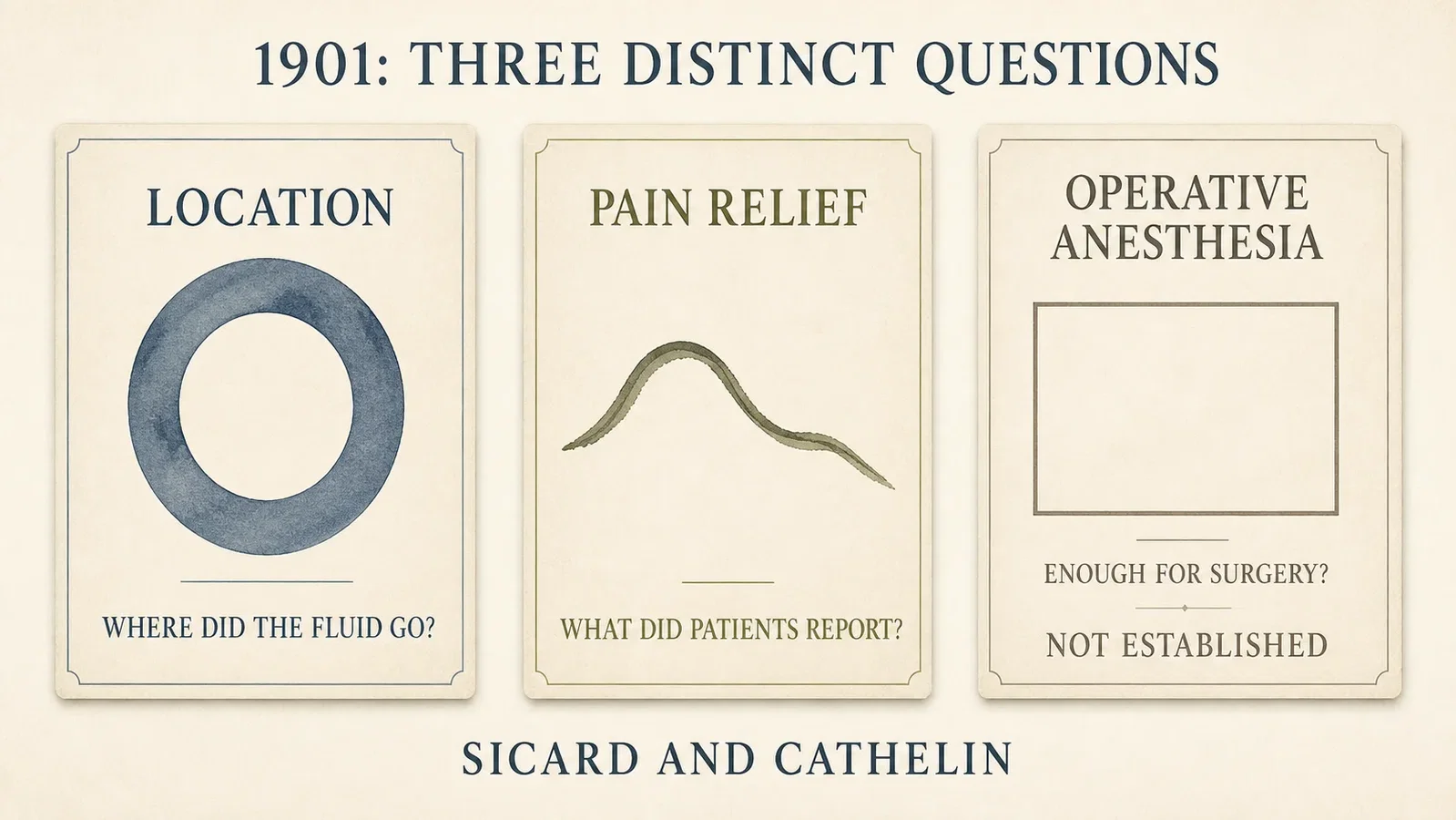
The sacral route, the attempt to establish extradural location and the reported human responses were recorded in a form that could be examined and challenged. The limitations were recorded too.
Those limitations preserve the problem subsequent work had to solve. Finding a way in was not the same as making an operation possible.
Sources and reading limits
Read: Sicard’s and Cathelin’s communications in the Comptes rendus de la Société de Biologie, 20 and 27 April 1901, pp. 396–398 and 452–453; the historical chapter of Cathelin’s 1903 book, pp. 19–28, in a scan hosted by CHAR; pp. 361 and 368–369 of Bier’s 1899 paper; the European Association of Urology biography of Cathelin.
Not covered: the rest of Cathelin’s 1903 book; Sicard’s later papers on the method; the Société de chirurgie discussion of May 1901, except as Cathelin quotes it.
- Sicard A. Les injections médicamenteuses extra-durales par voie sacro-coccygienne. Comptes rendus de la Société de Biologie. April 20, 1901;53:396–398. Internet Archive
- Cathelin F. Une nouvelle voie d’injection rachidienne. Méthode des injections épidurales par le procédé du canal sacré. Applications à l’homme. Same journal, April 27, 1901;53:452–453. Internet Archive
- Cathelin F. Les Injections épidurales par ponction du canal sacré et leurs applications dans les maladies des voies urinaires. Paris: J.-B. Baillière et Fils, 1903.
- Bier A. Versuche über Cocainisirung des Rückenmarkes. Deutsche Zeitschrift für Chirurgie. 1899;51:361–369. Zenodo
- Schultheiss D. Fernand Cathelin (1873–1960): Eminent urologist and pioneer of sacral anaesthesia. European Association of Urology, April 1, 2024.
Continue exploring
Related reading connects shared questions and contexts; it does not by itself establish historical influence.
- 1898: Bier's Spinal Analgesia and Its Aftermath
- 1899: Tuffier Brings Spinal Cocaine to the Société de Chirurgie
- 1921: Pagés Achieves Surgical Anesthesia Outside the Dura
- 1942: Hingson and Edwards Sustain Caudal Analgesia Through Labor
- 1953: Lièvre's Hydrocortisone Report in the History of Sciatica Treatment
Anesthesia Epochs · The Source Room · About & Editorial Method
Sources and reading limits are stated above. Illustrations are labelled as original source images or AI-made. Historical accounts are educational; they are not current treatment instructions.