The 1942 application and the promise, complications and comparisons recorded in primary reports.
Reading Library · Anesthesia Epochs · 中文版
Watch the companion film
1942: Hingson and Edwards—Making Labor Pain Relief Last · Watch on YouTube
Historical anchor: 1942. Date details and source qualifications are explained below.
Keeping a route for another injection changed what a caudal block could attempt. A single injection offered a limited interval of relief. Labor could outlast it, or delivery could arrive before the injection had taken full effect. Robert A. Hingson and Waldo B. Edwards made that mismatch central to their 1943 account of continuous caudal analgesia.[1, p.509]
An editorial illustration of care in a period setting. The people and room do not reconstruct a documented patient, delivery or hospital interior. No insertion procedure is shown.
A familiar route, an uncertain duration
The route itself had a history. In separate communications in 1901, Sicard and Cathelin described reaching the space outside the dura through the sacral approach. Their original pages record experiments, observations in patients with pain, and sensory changes that were not yet sufficient for major surgery. Cathelin included childbirth pain among possible subjects for further work. Those pages do not describe an established continuous obstetric technique.[4]
Hingson and Edwards acknowledged these predecessors explicitly. They also reviewed obstetric uses of single caudal injections before their own work. Their contribution can therefore be described more precisely as extending analgesia through an unpredictable period of labor, rather than discovering the caudal route or introducing every form of obstetric regional anesthesia.[1, pp.507–509]
A 1946 Public Health Service report distinguished the early surgical and obstetric applications. It placed Southworth and Hingson's lower-extremity surgical use in October 1941 at the Public Health Service hospital in Stapleton, New York, and Hingson and Edwards' obstetric application at the same hospital in January 1942. Here, 1942 marks the obstetric application, without assigning an exact first-procedure day.[2, p.1713]
There were several publications around this development. The publisher identifies Edwards and Hingson's American Journal of Surgery paper as September 1942, pages 459–464. The Anesthesia & Analgesia paper, pages 301–311, appears in the 1946 report's bibliography as November–December 1942. Neither 1942 article body is covered here. Their metadata establishes publication records; the detailed narrative rests on the primary reports read.[2, p.1735; 3]
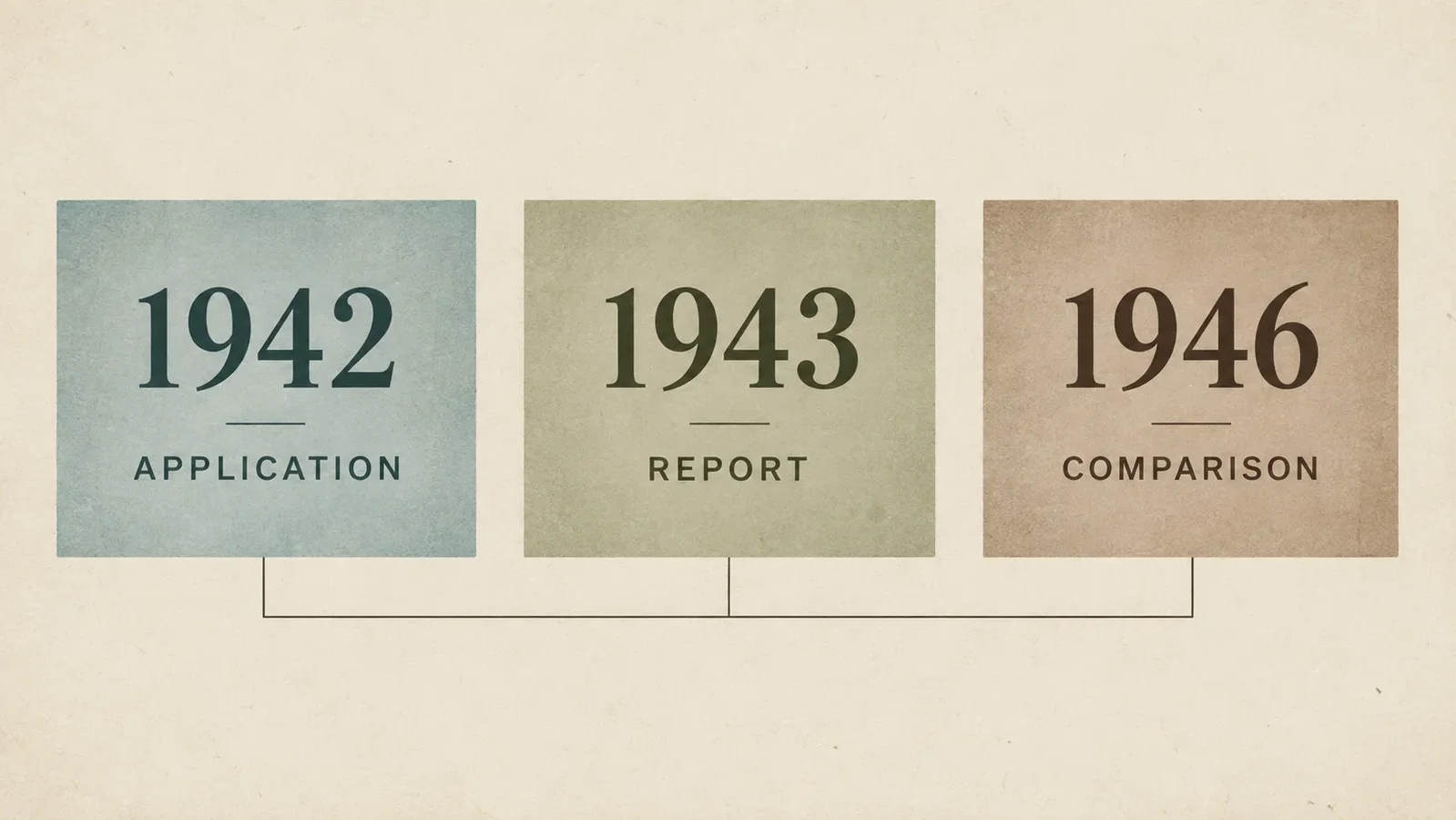
The 1942 application, 1943 report and 1946 comparison are separate stages. The later study does not describe the first 1942 cohort.
What remained in place
The 1943 article lists a reservoir bottle, rubber tubing, a two-way valve and a malleable stainless-steel needle. The needle remained in place while further local anesthetic was given through the connection. Its flexibility was intended to accommodate prolonged use and movement without the breakage associated with earlier needles.[1, pp.509–510, 514]
“Continuous” described the ability to sustain analgesia. The reported administration used repeated injections, not an electronic pump delivering an uninterrupted infusion. The retained component was a needle, not a modern flexible epidural catheter. Historical quantities and intervals appear in the paper; they are not reproduced here as a clinical regimen.[1, pp.510, 514]
Maintaining access also extended the work of care. Position, connections, subsequent injections and the woman's responses remained matters for attention. The authors described demonstrations at teaching hospitals and stressed training and hospital practice. An apparatus alone could not supply those conditions.[1, pp.513–517]
Read the complications alongside the promise
The authors reported 660 obstetric cases, 654 live babies and one maternal death. Elsewhere they discussed more than a thousand surgical and obstetric patients together. Those are different groups. Nor does subtracting 654 from 660 produce a valid neonatal-death count.[1, pp.509, 514]
The report's enthusiasm was considerable. Preserving consciousness while relieving pain was central to the authors' account, and they described several favorable obstetric observations. The same paper, however, documented twelve needle breakages during early experience with different needles; four required surgical incisions. It also described an obstetric patient with a peridural abscess and Staphylococcus aureus bacteremia who died on the thirty-first day after delivery.[1, pp.513–515]
The authors considered the patient's skin, the solution and contamination during later injections as possible routes of infection. They did not identify one as the proven cause. Broad reassuring language later in the article cannot erase the fatal complication already reported. Together, these passages explain why needle design, connections and subsequent handling remained active problems.[1, pp.514–517]
A larger series brought a different set of questions
In 1946, Public Health Service statisticians Selwyn D. Collins, F. Ruth Philips and Dorothy S. Oliver published an analysis from the Philadelphia Lying-in Unit of the Pennsylvania Hospital, with Hingson, Norris Vaux and Clifford B. Lull as collaborators.[2, pp.1713–1714]
The caudal group comprised 2,516 mothers and 2,546 infants delivered from May 1943 through August 1945. The comparison group included 1,024 mothers and 1,034 infants delivered from December 1942 through July 1943. The periods partly overlapped but differed substantially. There was no random assignment. Comparing age, parity and health characteristics helped readers assess the groups; it did not remove every difference in selection, timing or care.[2, pp.1714, 1719–1721]
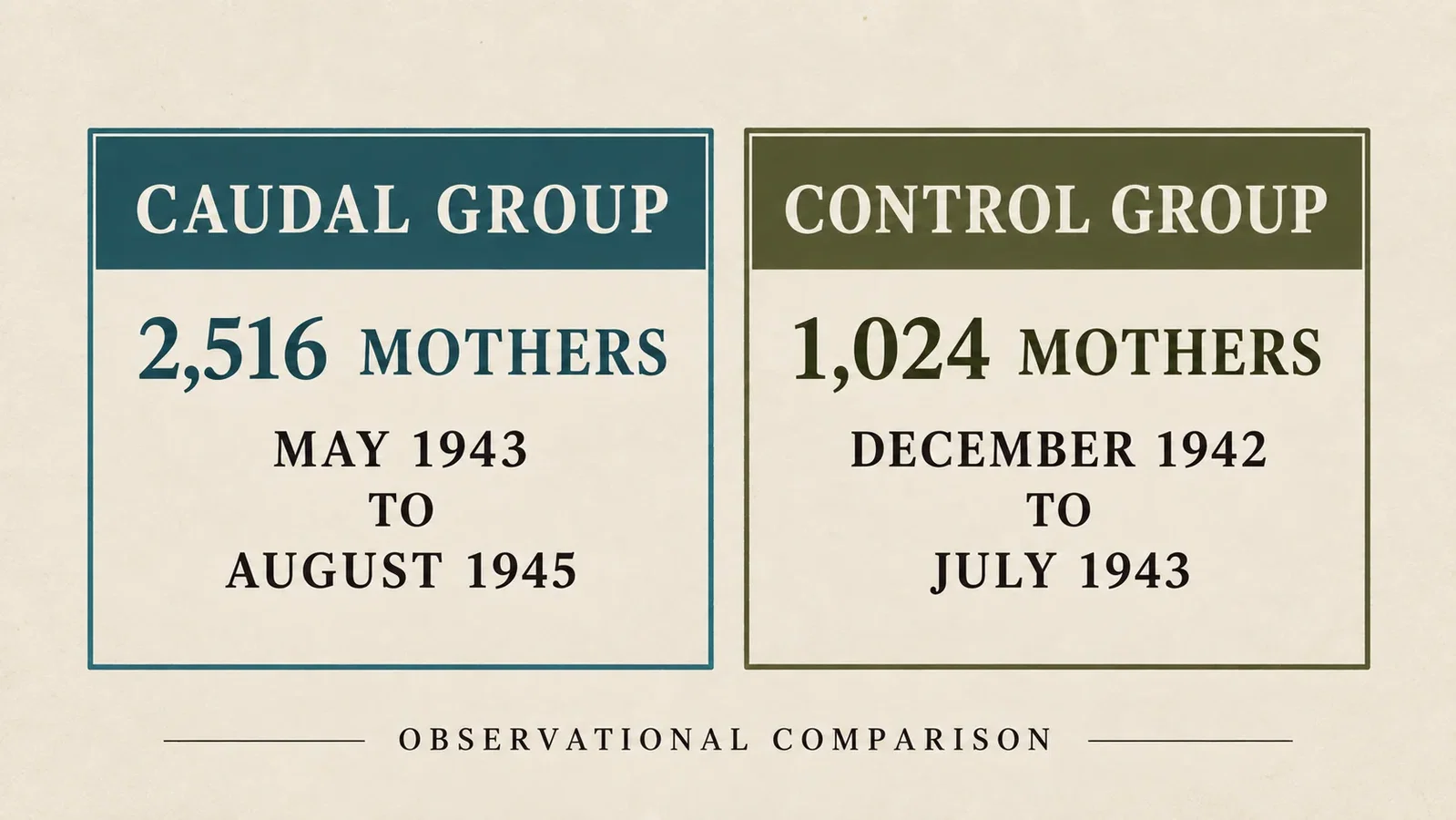
The numbers on these cards count mothers. Infant counts are separate. This is a description of the comparison groups, not a randomized-trial diagram.
The study made the pain-relief claim more inspectable. Table 1 contained known pain-relief records for 2,482 mothers, with 90.4% recorded as having complete relief. But 202 of the 2,243 mothers with complete relief received supplementary analgesia. The percentage cannot be presented as success from caudal analgesia alone in all 2,516 mothers.[2, pp.1714–1715, Table 1]
The results also included falls in blood pressure. Labor outcomes did not all move in a favorable direction: mean total duration was similar between groups, while forceps use was more frequent in the caudal group. Routine morphine after delivery complicated interpretation of the afterpain comparison. These details belong beside the favorable findings.[2, pp.1715–1718, 1722–1726]
There were two maternal deaths in each group. The authors explicitly said the samples were too small to measure maternal mortality. For infants, they reported differences in stillbirths and deaths during the first week of life. Their neonatal-mortality measure was limited to that first week, and the partly historical, nonrandomized comparison could not establish that nationwide adoption would halve infant losses. That extrapolation appeared in the paper's conclusion; it is not treated here as a demonstrated achievement.[2, pp.1726, 1731–1734]

An editorial concept about preserving both kinds of record. No patient data or efficacy curve has been invented.
The historical change is concrete: an existing sacral route became an arrangement for repeated administration, allowing the duration of analgesia to be organized around labor. The original reports also show the accompanying work: continued care, revised equipment, reporting complications and making comparisons that others could examine.[1–2]
Sources and reading limits
- Edwards WB, Hingson RA. The Present Status of Continuous Caudal Analgesia in Obstetrics. Bull N Y Acad Med. 1943;19(7):507–518. Primary report at PMC. All 12 consecutively numbered pages, including text and references, were read and individually checked as scans. Figures 1 and 2 are referenced but absent from this PDF; Figure 3 is present. Acquisition of every referenced plate is not claimed.
- Collins SD, Phillips FR, Oliver DS. A Statistical Study of Delivery with Continuous Caudal Analgesia, as Compared with Other Methods. Public Health Rep. 1946;61(48):1713–1735. Original issue preserved by CDC. The complete 23-page article, tables and figures were read. The other 20 pages of the 43-page issue were not included in that reading claim. Hingson's collaboration prevents describing this as wholly independent validation of his technique.
- Edwards WB, Hingson RA. Continuous caudal anesthesia in obstetrics. Am J Surg. 1942;57(3):459–464. Publisher metadata, DOI:10.1016/S0002-9610(42)90599-3. Authors, title, pages and September 1942 were verified; the body required access and is not covered. The 1942 Anesthesia & Analgesia article, 21:301–311, was also not directly read.
- Sicard A. Les injections médicamenteuses extra-durales par voie sacro-coccygienne. C R Soc Biol. 1901;53:396–398; Cathelin F. Une nouvelle voie d’injection rachidienne. Méthode des injections épidurales par le procédé du canal sacré. Applications à l’homme. Same journal. 1901;53:452–453. Five original pages were read in an archived copy for the specific route-versus-duration comparison. Reading the entire volume or establishing a personal mentorship chain is not claimed.
Continue exploring
Related reading connects shared questions and contexts; it does not by itself establish historical influence.
- 1901: Sicard and Cathelin Find an Epidural Route, Not Yet an Anesthetic
- 1946: Mendelson Describes Two Patterns of Aspiration Injury
- 1947: Bonica Organizes Obstetric Anesthesia Around the Clock
Anesthesia Epochs · The Source Room · About & Editorial Method
Sources and reading limits are stated above. Illustrations are labelled as original source images or AI-made. Historical accounts are educational; they are not current treatment instructions.