Obstruction, acidic injury and anesthesia care in the 1946 paper.
Reading Library · Anesthesia Epochs · 中文版
Watch the companion film
1946: Mendelson—Two Patterns of Aspiration Injury · Watch on YouTube
Historical anchor: 1946. Date details and source qualifications are explained below.
The fatal cases in Curtis L. Mendelson's 1946 paper involved food blocking the airway. They were not two demonstrated deaths from acid injury to the lungs. That distinction matters in an article remembered for its explanation of the pulmonary effects of acidic gastric contents.[1,pp.192,195]
Mendelson, an obstetrician, brought together a review of hospital records, animal experiments and proposals for anesthesia care. His clinical material contained different patterns of injury. Keeping those patterns separate explains both the question his experiments addressed and the limits of their answer.[1,pp.191–204]

The anonymous figure and room are editorial inventions, not a portrait of Mendelson or a record of a particular patient's care.
Reading the denominator
Mendelson reviewed records from the New York Lying-In Hospital for 1932–1945. He identified 66 instances of aspiration among 44,016 pregnancies and printed a frequency of 0.15%. Pregnancies were the denominator; the paper did not describe 44,016 administrations of general anesthesia. All 66 affected patients had received anesthesia with a gas, oxygen and ether mixture.[1,pp.191–192]
Aspiration was recognized at delivery in 45 cases: 40 involved liquid and five involved solid material. Another 21 cases were diagnosed later. The table's 61 asthma-like presentations describe a clinical pattern, not 61 witnessed episodes of liquid aspiration. Replacing one count with the other would erase how the cases were identified.[1,pp.191–194]
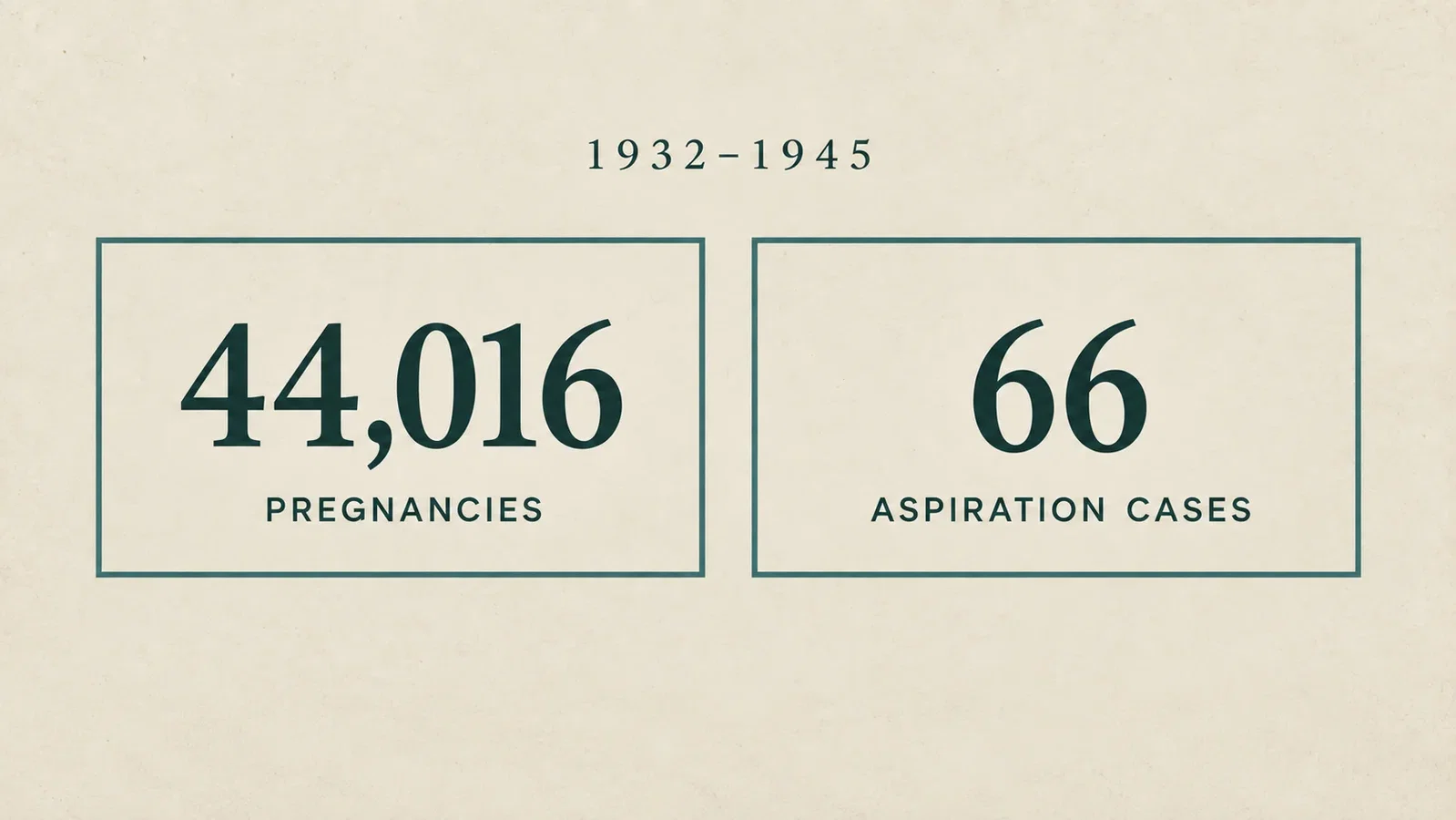
44,016 denotes pregnancies during the review period; 66 denotes recorded aspiration cases. The cards do not imply that every pregnancy involved general anesthesia.
Among the five obstructive presentations, three involved complete obstruction. Two patients died; one recovered after coughing up food. The other two patients developed extensive atelectasis after incomplete obstruction and recovered. The asthma-like pattern, with wheezing and pulmonary opacities, called for an explanation beyond blockage by a piece of food.[1,pp.192–195]
Testing an explanation for the liquid reaction
In rabbits, Mendelson compared acidic gastric fluid, hydrochloric acid, neutralized gastric fluid, water, saline and solid materials. Radiographs, gross specimens and microscopic images accompanied the experiments. Acidic liquids produced severe reactions; neutralized fluid produced much milder changes under the conditions he used. Solid material could still obstruct the airway.[1,pp.195–202,Figs.6–20]
The comparisons supported his interpretation that acidity contributed to the acute pulmonary reaction after liquid aspiration. They did not provide a universal human threshold for acidity or volume. The article did not report an animal sample size, random allocation or blinded assessment, and milder experimental reactions did not establish that neutral fluid or food particles were harmless in human lungs.[1,pp.195–202]
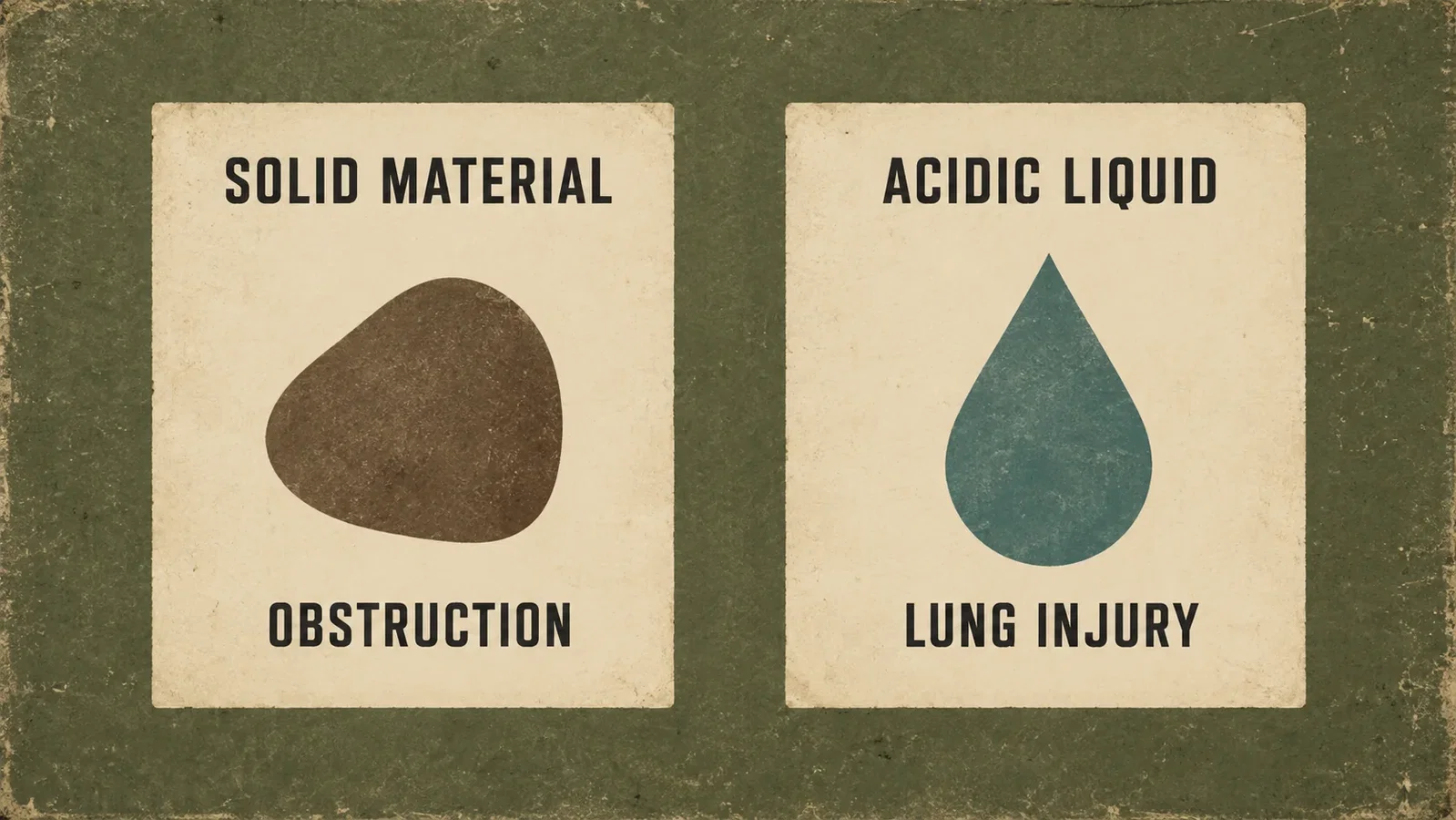
These are two patterns emphasized in the 1946 paper, not a complete modern classification. Mixed injury is not excluded.
Writing retrospectively in the ASA Newsletter in 1999, Paul R. Knight warned that the later emphasis on acid had contributed to relative neglect of injury from particles and mixed gastric contents. That assessment belongs to the subsequent history of the work. It should not be attributed to experiments Mendelson had already completed in 1946.[3,p.16]
A problem of observation and organization
Mendelson warned that the stomach might still secrete and retain a hazardous amount of acid even when food was withheld. His proposals also addressed how anesthesia was delivered. He criticized inadequately assessed general anesthesia, inexperienced personnel and masks that concealed vomiting. He called for closer observation, trained care and equipment that was both available and understood by its users.[1,pp.202–204]
These were proposals drawn from clinical experience and experimental reasoning. The article did not measure the effect of implementing the whole package on mortality. Its historical treatment discussions should likewise be read as part of that period's practice, rather than instructions for care today.[1,pp.202–204]
His recommendation to use local anesthesia more widely where feasible provides a specific comparison with earlier work on caudal analgesia. Edwards and Hingson's 1943 report emphasized preserved consciousness and claimed that patients needing special feeding arrangements could continue their diets. It also recorded a fatal infectious complication. Read together, the papers show how the choice of analgesia altered assumptions about consciousness and feeding while introducing its own risks.[1,pp.203–204;4,pp.507,514–515]
This is an editorial comparison. Mendelson did not name or endorse that caudal technique in this recommendation, and the two reports did not directly compare aspiration outcomes. They cannot establish that the earlier technique prevented the events in his series.[1,4]
A later investigation measured something different
In 1951, George A. Culver, Harry P. Makel and Henry K. Beecher examined 300 unselected surgical patients receiving general anesthesia, using dye placed in the stomach. Inspection at the end of the operation distinguished dye in the pharynx from dye below the vocal cords. The latter was found in 49 patients, a reported frequency of 16.3%.[2,pp.289–292]
That result represented dye-detected aspiration, not a count of 49 clinically diagnosed cases of pneumonitis. It did not supply a rate directly comparable with Mendelson's retrospectively identified obstetric cases. The population, method and outcome differed. The later paper did not cite Mendelson, so chronology alone also cannot establish a direct line of intellectual influence.[1–2]
Of those 300 patients, 215 had endotracheal tubes. None of the tubes was cuffed. Preserving that detail avoids an erroneous account in which every patient was without an endotracheal tube; it also prevents the study from being used to judge the protective performance of modern cuffed tubes.[2,p.291]

The separate columns represent different observed outcomes, not comparable rates to be pooled or plotted on one scale.
The article's date is August 1946, the month of publication. Mendelson had presented the paper to the New York Obstetrical Society on 11 December 1945. Neither date identifies when all the clinical events occurred.[1,p.191 and reprint cover]
The paper linked distinctions in the case records to a testable explanation and to questions about how anesthesia was delivered. Its contribution becomes clearer when the denominator, the material aspirated and the outcome observed remain visible. An eponym can name the history; the original pages show the work behind it.[1–3]
Sources and reading limits
- Mendelson CL. The Aspiration of Stomach Contents into the Lungs During Obstetric Anesthesia. American Journal of Obstetrics and Gynecology. 1946;52(2):191–205. DOI; WLM permission reprint · Archived copy; PubMed record. Entire 15-page article, Table I, all 20 figures and appended discussion read. The preceding permission cover identifies the August issue. Other articles in the collection were not counted as read.
- Culver GA, Makel HP, Beecher HK. Frequency of Aspiration of Gastric Contents by the Lungs During Anesthesia and Surgery. Annals of Surgery. 1951;133(3):289–292. Original article at PMC; DOI. All four original page images and both tables read. Dye detection is not a clinical pneumonitis outcome. This paper does not cite Mendelson.
- Knight PR. Curtis L. Mendelson, M.D.: Aspiration Investigator (1913–). ASA Newsletter. 1999;63(9):14–16. Complete issue at WLM. The entire three-page retrospective was read; the other issue contents and its separately available references were not counted as read.
- Edwards WB, Hingson RA. The Present Status of Continuous Caudal Analgesia in Obstetrics. Bulletin of the New York Academy of Medicine. 1943;19(7):507–518. Original article at PMC. Pages 507, 514 and 515 were read from an archived copy: conscious analgesia, a fatal infectious complication, and the authors' claimed allowance for feeding. Used for an editorial comparison, not evidence that caudal analgesia prevented aspiration.
Continue exploring
Related reading connects shared questions and contexts; it does not by itself establish historical influence.
- 1942: Hingson and Edwards Sustain Caudal Analgesia Through Labor
- 1955: Gertie Marx at Einstein, Pain Relief, Risk and Teaching
- 1961: Sellick's Maneuver and Its Two Purposes
The Source Room · About & Editorial Method
Sources and reading limits are stated above. Illustrations are labelled as original source images or AI-made. Historical accounts are educational; they are not current treatment instructions.