A 1955 appointment followed by decades of clinical investigation and teaching.
Reading Library · Anesthesia Epochs · 中文版
Watch the companion film
1955: Gertie Marx — The Work Is Not Finished · Watch on YouTube
Historical anchor: 1955. Date details and source qualifications are explained below.
The 1955 entry in Gertie F. Marx’s career begins with a move from Beth Israel to the Albert Einstein College of Medicine in the Bronx. Ivan Oransky’s Lancet obituary identifies her new position as assistant professor. SOAP’s commemorative booklet records her recruitment by Louis R. Orkin into the new anesthesiology department. Neither account makes her chair of the whole department.[1,2]
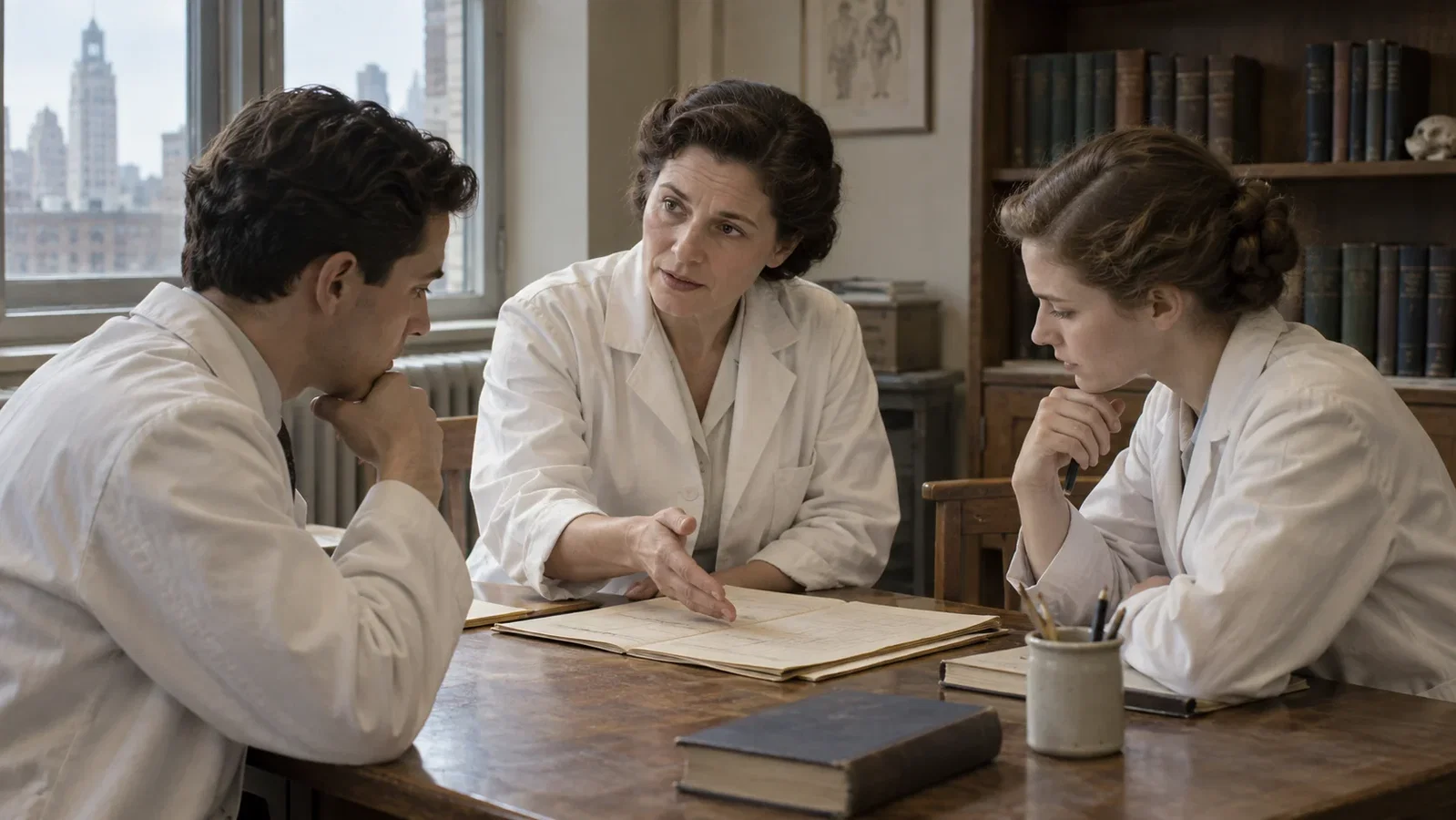
The later description “Mother of Obstetrics Anesthesiology,” used in a New York State Society of Anesthesiologists remembrance, belongs to the assessment of her career.[4] It is not a job title from 1955 or a claim that she invented regional anesthesia. In Oransky’s interviews, Gerard Bassell described her contribution as promoting regional techniques while recognizing their complications, including hypotension.[1]
One of Bassell’s own recollections makes the teaching tangible. Marx expected residents to take responsibility when a block failed or a woman remained in pain despite an epidural. Blaming the patient was unacceptable. The account preserves a colleague’s memory of her teaching, rather than a transcript of a particular class in 1955.[2, PDF pp. 51–52]
Her own writing helps define what that responsibility involved. Anesthesia-related maternal mortality, published with Jeffrey A. Berman in 1985, began by acknowledging that such deaths still occurred. Its discussion covered hypotension and cardiac toxicity under regional analgesia, then failed intubation and aspiration under general anesthesia. Advocacy for pain relief did not remove the need to examine how anesthesia could harm a patient.[3, pp. 323–329]

The paper provides a specific connection with an earlier episode in this history. Its discussion of acid aspiration names Curtis Mendelson and cites his 1946 paper. That explicit reference supports a link to the 1946: Mendelson Describes Two Patterns of Aspiration Injury. It establishes a later connection in the literature, without establishing personal mentorship or placing the 1985 discussion in 1955.[3, pp. 328, 330]
This was a review and professional argument, originating in a 1983 symposium presentation and published in 1985. Its conclusion called for around-the-clock obstetric anesthesia by specialists who kept up with developments. It did not report a new controlled trial measuring the effect of Marx’s appointment or a service model on mortality. Its management recommendations are historical material, not current clinical instructions.[3, pp. 323, 329]
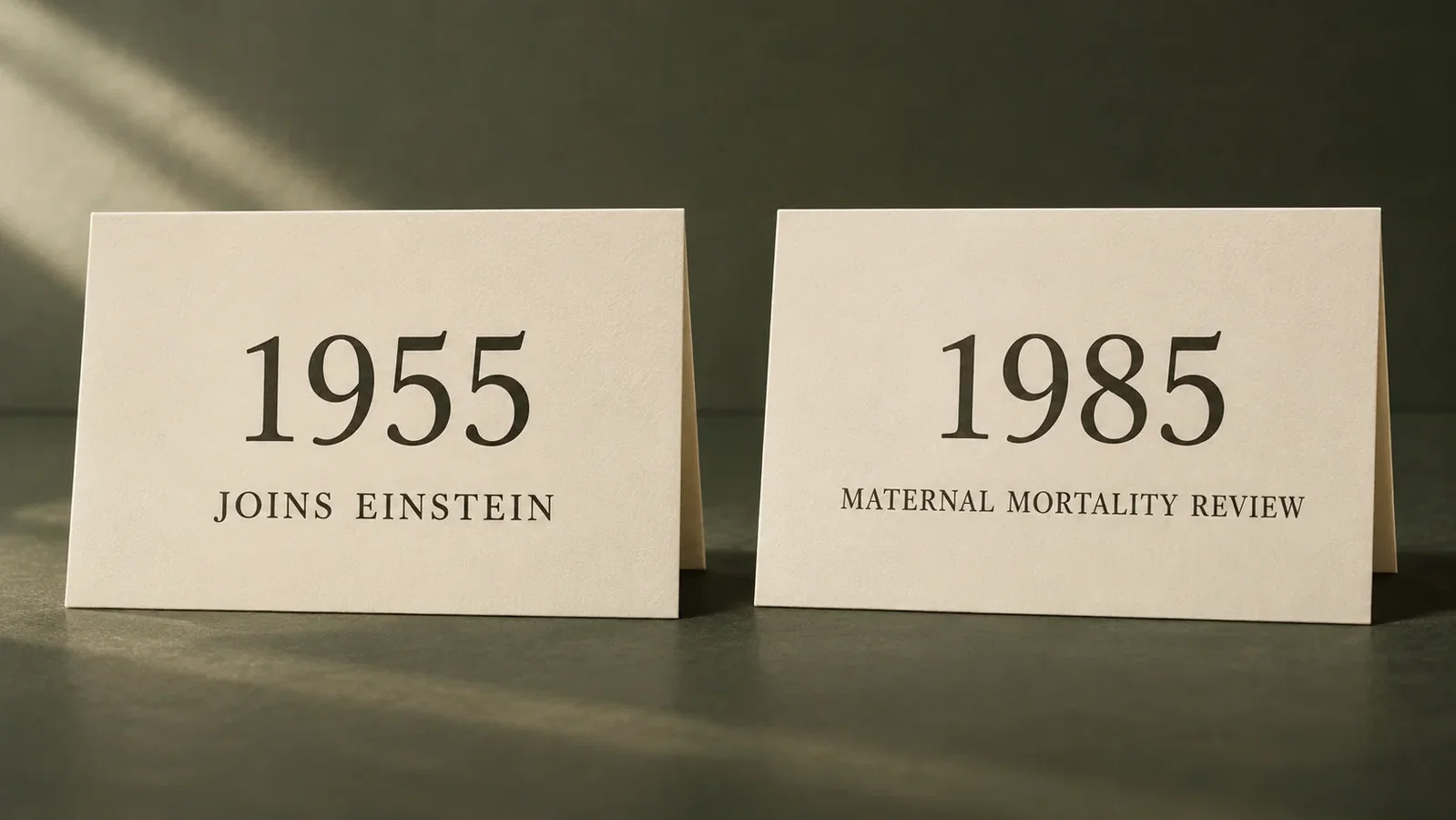
Keeping colleagues informed was another part of her work. The first issue of Obstetric Anesthesia Digest appeared in 1981. Bassell’s account describes Marx preparing abstracts in libraries, typing them and assembling material for publication. This editorial labor extended the work of teaching beyond a hospital discussion; it occurred decades after the appointment that anchors this article.[2, PDF p. 19]

The sources give 1955 a precise role: it marks her arrival at Einstein. Her later paper and colleagues’ recollections supply the detail of a career spent responding to women’s pain, investigating anesthetic risk and helping other physicians follow the literature.
Sources and reading limits
Source note. The Lancet obituary, SOAP booklet and BMJ obituary agree on the 1955 move; the assistant-professor rank is explicitly stated in the Lancet. The appointment letter itself has not been obtained.[1,2,5] Bassell wrote both SOAP sections used here and was interviewed for the Lancet, so these accounts do not represent wholly independent witnesses. All eight original scanned pages of the 1985 paper were read. The WLM’s 1984 interview was identified only in a catalogue; its contents were not accessed. Conflicting dates and needle-design descriptions in later commemorations have not been used to reconstruct additional details.
Image note. All four images are newly generated editorial illustrations. They depict anonymous people and invented settings, without reproducing a portrait, patient record or appointment letter. The 1950s scenes do not reconstruct a documented event; the editing desk and date graphic explicitly include later work.
References
- Oransky I. Gertie Florentine Marx. Lancet. 2004;363(9416):1241. DOI:10.1016/S0140-6736(04)15972-2. Full publisher text read; the author spelling follows the publisher, while PubMed displays Oranksy. Original obituary.
- Society for Obstetric Anesthesia and Perinatology. A Celebration of Forty Years: Milestones and Pioneers We Salute. 2008. PDF pp. 1, 2, 19, 51–52 read. Gerard M. Bassell wrote the OAD history and Marx biography. Official booklet.
- Marx GF, Berman JA. Anesthesia-related maternal mortality. Bull N Y Acad Med. 1985;61(4):323–330. All eight original page scans read; presented December 10, 1983. Original paper.
- Beg T. Dr. Gertie Florentine Marx: The Mother of Obstetrics Anesthesiology (1912–2004). NYSSA Sphere. 2025;77(2). Main text read; used here for the later commemorative title. Society remembrance.
- Lenzer J. Gertie Marx. BMJ. 2004;328(7439):586. Complete PMC HTML obituary read for career cross-checking; its categorical clinical-safety language is not adopted. Original obituary.
Continue exploring
Related reading connects shared questions and contexts; it does not by itself establish historical influence.
The Source Room · About & Editorial Method
Sources and reading limits are stated above. Illustrations are labelled as original source images or AI-made. Historical accounts are educational; they are not current treatment instructions.