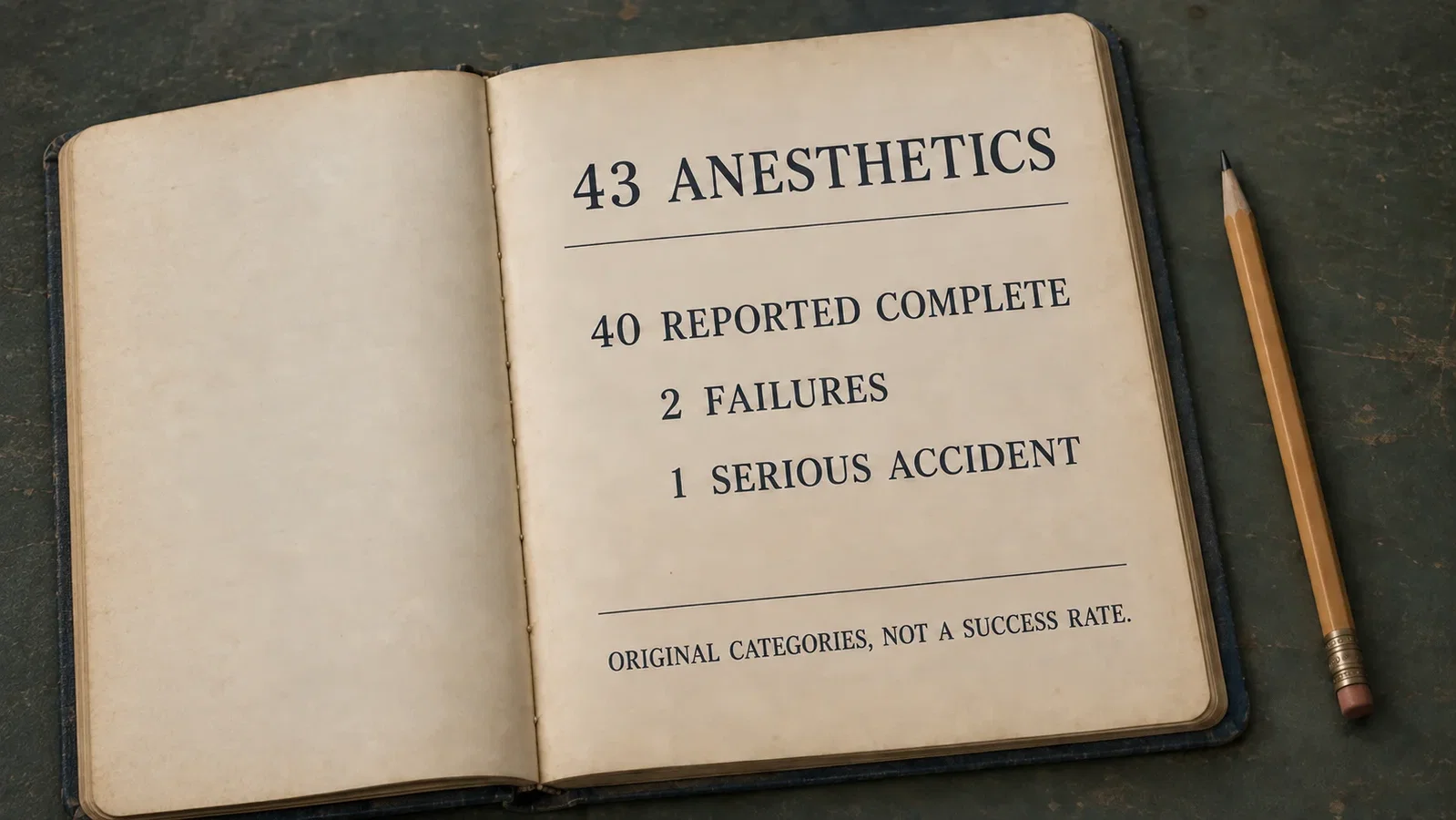
A 1921 report recorded operations, failures and a serious accident together.
Reading Library · Anesthesia Epochs · 中文版
Watch the companion film
1921: Pagés and Metameric Anesthesia · Watch on YouTube
Historical anchor: 1921. Date details and source qualifications are explained below.
A new route mattered only if it could provide the anesthesia an operation required.
In 1921, Fidel Pagés described a way to block spinal nerve roots outside the dura and produce anesthesia in a segment of the body. His report, Anestesia metamérica, went well beyond an anatomical proposal. It described operations, changing sensory boundaries, incomplete blocks and a serious accident. Its final sentence asked for further investigation, not unconditional acceptance.[1]
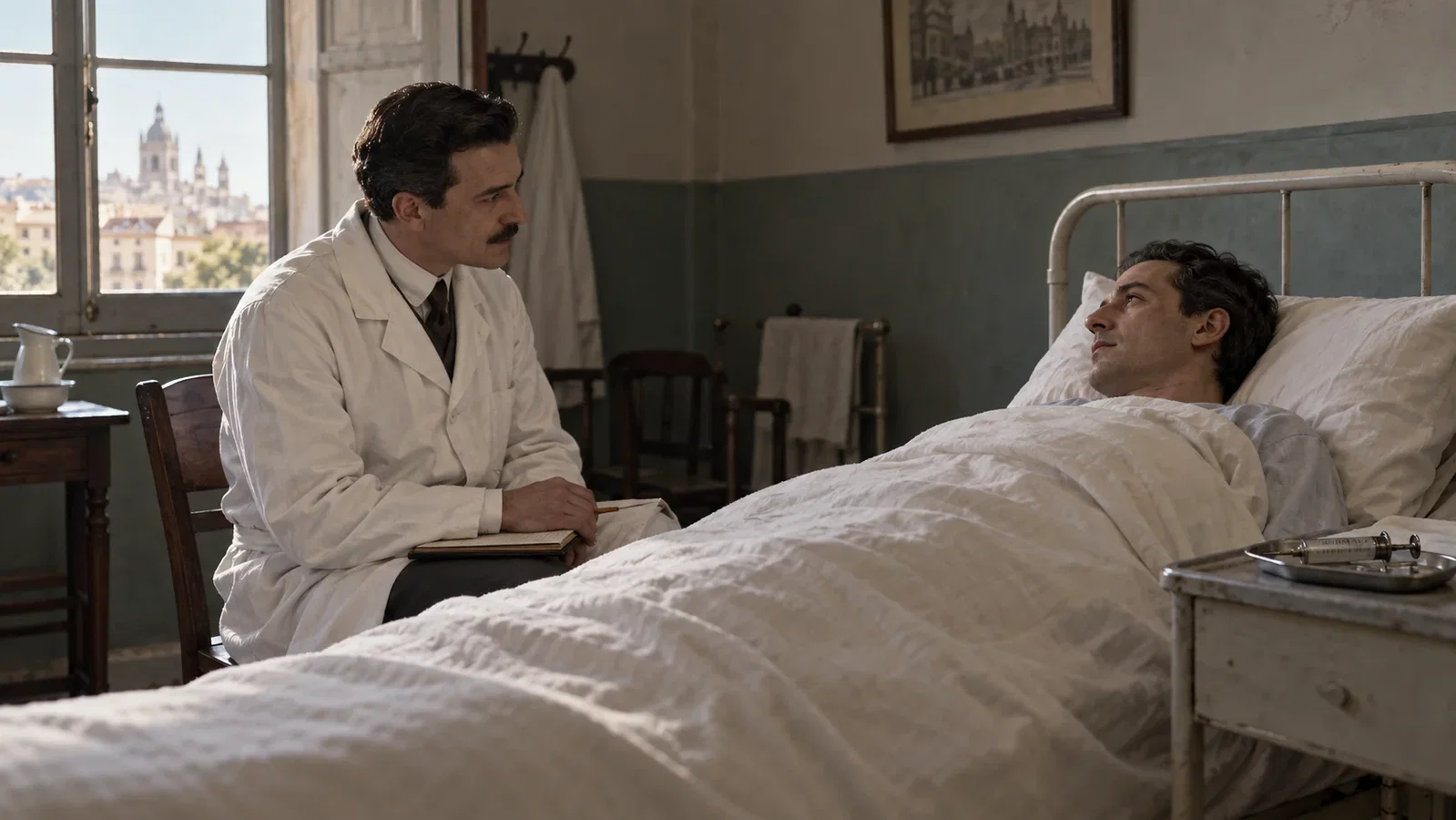
A surgical question, not an empty space
Pagés placed his initial clinical experience in November of the previous year: November 1920. While preparing to perform spinal anesthesia, he considered blocking the roots outside the meningeal space. He reported that the resulting sensory change allowed a right inguinal hernia repair to proceed.[1, pp351–352]
The distribution was important. Sensation diminished in some regions while remaining in others. The name metameric anesthesia expressed the possibility of an anesthetized segment with sensitive regions above and below it. This was a regional objective, not a claim that the patient had to become unconscious.
Nor was the extradural space a place without a history. Pagés discussed the caudal work of Cathelin, Sicard and others, including difficulties extending that approach to operations higher in the body. He also admitted that he had been unable to obtain certain earlier original reports and could not compare their technical details.[1, pp352–355]
The defensible emphasis is therefore not “the first injection of any kind into the epidural space.” It is Pagés's systematic account of thoracolumbar access for segmental surgical anesthesia, with the clinical observations that made the proposal examinable.

Sensory change was not yet operative adequacy
An earlier original report makes the distinction tangible. In 1901, Cathelin described four patients with inguinal hernias whose sensitivity decreased after sacral injections, but not enough to attempt a major operation.[2]
Pagés's report addressed that next question. It described the extent of anesthesia, the operations performed, failures and unwanted effects. His table included 18 inguinal hernia procedures and four operations for appendicitis among a varied series.[1, pp395–396]
These are not two arms of a clinical trial. The comparison does not demonstrate that the exact 1901 paper directly caused Pagés's work. This site records a specific editorial relationship between the articles: sensory reduction versus anesthesia adequate for surgery. A causal arrow would say more than that comparison establishes.
The denominators also need care. Pagés mentioned experience with roughly 1,500 spinal anesthetics. That was his earlier spinal practice, not the size of the epidural series he was reporting.[1, p393]
What the last page actually says
The final summary states that anesthesia was complete in 40 of 43 administrations. It then describes two failures and an alarming cervical-block event. Yet the table on the same page labels the cervical case as complete anesthesia accompanied by an accident.[1, p396]
A modern review summarizes 41 satisfactory cases.[3, p70] That wording should not silently replace the original's 40 complete. Rather than manufacture a single neat success percentage, we can preserve the categories and their limitations. Adequate anesthesia and freedom from a serious complication are different outcomes; the report did not define them as a modern trial would.
The cervical event makes the distinction especially clear. The patient lost consciousness and stopped breathing. Pagés described artificial respiration and the return of spontaneous breathing approximately 40 minutes after the accident began. His proposed explanation was a contemporary hypothesis, not a diagnosis independently established by modern investigation.[1, pp390–391]
Elsewhere, he reported incomplete anesthesia, an error in filling a syringe that preceded unusually extensive sensory block, near-syncope, delayed headache and back pain. Recovery did not make those observations disappear.[1, pp362–365,389–392]
The text also exposes limits in how patients' experiences were interpreted. At times, complaints were attributed to touch, emotion or temperament. We need not endorse those judgments to read the report accurately. A nephropexy patient also received ether; the series cannot be presented as proof that every procedure required no supplementary anesthetic.[1, pp388,396]
Several dates, not one discovery day
The November 1920 experience and the 1921 publication belong to different stages of the story.
The fully read modern review dates the first publication in Revista Española de Cirugía to March 1921. That particular original version was not acquired for this article, so the chronology is explicitly attributed to the review.[3]
The primary text archived and read here is the two-part version in Revista de Sanidad Militar: pages 351–365 in the issue dated June 15, and pages 385–396 in the issue dated July 1, 1921. The second installment is headed “Conclusion” and ends with Pagés's signature. An editorial notice immediately afterward says that the issue appeared late. July 1 is thus an issue date, not a verified day of circulation.[1,5]

Pagés died in 1923. Recognition and dissemination subsequently followed a more complicated path. Chinn and colleagues caution that the intentionality of Dogliotti's initial failure to credit him is unknown. An omission should not be turned into a proven accusation of theft.[4]
That later dispute need not dominate the clinical record. The lasting question in Pagés's paper was whether anesthesia could be organized around the region an operation needed. His answer included a method and a case series, but also failures, hazards and a reason to keep investigating.
Sources and reading limits
- Pagés F. Anestesia metamérica. Revista de Sanidad Militar. 1921;XI(12):351–365;XI(13):385–396. Both complete installments read, including Figures 1–7, the operation table, accidents and conclusion. First-issue facsimile · Archived copy; official second-issue PDF. Digital-copy attribution: Fuente: Biblioteca Virtual de Defensa.
- Cathelin F. Une nouvelle voie d’injection rachidienne. Méthode des injections épidurales par le procédé du canal sacré. Applications à l’homme. Comptes rendus de la Société de Biologie. 1901;53:452–453. Both original pages freshly re-read in the previously archived volume. Original volume.
- Beleña JM, Núñez M. Fidel Pagés, el auténtico descubridor de la anestesia epidural, en el centenario de su publicación Anestesia metamérica (1921-2021). Rev Mex Anestesiol. 2023;46(1):67–72. All six pages, figures/captions and references read; a historical review, not a substitute for the 1921 original. Full article.
- Chinn GA, Gray AT, Larson MD. Overcoming Obstacles: The legacy of Fidel Pagés, founder of the epidural, 100 years after his passing. Anesth Analg. 2024;138(2):475–479. DOI:10.1213/ANE.0000000000006706. Online December 4, 2023. Complete PMC author-manuscript HTML text, captions and references read; not a publisher-PDF or embedded-image reading claim. Author manuscript.
- Biblioteca Virtual de Defensa. Official catalogue records for the issues dated June 15, 1921 and July 1, 1921. Saved and read for issue identity, institution and digital-copy rights.
All four images are modern historical or conceptual illustrations, not photographs of actual patients, original pages or authenticated instruments, and not clinical instruction.
Continue exploring
Related reading connects shared questions and contexts; it does not by itself establish historical influence.
The Source Room · About & Editorial Method
Sources and reading limits are stated above. Illustrations are labelled as original source images or AI-made. Historical accounts are educational; they are not current treatment instructions.