In Oxford around 1656, Christopher Wren helped inject opium dissolved in wine into a dog's vein; Boyle's 1663 account describes deep stupor and recovery, which opened a route into the blood but did not yet amount to a surgical anesthetic.
Reading Library · Anesthesia Epochs · 中文版
Watch the companion film
1656: Wren and the Intravenous Route · Watch on YouTube
Historical anchor: 1656. Date details and source qualifications are explained below.
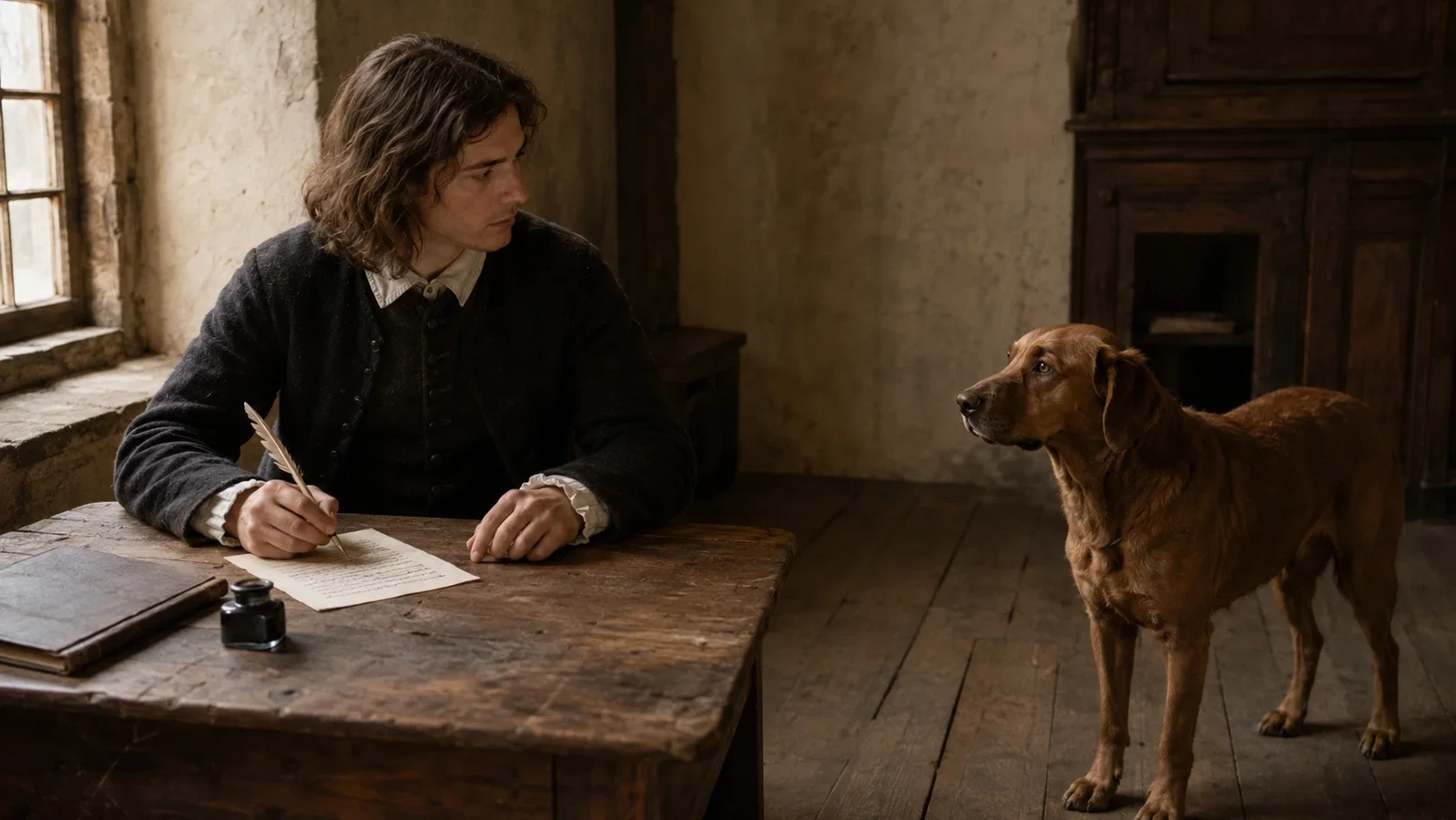
(Figure 1) Observation, not a surgical triumph. This original historical imagining shows neither an authenticated portrait nor an identified room. It is not the injection scene, and the standing dog must not be taken to imply painless preparation for the experiment.[1,3]
The date usually attached to Christopher Wren's intravenous experiment is 1656. The account you can actually open, however, may be a book printed in 1663 or a report published in 1665. That distinction is a good place to begin. The experiment, its narration, and a later defense of its priority are not interchangeable pieces of evidence.[1–3]
Nor are an injection and a surgical anesthetic the same achievement. Robert Boyle described a dog becoming unsteady and profoundly stuporous after receiving opium dissolved in wine through a vein. He also reported its recovery. What he did not describe was a reliable method of maintaining anesthesia for an operation. Wren had helped turn a route into the circulation into an experimental tool. The clinical destination remained open.[1]
What the original account lets us see
Boyle's account appears in a four-page Postscript to the second essay in Part II of Some Considerations Touching the Usefulnesse of Experimental Naturall Philosophy. In the 1663 copy read for this article, those are printed pages 62–65. They contain considerably more friction than a neat invention story suggests.[1]
Wren first raised the possibility of conveying liquids directly into the blood in conversation with Boyle and John Wilkins. Boyle supplied a large dog; physicians and other learned men witnessed or assisted with the work. Proposal, provision, manipulation, and observation belonged to a small circle of participants, not to a solitary inventor working without help.[1, p.62]
The idea made sense within a world in which the circulation of blood could be used to explain the movement of substances through an animal. Boyle explicitly invoked that circulation when discussing how the injected liquid could reach the brain and other parts rapidly. We can follow his reasoning without crediting him with a modern, experimentally measured pharmacokinetic model.[1, p.63; 4, p.334]
The Wren of this episode is therefore worth meeting before the familiar architect eclipses him. W. C. Gibson's historical account places instrument-making, anatomy, and biological inquiry within his early intellectual life. Practical skill with an apparatus was not a diversion from his interests; it was one way of pursuing them.[4]
A device changed while the experiment was changing
The initial vascular access was not a needle passing through intact skin. Boyle described opening the tissues of the hind limb, exposing a vessel, stabilizing it with a small brass plate, and introducing the slender pipe of a syringe into an opened vein. The dog struggled, and blood loss was difficult to avoid. Its subsequent stupor cannot be moved backward in time to make that preparation painless.[1, pp.62–63]
Only afterward does the narrative explain that the plate proved unnecessary in further attempts and that a quill attached to a bladder was more convenient than a syringe. The familiar quill-and-bladder image belongs to this later modification. It should not silently replace the apparatus first described.[1, pp.63–64]
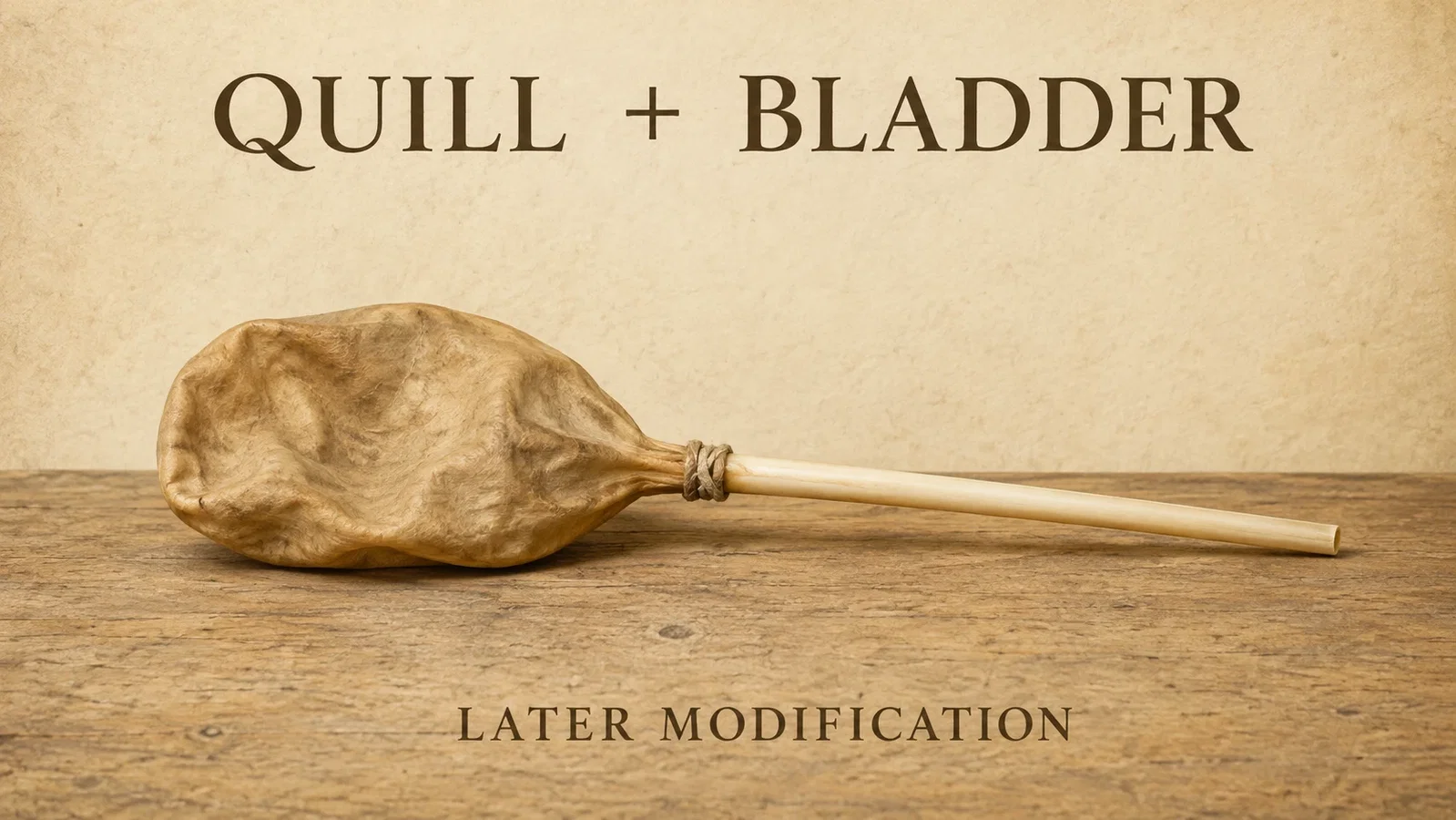
(Figure 2) A later apparatus, reconstructed conceptually. Boyle distinguishes the quill-and-bladder modification from the initially described syringe. This is not a surviving Wren artifact, an exact reconstruction of every component, or a usable administration guide.[1, pp.63–64]
That is more than an antiquarian distinction. If successive devices become one polished object in an illustration, an evolving and difficult experiment starts to look like a completed technology. The surviving description does not establish the complete design of an authenticated syringe that an illustrator could simply reproduce.
The injected substance also needs its own historical name. Boyle specified opium dissolved in sack, a kind of wine explained in the later Oxford study. This was not purified morphine prepared to modern standards. His account does not provide the standardized dose and preparation data needed to turn the episode into a reproducible dosing method, and this article supplies no such instructions.[1, p.63; 3, p.136]
A recovering dog is an observation, not a safety trial
Once released, the dog nodded, reeled, and became so stuporous that its survival appeared uncertain. Boyle wanted it kept alive for further observation and ordered it driven about the garden by whipping. Recovery followed, and later care brought weight gain.[1, p.63]
The sequence must be recorded without rehabilitating the harmful intervention. An animal recovering after being whipped does not establish that whipping was an effective treatment. It is a historical action in the account, not a recommendation or a controlled causal finding.
Boyle also supplied an unusually concrete limit to follow-up: after this and other experiments had made the dog well known, it was stolen. He could no longer observe it. Recovery and later weight gain are therefore reportable observations; an exact follow-up interval, a verified lifetime outcome, or systematic evidence of long-term safety would be additions that the passage does not support.[1]
Equally important is what the account never reports: an operation performed under the drug's effect, a modern assessment of responses to painful stimulation, or a complete scheme for monitoring respiration, anesthetic depth, and recovery. There was observation of recovery, but not an established clinical monitoring system. Profound drug-induced stupor is not, by itself, proof of dependable surgical anesthesia.
Why three dates stay on the page
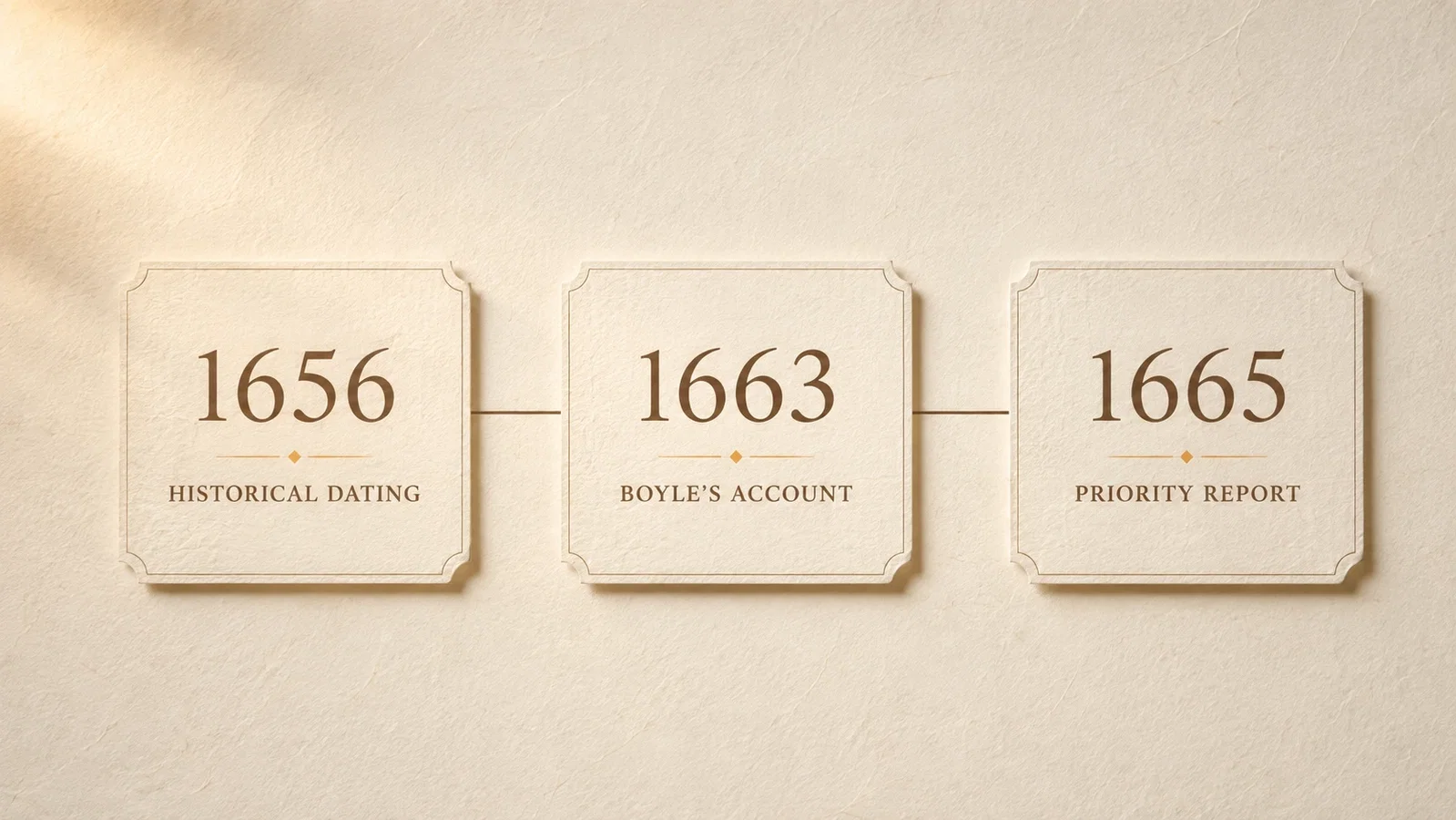
(Figure 3) Dating an experiment and dating its publications are different tasks. These are modern editorial cards, not facsimiles of seventeenth-century documents. The year 1656 is a historical reconstruction, not an exact procedure date recovered from an operative record.[1–3]
Keith Dorrington and William Poole's 2012 University College article discusses both Boyle's move to Oxford in the winter of 1655–56 and correspondence identified as a June 1656 letter from Wren to William Petty. These support the historical placement in 1656. An approximate March date discussed there is a further inference, not a date entered in a surviving procedure log. The original letter manuscript was not inspected for this article; its use here is mediated by the historical study.[3, p.131]
The same restraint applies to place. Oxford is defensible; an exact room is not. The case for Deep Hall is circumstantial, and the Oxford authors distinguish known evidence from later imaginative additions involving a doorway, an apron, and a dog bought that morning. This article therefore names the city, not the room where the experiment took place.[1–3]
The three-page Philosophical Transactions report of 4 December 1665 has a different purpose. Its opening responds to foreign publications, and its ending defends Wren's priority and Oxford's role. It is valuable contemporary testimony, but its rhetorical task matters. Its own reference to events at least six years earlier cannot independently yield 1656, still less adjudicate every possible predecessor around the world.[2]
Even its page reference needs checking. It directs readers to Boyle's Part II, pages 53–55. The relevant Postscript in the 1663 edition is actually on pages 62–65. We preserve that discrepancy instead of inventing a reason for it or reproducing a citation that does not land in the original.[1,2]
The route admitted danger as well as possibility
In another experiment described in the same Postscript, a dog receiving a large quantity of crocus metallorum died. That was a different dog, substance, and outcome, not a second ending to the opium story. Opening access to blood did not make everything delivered through it safe or therapeutic.[1, p.64; 2, p.129]
The human anecdote is narrower still. Boyle relayed a foreign ambassador's account of an attempt involving the ambassador's servant. A swoon, described as possibly genuine or feigned, interrupted the procedure. A separately reported bowel action might, Boyle suggested, have resulted from fear or distress; that is neither a diagnosis of the swoon nor secure evidence of a drug effect. Neither this account nor the 1665 report names the people performing that attempt. They do not establish Wren as its operator, successful human anesthesia, or freely informed consent in a modern sense.[1, pp.64–65; 2, p.129]
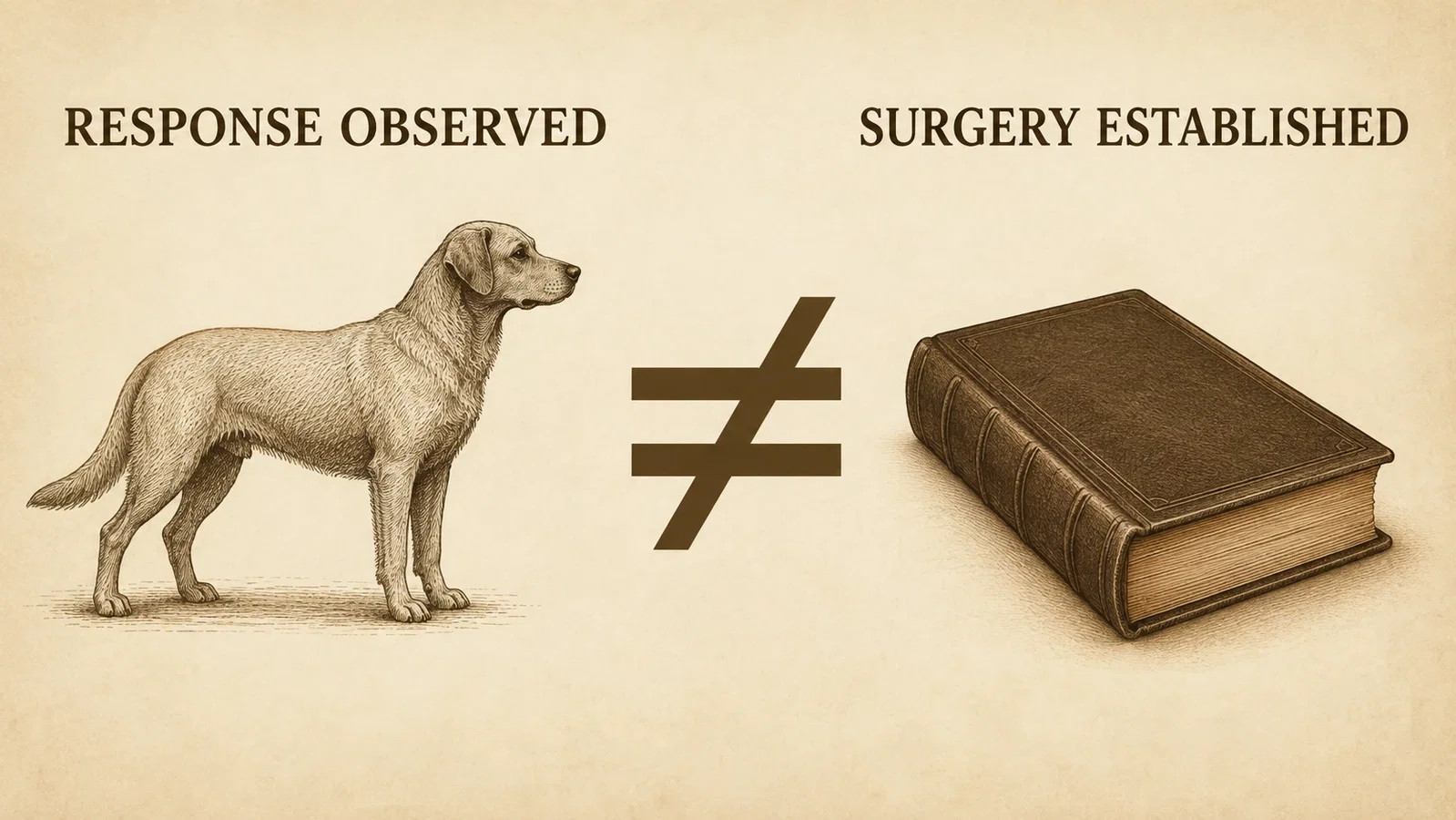
(Figure 4) A response does not establish a clinical method. The closed book is an editorial symbol for an organized body of practice, not a claim that an anesthetic textbook existed in 1656. No human surgical success is inferred from the animal account.[1,3]
Dorrington and Poole consider several possible reasons why the experiment did not rapidly become a surgical technique: difficult vascular access, dose control, respiratory danger, the investigators' purposes, and the conceptual setting. These are retrospective interpretations, not a single cause isolated by evidence. They cannot demonstrate that safe, painless surgery was simply available to be adopted almost two centuries before it was.[3, pp.139–142]
Nor should this episode be relabeled transfusion. Introducing drugs or other liquids and transferring blood from a donor to a recipient are related but distinct historical lines. The later donor, recipient, and transfusion outcomes do not belong in a picture of the 1656 experiment.[1,2,4]
Wren and Boyle made a route testable and left observations that could be argued over, repeated, or revised. Keeping that achievement separate from an established surgical anesthetic does not diminish it. It lets us see the work that a striking animal response had not yet done.
Sources and reading limits
- Boyle R. Some Considerations Touching the Usefulnesse of Experimental Naturall Philosophy. Oxford: H. Hall for R. Davis; 1663. Part II, Essay II, Postscript, printed pp.62–65. All four original scan pages were read. The whole book was not read.
- Anonymous, attributed to Henry Oldenburg in the later Oxford study. An Account of the Rise and Attempts, of a Way to Conveigh Liquors Immediately into the Mass of Blood. Philosophical Transactions. 1665;1(7):128–130. 4 December. The complete three-page scan was read page by page. A priority defense is not a neutral global-first adjudication.
- Dorrington KL, Poole W. Robert Boyle, the First Intravenous Anaesthetic, and the Site of the Shelley Memorial. University College Record. 2012:128–143. The complete 16-page article, including figures and footnotes, was read within the 200-page issue. The 2013 BJA journal-layout full text is not covered and is not counted as independent corroboration.
- Gibson WC. The bio-medical pursuits of Christopher Wren. Medical History. 1970;14(4):331–341. All 14 pages, including three illustration inserts, were read. Reading its quoted correspondence is not inspection of the original letter manuscript.
Images are original historical imaginings or editorial explanations. This is medical history and source criticism, not guidance for animal experimentation or clinical drug administration. Sources and reading limits are stated above. Illustrations are labelled as original source images or AI-made. Historical accounts are educational; they are not current treatment instructions.
Continue exploring
Related reading connects shared questions and contexts; it does not by itself establish historical influence.
- 1628: Harvey Connects the Outward and Returning Paths of Blood
- 1853: Wood and Pravaz, Similar Instruments for Different Questions
Anesthesia Epochs · The Source Room · About & Editorial Method