Anesthesia Epochs
About this film
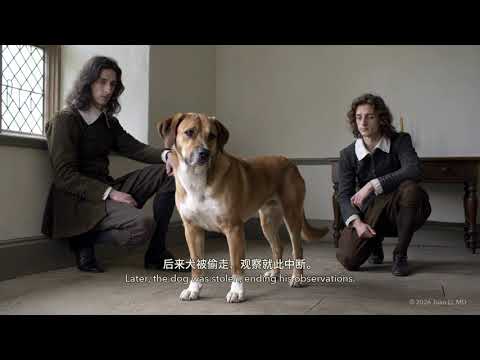
Oxford, around 1656. Christopher Wren and Robert Boyle explored a route for conveying substances directly into the blood. The surviving account describes a dog becoming stuporous and later recovering, but it does not establish reliable surgical anesthesia. This film follows the experiment, the later printed accounts, and the distinction between an early apparatus and subsequent modifications. A route into the circulation had opened; the meaning and limits of the observed response still required interpretation.
Read the companion essay · 1656: Wren Opens a Route into the Blood
Scientific takeaway
Demonstrating a route for drug delivery does not, by itself, demonstrate reliable surgical anesthesia.
Sources
- Boyle R. Some considerations touching the usefulnesse of experimental naturall philosophy. Oxford: H Hall for R Davis; 1663. Part II, Essay II, Postscript. pp.62–65. Read the cited edition
- An account of the rise and attempts, of a way to conveigh liquors immediately into the mass of blood. Philos Trans.1665;1(7):128–130. doi: 10.1098/rstl.1665.0057. Publisher record (access may be restricted)
- Dorrington KL, Poole W. Robert Boyle, the first intravenous anaesthetic, and the site of the Shelley Memorial. University College Record. 2012:128–143. Read the cited edition
Notes on reconstruction
People, the dog, equipment details, rooms, and dialogue are reconstructed; the initial apparatus and later modifications are kept distinct.
Read beyond the film
1656: Wren Opens a Route into the Blood
Explore the longer account, original references, reading limitations and connected stories.