In 1824 Hickman published six animal experiments using confined air or carbon dioxide, argued that operations could be made painless, yet would not recommend that a patient risk it.
Reading Library · Anesthesia Epochs · 中文版
Watch the companion film
1824: Hickman’s Animal Experiments · Watch on YouTube
The heading was not subtle: “Surgical Humbug.”
On 4 February 1826, a correspondent signing as Antiquack used the pages of The Lancet to attack Henry Hill Hickman's proposal for painless operations. The letter questioned his judgment, suspected commercial motives and treated his professional standing as fair game. It is easy to find the cruelty in this response. It takes a little more patience to identify the questions buried inside it.[2, pp. 646–647]
What happened to an animal before it stopped responding? Was the absence of an apparent reaction evidence that pain had been prevented? And if the method was so safe, why would its author hesitate to recommend that a patient undergo it?[2, p. 647]
These questions take us back to 1824. Hickman's place in anesthesia history is not best understood as a contest between an inspired doctor and an entirely foolish critic. His pamphlet contains a serious effort to investigate surgical suffering. It also contains a substantial distance between the observations he described and the human application he hoped to establish.
The operation as a problem to investigate
Hickman began with fear. A patient could trust a surgeon and understand the necessity of an operation while still recoiling from the pain ahead. He wanted something more useful than an instruction to endure it. Might a temporary alteration in the patient's condition change what surgery felt like?[1, pp. 5, 7–8]
His phrase was “suspended animation.” It belongs to the vocabulary of the period, not to a modern anesthesia chart. He proposed studying animals in a state of reduced or absent apparent responsiveness, observing interventions and subsequent recovery, then considering whether the approach could help people.[1, pp. 7–14]
The printed pamphlet offered six experimental summaries. They involved restricted access to atmospheric air or carbonic-acid gas, the historical name for carbon dioxide. They did not constitute a report of nitrous-oxide surgery. A history of inhalation loses an important distinction if every gas is allowed to stand in for every other one.[1, pp. 9–11]
There was more in the summaries than a moment of stillness. Hickman discussed respiration, apparent responses, bleeding, wound changes and later activity. He compared conditions and described returning to animals after an earlier intervention. Yet six summaries do not mean six independent subjects, and the selected reports do not supply a complete denominator from which a reliable success rate can be calculated.[1, pp. 8–13]
The experiments involved injuring animals. That fact should not disappear behind an attractive story of discovery, although there is no need to turn a historical account into a set of repeatable instructions. Hickman defended himself by saying the animals were already destined to die and by appealing to possible human benefit. Those were his stated reasons, not an independent ethical assessment or proof that no suffering occurred.[1, pp. 8–11]
Recovery did not settle the question
The pamphlet's observations were not uniformly favorable. In the third printed summary, Hickman described a less satisfactory result, including bleeding, inflammation and slower healing. Another summary included later inflammation and suppuration. To say that every wound healed without difficulty would be to improve the experiment retrospectively, even beyond the author's own account.[1, pp. 10–11]
His report of an animal's subsequent growth was likewise an observation, not a general safety guarantee. A return of movement cannot by itself establish the absence of earlier distress. Nor can apparent insensibility, without additional evidence, tell a reader everything about subjective pain. Those are limits of what the historical observations can demonstrate; they are not modern measurements secretly available in the pamphlet.[1, pp. 9–14]
This matters particularly because the work involved interfering with breathing. The gap between making a subject unresponsive and establishing controllable, safe anesthesia is not a technicality to be removed for the sake of a better ending. It is central to deciding whether the proposed intervention can be justified in a person.
Hickman nevertheless moved from the reported animal findings toward confident predictions about operations on humans. He anticipated less fear, greater ease for the surgeon and less bleeding. Then, near the end, he pulled back: he could not conscientiously recommend that a patient risk life in the experiment. His willingness to volunteer if he himself needed a long or severe operation was conditional. It was not a report that he had already tested the method on himself.[1, pp. 11–14]
Both the confidence and the reservation belong in the story. Removing either changes the author we encounter.
A letter is not necessarily the printed letter
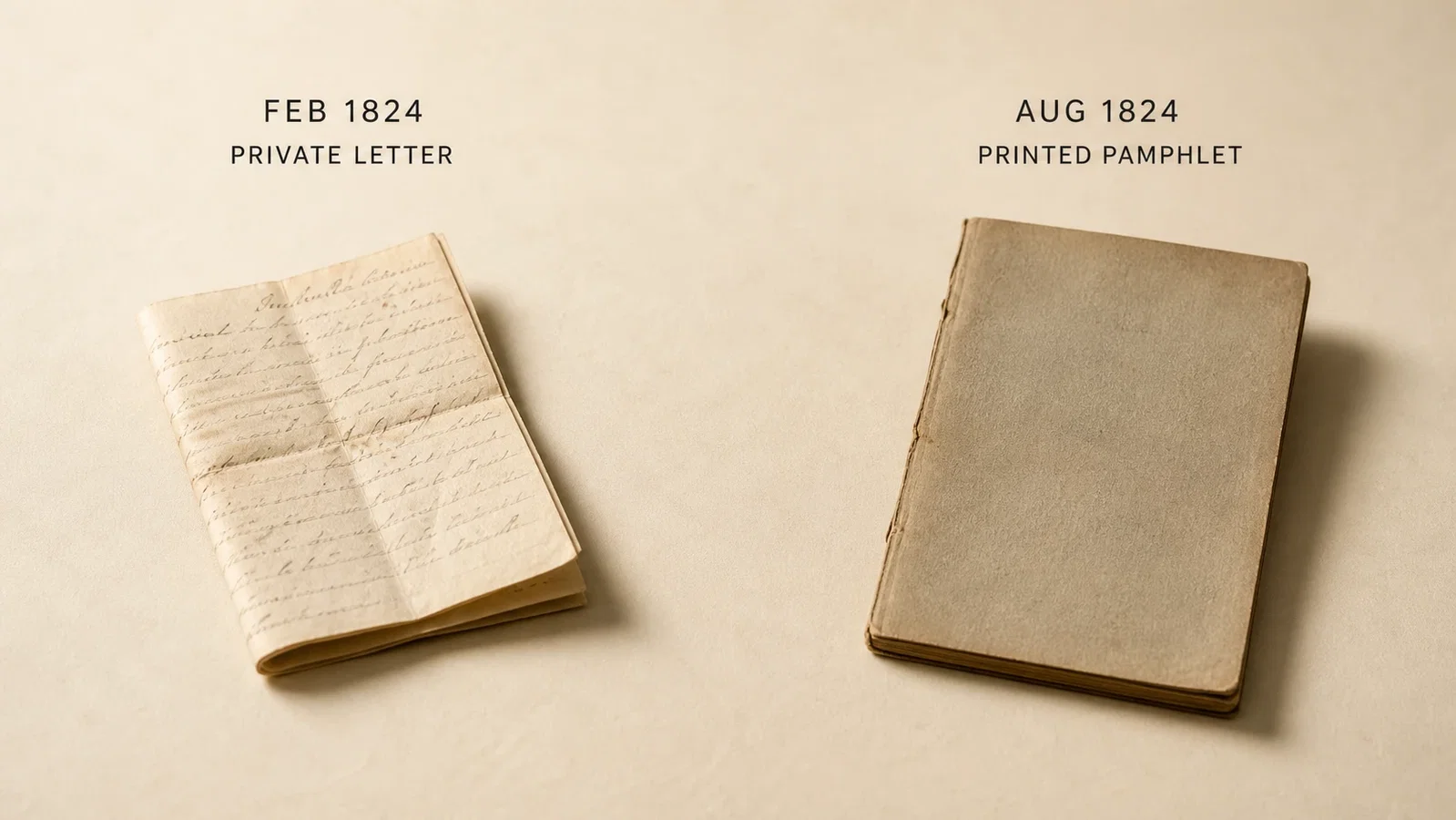
A small bibliographic distinction prevents several larger mistakes. An earlier private letter to Thomas Andrew Knight was dated 21 February 1824 at Ludlow. Its text and accompanying experimental entries were later reproduced in the 1930 Wellcome collection. The published pamphlet's concluding dateline was 14 August 1824 at Shifnal.[3, pp. 23–29; 1, p. 14]
These are different documents. The early record has seven experimental entries, whereas the pamphlet has six summaries with differences in content and order. Their details cannot be combined indiscriminately into a single protocol. Nor does either dateline establish the date of the first experiment. This article therefore uses 1824 as its anchor, without inventing a precise day for the beginning of the work.[1; 3]
The pamphlet's title page supplies another warning about documentary authority. A line claiming that Sir Humphry Davy had read the work before the Royal Society is visibly struck through in the surviving scan. The title also describes Knight as a president of the Society. A footnote in the 1930 collection corrects that description: he was a Fellow, not its president. An institution's name on a title page is not sufficient evidence of institutional endorsement.[1, title page; 3, p. 23]
Read the hostile letter without adopting its verdict
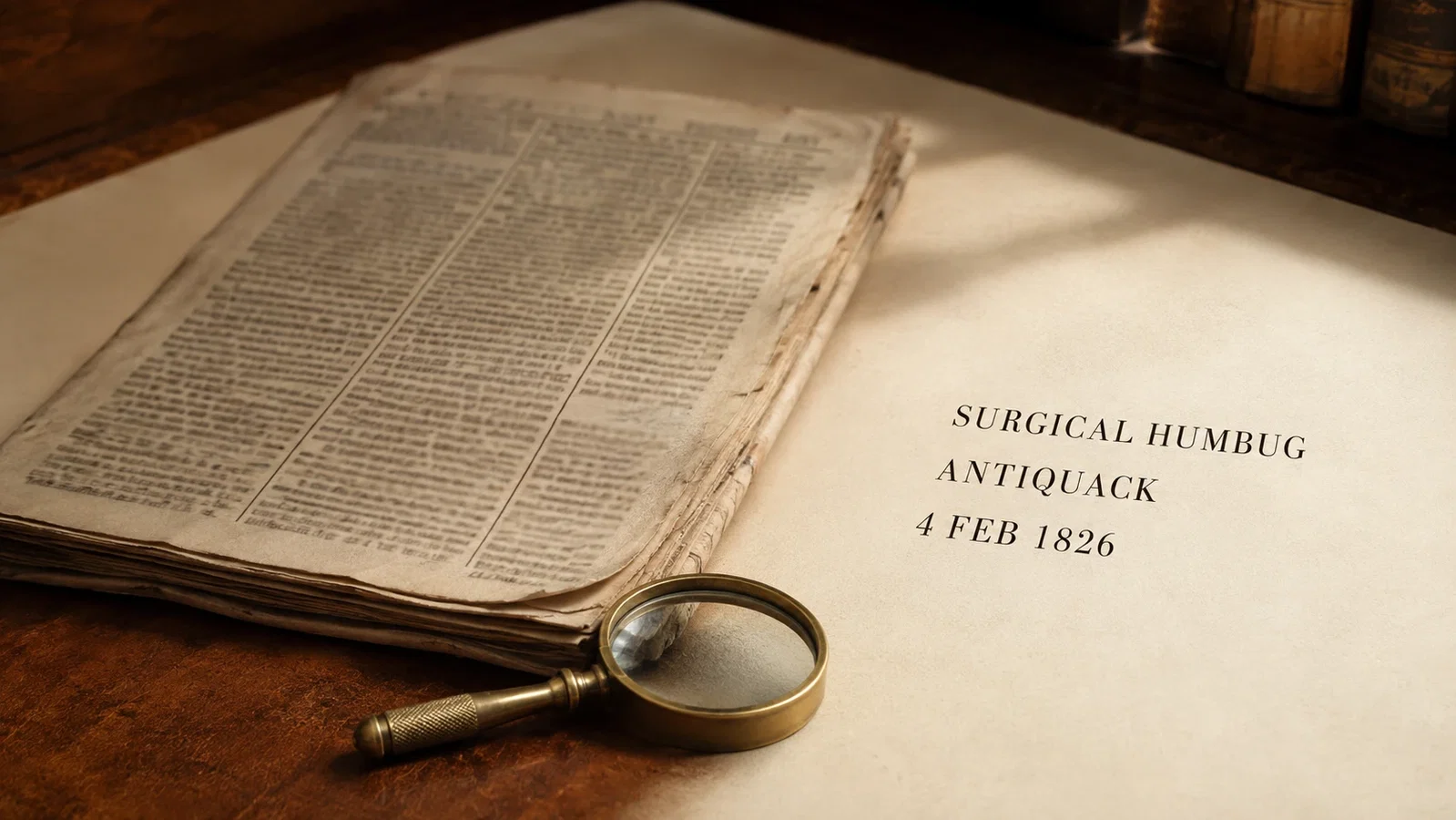
The original Lancet issue identifies itself as No.127, Vol.IX, dated 4 February 1826. The criticism occupies pages 646–647. The scanned page therefore resolves the month directly; a later September date is not followed here. Antiquack is the signature we can verify, not an invitation to assign the letter to a famous editor without evidence.[2]
Its attack was personal as well as medical. The writer suspected an advertisement masquerading as science and suggested that the public was being exploited. Those accusations were not established facts simply because a journal printed them.[2, pp. 646–647]
But the correspondent also raised specific objections: the harmful effects of breathing fixed air, distress before insensibility, postoperative pain and inflammation, and the discrepancy between Hickman's safety assurances and his reluctance to expose a patient to the risk.[2, p. 647]
Acknowledging these questions does not require accepting every physiological belief or insult in the letter. It reports no new experimental replication. One correspondent cannot stand for the entire profession. Still, the existence of this response means that the proposal was not met only with silence, and its concerns cannot be answered simply by pointing to the later success of other forms of anesthesia.
History need not choose between endorsing the insult and endorsing the experiment.
The patient remained on the other side of an analogy
In 1828 Hickman appealed to Charles X in Paris. The petition reproduced in the Wellcome collection describes animal work and argues by analogy for benefits in humans. It asks for the cooperation of medical and surgical experts to advance the investigation. It does not describe a successfully anesthetized human patient.[3, pp. 37, 39, 41]
Receipt, referral and clinical demonstration are different events. The reproduced administrative material supports the handling of his request, not royal certification of safety. The collection itself acknowledges that the final commission report had not been located. A missing report cannot be treated as a document whose complete conclusion we have read.[3, pp. 43–45]
Later remembrance brought its own hazards. Symons's archival study describes the 1911–1912 recovery of documents and the conflation of the early letter with the subsequently recovered pamphlet. A desired account of pioneering discovery could shape the reading of the evidence. His study helps distinguish the history of the experiments from the history of their rediscovery.[4, pp. 103–106]
The 1930 commemorative foreword celebrated Hickman's courage and treated the work as a remarkable anticipation of the future. We can use that volume to read reproduced documents without accepting its praise as retrospective physiological validation.[3, pp. 13–17]
What remains is neither a completed human anesthetic nor an empty curiosity. Hickman tried to make surgical suffering an experimental question. He recorded observations, pressed an analogy further than those observations warranted, and left a reservation at the point where a patient would bear the risk.
That unfinished passage is his contribution to this part of the story. A proposal can matter before it becomes a dependable practice. Remembering the difference does not diminish the ambition; it preserves the work still required before ambition can safely reach the patient.
Sources and reading limits
- Hickman HH. A Letter on Suspended Animation. Ironbridge: W. Smith; 1824. Read in full: title page, preface and letter. Gutenberg 58071 is a transcription of the same work, not an independent witness.
- Antiquack [pseudonym]. Surgical Humbug, original issue. The Lancet. 4 February 1826;IX(127):646–647. DOI 10.1016/S0140-6736(02)92183-5. Read in full, with the dated masthead. Publisher digital metadata uses volume 5; the citation here keeps the original IX.
- Wellcome Historical Medical Museum. Souvenir: Henry Hill Hickman Centenary Exhibition 1830–1930. London: Wellcome Foundation; 1930. Read: foreword (pp. 13–17), early letter and experiment record (pp. 23–29), petition (pp. 37–41) and archival discussion (pp. 43–45); not the rest of the volume. Reproduced documents and the 1930 commentary are kept apart; the manuscript was not independently authenticated.
- Symons J. The Quest for Hickman. Medical History. 1999;43(1):95–107. DOI 10.1017/S0025727300064735; PMID 10885135. Read in full. Archival scholarship, not a clinical validation study.
Continue exploring
Related reading connects shared questions and contexts; it does not by itself establish historical influence.
- 1800: Davy's Nitrous Oxide and Surgery in the Conditional
- 1842: Crawford Long Operates Before Publishing
- 1846: The Ether Dome, a Breakthrough Without a Perfect Moment
- 1923: Waters Keeps the Anesthetic and Removes the Carbon Dioxide
Anesthesia Epochs · The Source Room · About & Editorial Method
Sources and reading limits are stated above. Illustrations are labelled as original source images or AI-made. Historical accounts are educational; they are not current treatment instructions.