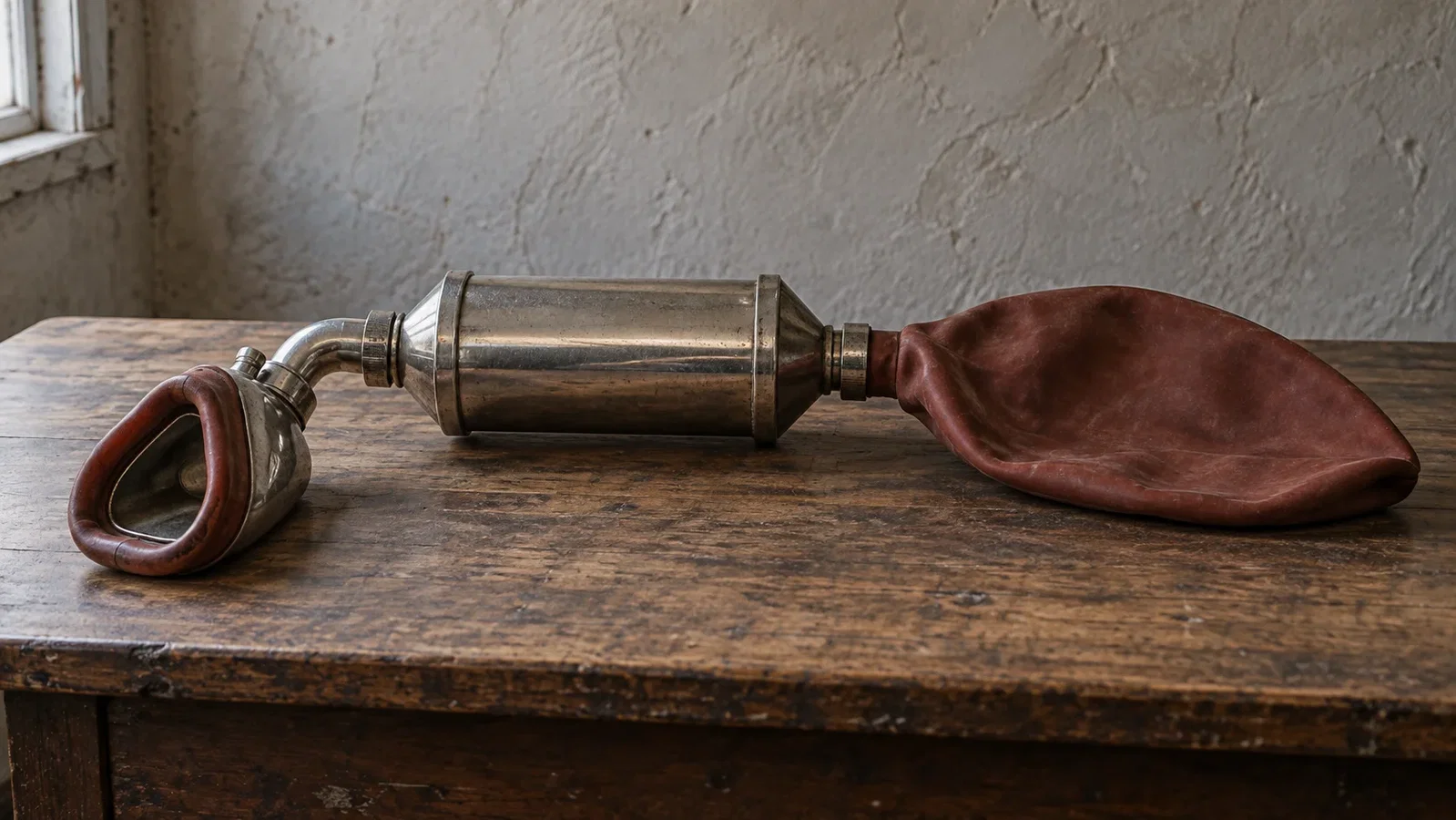
A simpler mask, absorber and bag—with oxygen supply and airtightness still essential.
Reading Library · Anesthesia Epochs · 中文版
Watch the companion film
1923: Waters and the CO2 Absorber · Watch on YouTube
Historical anchor: 1923. Date details and source qualifications are explained below.
The gas that left a patient still contained anesthetic. Why discard it?
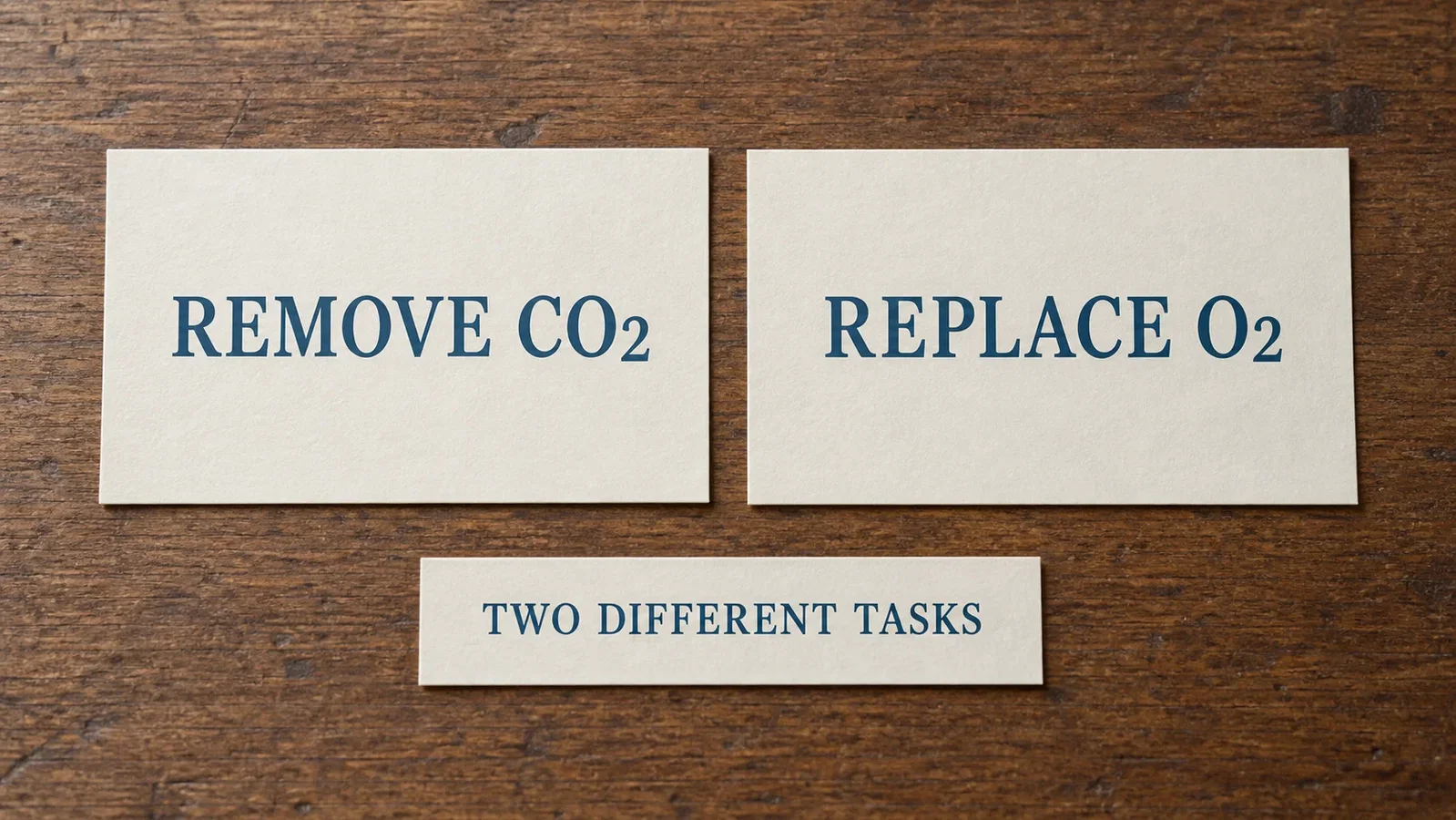
Reusing it meant dealing with two different problems: carbon dioxide returned in the expired breath, while the body continued to consume oxygen. Ralph M. Waters's solution was not simply to send the same gas around again. It separated what could be retained, what had to be removed and what had to be replenished.[1, reprint pp 1–3]
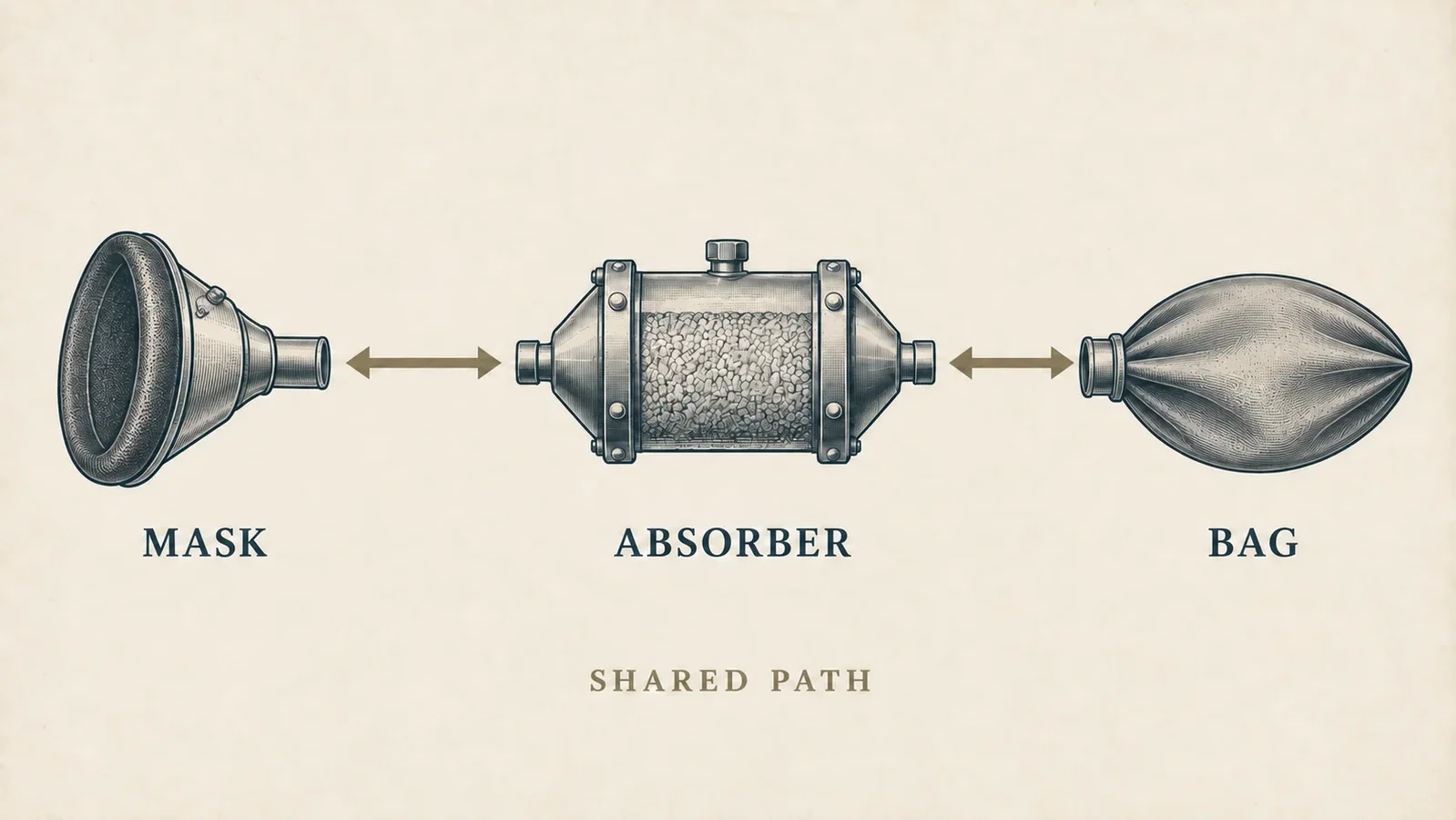
The hardware was modest: a mask, a canister of granular soda lime and a rubber breathing bag. Its importance lay in how those parts worked together.
A shared path, not a circle
In his 1924 report, Waters described experimenting with complicated valves, tubing and motors before choosing a simpler arrangement. The absorber sat between the face mask and the breathing bag. Anesthetic gas and oxygen came from an additional supply.[1, reprint pp 1–2 and diagram]
Expired gas traveled through the absorber toward the bag; inspired gas returned along the same path. That back-and-forth route explains “to-and-fro.” It should not be illustrated as the separate inspiratory and expiratory limbs of a circle system.
The original diagram also showed wire gauze holding the granules in place and a sampling stopcock. Waters's preference for dispensing with complicated valves does not mean that the drawing contained no stopcock, or that valves can be removed from modern anesthesia equipment. This is an account of a historical design, not an assembly guide.
A restrained claim about economy
Waters offered an attractive theoretical proposition: with metabolic oxygen requirements supplied, the anesthetic gas in the apparatus could be reused indefinitely. He immediately qualified it. In practice, air leaks might make emptying and refilling necessary.[1, reprint p 2]
“One charge forever” would therefore be a misleading summary of his report.
He discussed reduced anesthetic waste and odor, and retention of heat and moisture. Yet the hospital-use conclusion was narrower than the list of proposed benefits. At that point, the distinct advantage he said he could affirm was reduced expense.[1, reprint pp 2–4, conclusion 4]
That qualification does not dismiss the other possibilities. It preserves the strength of the author's own claim. His explanation of heat, moisture and rebreathing included a change in his thinking and references to other experiments; the report did not establish each mechanism as a modern causal finding.
Outside hospital, the practical story was more tangible. He described carrying equipment assembled from older parts in his car, with gas cylinders and other components in a bag. It reduced the burden of bringing apparatus into a private home and assembling it there. His weight statement concerned the carried set, not the metal canister alone.[1, reprint p 4]
Simplicity, in this passage, meant less equipment to move and less gas to waste—not the disappearance of every difficulty.
What did 200 records establish?
Waters reported recording pulse and systolic and diastolic pressures every five minutes during 200 anesthetics with the absorber. He compared these with many hundreds of earlier records from partial rebreathing and judged the results similarly satisfactory.[1, reprint p 3]
These were his observations and assessment, not a randomized trial of 200 patients against 200 controls. The account does not supply the information needed to convert that judgment into proof of equivalent safety, a comprehensive complication rate or an absence of harm.
He also described a practical limitation. The apparatus depended on an airtight connection with the airway, so operations involving the mouth or nose prevented its use to full advantage. Leakage at the mask was part of the design problem, not an incidental inconvenience.[1, reprint pp 1,3]
Removing carbon dioxide does not supply oxygen
The cautions in the paper separate several tasks that a compact apparatus could make easy to conflate.
Oxygen had to be supplied and maintained. Absorbing carbon dioxide did not replace oxygen consumed by the body. Absorbent also needed renewal, and water-related caking could obstruct breathing: continued chemical absorption did not by itself establish an adequately open gas path. Bacterial contamination was a further issue, distinct from carbon dioxide removal.[1, reprint p 3]
The paper contained period testing, replacement and sterilization instructions, including practices that cannot serve as a present-day safety standard. Those instructions are not reproduced here. The historical report is not a current clinical guideline.
A specific comparison with Hickman's 1824 text makes the distinction clearer. Hickman described restricting fresh air and using “carbonic acid gas,” or carbon dioxide, in attempts to produce animal unresponsiveness. Waters's arrangement required removing carbon dioxide from rebreathed gas while maintaining oxygen supply.[2, reprint pp 31–35; 1, reprint pp 1–3]
These were opposite purposes for managing the gas. Animal nonresponse did not establish safe human anesthesia; carbon dioxide removal did not solve every respiratory problem. This is an editorial comparison of two original texts, not evidence that Waters was influenced by Hickman or that a single direct line connects their work across a century.
Presented in 1923, published in 1924
The paper's footnote places its presentation during a joint meeting in Chicago on October 22–24, 1923. Its heading identifies publication in Anesthesia and Analgesia in February 1924. The meeting interval does not establish the particular day of the talk, and presentation must not be confused with publication.[1, reprint p 1]
This article consequently retains its 1923 position, using October's meeting as the date anchor rather than claiming a verified invention day or first clinical use. Sioux City, Iowa, appears in the author's byline; Chicago was the meeting location. Those are different kinds of geographical evidence.

The Wood Library-Museum's absorber catalog introduces another distinction: its manufacture dates are estimates, and the bag in its photographic reproduction is not original to the apparatus. A cataloged object, a replacement component and a diagram in the paper should not be treated as interchangeable evidence.[3, catalog and reproduction notes]
Waters's contribution does not require an artificially precise invention date. The short report is revealing because it combines a simpler apparatus with an account of leaks, oxygen supply, caking and contamination.
Keeping the anesthetic was the design goal. Knowing what could not simply be kept with it was an essential condition.
Sources and reading limits
- Waters RM. Clinical Scope and Utility of Carbon Dioxid Filtration in Inhalation Anesthesia. Anesthesia and Analgesia, February 1924. DOI:10.1213/00000539-192402000-00004. Complete WLM 1975 reprint pp 1–4 read, including the diagram/caption, five conclusions and three references. This does not claim inspection of every page in the original issue layout. WLM original-text reprint · Archived copy.
- Hickman HH. Letter on Suspended Animation, 1824. Complete pp 31–35 of the Wellcome 1930 transcription, subsequently collected by WLM in 1975, read with all six experimental narratives and the signoff. A later transcription/reprint of the original work, not a facsimile of the 1824 object. Original-text transcription · Archived copy.
- Wood Library-Museum of Anesthesiology. Waters CO2 Absorber, Access Key aiks, Accession 64-86. Complete website text and catalog record read; not every photograph was inspected. Authoritative museum record.
All four images are modern historical reconstructions or editorial concepts, not specimen photographs, original journal facsimiles or usable clinical diagrams.
Continue exploring
Related reading connects shared questions and contexts; it does not by itself establish historical influence.
- 1824: Hickman's Animal Experiments Toward Painless Surgery
- 1948: Leigh and Belton Organise Pediatric Anesthesia in Print
- 1952: Copenhagen Turns Respiratory Rescue into Continuous Care
- 1958: Vermeulen-Cranch's Professorship Gives Anesthesia a Departmental Base
- 1964: Carlos Parsloe and the São Paulo Congress
The Source Room · About & Editorial Method
Sources and reading limits are stated above. Illustrations are labelled as original source images or AI-made. Historical accounts are educational; they are not current treatment instructions.