Bedside ventilation sustained by observation, staffing and shared care.
Reading Library · Anesthesia Epochs · 中文版
Watch the companion film
1952: Copenhagen — Care That Continues · Watch on YouTube
Historical anchor: 1952. Date details and source qualifications are explained below.
Blegdam Hospital had one tank respirator and six cuirass respirators when Copenhagen's 1952 polio epidemic gathered pace. At times, seventy patients needed artificial respiration. Lassen's account describes the practical problem of providing support to everyone who needed it.[1,p.67]
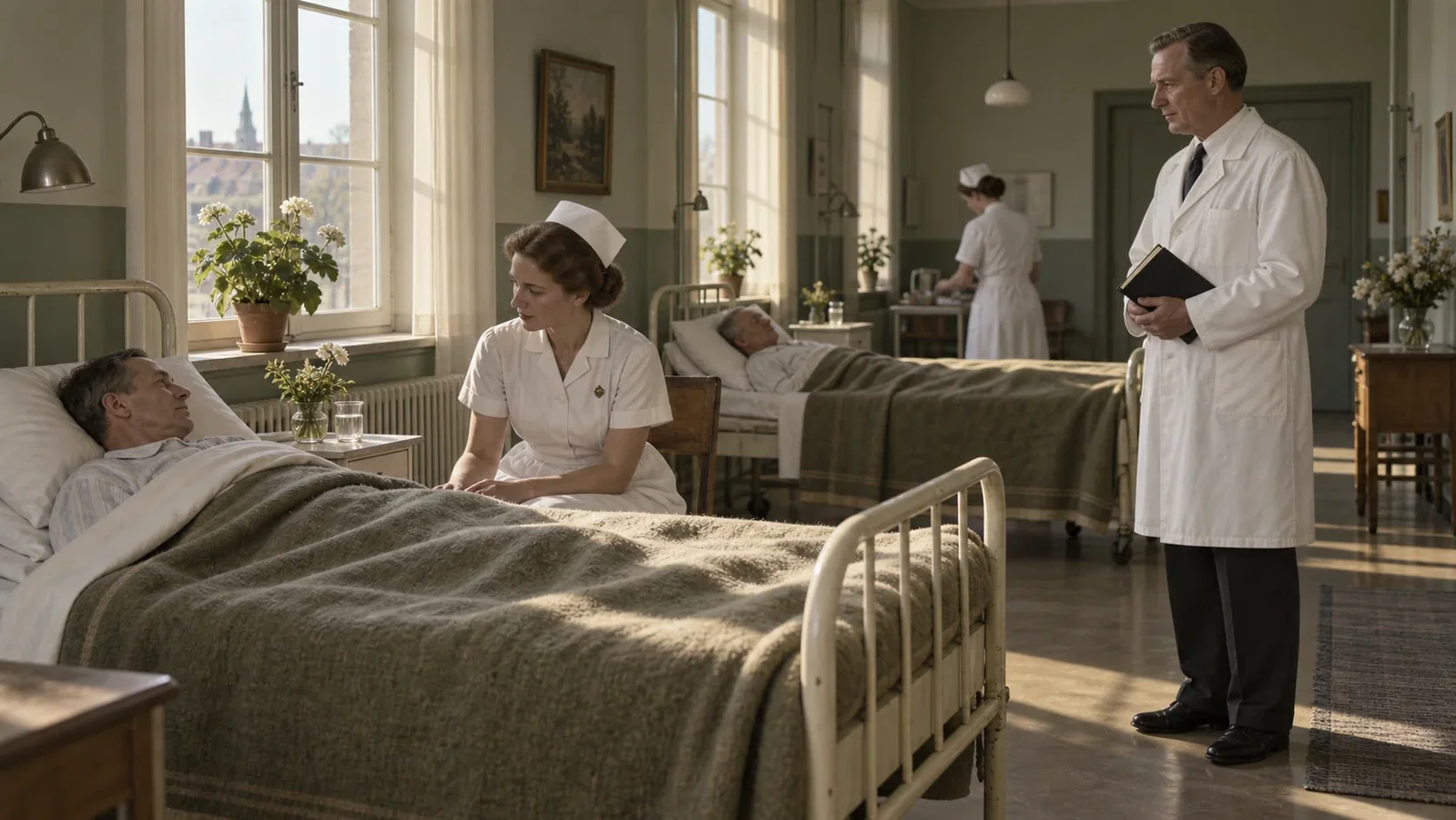
A historical illustration of concentrated care around 1952. Neither the room nor the people are authenticated reconstructions of Blegdam Hospital.
Oxygenation and ventilation were different problems
Ibsen's 1954 report dates his consultation to 25 August 1952. His account follows a twelve-year-old girl through tracheotomy, airway clearance and assisted breathing through a cuffed tube connected to a to-and-fro absorption system. Measurements showed that carbon dioxide could continue to accumulate even when oxygen improved blood oxygenation. Skills used during anesthesia had a role in treating a critically ill patient outside surgery.[2,p.72]
A Carbovisor measured respiratory-gas carbon dioxide, while a Millikan oximeter assessed oxygenation. The observations helped separate improvement in colour from adequate ventilation. The reports also discuss circulatory failure, secretions and atelectasis; their clinical descriptions should not be reduced to a single physiological explanation or used as a current treatment protocol.[2,p.72;1,p.69]
The exact demonstration date remains inconsistent across the sources. Lassen gives 27 August. The introduction to the record extracts published in 2011 gives the 26th, while its detailed entries run from the 27th into the 28th. The article is therefore dated to the year 1952, without declaring an exact birthday for intensive care.[1,p.68;4,pp.1–7]
A bag required a continuing bedside service
Ibsen describes mobilising anesthetists and medical students, with a large organisation working after eight days. Patients with respiratory problems were brought together for continuous observation. The team included physicians responsible for the epidemic, ear, nose and throat surgeons, anesthetists and laboratory staff. Daily conferences supported continuity, with radiologists and physiotherapists also joining the work.[2,p.73]
Andersen and Ibsen describe the division of labour: rotating anesthesia teams from other hospitals, medical students providing manual ventilation, nurses attending patients, workers changing cylinders and an engineer coordinating supplies. These arrangements made a bedside intervention into a service that could continue across shifts.[3,p.788]
An illustration of handover, without reproducing patient records or a documented meeting.
The equipment had its own history. Lassen's figure caption explicitly identifies a Waters canister. Waters's earlier paper depicts a mask, soda-lime container and rebreathing bag; the Copenhagen report shows an absorption system used with a tracheotomy tube. This is a specific use of established anesthesia equipment, with a different patient interface. It does not make the absorber a 1952 invention or a sufficient cause of the ICU.[1,p.69,Fig.1;6,reprint pp.1–2]
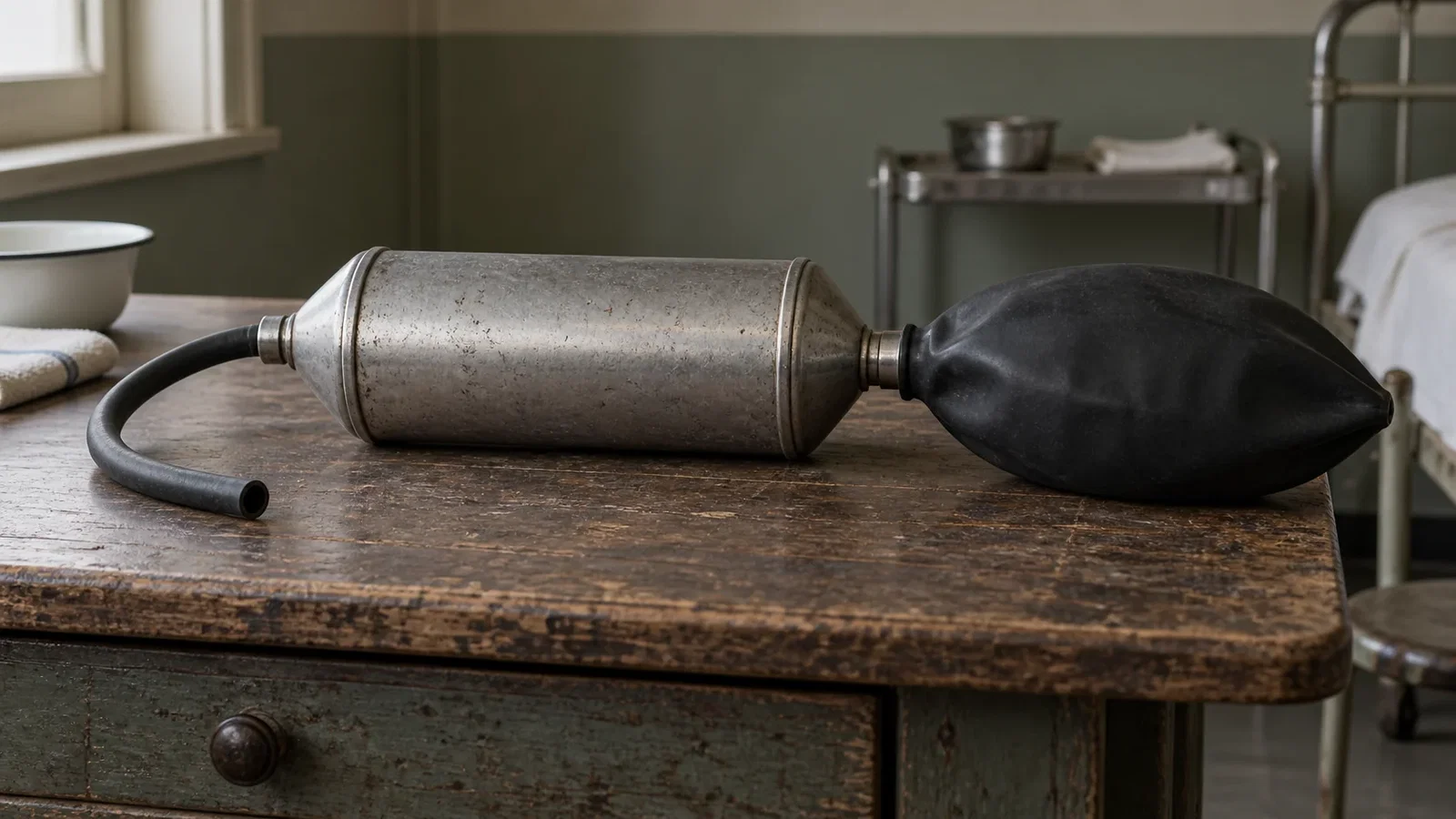
An editorial study of equipment types described in the sources, disconnected from any patient. It is neither a complete working circuit nor a photograph of an original object.
Reading mortality with its denominators
Lassen's Table VI reports 27 deaths among the first 31 patients needing special treatment, approximately 87%. Six subsequent consecutive groups, each of 50 patients, contained 300 patients and 114 deaths, or 38%, with 1 April 1953 as the reporting reference date. The decline was substantial. Patients were treated successively, however, while treatment and organisation developed. This was not random allocation and cannot isolate the effect of manual ventilation from the rest of the response.[1,p.71,Table VI]
Other tables use populations of 345 or 321 patients. Ibsen's late interview gives a remembered reduction from 92% to about 25%, without directly comparable denominators. This account uses the explicit counts in the contemporary Table VI and keeps the other series separate. Surviving the acute crisis also did not mean recovering respiratory muscle function: the published record narrative describes the girl's continuing dependence on assisted ventilation.[1,pp.70–71;5,p.5;4,pp.7–8]
The event and its later accounts
All three contemporary papers appeared in 1954 and describe the response to the 1952 epidemic. In his 2006 interview, Ibsen also recalled the later development of a recovery room into a place for concentrated treatment of critically ill patients. These stages are connected, but they should not be compressed into one universally established date for the world's first ICU. This article does not settle priority among all early units providing concentrated care.[1–3;5,pp.1–3]
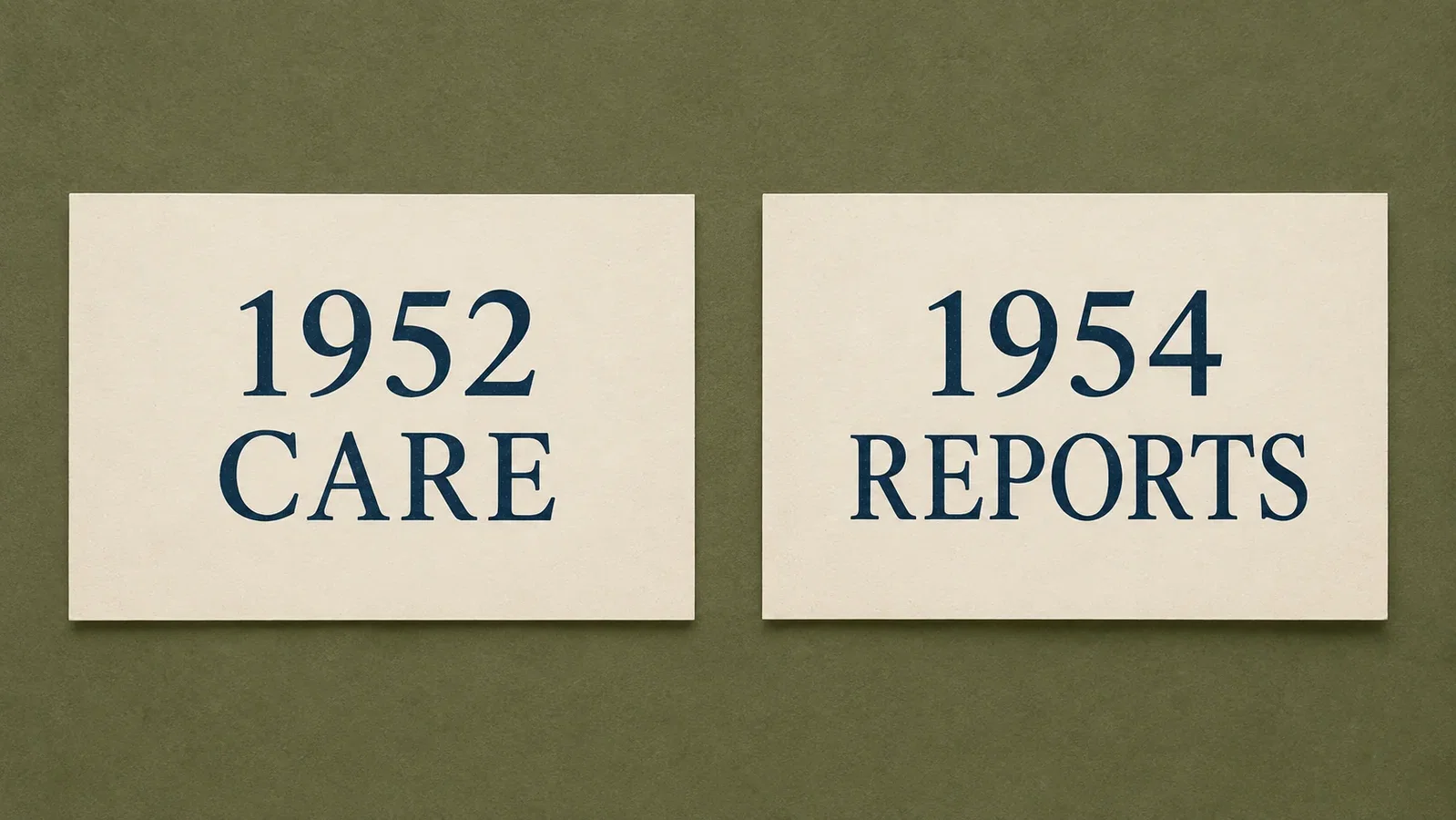
The cards distinguish the event year from publication, rather than dating treatment from a later account.
The sources also differ on the drug name. Ibsen's contemporary paper and the translated record name Pentothal; the late interview translation names Phenobarbital. Preserving that difference keeps the roles of a near-contemporary report, a translated record and recollection visible. The three papers also share a treatment team and overlapping authorship; they are not three independent studies of efficacy.[2,p.72;4,p.2;5,pp.5,8]
Copenhagen left a detailed account of how bedside care was organised: anesthesia skills entered a hospital for infectious diseases, while observation and staffing sustained respiratory support. It records one route by which intensive care took shape.[2,p.73;3,p.788]
Sources and reading limits
The supplements [4–5] were supplied as DOC files. Page citations use the pagination of PDF conversions of those files.
- Lassen HCA. The Epidemic of Poliomyelitis in Copenhagen, 1952. Proc R Soc Med. 1954;47(1):67–71. Original article and scans. DOI:10.1177/003591575404700119. All five original scanned pages read; the presentation date on p.67 is 16 October 1953.
- Ibsen B. The Anaesthetist's Viewpoint on the Treatment of Respiratory Complications in Poliomyelitis During the Epidemic in Copenhagen, 1952. Proc R Soc Med. 1954;47(1):72–74. Original article and scans. DOI:10.1177/003591575404700120. All three original scanned pages read.
- Andersen EW, Ibsen B. The Anaesthetic Management of Patients with Poliomyelitis and Respiratory Paralysis. Br Med J. 1954;1(4865):786–788. Original article and scans. DOI:10.1136/bmj.1.4865.786. All three original scanned pages read within the article boundaries. Text from neighbouring articles on pp.786 and 788 is excluded.
- Reisner-Sénélar L. Online Resource 1: Extracts from the patient record of Vivi E. (1952). Supplement to The birth of intensive care medicine: Björn Ibsen's records. Intensive Care Med. 2011;37(7):1084–1086. Publisher page and supplements. All English text read. The handwritten Danish was not independently transcribed in full. This is a published selection and translation, not the complete hospital record.
- Reisner-Sénélar L. Online Resource 2: Interview with Prof. Björn Ibsen, conducted in Danish on 16 July 2006, translated by Reisner-Sénélar. Supplement to the same 2011 article. Publisher page and supplements. Original DOC and all nine converted pages read. Late recollection; the subscription main article is not covered. Its correct PMID is 21611906.
- Waters RM. Clinical Scope and Utility of Carbon Dioxid Filtration in Inhalation Anesthesia. Anesthesia and Analgesia. 1924;3:20–22. DOI:10.1213/00000539-192402000-00004 (publisher page). The four-page reprint in the WLM 1975 collection, PDF pp.32–35, was reread as text and page images. The other papers in that collection were not reread.
Continue exploring
Related reading connects shared questions and contexts; it does not by itself establish historical influence.
- 1923: Waters Keeps the Anesthetic and Removes the Carbon Dioxide
- 1953: Gibbon Repairs an Atrial Defect with Heart-Lung Support
The Source Room · About & Editorial Method
Sources and reading limits are stated above. Illustrations are labelled as original source images or AI-made. Historical accounts are educational; they are not current treatment instructions.