A September 1948 book organised care for children and a range of anesthetic methods.
Reading Library · Anesthesia Epochs · 中文版
Watch the companion film
1948: Leigh and Belton — A Child’s World · Watch on YouTube
Historical anchor: 1948. Date details and source qualifications are explained below.
The introduction to Pediatric Anesthesia begins with the surroundings of a child in hospital. Play spaces, occupational therapy, teachers, murals and a friendly approach before surgery appear before the technical chapters. M. Digby Leigh and M. Kathleen Belton treated these matters as part of preparing a child for care. Their book included photographs of a playroom and a children's ward alongside that discussion.[1,introduction pp.xiii–xv]
The people, room and papers are editorial inventions representing collaboration, not authenticated portraits of the authors or a documented writing session.
A book with two authors
The title page identifies both authors and their appointments at Vancouver General Hospital, as well as earlier work at Children's Memorial Hospital and McGill University. The copyright page gives the publication month: September 1948. Macmillan published the book in New York. Vancouver identifies the authors' clinical setting; it does not establish where the book was launched.[1,title and copyright]
McGill's later institutional account identifies Belton as Mabel Kathleen “Kay” Belton and describes her move to Vancouver with Leigh in 1947. It calls their subsequent book the first North American guide to pediatric anesthesia. The original volume supplies more immediate evidence of the collaboration: both names appear on the title page and at the end of the preface. They describe a selection of methods drawn from years of practice and explicitly decline to cover every technique.[4,Belton section;1,preface p.ix]
The contents arrange this material into thirteen chapters. Preoperative management and respiration and circulation precede chapters on anesthetic stages, inhalation, intubation, intravenous, rectal and local methods. Later chapters address selection, complications, postoperative care, oxygen and fluids. This is evidence of the book's organisation. Reading the contents does not amount to reading each chapter or validating all the practices it lists.[1,contents p.xi]
The scene develops the introduction's environmental theme. It depicts no particular hospital and makes no claim about a clinical benefit from its decoration.
Teaching an established method for children
The selected pages on respiration and circulation discuss oxygen supply, children's breathing, mask dead space and carbon dioxide clearance. The inhalation chapter then gives a concrete example of how earlier equipment entered pediatric teaching. Leigh and Belton explicitly discuss Waters' carbon dioxide absorption technique, distinguish to-and-fro and circle systems, and illustrate masks, canisters and bags for children.[1,pp.13–17,61–65]
Waters' original report, published in February 1924 after a presentation in October 1923, had described a mask, soda-lime canister and rebreathing bag. Its discussion included oxygen supply, leaks, absorbent exhaustion and obstruction. The 1948 book brings the method into a pediatric discussion, including smaller canisters, dead space and retained heat. These passages establish a specific connection between the apparatus and its later teaching, without treating its adaptation as evidence that every application was safe.[5,pp.1–4;1,pp.61–65]
The dedication also matters. It thanks both Ralph M. Waters and Wesley Bourne for their contributions to the authors' basic knowledge of pediatric anesthesia. The documented equipment connection should not turn into a claim that one person alone supplied their education. The practices described here are historical records, not current anesthesia instructions.[1,dedication;5]
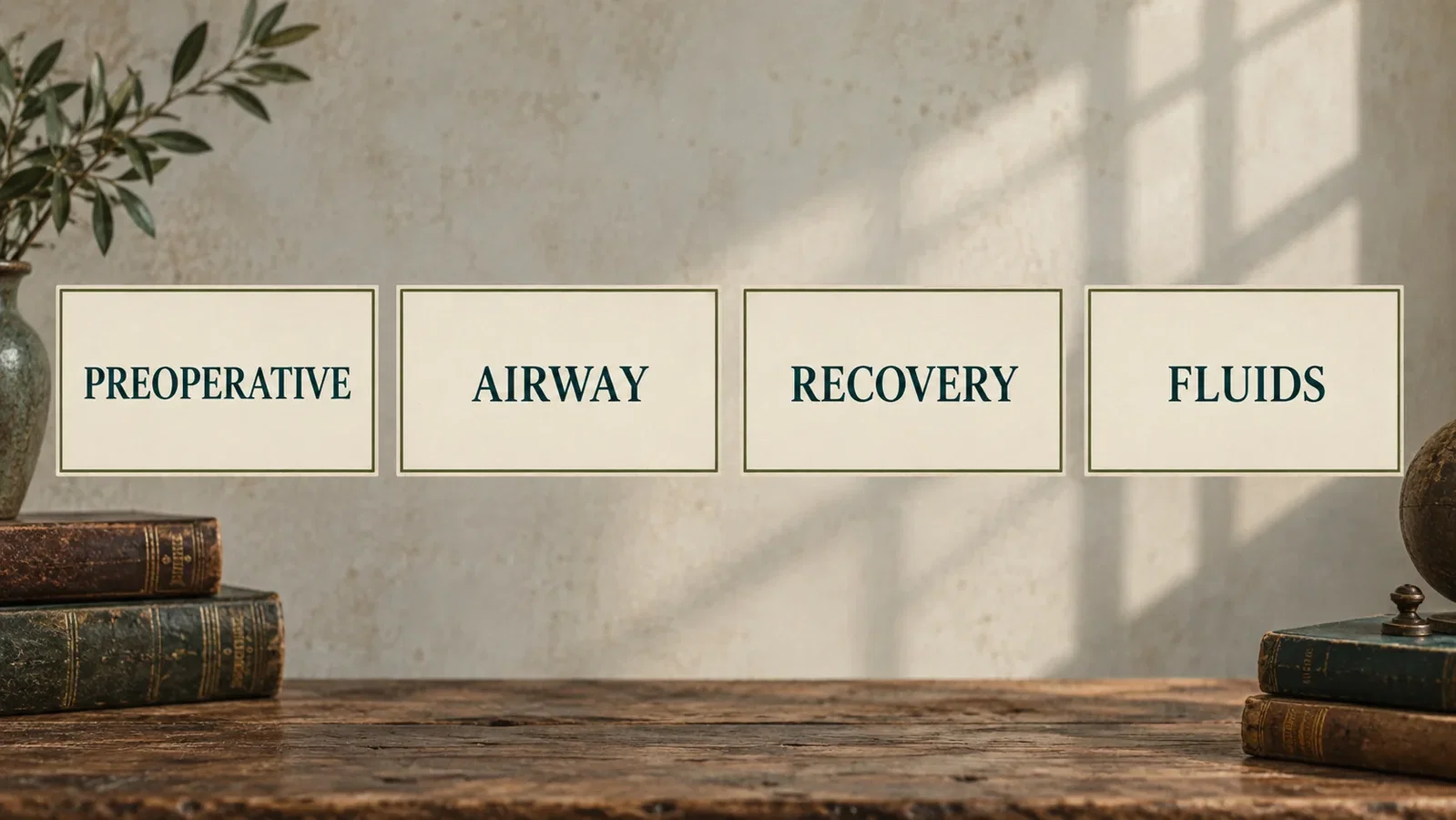
Preoperative care, airway, recovery and fluids represent topics in the contents. These are modern editorial cards, not reproduced book pages or a treatment protocol.
Presentation and publication
Leigh's article in the April 1949 issue of California Medicine begins with hospital atmosphere, toys, communication and preoperative assessment. Its footnote records an earlier presentation to the California Medical Association in April 1948. That talk, the book's September publication, and the article's appearance the following April are distinct events. The article is a contemporary account by the same clinician, not an independent review of the book.[2,p.278]
A different date limits any worldwide-first claim. A January 1924 notice in the British Journal of Anaesthesia lists C. Langton Hewer's Anaesthesia in Children, published in London in 1923. The full notice has been read; Hewer's underlying book has not. The listing establishes an earlier pediatric anesthesia title, without supporting a comparison of the two books' complete contents or a new claim that Hewer was the world's first.[3,p.148]
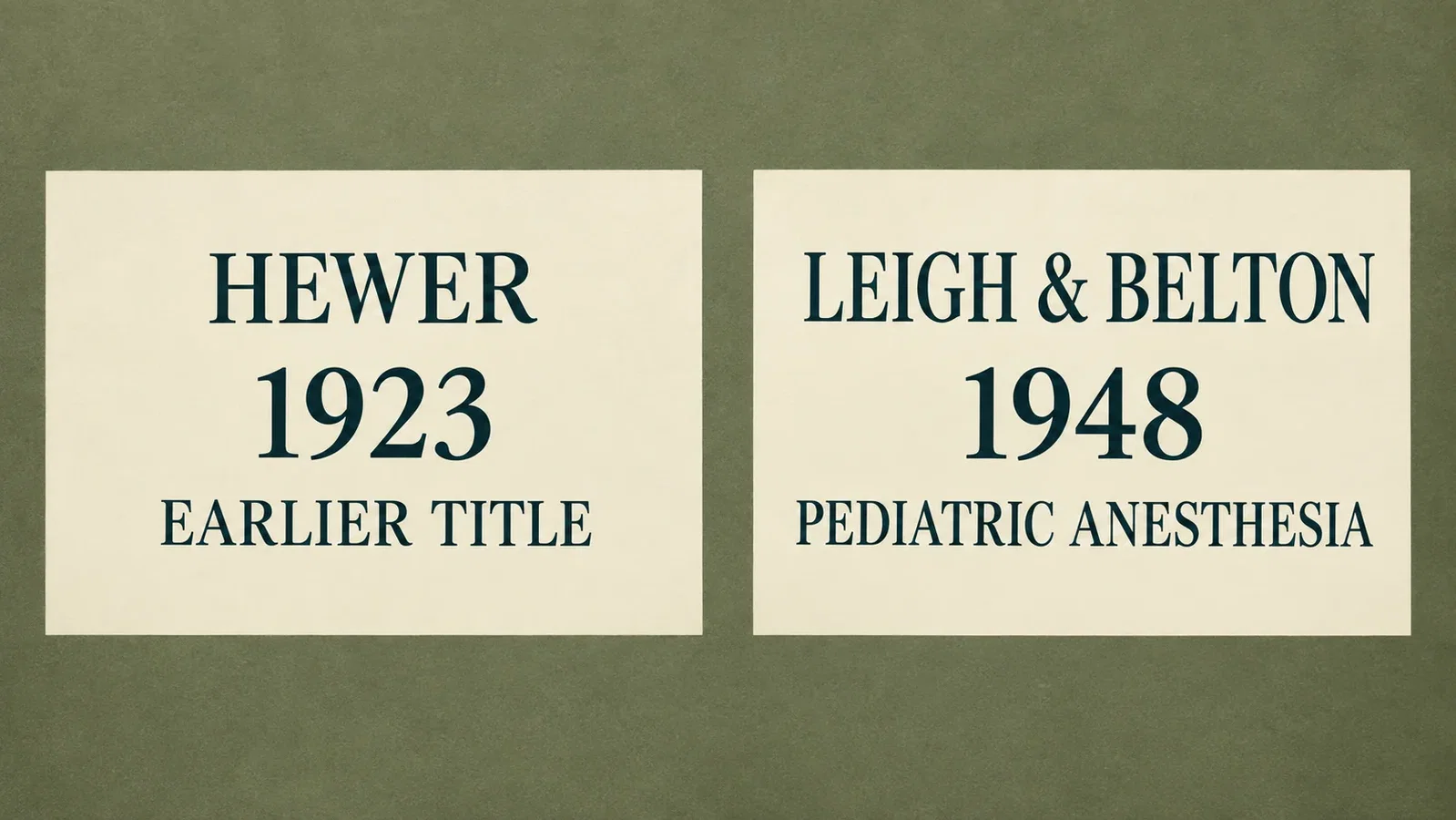
The cards distinguish the two bibliographic years. They imply no demonstrated transmission or causal relationship between the books.
In their 1948 book, Leigh and Belton organised children's experience of hospital, respiratory and other physiological concerns, and the choice and limits of practical methods into a teaching text. Their collaboration is visible in that organisation and in the specific discussions that fill its selected pages.[1,preface,contents,introduction,pp.13–17,61–65]
Sources and reading limits
- Leigh MD, Belton MK. Pediatric Anesthesia. New York: Macmillan Company; September 1948. Original book in HathiTrust. Twenty-five selected original scan images individually read: title, copyright, dedication, foreword, preface, contents, introduction and printed pp. 1, 13–17, 61–65; four of the 25 scans are blank. The other 239 viewer sequences were not viewed. This is selected-page reading, not a complete book PDF or a reading of every chapter.
- Leigh MD. Pediatric Anesthesia. California Medicine. 1949;70(4):278–281. PMID 18116232. Complete original article. All four pages read as text and page images. Presented at the California Medical Association meeting, 11–14 April 1948; published April 1949. A contemporary account by one of the book's authors, not an independent review of the book.
- Anonymous. Latest Books on Anæsthesia. Br J Anaesth. 1924;1(3):148. DOI: 10.1093/bja/1.3.148. Original book notice. The entire one-page January 1924 notice was read; it lists Hewer's Anaesthesia in Children, London, 1923. Hewer's underlying book is not covered.
- Woodford G. Mothers of anaesthesia: Dr. Enid Johnson and Dr. Kay Belton. McGill Health e-News. 11 March 2021. Institutional history. Complete article body, captions and three reference notes read. Later institutional history, not contemporary personnel files or an independent audit of book priority. Embedded photographs were not separately inspected.
- Waters RM. Clinical Scope and Utility of Carbon Dioxid Filtration in Inhalation Anesthesia. Anesthesia and Analgesia. February 1924. Reproduced in The History of Anesthesiology: Reprint Series, Part Five: Carbon Dioxide Absorption, Wood Library-Museum, 1975, printed pp. 1–4 in the article reprint. Original WLM reprint PDF · Archived copy. Printed pp. 1–4 were read; the other pages of the collection are not covered. Presentation in October 1923 and publication in February 1924 are distinct. Underlying references were not read.
Continue exploring
Related reading connects shared questions and contexts; it does not by itself establish historical influence.
The Source Room · About & Editorial Method
Sources and reading limits are stated above. Illustrations are labelled as original source images or AI-made. Historical accounts are educational; they are not current treatment instructions.