In 1881 Lyman wrote that student William E. Clarke gave ether on a towel while a dentist drew a tooth; Buxton in 1925 called it 'said to have been performed'.
Reading Library · Anesthesia Epochs · 中文版
Watch the education video (for clinicians)
1842: William E. Clarke's Ether — A Story Without a Record · Anesthesia Epochs Education Series
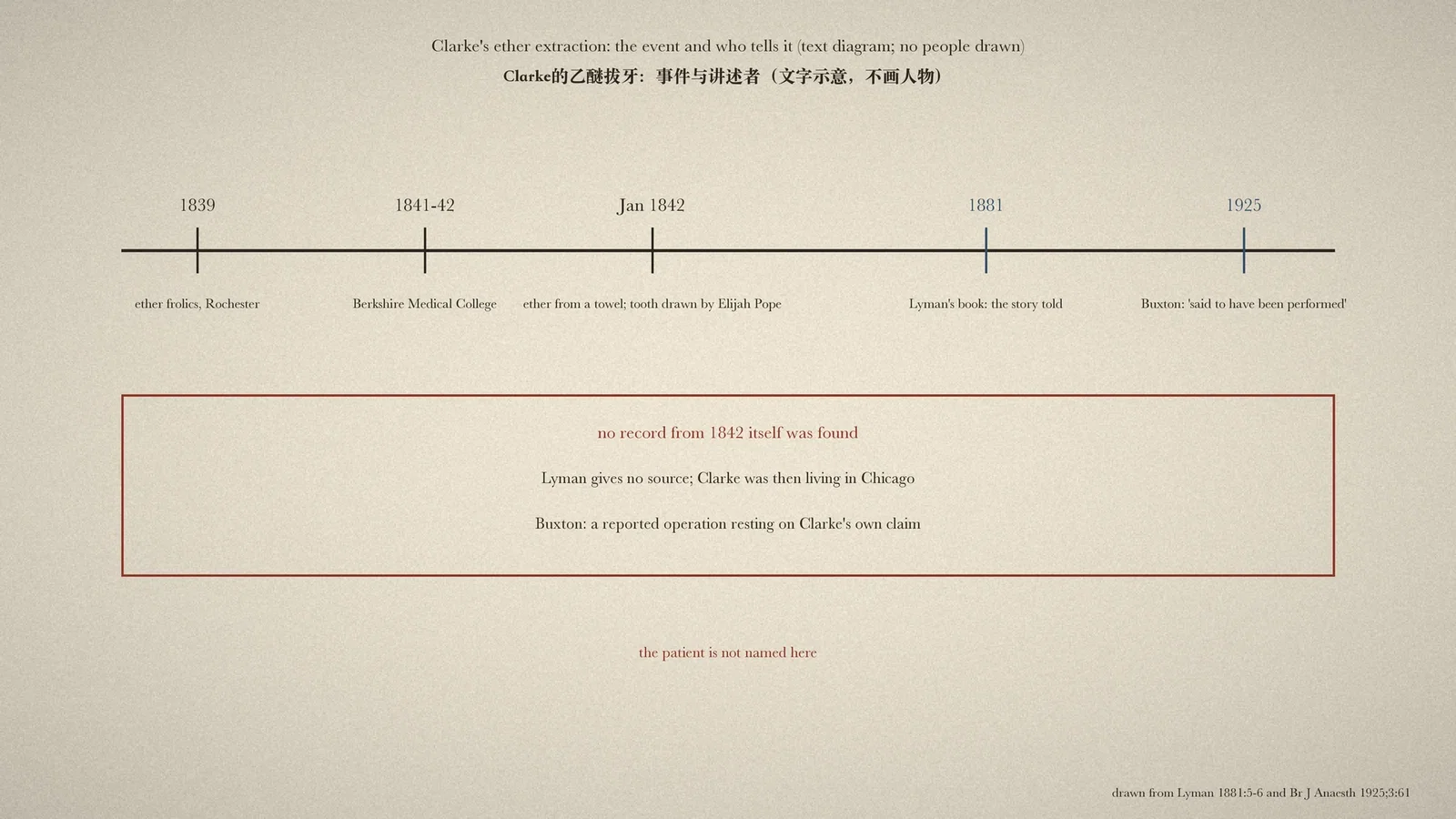
Some events in the history of anaesthesia survive only as a story told long afterwards. This is one of them: a medical student, a towel soaked in ether, a dentist and a tooth, in a city in upstate New York in the winter of 1842. Nothing written at the time was found. What survives is a paragraph in a textbook of 1881 and a doubtful sentence in a journal of 1925. [1, p. 6][2, p. 61]
The book
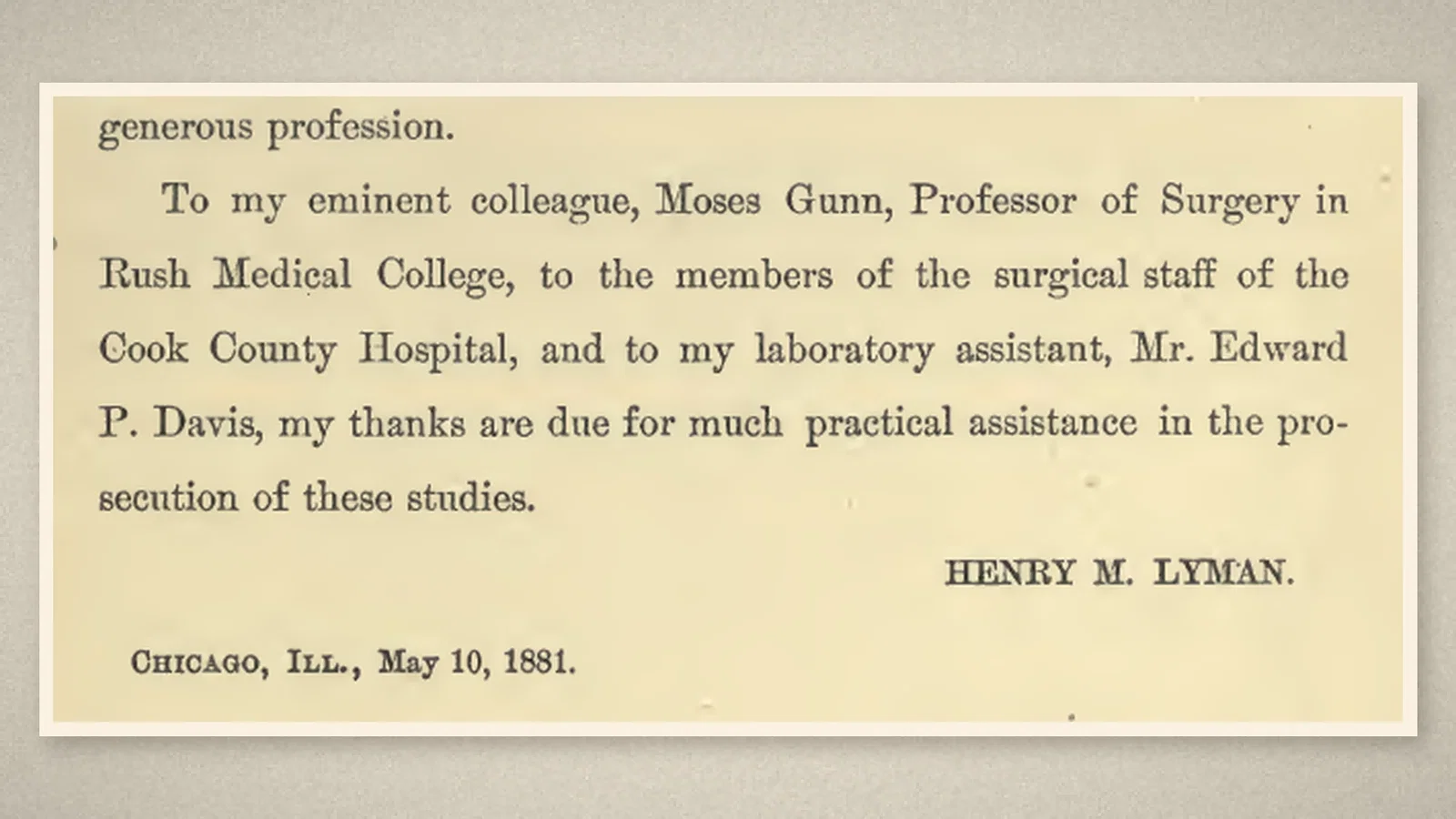
Henry M. Lyman's Artificial Anaesthesia and Anaesthetics was published in 1881, its preface signed "Chicago, Ill., May 10, 1881". The book opens with a history of anaesthesia, in which the story of ether before 1846 is told through a series of near-misses. [1, Preface][1, p. 5]
Frolics in Rochester
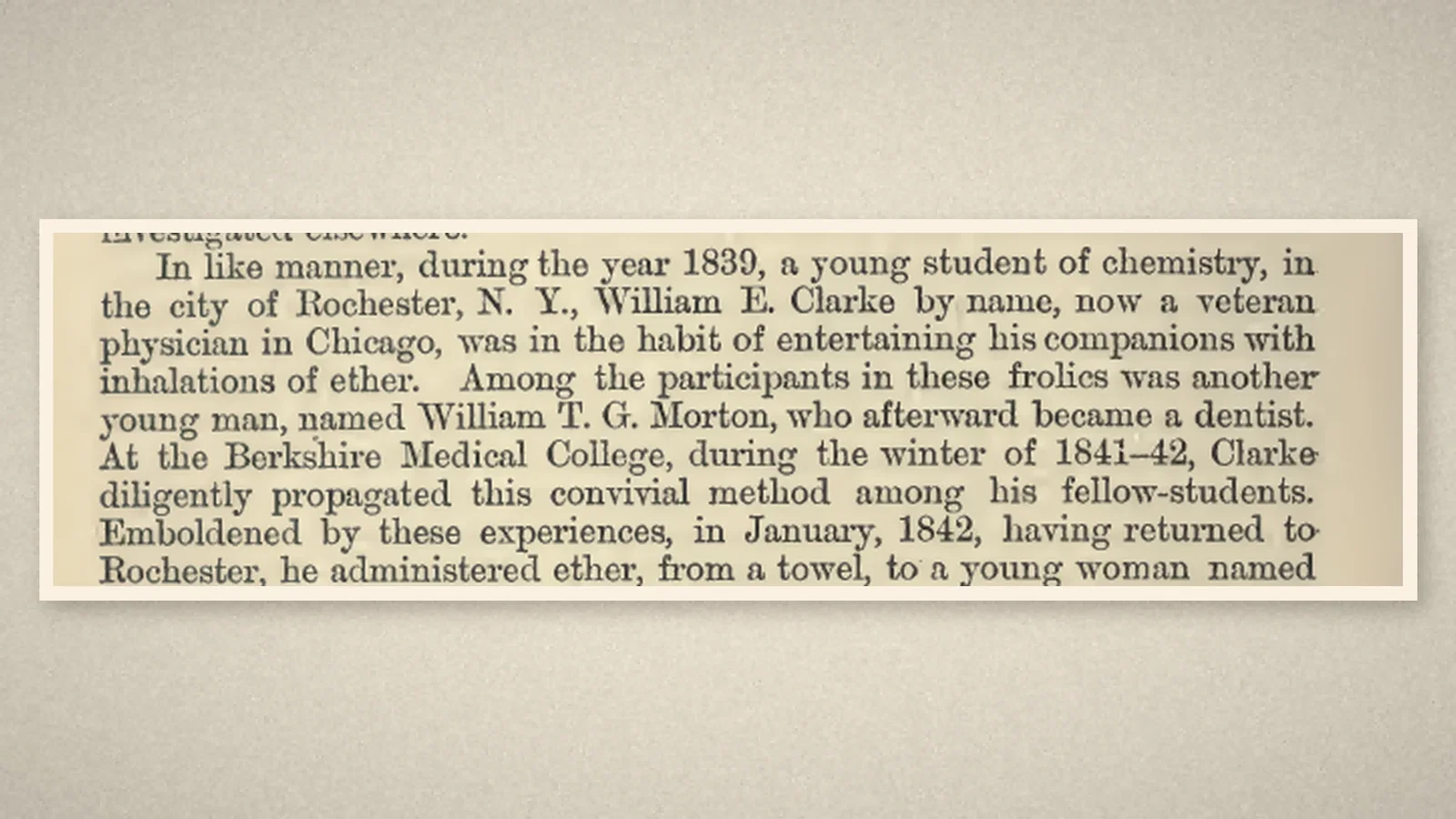
"In like manner, during the year 1839," Lyman writes, "a young student of chemistry, in the city of Rochester, N. Y., William E. Clarke by name, now a veteran physician in Chicago," used to entertain companions with inhalations of ether. Among them, Lyman adds, was "another young man, named William T. G. Morton, who afterward became a dentist". [1, p. 6]
"At the Berkshire Medical College, during the winter of 1841-42," Lyman goes on, Clarke "diligently propagated this convivial method" among fellow students. Then: "Emboldened by these experiences, in January, 1842, having returned to Rochester," Clarke "administered ether, from a towel, to a young woman", and a tooth "was then extracted without pain by a dentist named Elijah Pope". [1, p. 6]
That is the whole account. Lyman tells it between two other stories: Crawford Long's tumour removal under ether in Georgia, recorded in a ledger, and "the next step on the pathway of experiment", Horace Wells's nitrous oxide at Hartford. Lyman gives no source for the Clarke story and does not say whether anyone wrote it down at the time. [1, p. 5][1, p. 6]
A doubt in 1925
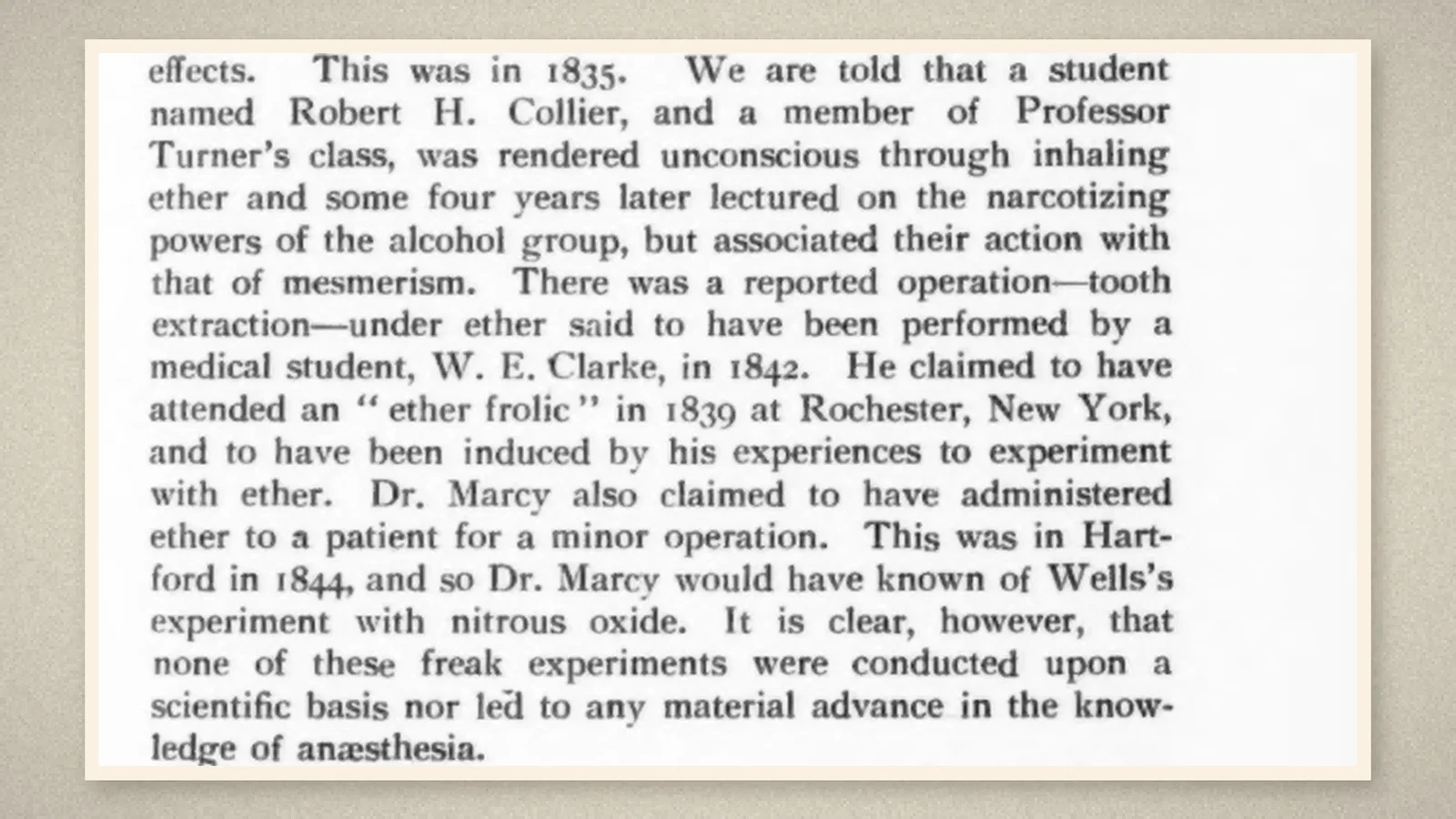
Forty-four years later, in the British Journal of Anaesthesia, Dudley Wilmot Buxton wrote about the background to the ether demonstration of October 1846. Buxton's wording was careful: "There was a reported operation—tooth extraction—under ether said to have been performed by a medical student, W. E. Clarke, in 1842." Clarke, Buxton added, had claimed to have attended an "ether frolic" in 1839 at Rochester and to have been led by it to experiment. [2, p. 56][2, p. 61]
Buxton grouped Clarke with other early claims and judged that "none of these freak experiments were conducted upon a scientific basis nor led to any material advance in the knowledge of anaesthesia". [2, p. 61]
What the record shows
An event known only by later report. Lyman's paragraph is specific: names, places, a month, a towel, a dentist. Lyman calls Clarke "now a veteran physician in Chicago", where Lyman also lived, which suggests the story came, directly or indirectly, from Clarke; that is an inference, not something the book says. By 1925 a historian was calling it "reported" and "said to have been performed". Neither source settles what happened in Rochester in January 1842.
Sources and reading limits
Read: Henry M. Lyman, Artificial Anaesthesia and Anaesthetics (1881), the preface and the history of anaesthesia at pp. 5-7; Dudley Wilmot Buxton, "The advent of a great discovery: October, 1846", British Journal of Anaesthesia 1925;3(2), the opening (p. 56) and the passage on Clarke (p. 61).
Not covered: any record from 1842; anything written by Clarke; any record kept by Elijah Pope; later historical studies of Clarke.
Limits: both sources are secondary and late. Lyman wrote decades after the event and cites nothing; Buxton treats the event as a claim. Lyman names the patient; the name is not repeated here, and the page crop stops before it. No dose is given. Whether this was the first use of ether in dentistry is not established by these pages.
Three illustrations are crops of Lyman 1881 (the preface and p. 6) and the British Journal of Anaesthesia 1925 (p. 61); one is a text timeline drawn from both, with no people drawn.
- Lyman HM. Artificial Anaesthesia and Anaesthetics. 1881:5-6. Internet Archive
- Buxton DW. The advent of a great discovery: October, 1846. Br J Anaesth. 1925;3(2):56-65. Internet Archive
Continue exploring
Related reading connects shared questions and contexts; it does not by itself establish historical influence.
- 1846: Fisher's Ether Fails in Paris Before a Boston Inhaler Succeeds
- 1847: Robinson Publishes a Treatise on Inhaling Ether
- 1730: Frobenius Shows the Royal Society an Ethereal Spirit of Wine
- 1842: Crawford Long Operates Before Publishing
- 1844: Horace Wells, the Dentist Who Became the Patient
Anesthesia Epochs · The Source Room · About & Editorial Method
Published November 3, 2026. Sources and reading limits are stated above. Illustrations are labelled as original source images or AI-made. Historical accounts are educational; they are not current treatment instructions.