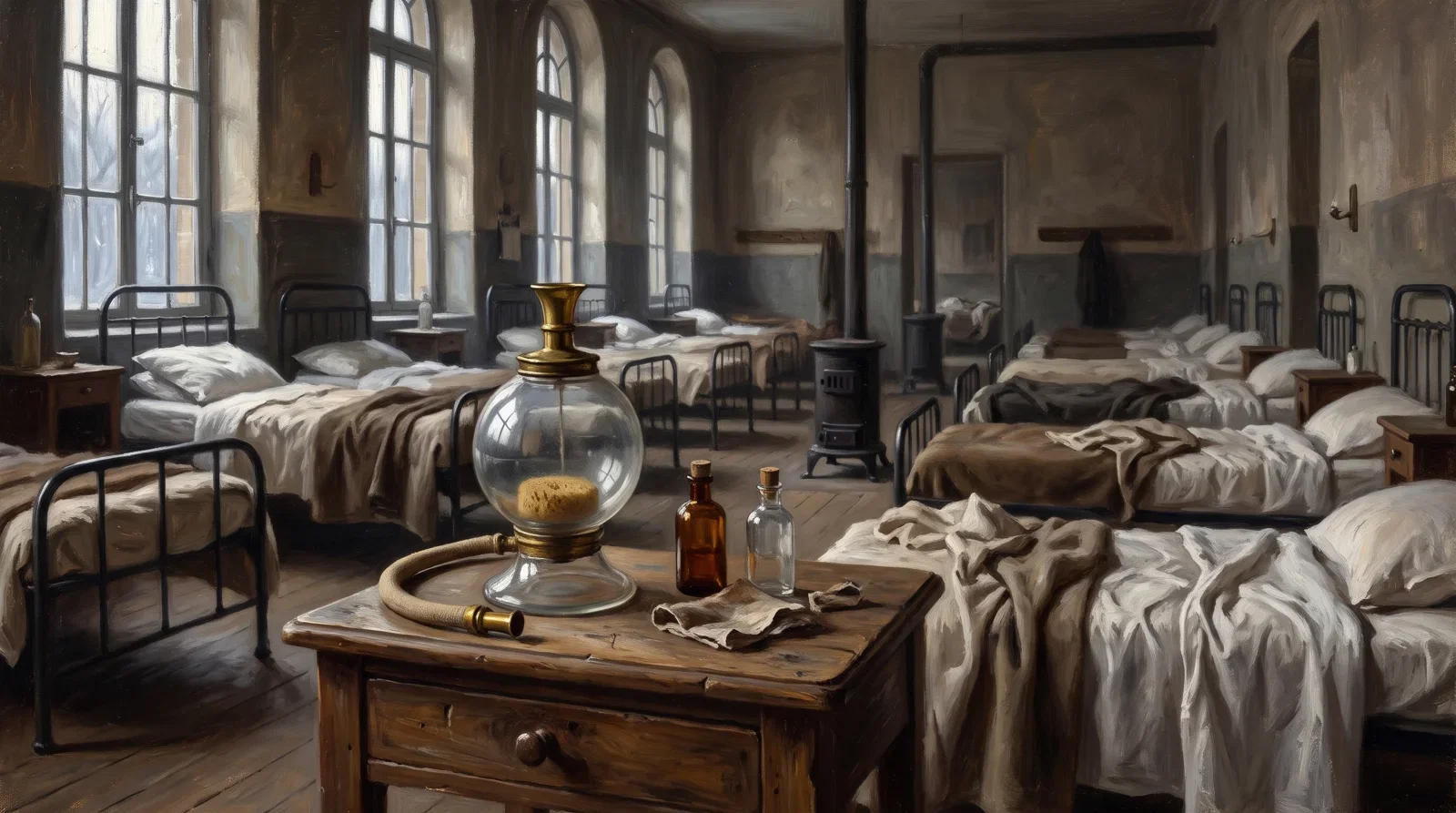
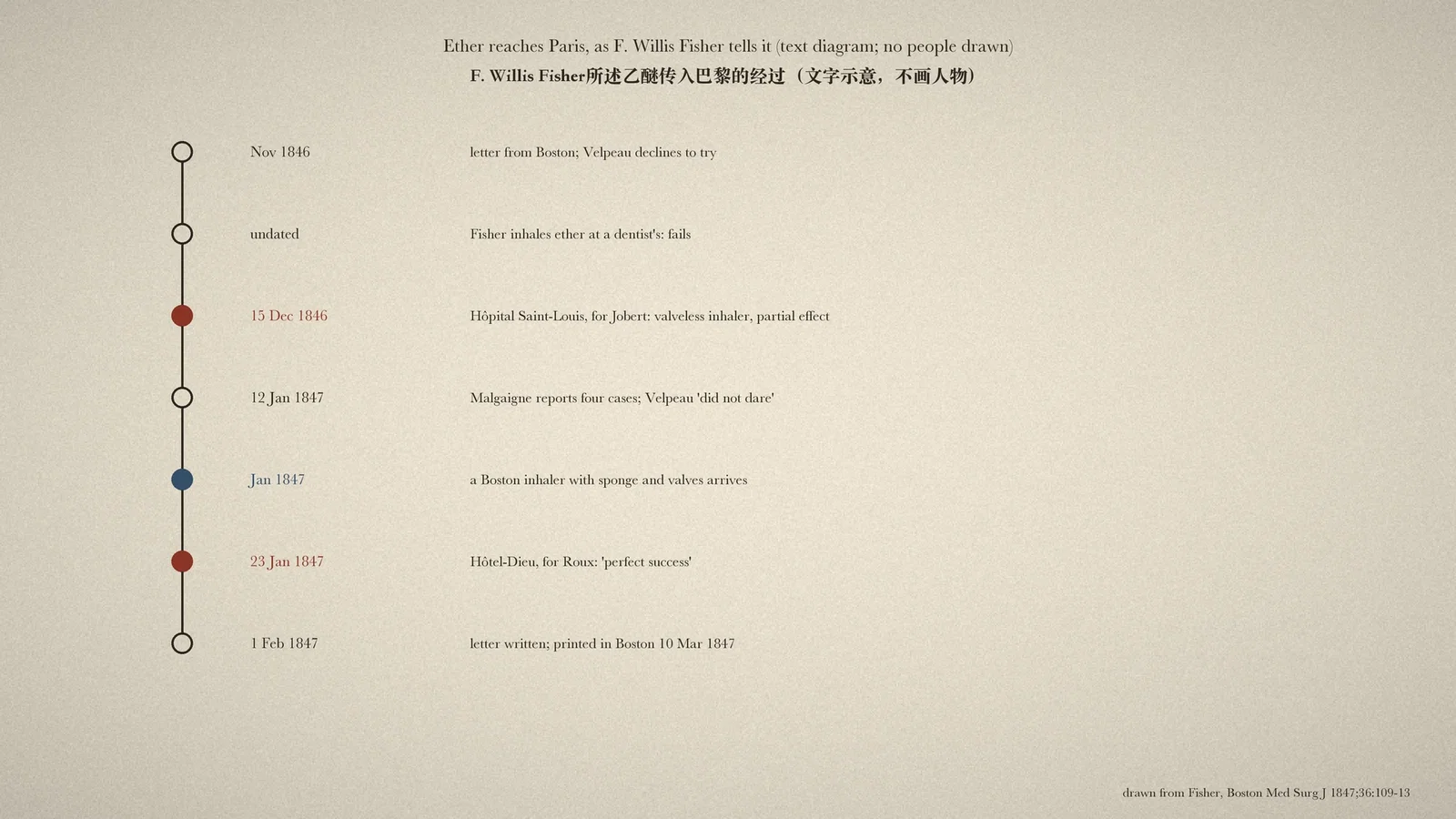
In Paris in December 1846 F. Willis Fisher's first trial of ether on a patient of Jobert's failed; on 23 January 1847, with a Boston inhaler, Fisher gave ether at the Hôtel-Dieu with perfect success.
Reading Library · Anesthesia Epochs · 中文版
Watch the education video (for clinicians)
1846: Fisher's Ether in Paris — The Apparatus, Not the Agent · Anesthesia Epochs Education Series
News of ether reached Paris before the ether apparatus did. A young Boston physician studying there spent two months trying to persuade the city's great surgeons, failed in the first attempt, and finally succeeded once a properly made inhaler arrived in the post. The physician, F. Willis Fisher, wrote it all down in a letter home. [1, pp. 109-13]
The letter
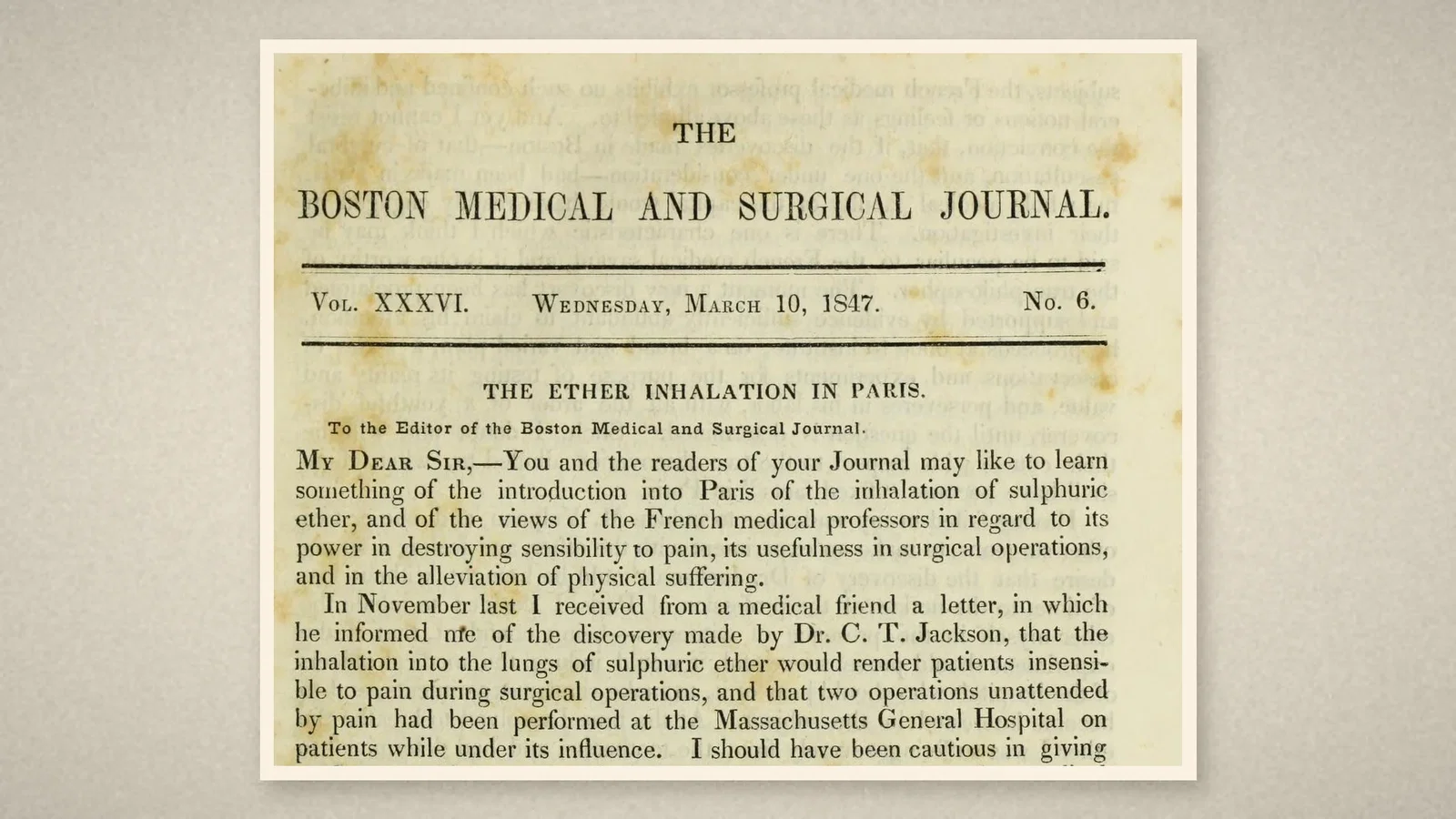
The Boston Medical and Surgical Journal of 10 March 1847 printed "The ether inhalation in Paris", a letter to the editor signed "Paris, February 1st, 1847. F. Willis Fisher." [1, pp. 109, 113]
November: a refusal
In November 1846, Fisher wrote, a letter came from a former medical teacher describing the new discovery: inhaling sulphuric ether made patients insensible to pain during operations, and two such operations had been done at the Massachusetts General Hospital. Fisher read the letter to Velpeau, who was interested but did not believe it and "politely declined" to try ether on a patient. One or two other surgeons also declined. [1, pp. 109-10]
Fisher then decided to try it personally, in front of witnesses. Suffering from toothache and with an extraction already booked, Fisher went to the dentist with a Dr Mason and inhaled ether from a home-made apparatus. After about a minute, seeing Fisher much excited, the friends stopped the inhalation. The experiment was "a failure, but not a total one": a feeling of stupor and drowsiness followed. [1, p. 110]
15 December: Saint-Louis
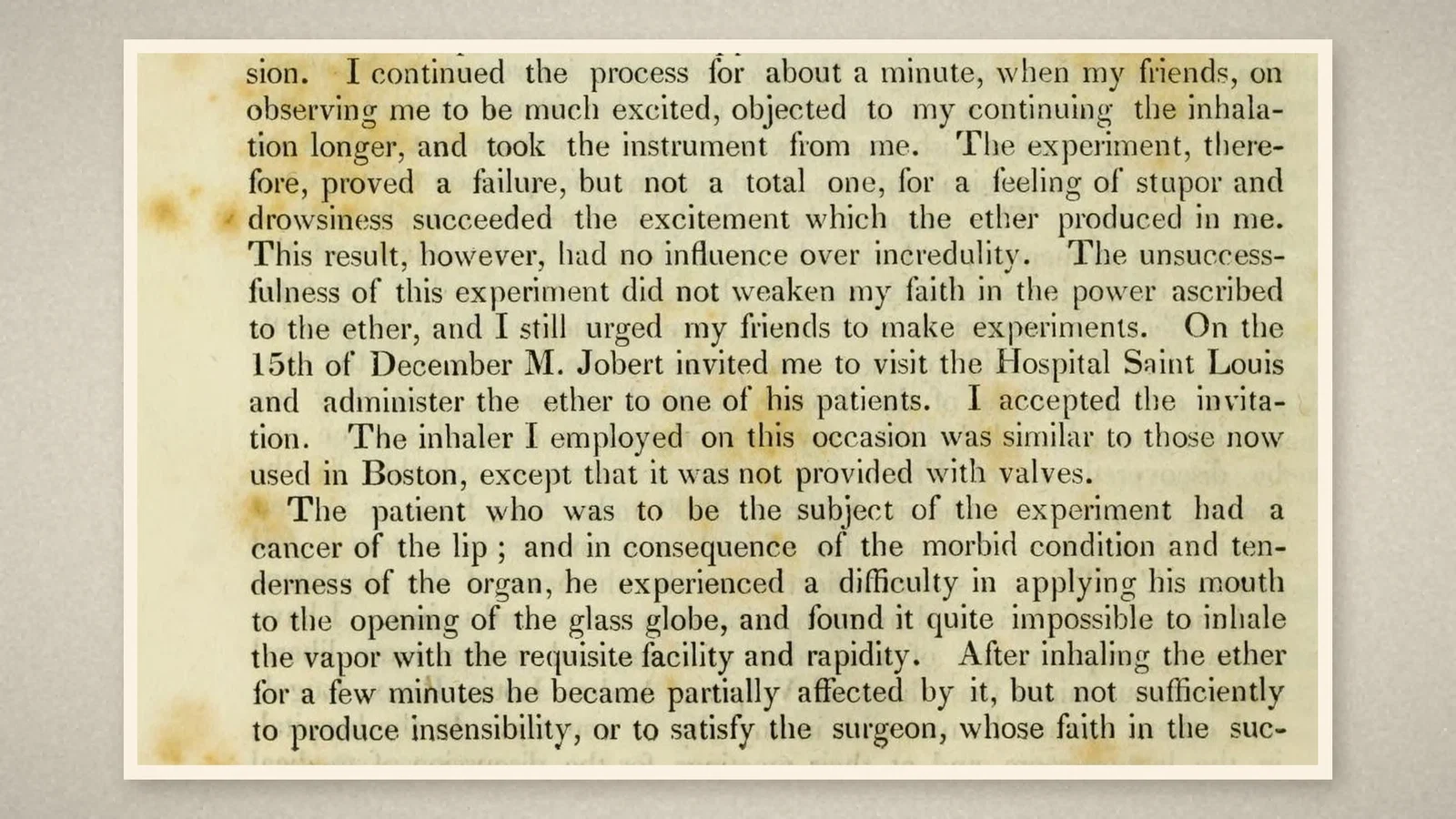
On "the 15th of December", Fisher writes, "M. Jobert invited me to visit the Hospital Saint Louis" to give ether to one of Jobert's patients. The inhaler was like those used in Boston "except that it was not provided with valves". The patient had a cancer of the lip, which made it painful and difficult to keep the mouth on the opening of the glass globe and to breathe the vapour properly. After a few minutes there was only a partial effect, not insensibility, and the surgeon was not convinced. After that nothing more was attempted for a while. [1, pp. 110-11]
January: the Academy
Interest returned only when reports from American and English surgeons, and letters from Drs Ware and Warren of Boston, appeared in the Paris medical journals. On 12 January Malgaigne reported four operations under ether at the Hôpital Saint-Louis to the Academy of Medicine. In the discussion, Velpeau recalled that "a young American student" had told of the new use some six weeks earlier. "Still," Velpeau said, "I did not dare to make the experiment." By the next meeting on 18 January many trials had been made in Paris, mostly failures. Fisher blamed poor instruments and impure ether; people were using phials, bottles, glass funnels and retorts. [1, pp. 111-12]
23 January: Hôtel-Dieu
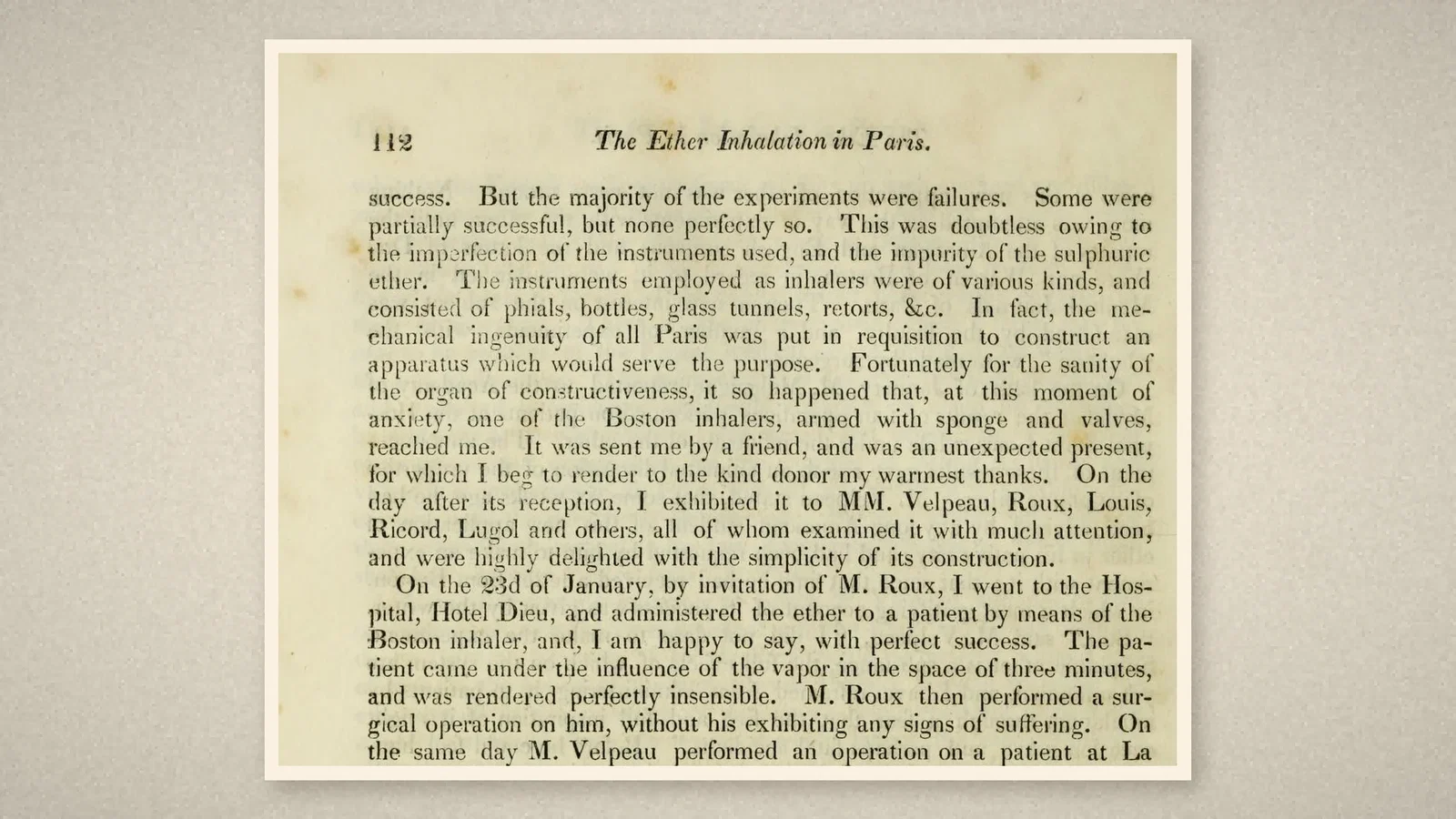
Then a friend sent Fisher "one of the Boston inhalers, armed with sponge and valves". Fisher showed it to Velpeau, Roux, Louis, Ricord and Lugol, who admired how simply it was made. On 23 January, at Roux's invitation, Fisher went to the Hôtel-Dieu and gave ether with the Boston inhaler "with perfect success": the patient became insensible within three minutes, and Roux operated without the patient showing any sign of suffering. The same day Velpeau operated under ether at La Charité. [1, p. 112]
By 1 February, Fisher reported, ether was being used in Paris for operations large and small, and on horses and dogs at the veterinary school at Alfort. The Boston inhaler had become the model for all those made in Paris; the only change was a flexible tube that let patients inhale lying down. The letter adds that the members of the Academies gave the honour of the discovery to Jackson. [1, pp. 112-13]
What the record shows
How a medical novelty crossed the Atlantic: first as a report the leading surgeons would not trust, then as a failed demonstration with the wrong equipment, and finally as a success once a proper inhaler arrived. The patient on 15 December did not become insensible, and Fisher put that first failure on record.
Sources and reading limits
Read: Fisher, "The ether inhalation in Paris", Boston Medical and Surgical Journal 10 March 1847;36:109-13, in full.
Not covered: Fisher's second letter from Paris (dated 1 March 1847) in the same volume; the Academy of Medicine's Bulletin for 12 and 18 January 1847; Malgaigne's and Velpeau's own reports; the Paris journals Fisher mentions.
Limits: this is Fisher's own account and puts Fisher at the centre. The views on French surgeons and the credit given to Jackson are Fisher's, written while the priority dispute was going on. The date of Fisher's self-experiment is not given, and the patients are not identified. The letter gives no ether amounts.
Three illustrations are crops of the Boston Medical and Surgical Journal (pp. 109, 110 and 112); one is a text timeline drawn from the letter, with no people drawn.
- Fisher FW. The ether inhalation in Paris. Boston Med Surg J. 1847;36(6):109-13. Internet Archive
Continue exploring
Related reading connects shared questions and contexts; it does not by itself establish historical influence.
- 1847: Charrière Prints an Illustrated Leaflet on Ether Inhalers
- 1846: Morton Extracts a Tooth for Eben Frost Under an Ether Preparation
- 1846: The Ether Dome, a Breakthrough Without a Perfect Moment
Anesthesia Epochs · The Source Room · About & Editorial Method
Published November 3, 2026. Sources and reading limits are stated above. Illustrations are labelled as original source images or AI-made. Historical accounts are educational; they are not current treatment instructions.