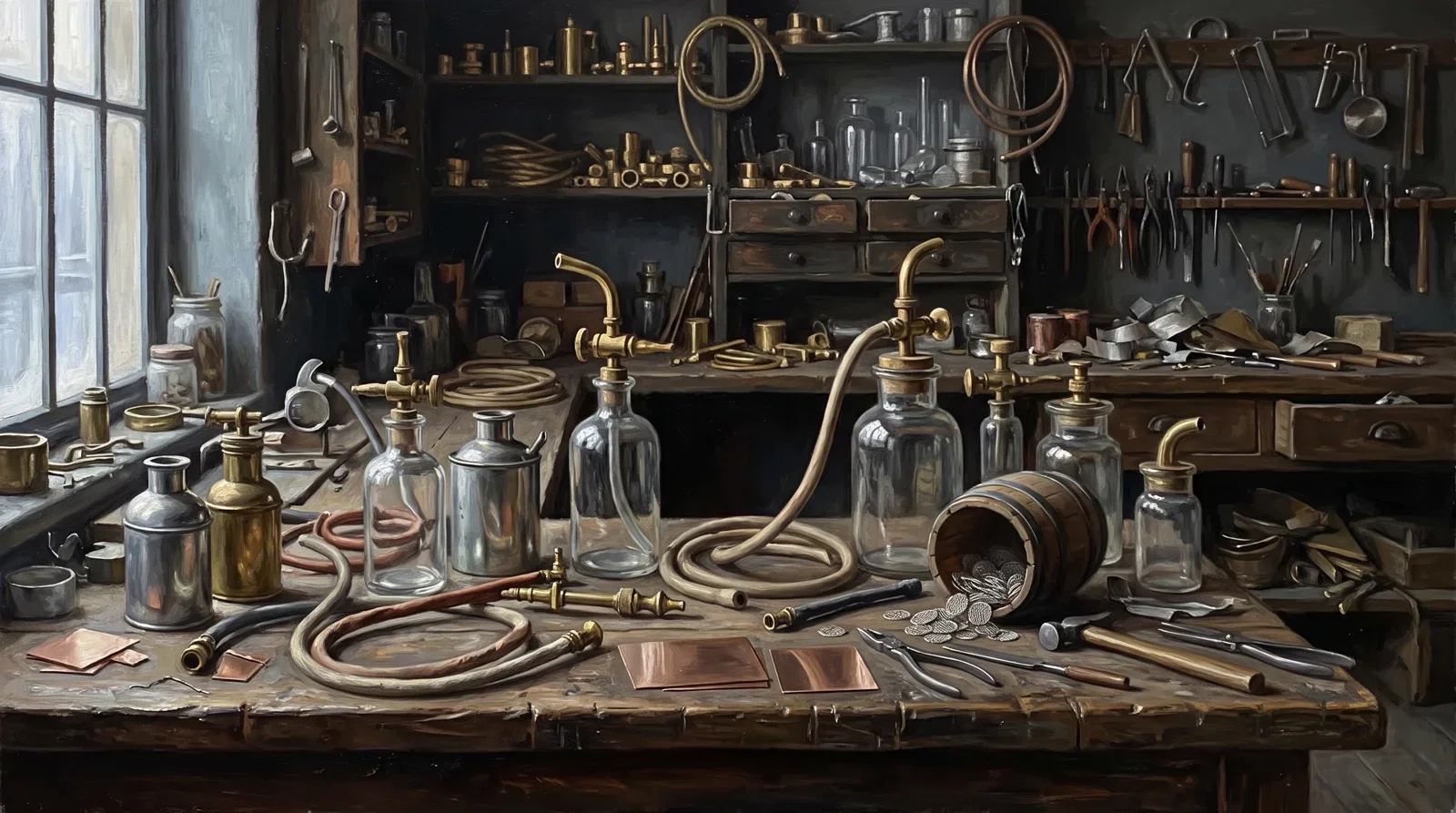
The Paris instrument maker Charrière recorded three months of inhalers built for the Paris hospitals and the changes surgeons asked for.
Reading Library · Anesthesia Epochs · 中文版
Watch the education video (for clinicians)
1847: Charrière's Ether Inhalers — What the Paris Surgeons Asked For · Anesthesia Epochs Education Series
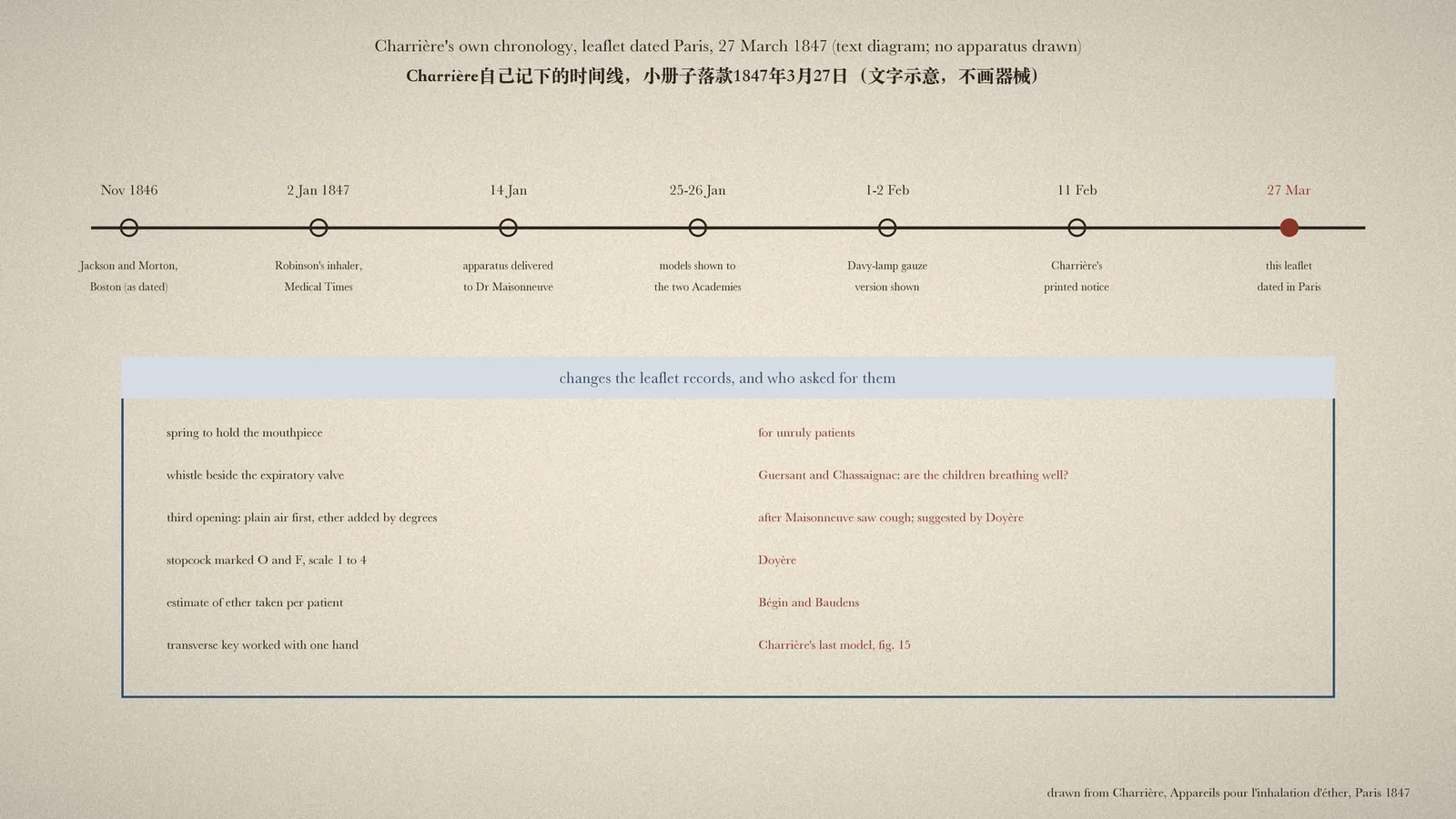
When ether reached Paris, surgeons needed something to give it with, and someone had to build it. In the winter of 1847 much of that work went to one shop near the Faculty of Medicine. Its owner kept a record, printed it with engravings, and signed it off "Paris, 27 mars 1847". [1, title page; p. 14]
The maker
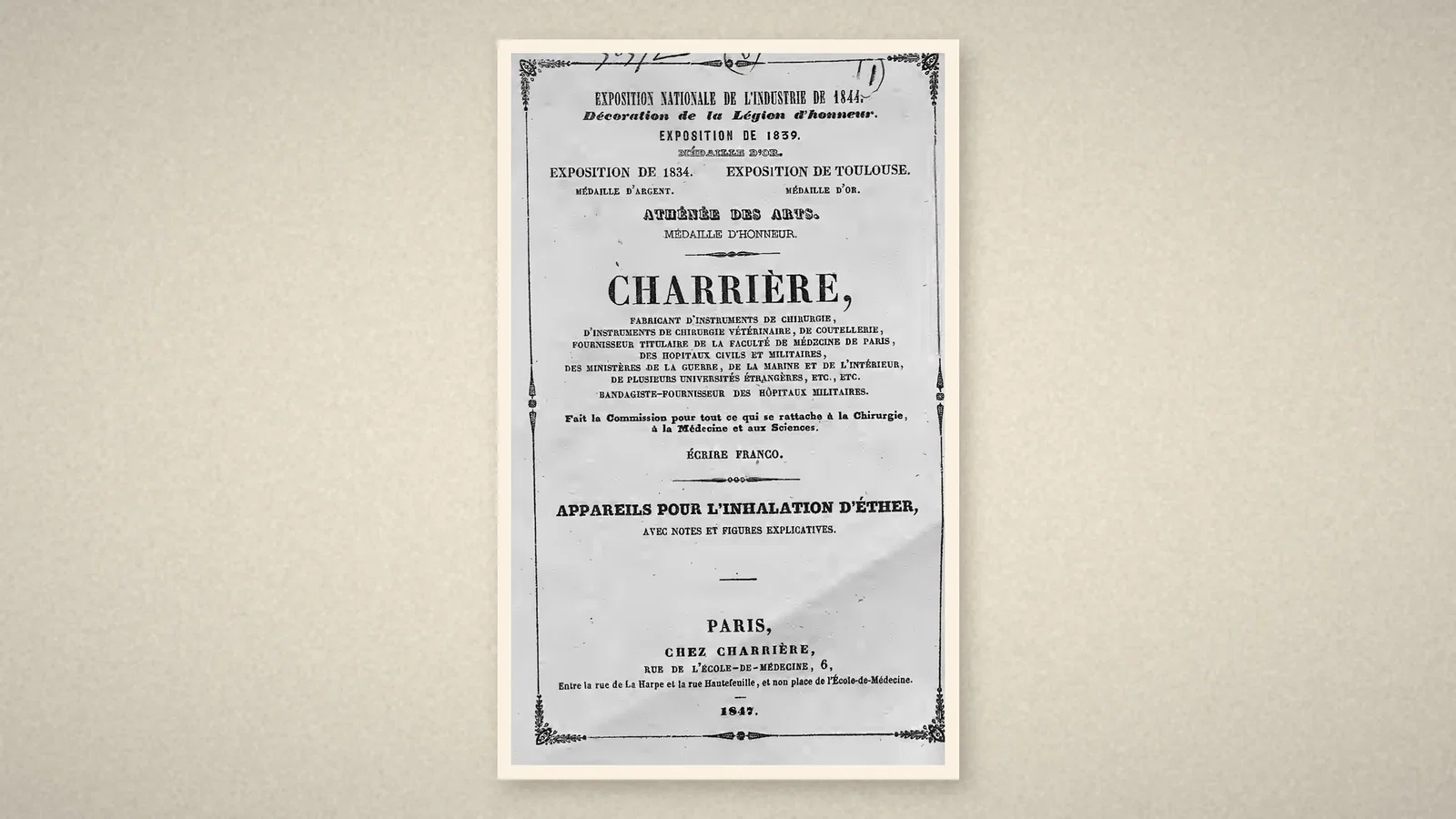
The title page names Charrière, "fabricant d'instruments de chirurgie", at 6 rue de l'École-de-Médecine, supplier to the Paris Faculty of Medicine, the civil and military hospitals and several ministries. The leaflet is called "Appareils pour l'inhalation d'éther, avec notes et figures explicatives". The models, it says, had been registered as the law required, and the description and price of each were at the end. [1, title page; p. 1]
A maker's chronology
Charrière set things out "in chronological order". First came the apparatus of Jackson and Morton, put into practice in Boston, by Charrière's dating, in November 1846, shown in figure 1 from a model passed on by a Dr Fisher of the United States; then Robinson's inhaler, described in the Medical Times on 2 January 1847. Both had independent double valves. [1, pp. 1-2]
The apparatus, Charrière wrote, "was made in France from the first days of 1847", and was soon modified as practice demanded. A footnote records one apparatus delivered to Dr Maisonneuve on 14 January. New models went to the Academy of Sciences and the Academy of Medicine at their sessions of 25-26 January and 1-2 February, after working, by Charrière's account, in all the civil and military hospitals of Paris. [1, p. 2]
The Charrière model
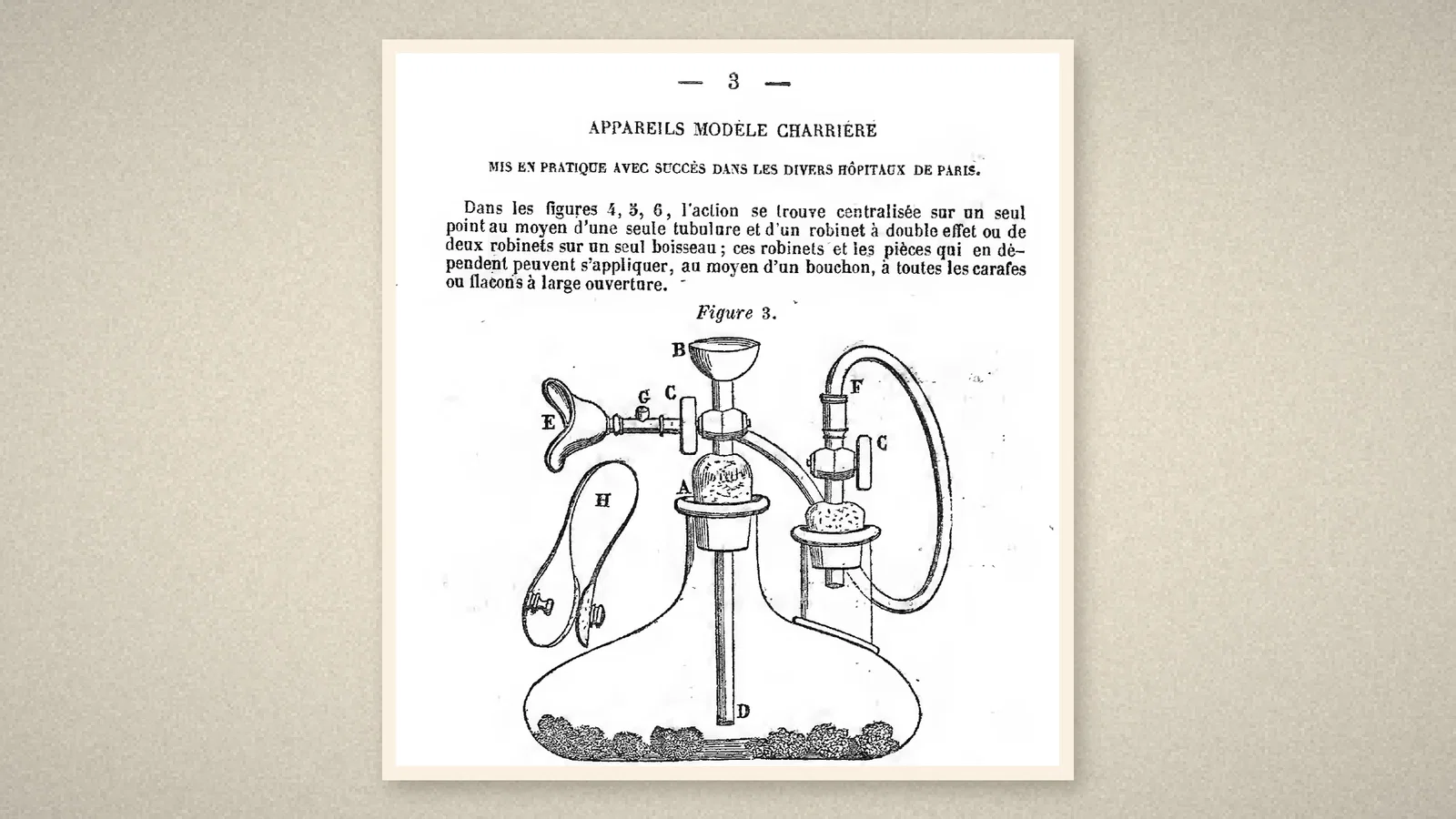
The models were headed "put into practice with success in the various hospitals of Paris". The idea was to centralise everything on one opening with a double-effect stopcock, so that the fittings could be pushed with a cork into any wide-mouthed bottle or carafe. One version added a barrel of wire-gauze discs "on the principle of Davy's lamp"; another used a small flask, proposed by Dr Morel Lavallée, warmed in the hand to help the ether evaporate. Roux, Velpeau, Dubois, Gerdy, Blandin, Malgaigne, Baudens, Ricord, Jobert, Guersant and Maisonneuve are named as users. [1, pp. 3-5]
What surgeons asked for
The most useful pages are the list of changes, each with a name attached. For unruly patients Charrière added a spring that held the mouthpiece on the mouth. At the request of Guersant and Chassaignac, a whistle went beside the expiratory valve, so that one could tell whether "les jeunes malades aspirent et expirent bien", whether the children were breathing in and out well. Experience showed that a sudden breath of air saturated with ether caused cough and even suffocation; Maisonneuve had managed it by applying the mouthpiece first and connecting it to the reservoir only gradually, and Doyère proposed a third opening in the stopcock, so that the patient first breathed plain air and saturated air was then added by degrees. The stopcock was stamped O and F, with a scale from 1 to 4 between. Bégin and Baudens suggested a graduated vessel to estimate how much ether each patient took. [1, p. 6]
Materials mattered too. Copper and nickel silver oxidised; Charrière preferred fine tin, and found glass and porcelain safe but too easily broken. [1, p. 1]
Everyone else's
The leaflet does not stop at the maker's own work. It describes the London inhalers of Hooper, Smee, Startin and Squire as they appeared in the medical press; a pipe-shaped apparatus with a mask built for Professor J. Cloquet; the Lyon apparatus of Bonnet and Ferrand, with an air-filled rubber cushion between mask and face; and the simplest method of all, from Mayor of Lausanne: sponges soaked in ether in a basin, the patient's head held over it under a sheet of oilcloth with a glass window, so the doctor could watch the face. [1, pp. 7-10]
The last model
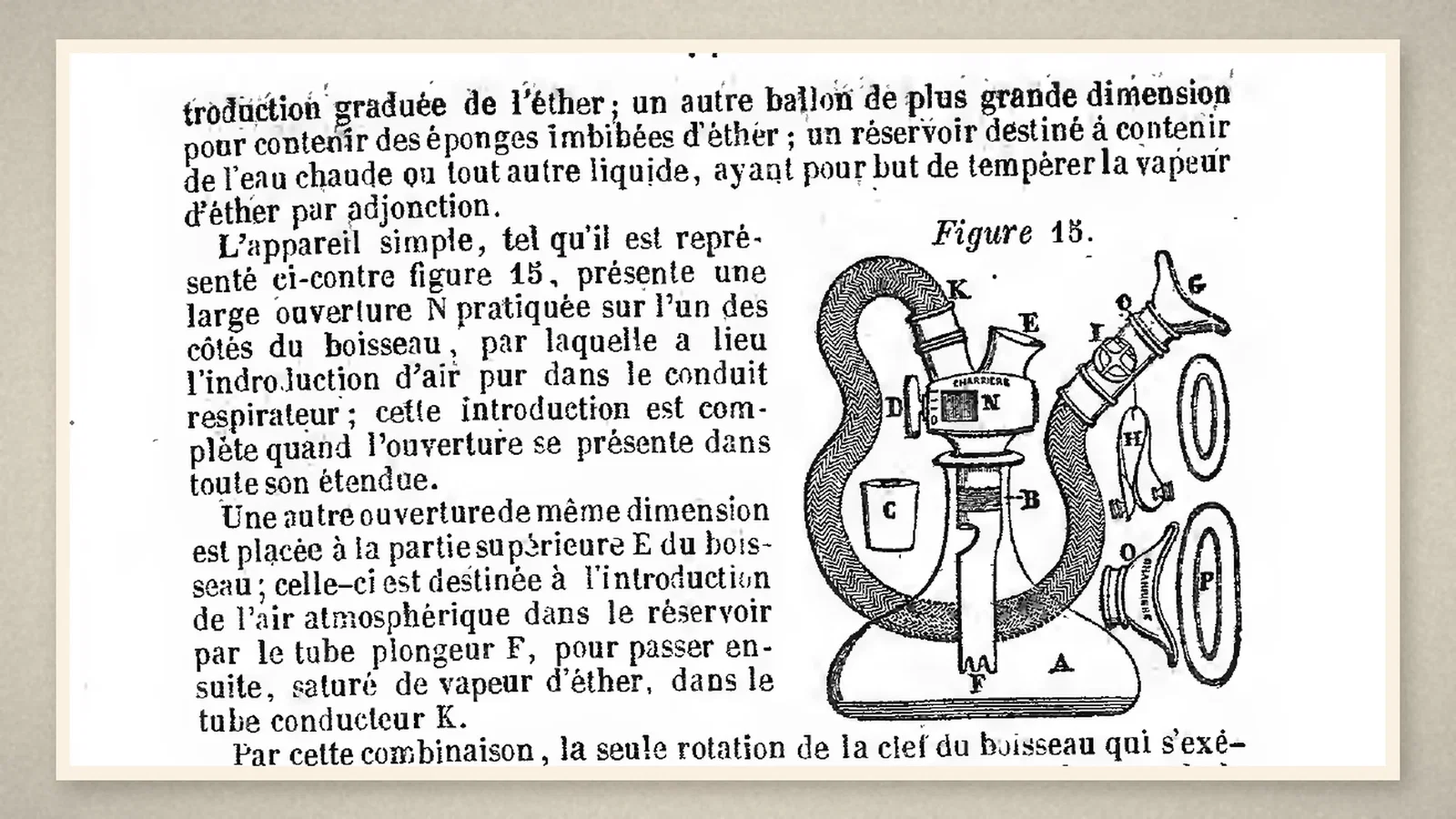
After hearing "a great number of opinions and criticisms", Charrière settled on a stopcock with a transverse key and wide channels. Its advantage was that one hand was always enough, "above all when the operator is alone". A single turn of the key set both the ether vapour and the plain air, one opening growing as the other shrank. [1, pp. 10-11]
What the record shows
A record kept by the person who built the apparatus. It shows, request by request, how the first weeks of ether in Paris turned into equipment: a way to start with plain air, a scale on the tap, a whistle to listen to a child breathe, a design for an operator with no assistant.
Sources and reading limits
Read: Charrière, "Appareils pour l'inhalation d'éther, avec notes et figures explicatives" (Paris, 1847; dated 27 March 1847), the whole leaflet with title page and trade list.
Not covered: Charrière's printed notice of 11 February 1847; the Comptes rendus and the Bulletin of the Academy of Medicine for the January and February sessions; Pajot's brochure with the clinical observations; the Wood Library-Museum video.
Limits: this is the maker's own account and a sales document with prices at the end; that the apparatus worked "with success" in the Paris hospitals is Charrière's statement, and Boston's November date is Charrière's dating. The leaflet gives no first names for the maker and most surgeons, and none are added here. Prices, dimensions and capacities are not repeated. Quotations are translated from the French.
Three illustrations are crops of the leaflet (title page, pp. 3 and 11); one is a text diagram drawn from it, with no apparatus drawn.
- Charrière. Appareils pour l'inhalation d'éther, avec notes et figures explicatives. Paris: Charrière; 1847. BIU Santé 50592x06x01. Internet Archive
Continue exploring
Related reading connects shared questions and contexts; it does not by itself establish historical influence.
- 1847: Hedley's Wooden Ether Inhaler in the Pharmaceutical Journal
- 1846: Squire Assembles an Ether Inhaler for Liston's Thigh Amputation
- 1846: Hooper Builds an Ether Inhaler to Boott and Robinson's Design
- 1846: Fisher's Ether Fails in Paris Before a Boston Inhaler Succeeds
Anesthesia Epochs · The Source Room · About & Editorial Method
Published November 3, 2026. Sources and reading limits are stated above. Illustrations are labelled as original source images or AI-made. Historical accounts are educational; they are not current treatment instructions.