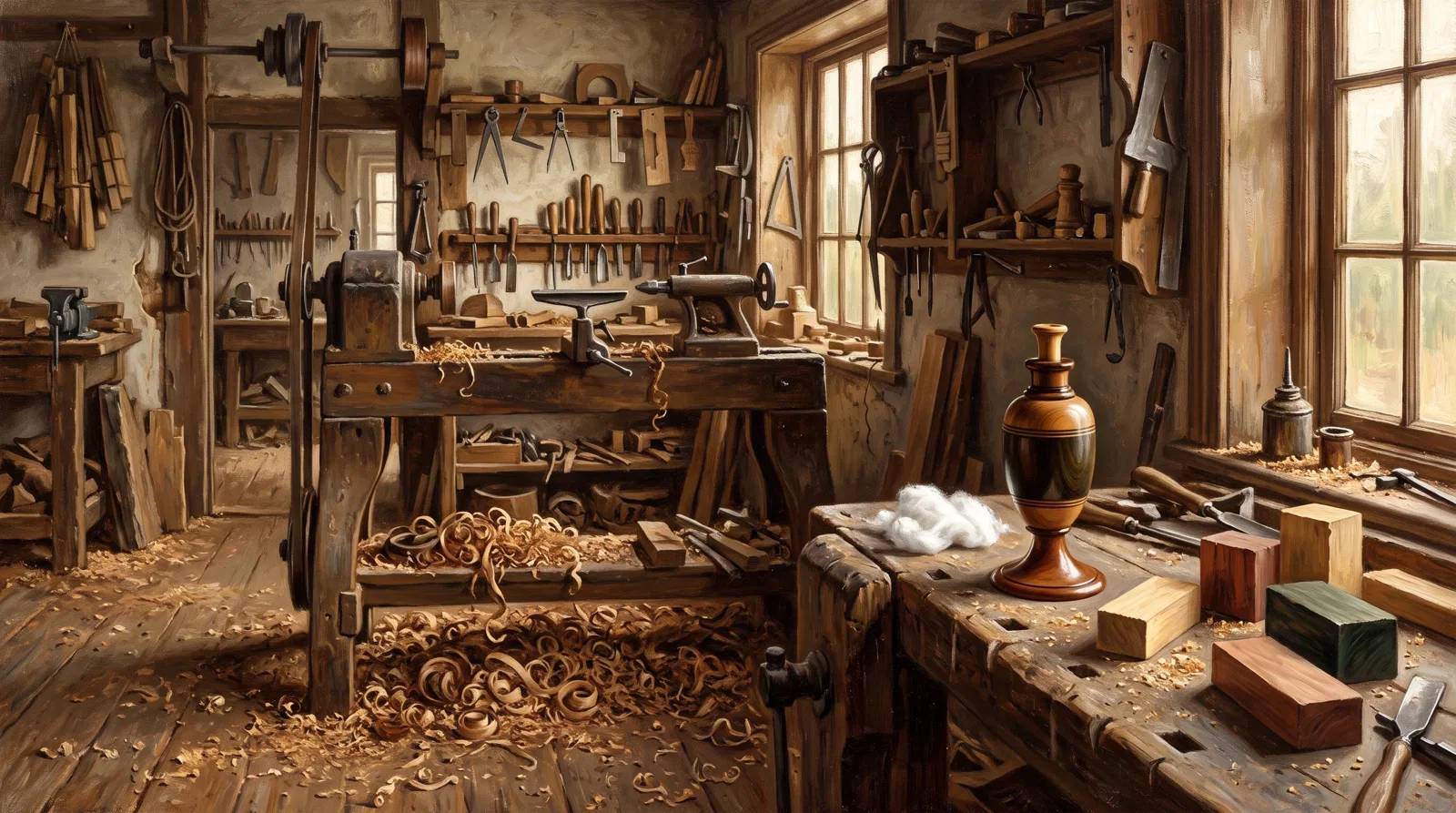
The Pharmaceutical Journal printed four portable ether inhalers, among them Hedley of Bedford's bottle made of boxwood, mahogany, cherry and lignum vitae.
Reading Library · Anesthesia Epochs · 中文版
Watch the education video (for clinicians)
1847: Hedley's Wooden Ether Inhaler — The Pharmaceutical Journal · Anesthesia Epochs Education Series
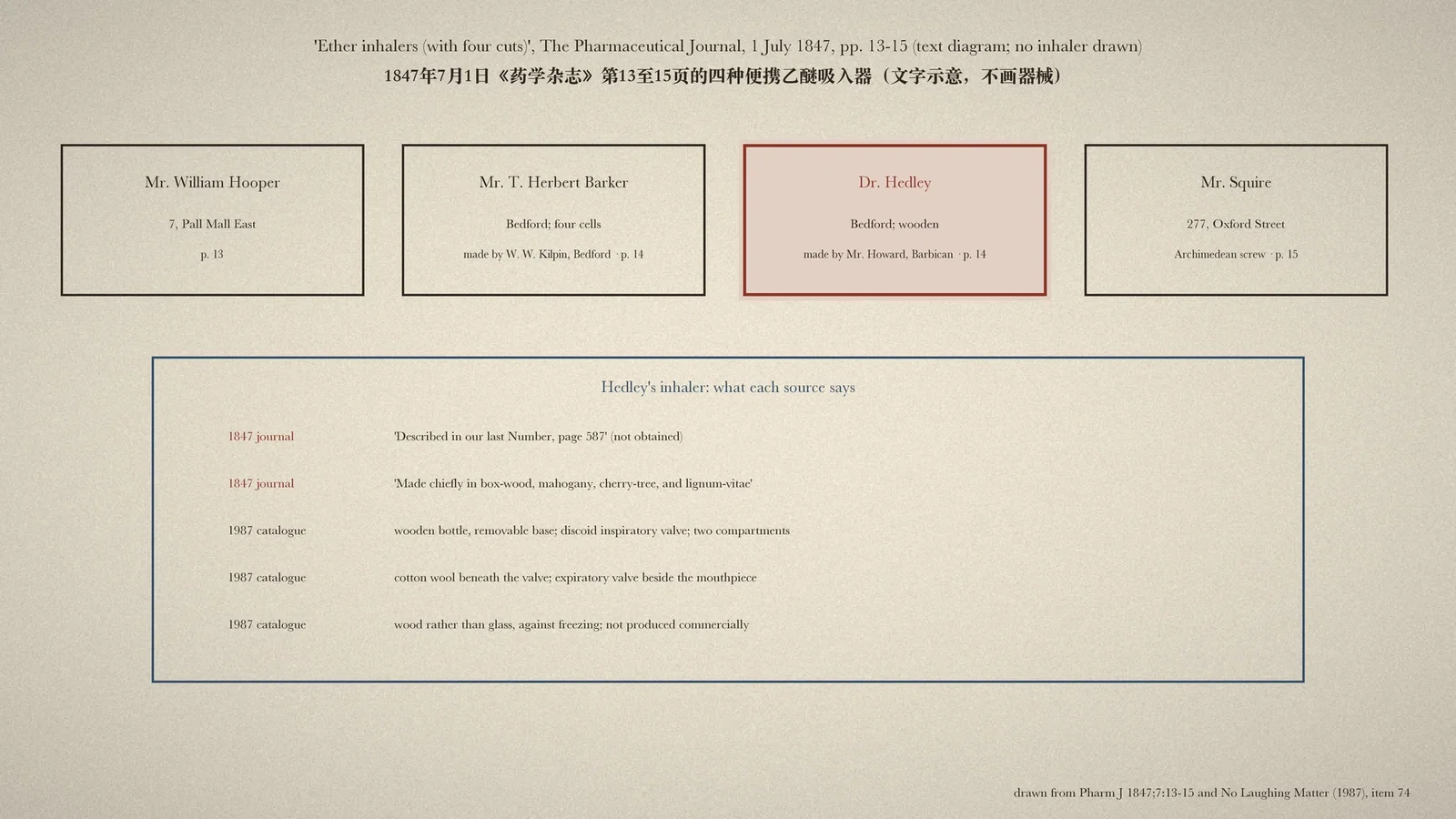
In the first months of ether anaesthesia in Britain, the problem looked like one of equipment. How should the vapour reach the patient, how much air should come with it, and what should the breath go back through? Doctors and instrument makers answered with devices, and the pharmaceutical press printed them. One of those devices was made of wood. [1, pp. 13-15][2, p. 25]
Four cuts in one issue
The Pharmaceutical Journal and Transactions, edited by Jacob Bell, opened its seventh volume with No. I, dated 1 July 1847. The contents list "Ether Inhalers (with four cuts)" at p. 13. On three pages the journal printed four portable ether inhalers: that of Mr. William Hooper of 7 Pall Mall East; the "four-celled portable ether inhaler" of Mr. T. Herbert Barker of Bedford; the ether inhaler of Dr. Hedley, also of Bedford; and the portable ether inhaler of Mr. Squire of 277 Oxford Street. [1, pp. 13-15]
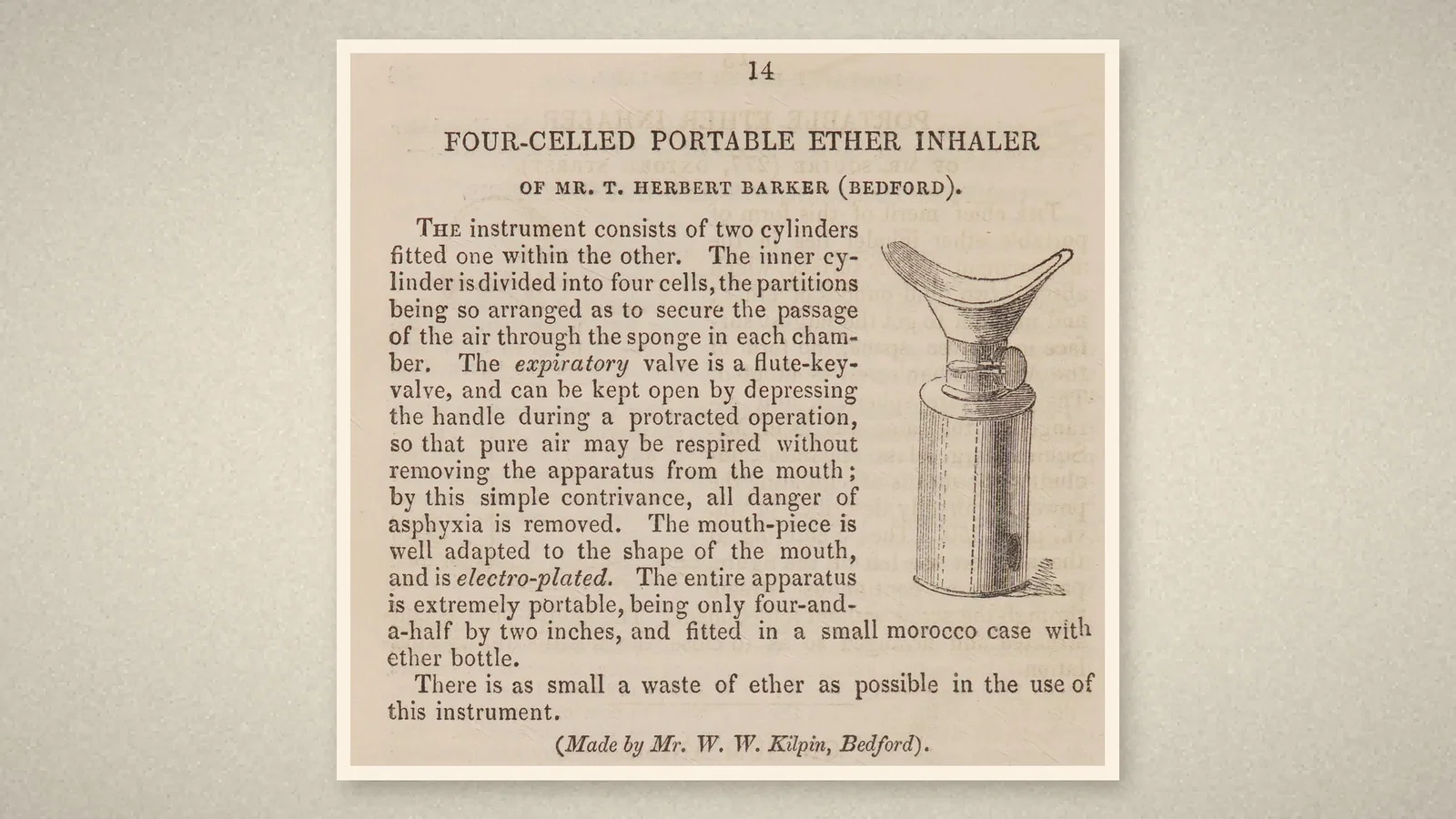
The entries are short and practical. Barker's instrument "consists of two cylinders" fitted one inside the other, the inner divided into four cells so that the air passed through the sponge in each; its expiratory valve could be kept open by pressing a handle during a long operation, so that the patient breathed plain air without the apparatus being taken from the mouth. It was made by W. W. Kilpin of Bedford. Squire's used a spiral surface, and its mouthpiece was built to close the nostrils. A note under Hooper's promised a cut, the following month, of an inhaler for horses. [1, pp. 13-15]
Hedley's entry
Hedley's inhaler gets a heading, an engraving and two lines. The heading reads "Ether inhaler of Dr. Hedley (Bedford)", and under it: "Described in our last Number, page 587." Under the cut: "Made chiefly in box-wood, mahogany, cherry-tree, and lignum-vitae", and "Made by Mr. Howard, Barbican." The volume's index lists it as "Hedley's, Dr., Ether Inhaler", p. 14. [1, p. 14]
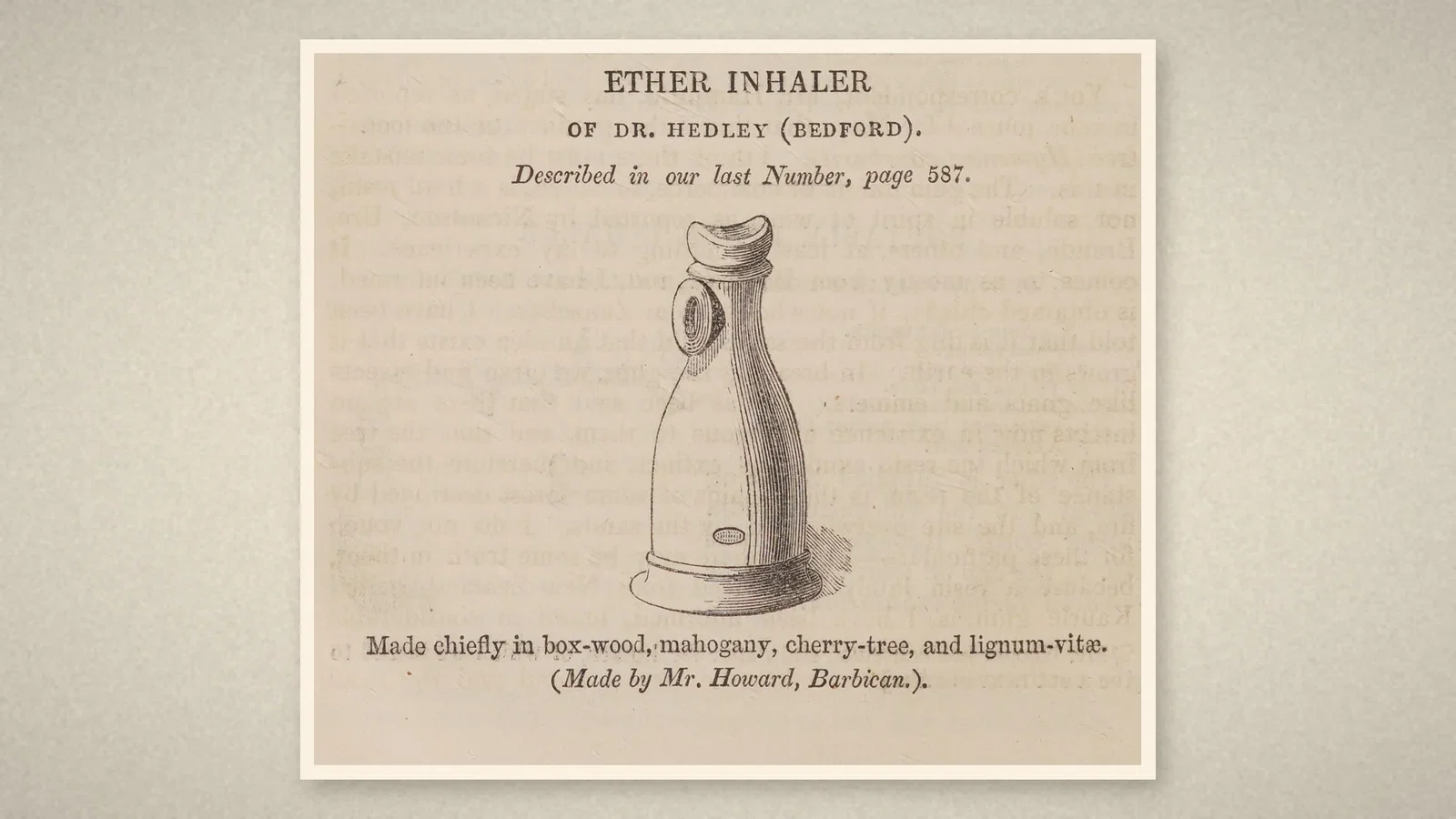
The engraving shows a bottle-shaped instrument on a broad foot, a mouthpiece at the top, a round fitting on the side just below the mouthpiece and a small oval opening near the base. The journal labels none of these. What they did is not stated on this page; the explanation was in the previous number, at p. 587 of vol. 6, which could not be obtained for this article. [1, p. 14]
The surviving example
A Hedley inhaler survives. In 1987 the Wellcome Institute for the History of Medicine and the Science Museum held an exhibition called "No Laughing Matter: historical aspects of anaesthesia", and the catalogue lists it as item 74, "Hedley's ether inhaler", dated 1847. [2, p. 25]
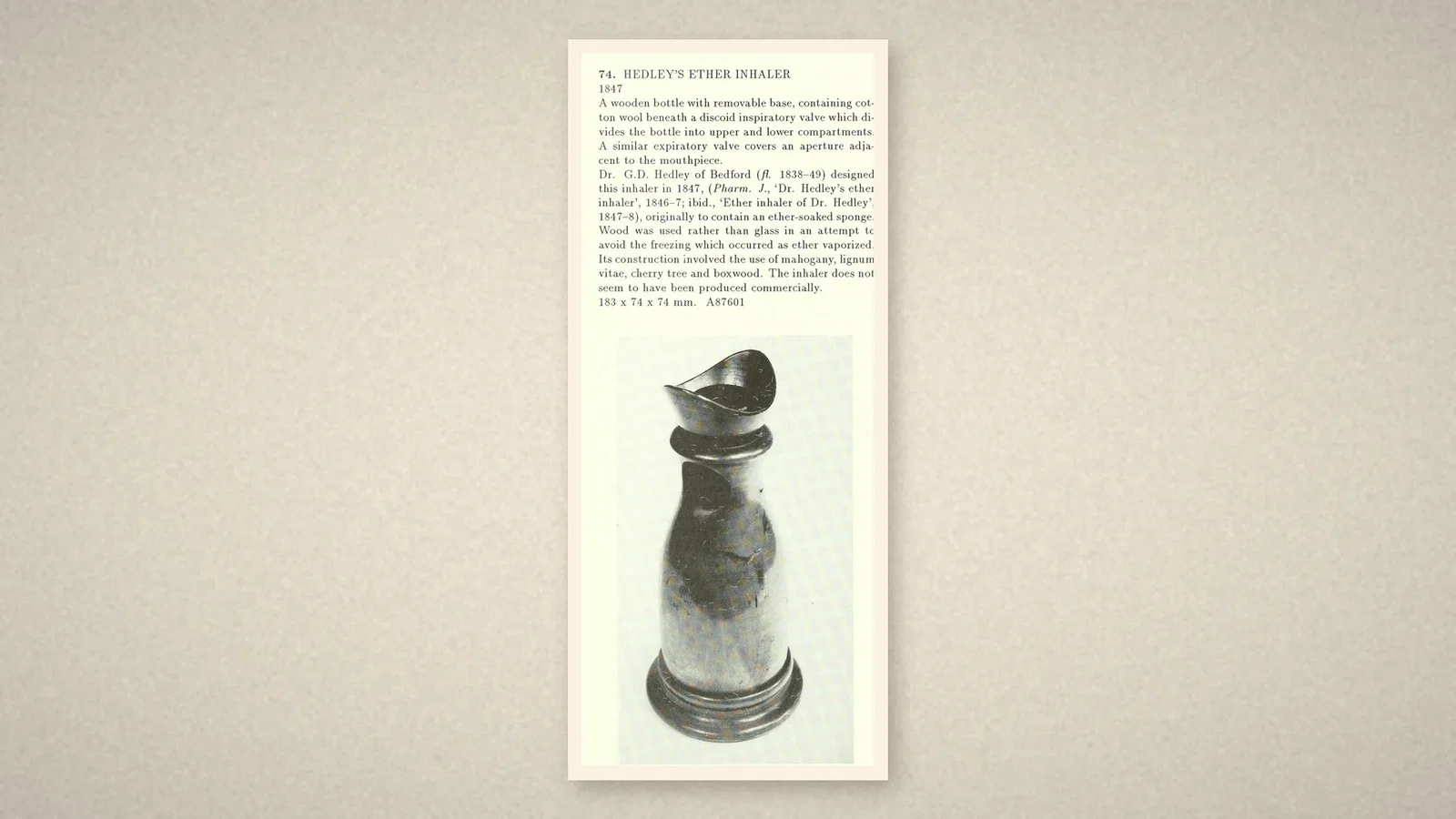
The catalogue describes "a wooden bottle with removable base". Inside, cotton wool lay beneath "a discoid inspiratory valve" that divided the bottle into an upper and a lower compartment, and "a similar expiratory valve covers an aperture adjacent to the mouthpiece". The catalogue names the designer as Dr. G. D. Hedley of Bedford, says the inhaler was designed in 1847 "originally to contain an ether-soaked sponge", and offers a reason for the material: "Wood was used rather than glass in an attempt to avoid the freezing which occurred as ether vaporized." It lists the same four woods as the 1847 journal, and closes: "The inhaler does not seem to have been produced commercially." Its bibliography gives both journal references, "Dr. Hedley's ether inhaler", Pharmaceutical Journal 1846-7, vi: 587, and the July 1847 cut. [2, p. 25 and bibliography]
What the record shows
A small instrument from the months when everyone tried a version. Two inhalers from one provincial town appeared on the same page, each made by a different craftsman. Hedley's is the one made of four woods, and the catalogue's explanation is that wood was chosen to avoid the freezing seen when ether evaporated in glass. The page also shows how quickly the field moved: before the volume ended, its index listed chloroform inhalers as well.
Sources and reading limits
Read: The Pharmaceutical Journal and Transactions vol. 7, No. I, 1 July 1847, pp. 13-15, "Ether inhalers (with four cuts)", with the contents and index; the 1987 Wellcome Institute catalogue "No Laughing Matter", item 74 and its bibliography.
Not covered: the original description, "Dr. Hedley's ether inhaler", Pharmaceutical Journal vol. 6 (1846-7), p. 587; the Wood Library-Museum video and the Science Museum's own record of the object.
Limits: how the valves and compartments work is known here only from the 1987 catalogue; the 1847 cut shows the outside and labels nothing. The designer's initials, the reason for using wood and the judgement that the inhaler was not made commercially are the catalogue's statements. Nothing read here records how often, or on whom, the inhaler was used. Dimensions are not repeated.
Three illustrations are crops of the Pharmaceutical Journal (p. 14) and the 1987 catalogue (p. 25); one is a text diagram drawn from them, with no instrument drawn.
- Ether inhalers (with four cuts): Ether inhaler of Dr. Hedley (Bedford). Pharm J Trans. 1847;7(1):13-15. Internet Archive
- Lawrence C, Lawrence G, Geddes H, Ward L. No laughing matter: historical aspects of anaesthesia. London: Wellcome Institute for the History of Medicine; 1987. Item 74. Internet Archive
Continue exploring
Related reading connects shared questions and contexts; it does not by itself establish historical influence.
- 1846: Squire Assembles an Ether Inhaler for Liston's Thigh Amputation
- 1846: Hooper Builds an Ether Inhaler to Boott and Robinson's Design
- 1847: Snow Makes Ether a Question of Observation and Control
- 1847: Charrière Prints an Illustrated Leaflet on Ether Inhalers
Anesthesia Epochs · The Source Room · About & Editorial Method
Published November 3, 2026. Sources and reading limits are stated above. Illustrations are labelled as original source images or AI-made. Historical accounts are educational; they are not current treatment instructions.