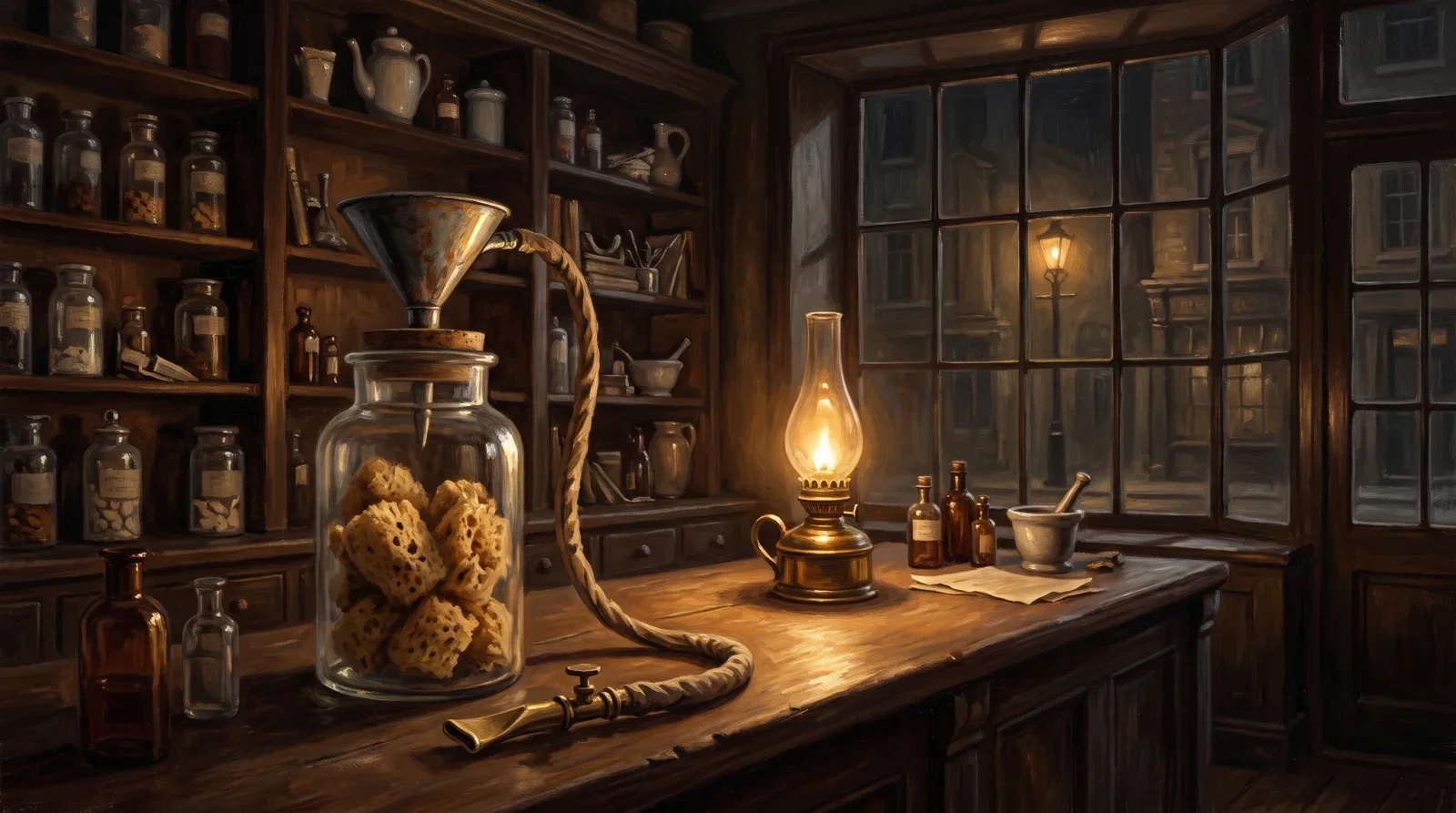
On 21 December 1846 Liston used ether for a thigh amputation with 'most perfect' results; Squire of Oxford Street had made the apparatus and later explained an improved version.
Reading Library · Anesthesia Epochs · 中文版
Watch the education video (for clinicians)
1846: Squire's Ether Inhaler — Put Hastily Together for Liston · Anesthesia Epochs Education Series
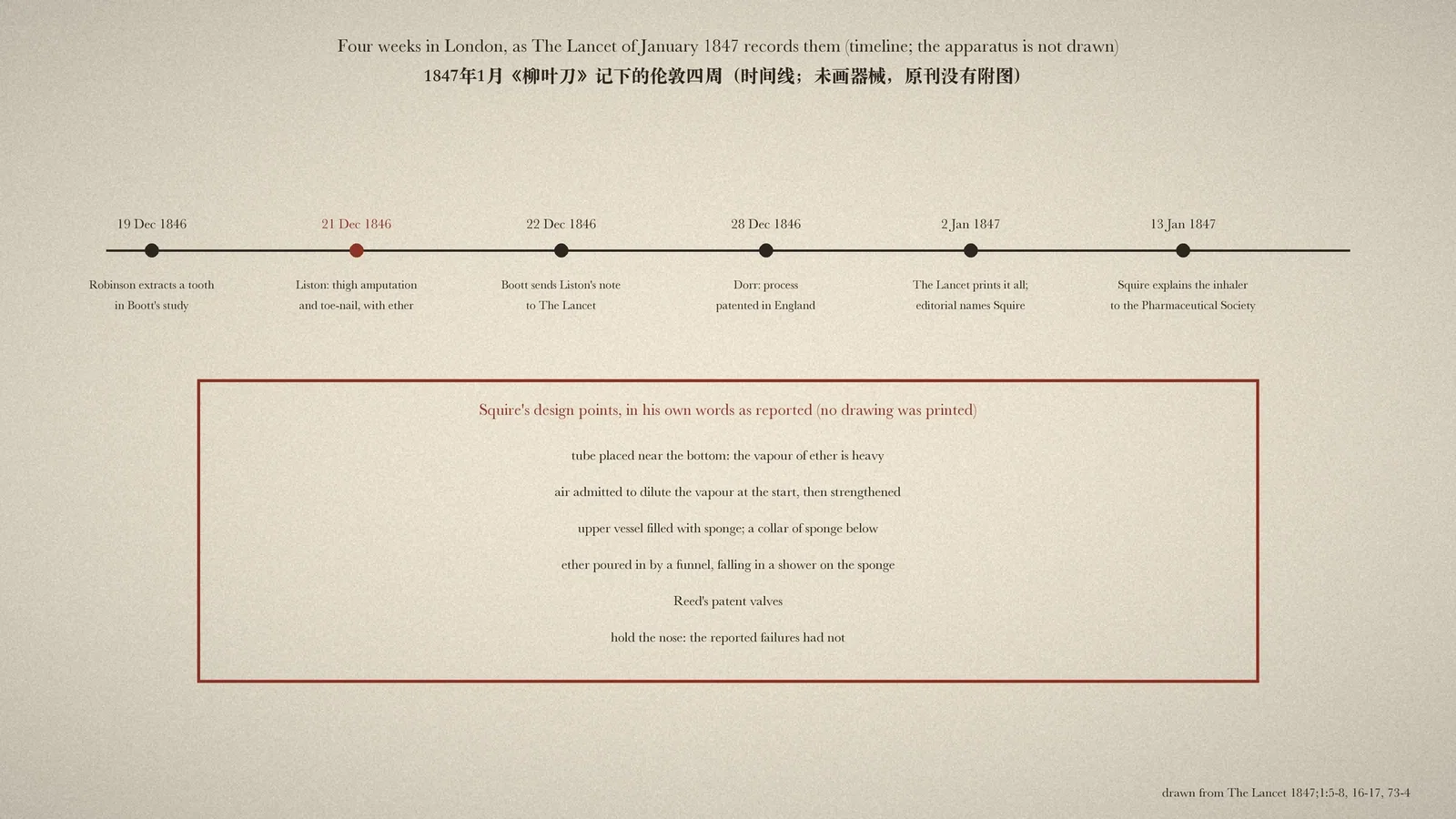
News of ether reached London by letter in December 1846. Within days it needed an object: something a patient could breathe the vapour from. Liston's operations under ether at University College Hospital were done with an inhaler made in a hurry by a pharmacist in Oxford Street, and The Lancet of January 1847 preserves both the surgeon's note and the maker's own account. [1][2][3]
Liston's note
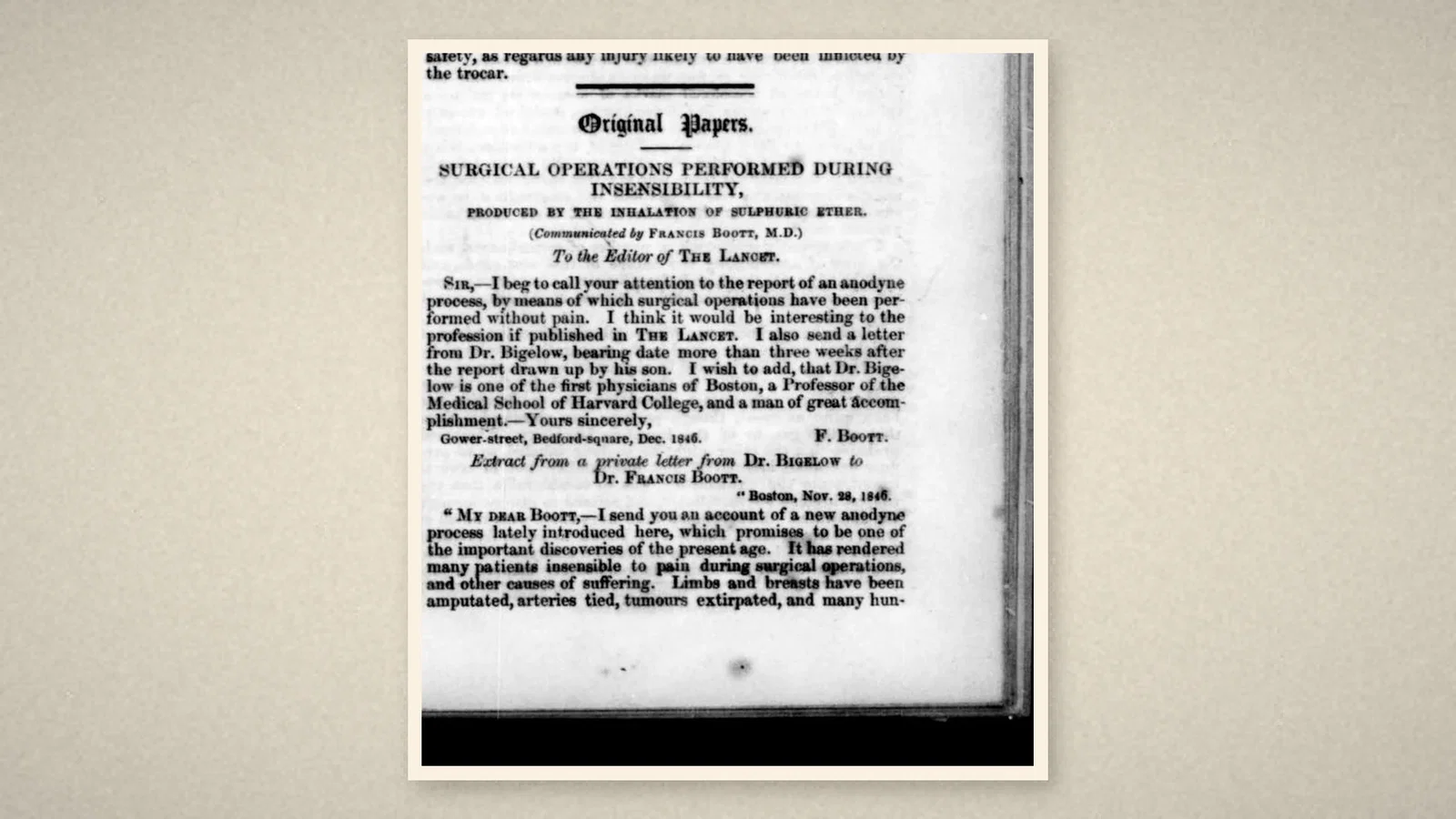
The Lancet of 2 January 1847 opened its original papers with "Surgical operations performed during insensibility", communicated by Francis Boott of Gower Street, who had received Bigelow's report from Boston. In a letter dated 21 December 1846 Boott described how, on Saturday the 19th, Mr. Robinson had extracted "a firmly fixed molar tooth" from Miss Lonsdale in Boott's study "without the least sense of pain", the whole process "over in three minutes"; the same apparatus then failed in three or four cases, which Boott blamed on a valve that "required a very strong expiration to make it act freely". [1, pp. 5-8]
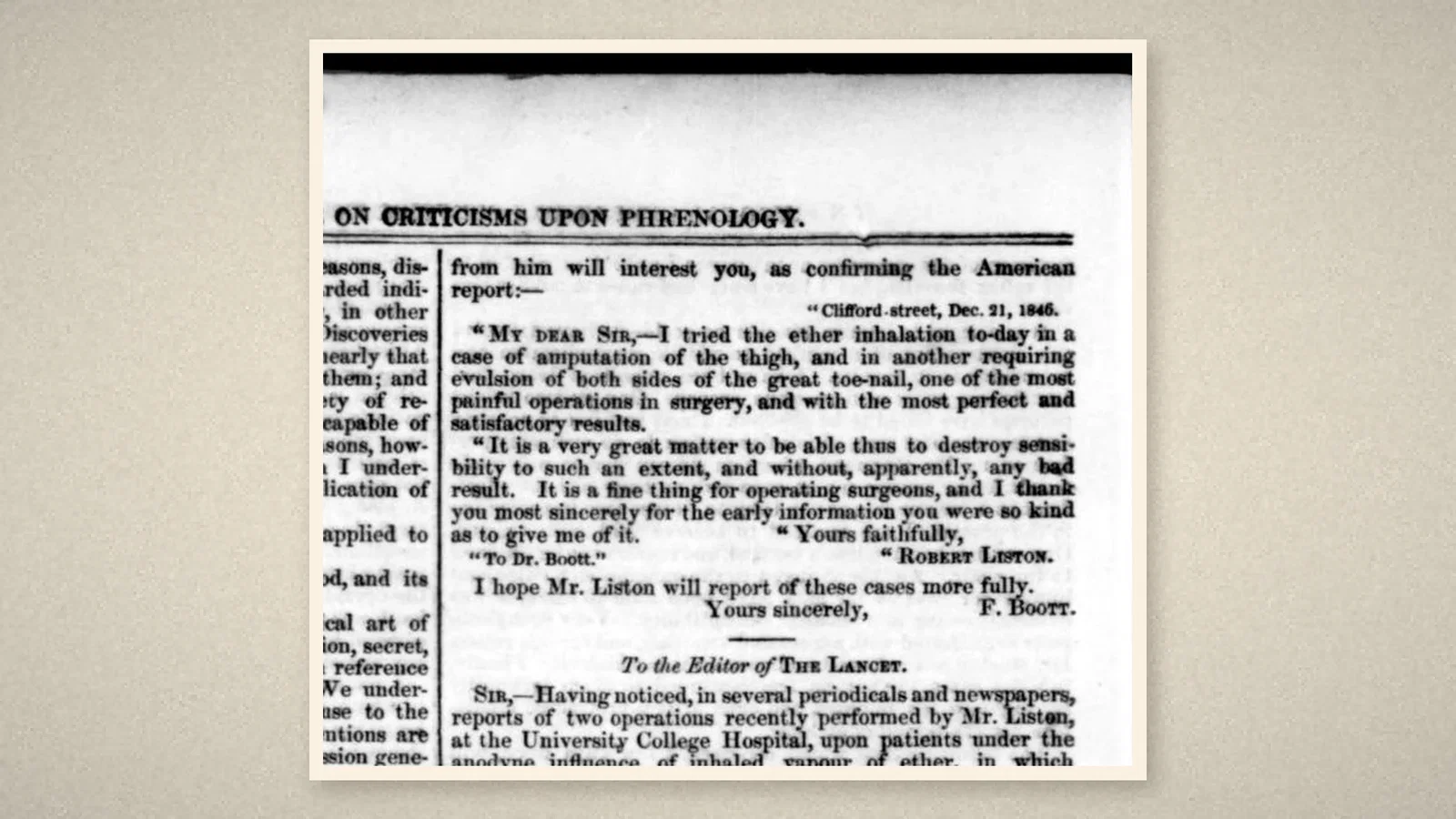
A second letter, of 22 December, enclosed a note from Robert Liston, written in Clifford Street on 21 December: "I tried the ether inhalation to-day in a case of amputation of the thigh, and in another requiring evulsion of both sides of the great toe-nail, one of the most painful operations in surgery, and with the most perfect and satisfactory results. It is a very great matter to be able thus to destroy sensibility to such an extent, and without, apparently, any bad result." On the same page James A. Dorr, agent for the American inventors, announced that the process was patented "for England and the Colonies". [1, p. 8]
The journal's editorial named the maker: "The operations of Mr. Liston, at University College Hospital, were performed after the inhalation of ether, by means of an apparatus contrived by Mr. Squires, of Oxford-street." [2, p. 16]
Squire's account
On 13 January 1847 the lecture room of the Pharmaceutical Society "was crowded this evening" to hear about "Mr. Squire's instrument". Squire called ether "the all engrossing subject". The "temporary apparatus" Squire had "put hastily together for Mr. Liston", for "the first capital operation in this country, without a sign even of pain", was "afterwards much improved". Two later operations had been reported as failures without any cause given; in both, Squire had found, "the noses of the patients were not held". Patients also differed in courage and needed encouragement and "a good deal of tuition in inhaling the vapour of ether from a tube". [3, p. 73]
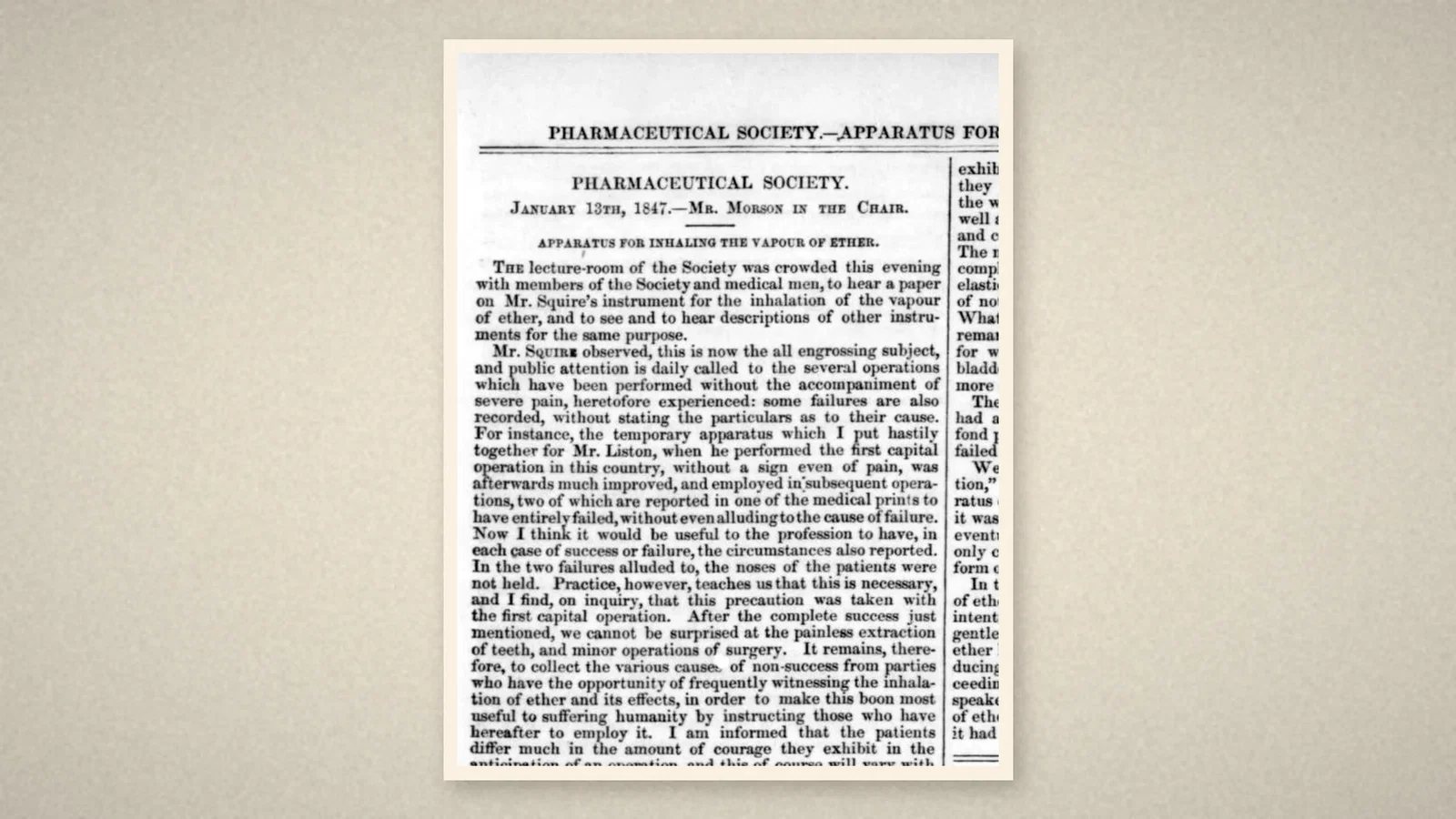
Then Squire explained the design. The maker had "taken into the account the weight of the vapour of ether" and placed the tube near the bottom; because the vapour made people cough, Squire had "regulated the supply of air to dilute it at the commencement of inhalation", increasing its strength as the patient could bear it; Squire had "filled the upper vessel with sponge" and put a collar of sponge around the descending tube; ether was poured in through a funnel and "falls in a shower on the sponge"; the valves were Reed's patent valves. Next, Mr. Hooper described improvements to an instrument "suggested by Dr. Boott and Mr. Robinson". [3, pp. 73-4]
What the record shows
An early piece of anaesthetic equipment in Britain, and how makeshift it was. The note from Liston records the result; the pharmacist's talk records what it took to get there: a hasty apparatus, failures nobody explained, a nose that had to be held, and a design reasoned from the weight of a vapour and the cough it caused.
Sources and reading limits
Read: The Lancet 1847, volume 1, pp. 5-8 (Boott's communication and letters with Liston's note, Dorr's notice), the editorial on pp. 16-17 and the Pharmaceutical Society report on pp. 73-4, with the volume index.
Not covered: Liston's own fuller account; a separate description or drawing of Squire's apparatus, including the Pharmaceutical Journal's report of the meeting; the Wood Library-Museum item. Hooper's apparatus and Robinson's paper belong to another article.
Limits: The Lancet spells the maker's name both Squire and Squires and gives no first name, so none is given here. "The first capital operation in this country" is Squire's phrase. No drawing of the apparatus was printed in these pages, so none is drawn here. The patent claim is Dorr's assertion. Quotations are from the English originals.
Three illustrations are crops of The Lancet (pp. 5, 8 and 73); one is drawn from these pages.
- Boott F. Surgical operations performed during insensibility; letters of 21 and 22 Dec 1846 with R. Liston's note. Lancet. 1847;1:5-8. Internet Archive
- [Editorial]. Lancet. 1847;1:16-17. Internet Archive
- Pharmaceutical Society. Apparatus for inhaling the vapour of ether. Lancet. 1847;1:73-4. Internet Archive
Continue exploring
Related reading connects shared questions and contexts; it does not by itself establish historical influence.
- 1846: The Ether Dome, a Breakthrough Without a Perfect Moment
- 1846: Hooper Builds an Ether Inhaler to Boott and Robinson's Design
Anesthesia Epochs · The Source Room · About & Editorial Method
Published November 3, 2026. Sources and reading limits are stated above. Illustrations are labelled as original source images or AI-made. Historical accounts are educational; they are not current treatment instructions.