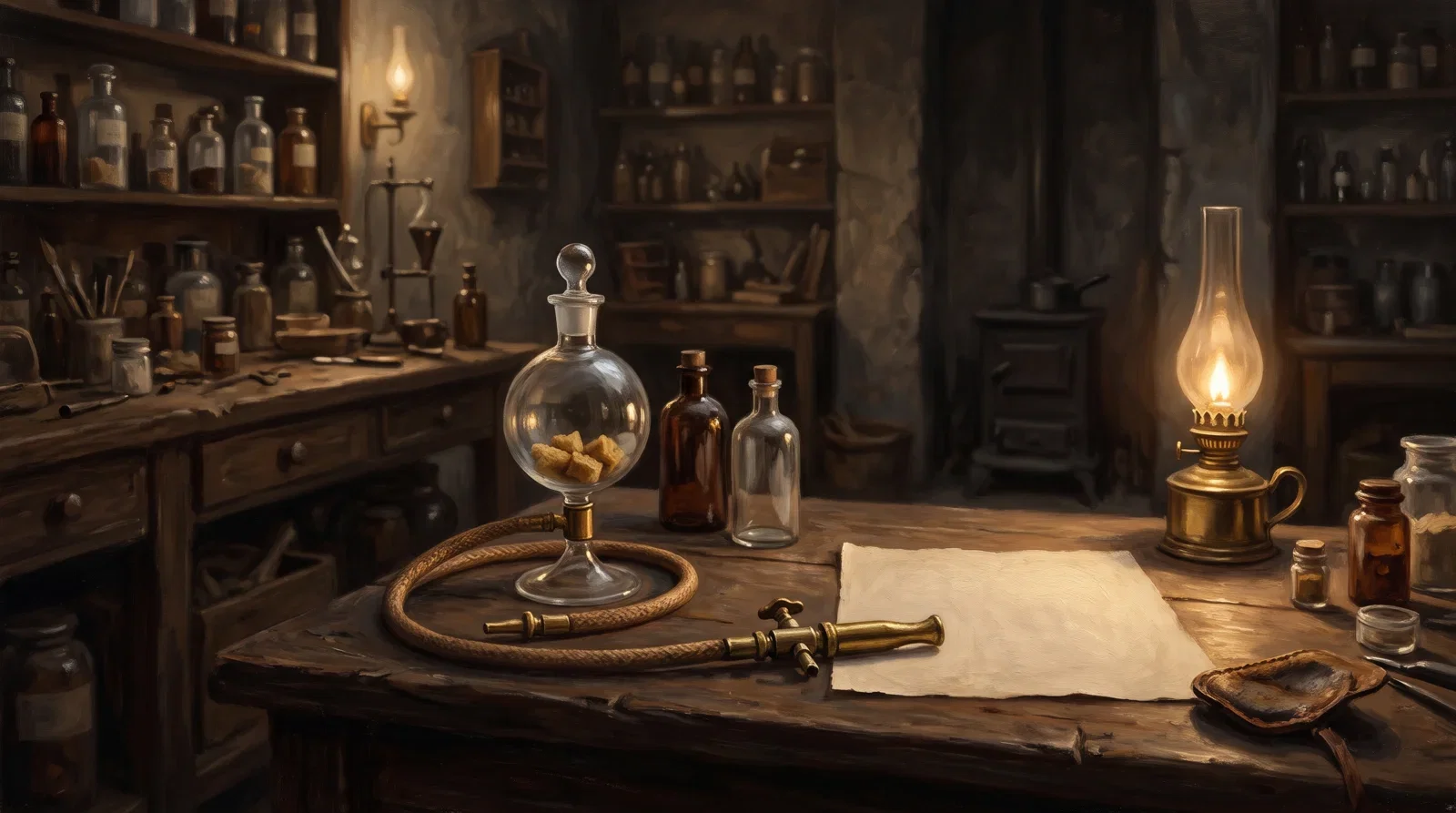
In January 1847 The Lancet printed an engraving of the ether inhaler that Hooper, a Pall Mall chemist, built to Boott and Robinson's instructions, with five requisites for its safe use.
Reading Library · Anesthesia Epochs · 中文版
Watch the education video (for clinicians)
1846: Hooper's Ether Inhaler — Five Requisites in The Lancet · Anesthesia Epochs Education Series
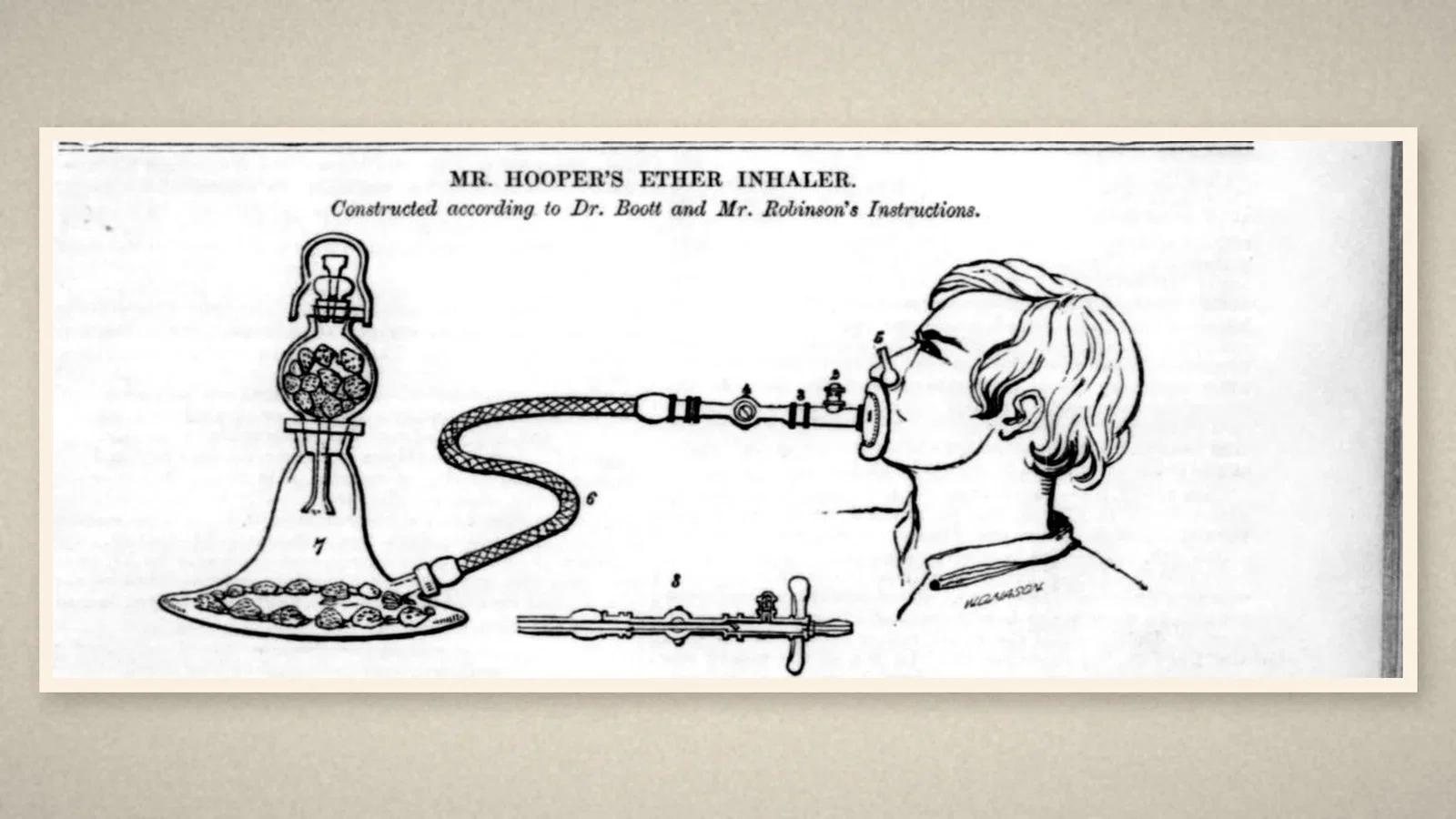
Early ether inhalers in London were described in letters and talks; this one was also drawn. In January 1847 The Lancet printed an engraving of an inhaler built by a chemist in Pall Mall to the instructions of the physician Francis Boott and the dentist James Robinson, together with five rules for using it, and on the same page a surgeon's operations with it on the last day of 1846. [1]
The engraving
"Mr. Hooper's ether inhaler. Constructed according to Dr. Boott and Mr. Robinson's instructions" shows a patient breathing from a mouth-piece connected by an elastic tube to a stoppered glass vessel. The key names the parts: a pad for the mouth, held on by the operator or an attendant; a horizontal valve for the escape of expired air; a vertical flap valve; a stop-cock; a nasal spring; the elastic tube; and glass vessels "containing small pieces of sponge saturated with ether". The full effect was "generally produced in two or three minutes". [1, p. 77]
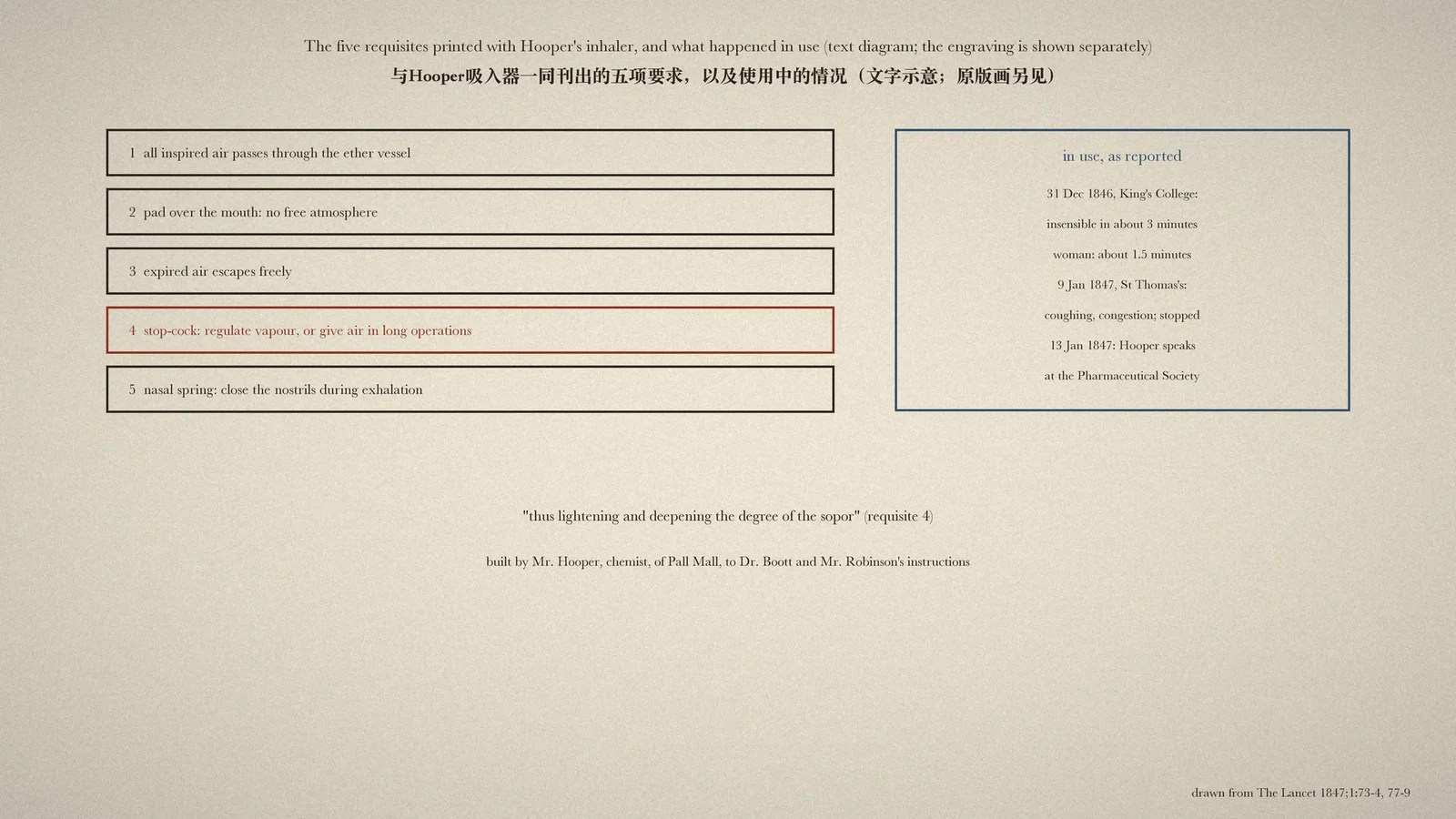
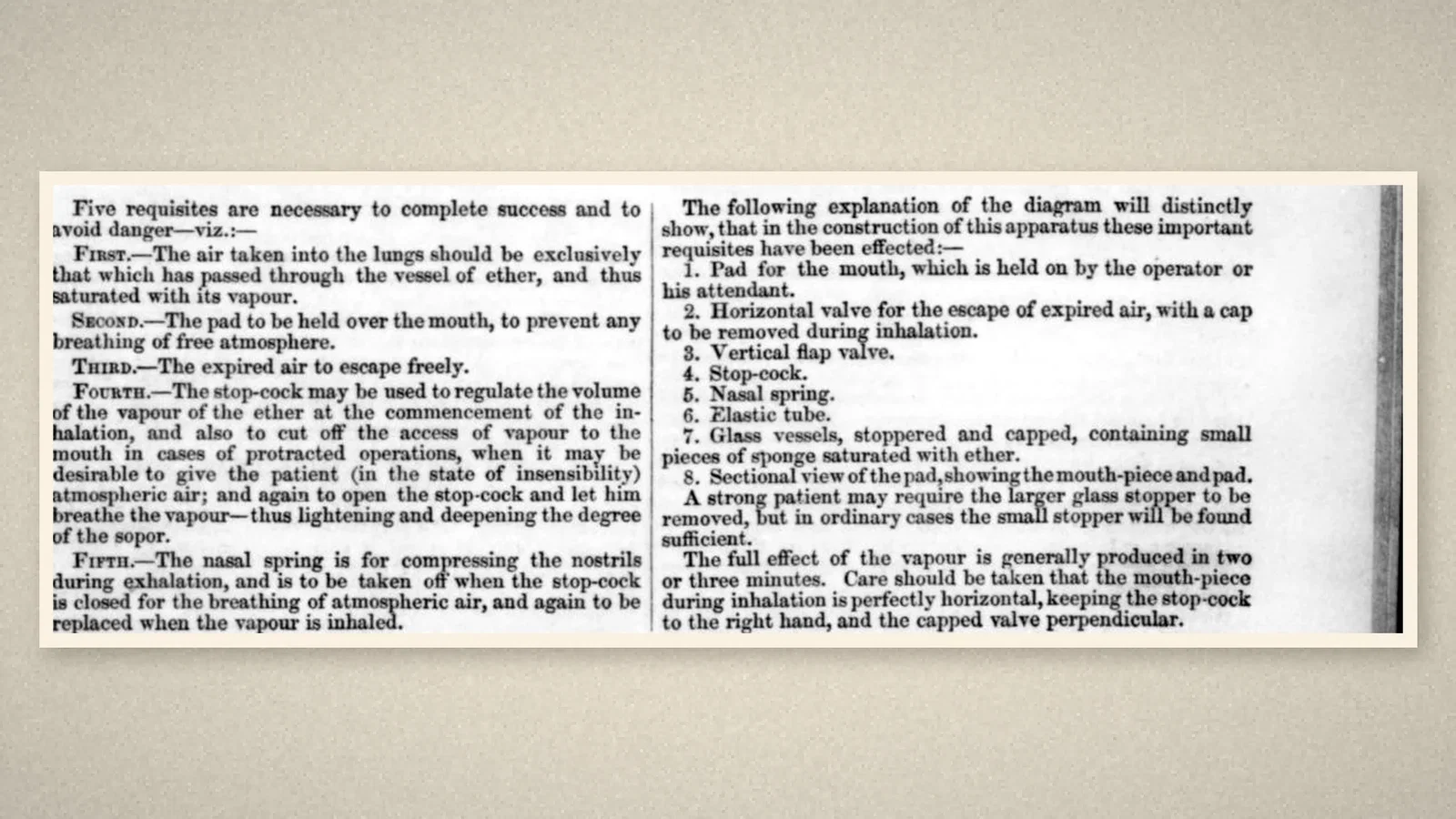
"Five requisites are necessary to complete success and to avoid danger." The air taken into the lungs should be "exclusively that which has passed through the vessel of ether"; the pad must cover the mouth "to prevent any breathing of free atmosphere"; the expired air must escape freely; the stop-cock could regulate the vapour at the start or cut it off in long operations, giving the insensible patient air and then vapour again, "thus lightening and deepening the degree of the sopor"; and the nasal spring closed the nostrils during exhalation. [1, p. 77]
In use
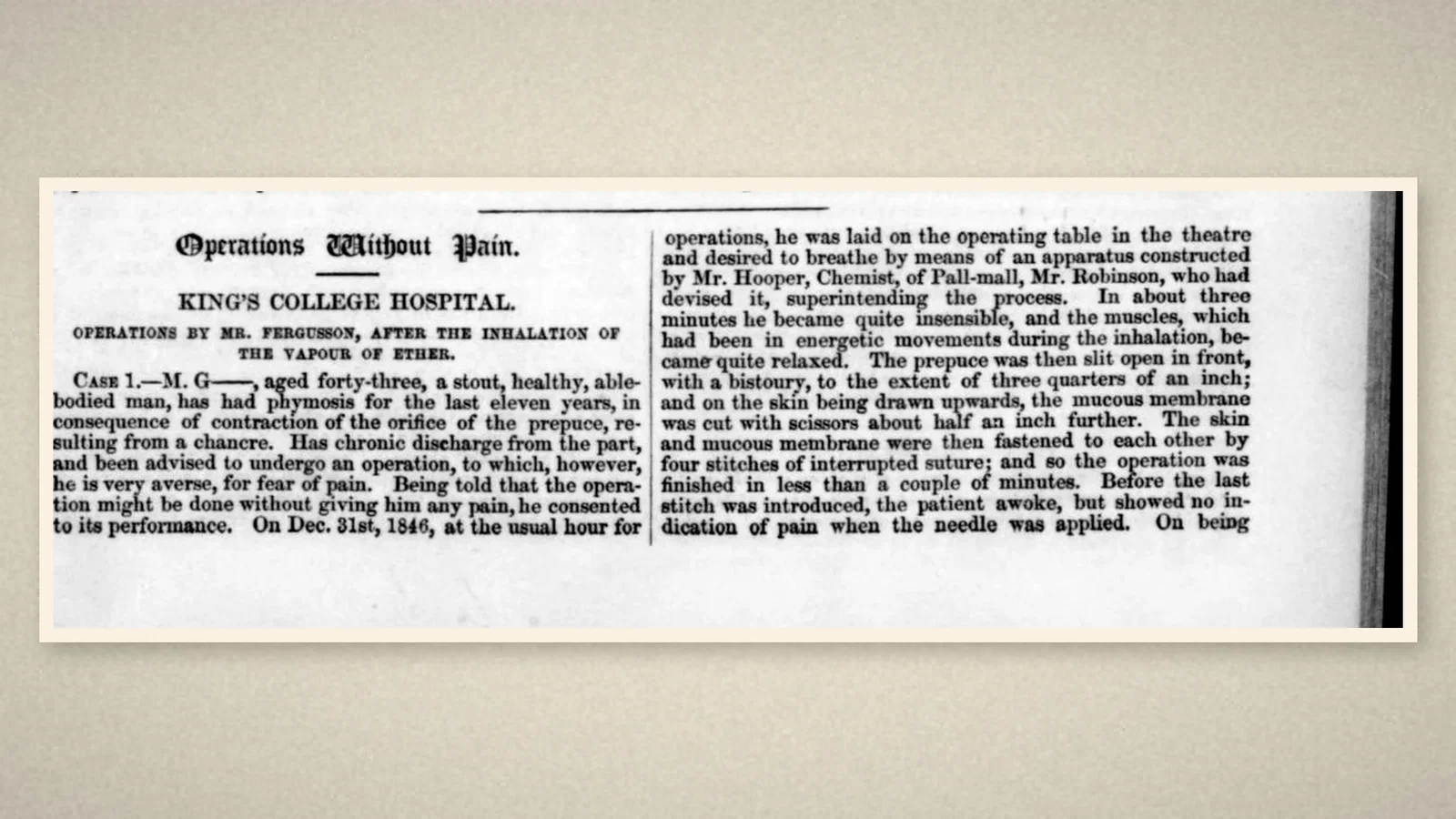
Beneath the engraving, "Operations without pain" reported Fergusson's cases at King's College Hospital. On 31 December 1846 a man of forty-three, afraid of pain, was laid on the operating table "and desired to breathe by means of an apparatus constructed by Mr. Hooper, Chemist, of Pall-mall, Mr. Robinson, who had devised it, superintending the process". In about three minutes the patient was insensible; the operation took less than two minutes; afterwards the patient remembered nothing. A woman of twenty-six with a painful abscess, using "the same apparatus", became insensible after about a minute and a half and felt only "a pain like that of a leech-bite". [1, pp. 77-8]
Not every use went well. At St Thomas's Hospital on 9 January a strong man breathed ether through "Mr. Hooper's apparatus, as devised by Dr. Boott and Mr. Robinson" and became insensible, but there was "so much coughing, turgidity of the face, quickened circulation, with dilatation of the pupils" that the physicians stopped the inhalation and did not operate. [2, p. 79]
At the Pharmaceutical Society on 13 January, after the pharmacist Squire had explained a rival inhaler, Hooper gave an account of improvements to the instrument "suggested by Dr. Boott and Mr. Robinson". The reporter added that the instruments shown ranged from elaborate machinery to mere bladders with a tube, and that "the mere bladder and pipe had been as efficacious as the patented and more expensive articles". [3, pp. 73-4]
What the record shows
An apparatus printed together with rules for its use. The engraving shows a device; the five requisites show a theory of it: all the air through the ether, none around it, an easy way out, a tap to make the sleep lighter or deeper, and a clip for the nose. The reports beside it show that the theory did not yet make the result predictable.
Sources and reading limits
Read: The Lancet 1847, volume 1: "Mr. Hooper's ether inhaler" and Fergusson's cases (pp. 77-8), the St Thomas's report (p. 79), the Pharmaceutical Society report (pp. 73-4) and Boott's letter (p. 5).
Not covered: any account by Hooper; Robinson's paper on the inhalation of ether later in the same volume; the Wood Library-Museum item.
Limits: The Lancet names the maker only as Mr. Hooper, chemist, of Pall Mall, so no first name is given. The illustrated description carries no date of its own; it appeared in the January issues. Ether quantities are not repeated. The engraving is reproduced as printed and not redrawn. Quotations are from the English originals.
Three illustrations are crops of The Lancet (p. 77); one is drawn from these pages.
- Mr. Hooper's ether inhaler. Constructed according to Dr. Boott and Mr. Robinson's instructions; Operations without pain: King's College Hospital. Lancet. 1847;1:77-8. Internet Archive
- Operations under the influence of ether: St. Thomas's Hospital. Lancet. 1847;1:79. Internet Archive
- Pharmaceutical Society. Apparatus for inhaling the vapour of ether. Lancet. 1847;1:73-4. Internet Archive
Continue exploring
Related reading connects shared questions and contexts; it does not by itself establish historical influence.
- 1846: Squire Assembles an Ether Inhaler for Liston's Thigh Amputation
- 1846: Fisher's Ether Fails in Paris Before a Boston Inhaler Succeeds
Anesthesia Epochs · The Source Room · About & Editorial Method
Published November 3, 2026. Sources and reading limits are stated above. Illustrations are labelled as original source images or AI-made. Historical accounts are educational; they are not current treatment instructions.