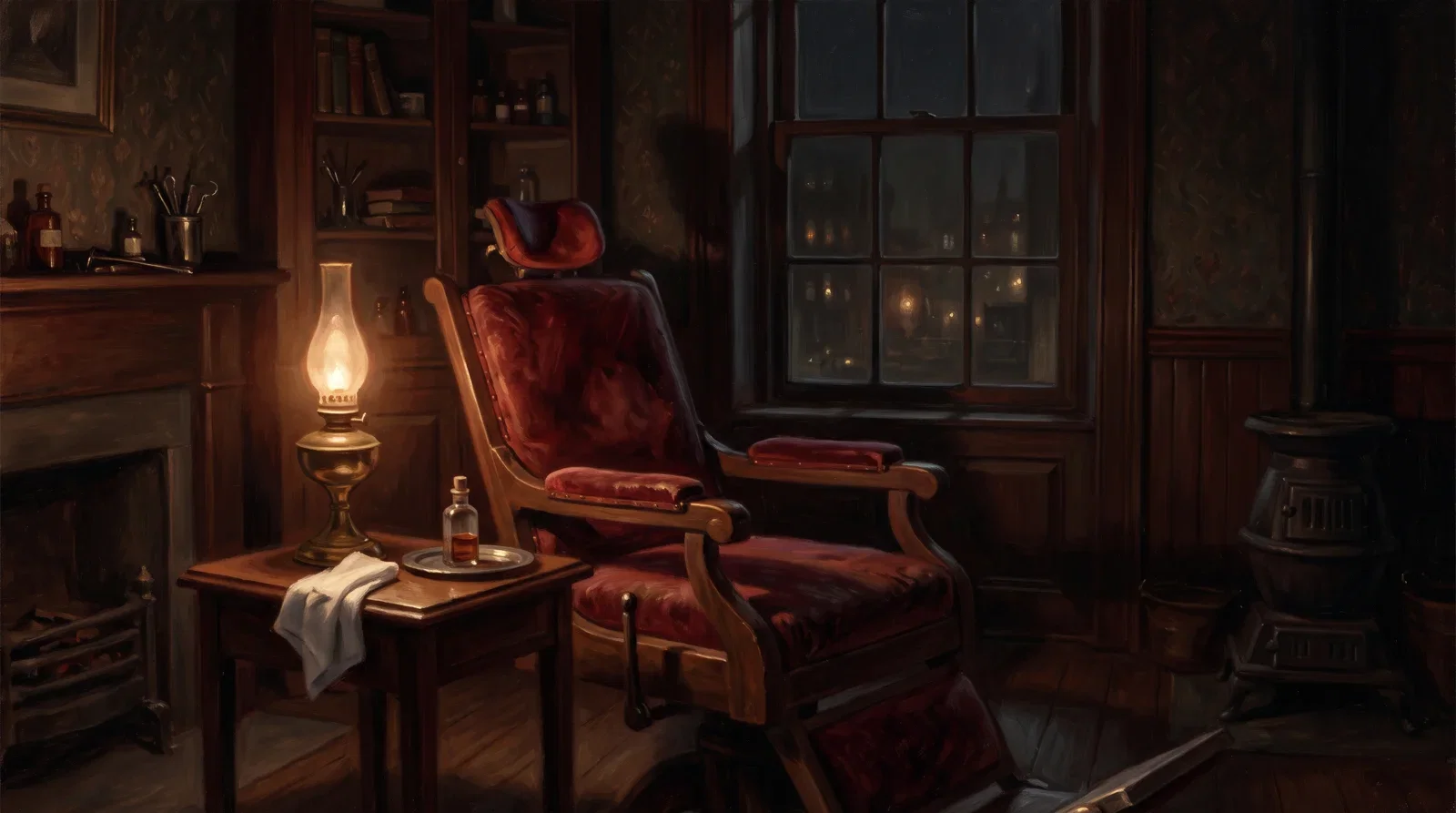
On 30 September 1846 Morton gave Eben Frost a preparation on a handkerchief; Frost woke to find the tooth out and signed a certificate with two witnesses that night.
Reading Library · Anesthesia Epochs · 中文版
Watch the education video (for clinicians)
1846: Morton and Eben Frost — A Certificate Signed That Night · Anesthesia Epochs Education Series
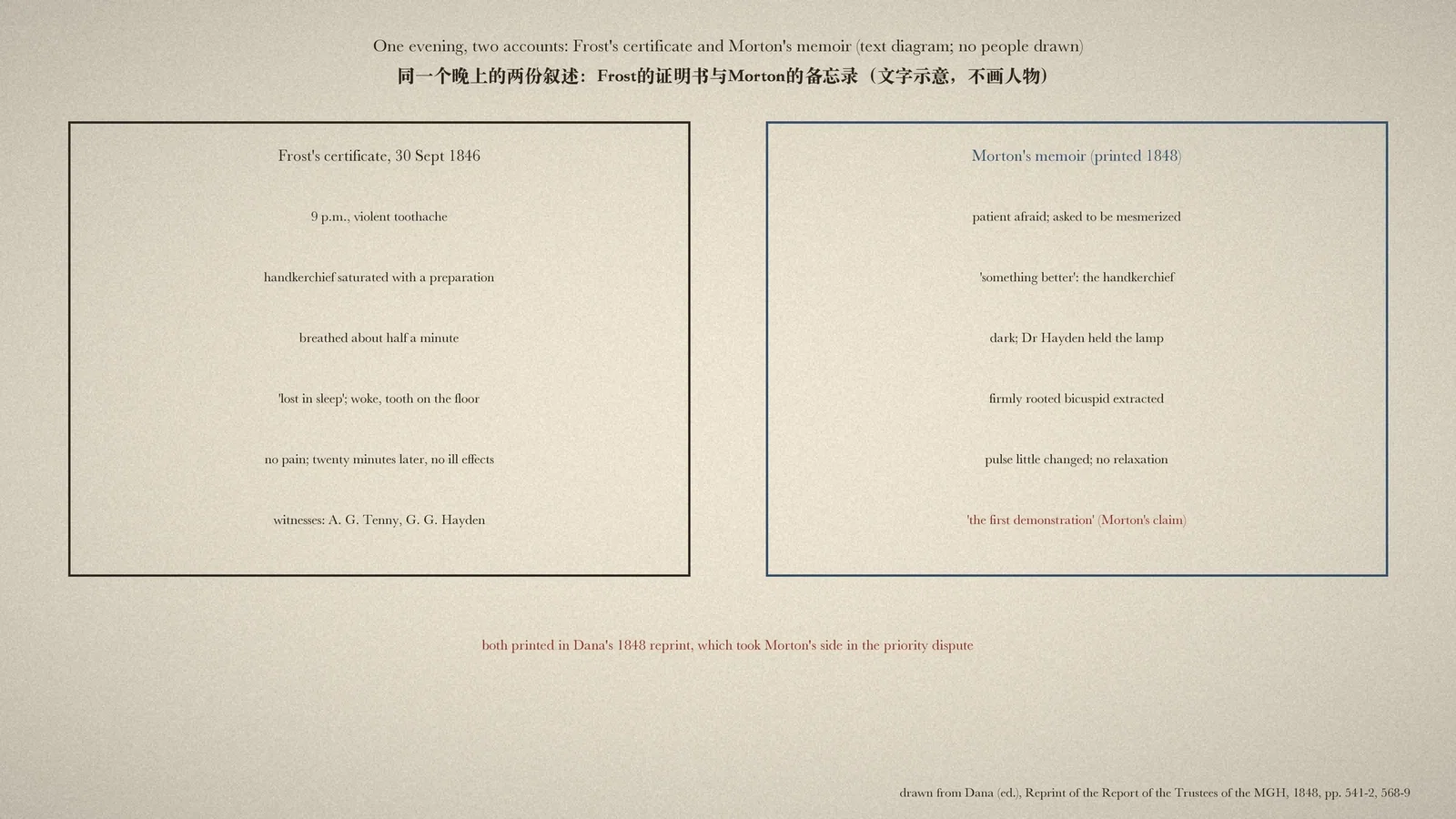
Two weeks before the demonstration at the Massachusetts General Hospital, a man with toothache walked into a Boston dental office one evening. What happened there is known from two documents: a short certificate signed that night, and the dentist's own account written later for the French Academy. Both were printed together in 1848, in a publication that took the dentist's side. [1, pp. 541-2, 568-9]
The reprint
In 1848 R. H. Dana Jr. edited, as a number of Littell's Living Age, a "Reprint of the Report of the Trustees of the Massachusetts General Hospital, with a history of the ether discovery, and Dr. Morton's Memoir to the French Academy". It was produced in the middle of the dispute over who should be credited with ether anaesthesia, and it set out W. T. G. Morton's case. [1, wrapper]
The certificate
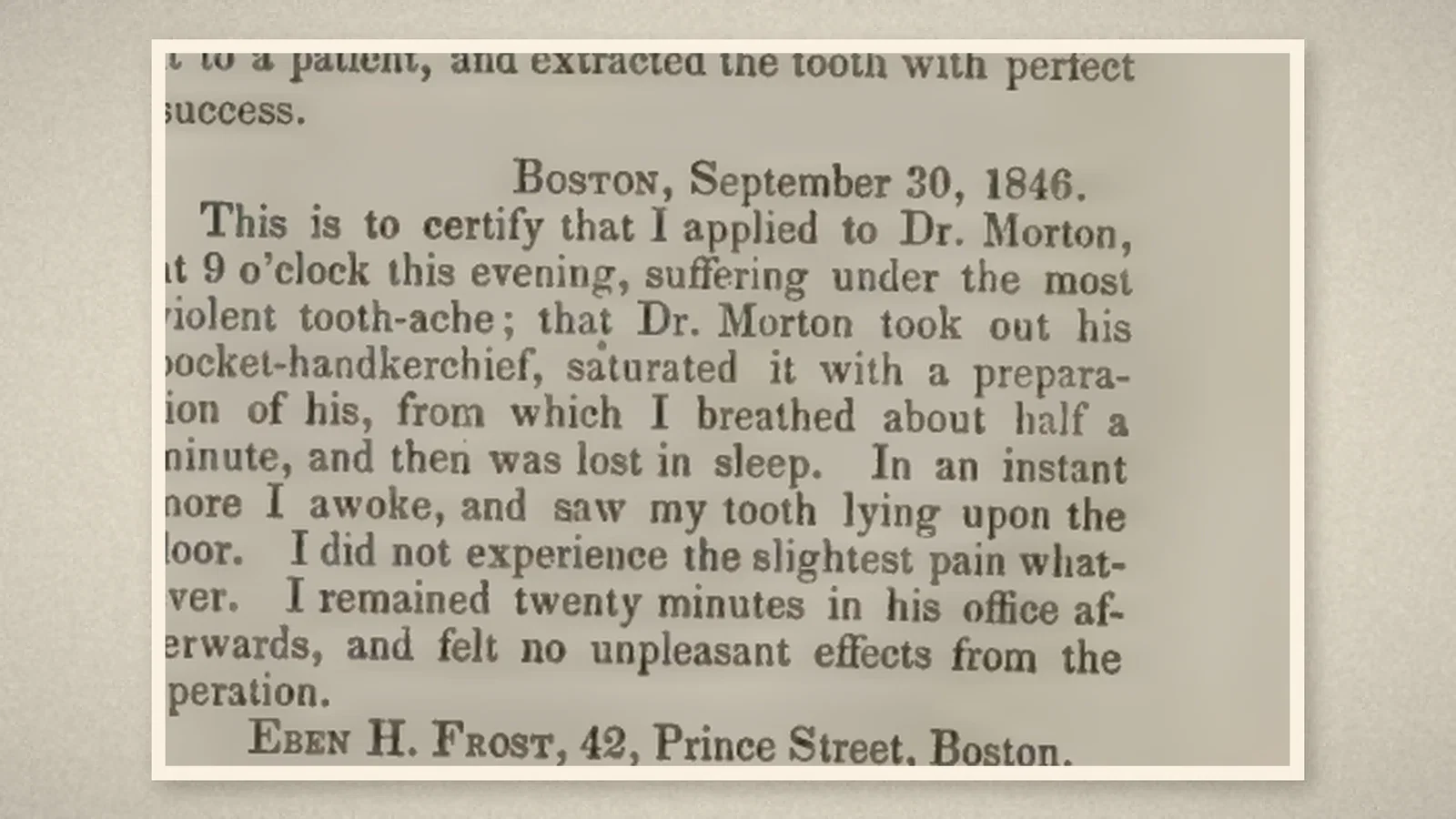
The certificate is dated "Boston, September 30, 1846" and signed "Eben H. Frost, 42, Prince Street, Boston". Frost certifies having come to Dr Morton at nine o'clock that evening "suffering under the most violent tooth-ache". Morton saturated a pocket-handkerchief with a preparation; Frost breathed it for about half a minute and "then was lost in sleep. In an instant more I awoke, and saw my tooth lying upon the floor. I did not experience the slightest pain whatever." Frost stayed in the office for twenty minutes afterwards and "felt no unpleasant effects from the operation". [1, p. 541]
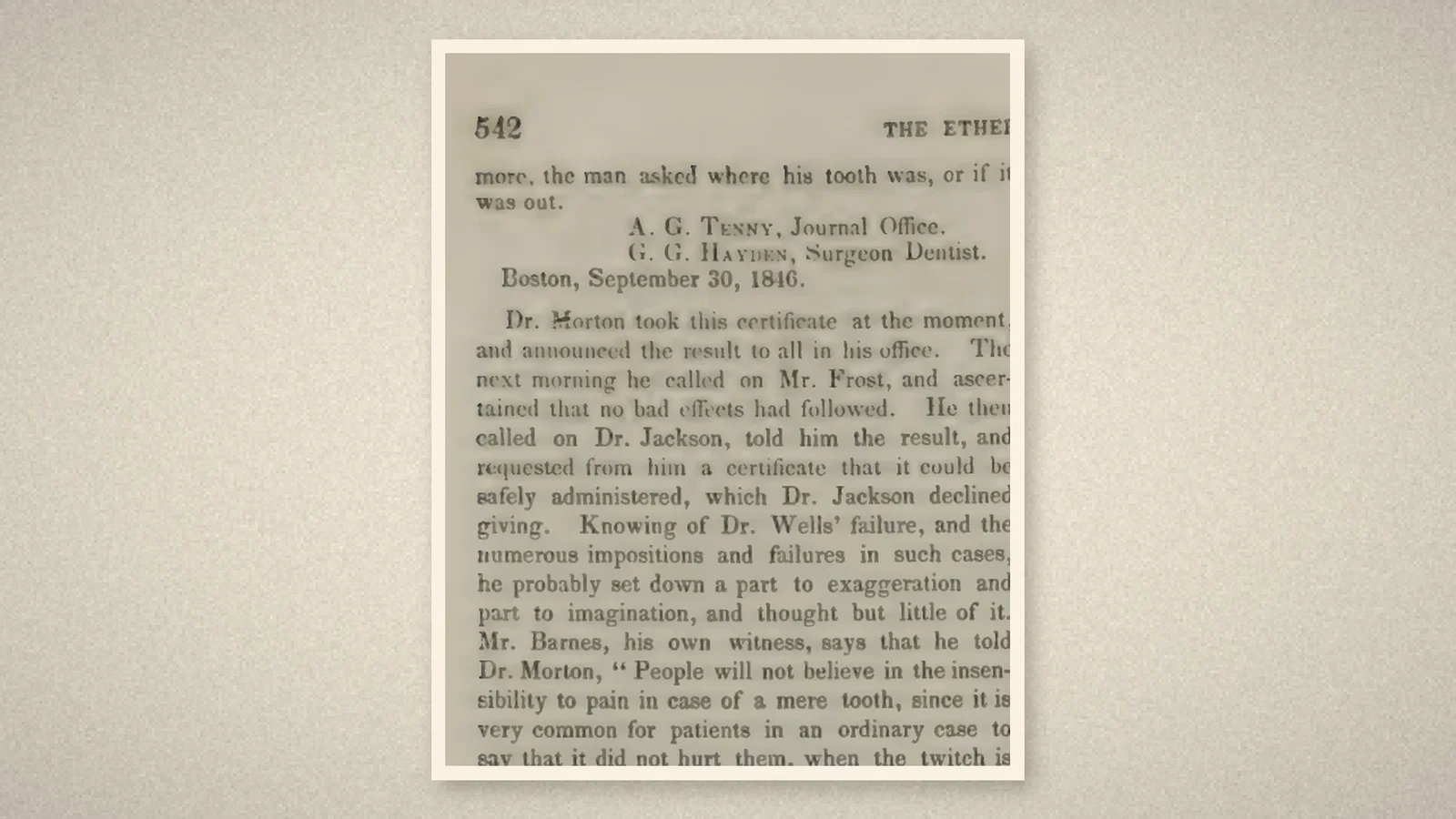
Two witnesses signed underneath, A. G. Tenny of the Journal Office and G. G. Hayden, surgeon dentist: "We witnessed the above operation, and the statement is, in all respects, correct". They added that the patient had asked where the tooth was, or whether it was out. [1, pp. 541-2]
The next steps
Dana's history continues the story. Morton took the certificate on the spot and told everyone in the office. The next morning Morton called on Frost and found no ill effects, then went to Charles T. Jackson, reported the result and asked for a certificate that the agent could be given safely; Jackson declined. A witness named Barnes is quoted as warning Morton that "people will not believe in the insensibility to pain in case of a mere tooth", because patients often said an extraction had not hurt when it was done quickly. [1, p. 542]
Morton's own account
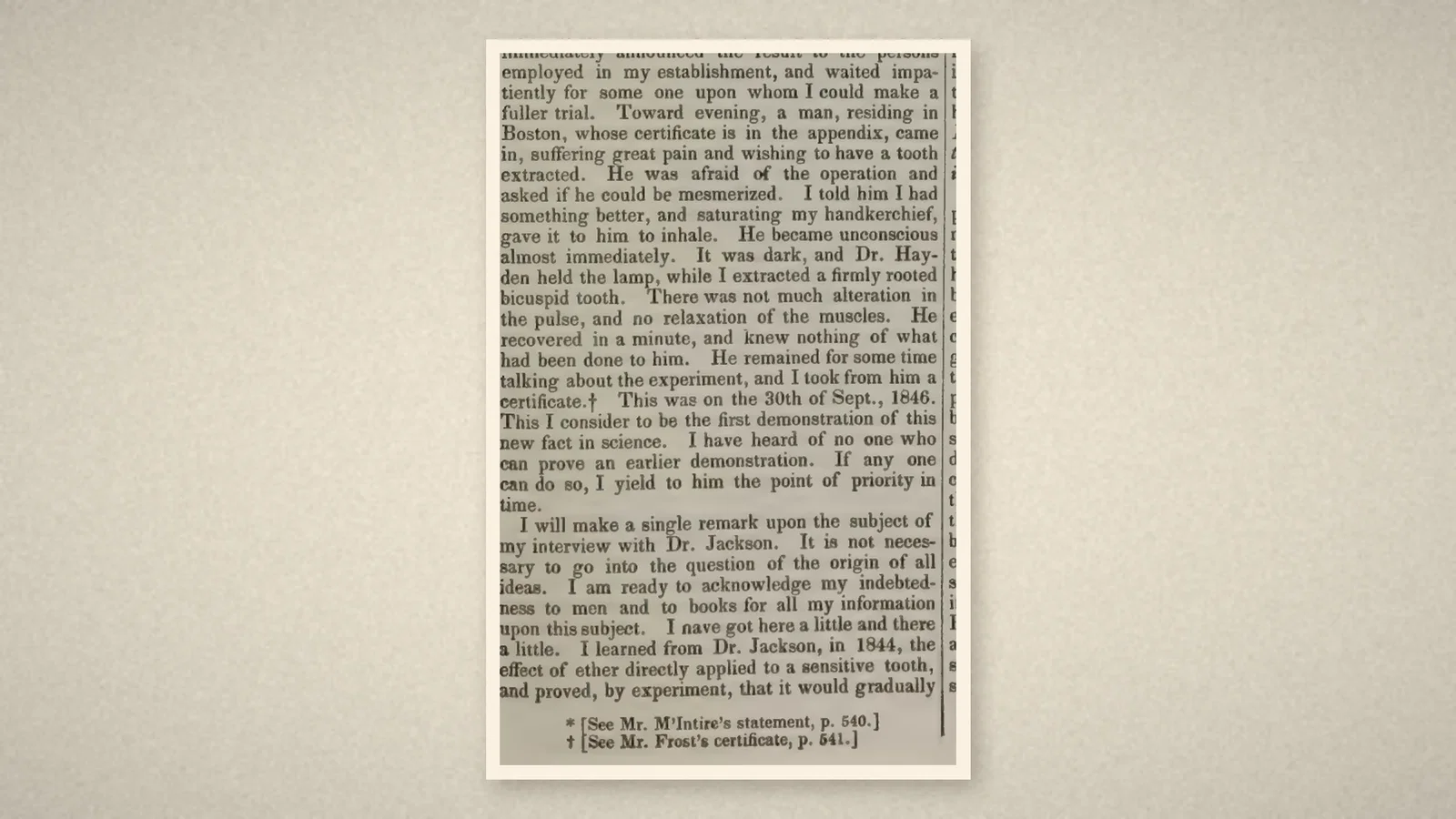
In the memoir to the French Academy, printed later in the same reprint, Morton tells it differently. The patient was afraid of the operation and asked to be mesmerized; Morton said there was "something better" and gave the saturated handkerchief to inhale. Unconsciousness came almost immediately. "It was dark, and Dr. Hayden held the lamp", while Morton extracted "a firmly rooted bicuspid tooth". The pulse changed little and the muscles did not relax. The patient recovered within a minute, remembering nothing, and Morton took the certificate. "This was on the 30th of Sept., 1846. This I consider to be the first demonstration of this new fact in science." Morton offered to give up priority to anyone who could prove an earlier demonstration. [1, p. 569]
What the record shows
A small dental case recorded with care. A signed statement from the patient, two named witnesses, a time and an address: Morton was collecting evidence from the first evening. The two accounts do not quite match: a quick sleep and waking in the patient's version, a firmly rooted tooth in a dark room in Morton's. Both reached print through a document written to support Morton's claim.
Sources and reading limits
Read: Dana (ed.), "Reprint of the Report of the Trustees of the Massachusetts General Hospital, with a history of the ether discovery, and Dr. Morton's Memoir to the French Academy" (Boston, 1848): the wrapper, pp. 541-2 with Frost's certificate and the witnesses, and pp. 568-9 of Morton's memoir.
Not covered: the original manuscript certificate; the Boston Daily Journal notice of 1 October 1846; the 1847 French printing of Morton's memoir; Jackson's own account.
Limits: the certificate and the memoir are first-hand but come from Morton's side and were printed in a reprint that argues Morton's priority, so they are not independent. "The first demonstration" is Morton's claim. The certificate does not name the preparation. No amounts are given.
Three illustrations are crops of the 1848 reprint (pp. 541, 542 and 569); one is a text diagram drawn from it, with no people drawn.
- Dana RH Jr, editor. Reprint of the Report of the Trustees of the Massachusetts General Hospital, with a history of the ether discovery, and Dr. Morton's Memoir to the French Academy. Boston: E. Littell; 1848. p. 541-2, 568-9. Internet Archive
Continue exploring
Related reading connects shared questions and contexts; it does not by itself establish historical influence.
- 1846: The Ether Dome, a Breakthrough Without a Perfect Moment
- 1846: Holmes Gives an Old Word a New Task
- 1845: Wells in Boston, One Demonstration and Three Kinds of Evidence
Anesthesia Epochs · The Source Room · About & Editorial Method
Published November 3, 2026. Sources and reading limits are stated above. Illustrations are labelled as original source images or AI-made. Historical accounts are educational; they are not current treatment instructions.