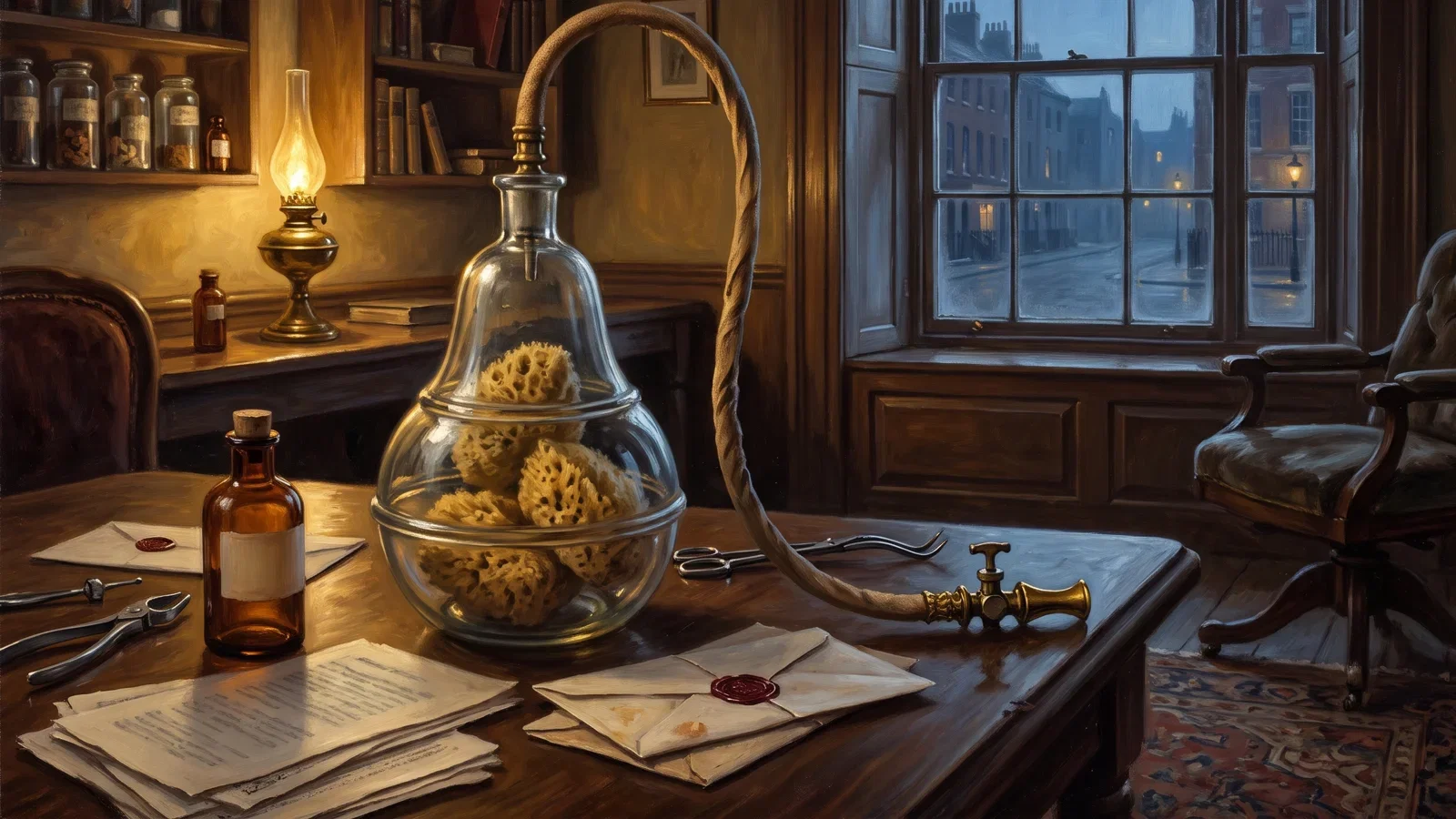
The London dentist James Robinson told of the trial at Boott's house in December 1846, the failures after it, and collected British cases with the operators' names.
Reading Library · Anesthesia Epochs · 中文版
Watch the education video (for clinicians)
1847: James Robinson's Treatise on Inhaling Ether · Anesthesia Epochs Education Series
News of ether reached London in mid-December 1846. Within a few months a London dentist had put into print the trials, failures and improvements of those weeks, the cases heard of from elsewhere, a letter from Boston and a lawyer's opinion. The book records results, but also what a new method looked like when it had just arrived: apparatus that did not work, doctors insisting on witnesses, and patients afraid of being put to sleep and losing every tooth. [1, title page][1, p. 8]
The book
"A treatise on the inhalation of the vapour of ether, for the prevention of pain in surgical operations" was published in London in 1847 by Webster and Co., 60 Piccadilly. The author, James Robinson, is styled "surgeon-dentist to the Metropolitan Hospital", and the book is dedicated to Dr Francis Boott. The title page promises "a numerous collection of cases", with the names of the operators, a history of the discovery, a description of the apparatus, the method of preparing the ether, and remarks on when the operation should begin. [1, title page]
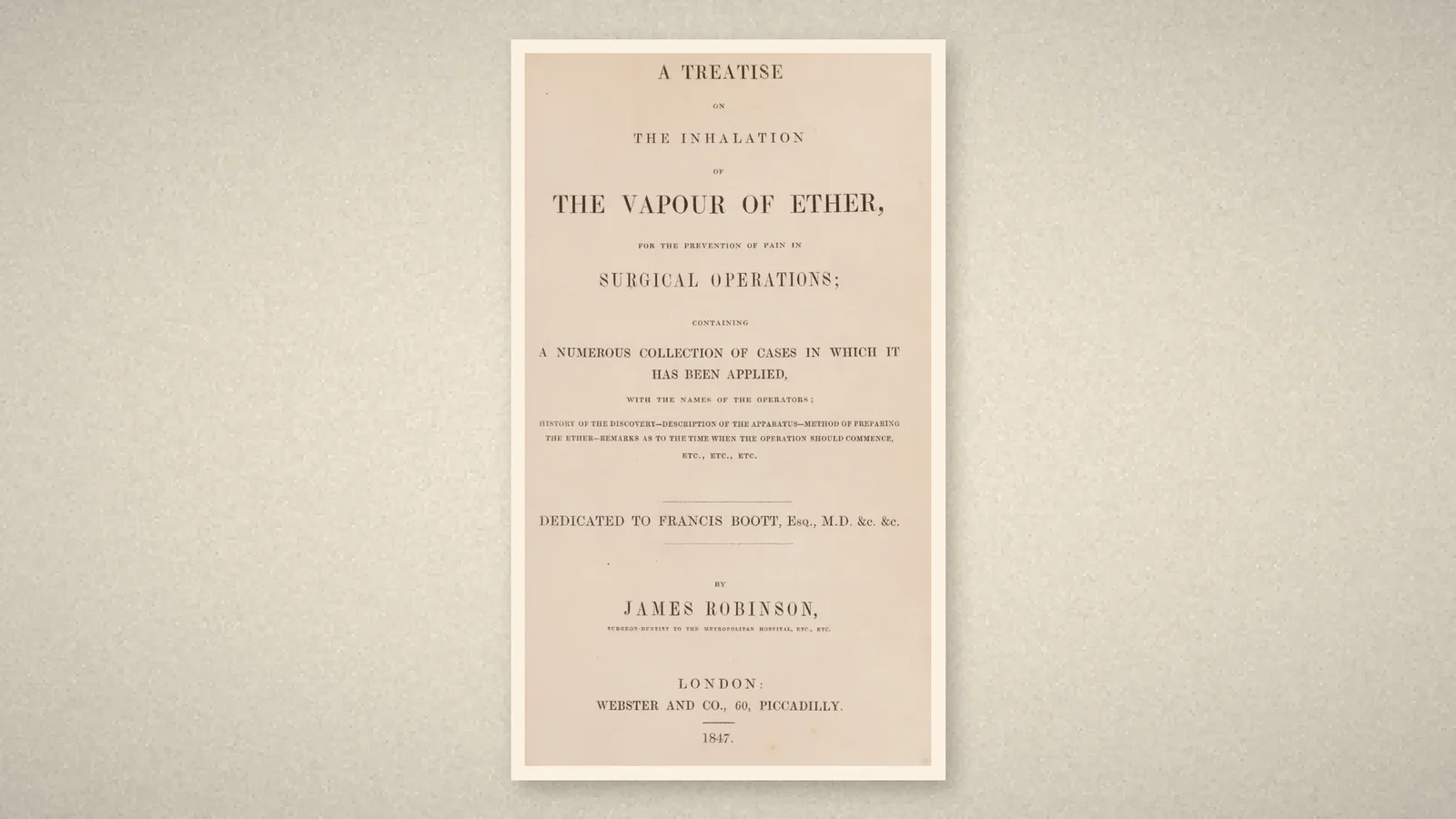
The dedication is direct: without Boott's kindness and help the attempt would probably never have been made. Boott gave Robinson the earliest information on ether, and Robinson's later experiments to perfect an apparatus were made in Boott's presence and with Boott's advice. [1, dedication]
News from Boston
The book opens with a private letter to Boott from Dr Bigelow in Boston, dated 28 November 1846. It describes a new anodyne process that "promises to be one of the most important discoveries of the present age" and encloses a newspaper article written by "my son Henry". Henry Jacob Bigelow's paper read in Boston follows. These, Robinson writes, were the whole of the intelligence on ether received in Britain and imparted to the profession on 17 December 1846. [1, p. 1][1, p. 5]
19 December: one success, then failures
Two letters to The Lancet follow. In the first, Boott reports that on Saturday 19 December, in Boott's study and in front of Boott's wife and two daughters, Robinson extracted a firmly fixed molar from Miss Lonsdale "without the least sense of pain, or the movement of a muscle"; inhaling, extracting and waking were over in three minutes. But the same apparatus was used in three or four cases afterwards and failed every time. Boott blamed the valve of the mouthpiece, a ball-and-socket valve that needed a very strong breath to open, so that expired air went back into the bottle. [1, p. 6]
Robinson's own verdict is harsher: "a very imperfect apparatus, hastily got up", condemned after its failures the next day. [1, p. 5]
A rebuilt apparatus and a run of extractions
Robinson had another apparatus made and tried it first on Robinson's own servant, to check that it worked mechanically, before using it on patients. The book records a run of extractions at the surgery in Gower Street and at the Metropolitan Hospital, in children, young people and adults. One youth, persuaded to have the tooth out, then became afraid of the vapour, and only agreed after watching the servant inhale it first. Another patient refused outright, having heard that Robinson "sent people to sleep and then took out the whole of their teeth"; Robinson took the tooth out the old way and recorded the case to show the prejudice a novelty has to meet. [1, p. 7][1, p. 8]
Robinson sent some of these cases, with a description, to the Morning Chronicle, which printed them. The book also warns that people "in the habit of taking spirituous liquors" may respond little, with the ether producing only intoxication; that opium users may be the same; and that nervous people may fear the state of insensibility itself. [1, p. 9]
When one patient said the first extraction had hurt a little, Robinson suspected something besides the apparatus. Asked about habits, the patient admitted to drinking gin that day for courage. [1, p. 11]
The eye as index
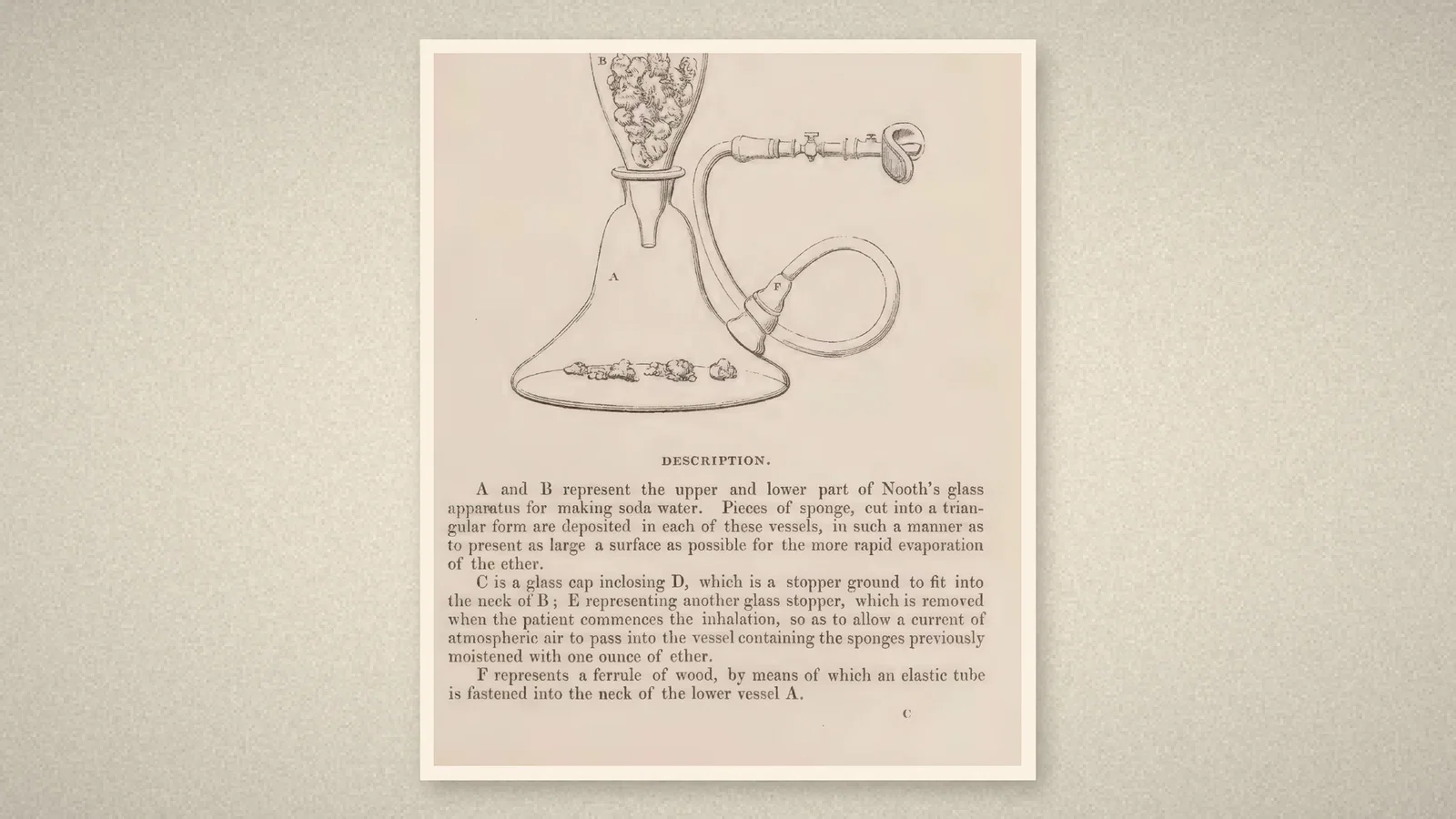
From experience and the opinions of others, Robinson concluded that "the principal index" of success was the eye. At the start the pupil was watched: after about a minute it dilated; after more breaths it stayed still for a few seconds, then turned toward the lids, several times; finally it turned under the upper lid or rested in the centre, and a few breaths later the operation could begin. For long operations a stop-cock on the mouthpiece let vapour and air be given alternately. [1, p. 13][1, p. 14]
Robinson also declined to operate, even on private patients and at Robinson's own residence, unless medical men could be present to watch. [1, p. 14]
The apparatus, built from Nooth's glass apparatus for making soda water, is set out with five requisites and an engraving. A footnote says that an apparatus "on similar principles, but of more elegant form" was made by Hooper, operative chemist, of Pall Mall East; that apparatus has its own article. [1, p. 16][1, p. 17][1, p. 18]
Washing the ether
Once, Robinson writes, a chemist sent ether of a different quality, and two patients were made only partly unconscious, not insensible to pain, so the extractions were put off. Robinson then adopted the American method of washing the ether with water to remove acid and drying it, and sent the method to Howards and Kent for analysis. Their reply of 3 February 1847 concludes that ether for inhalation "should always be washed". [1, p. 18][1, p. 19]
The patent
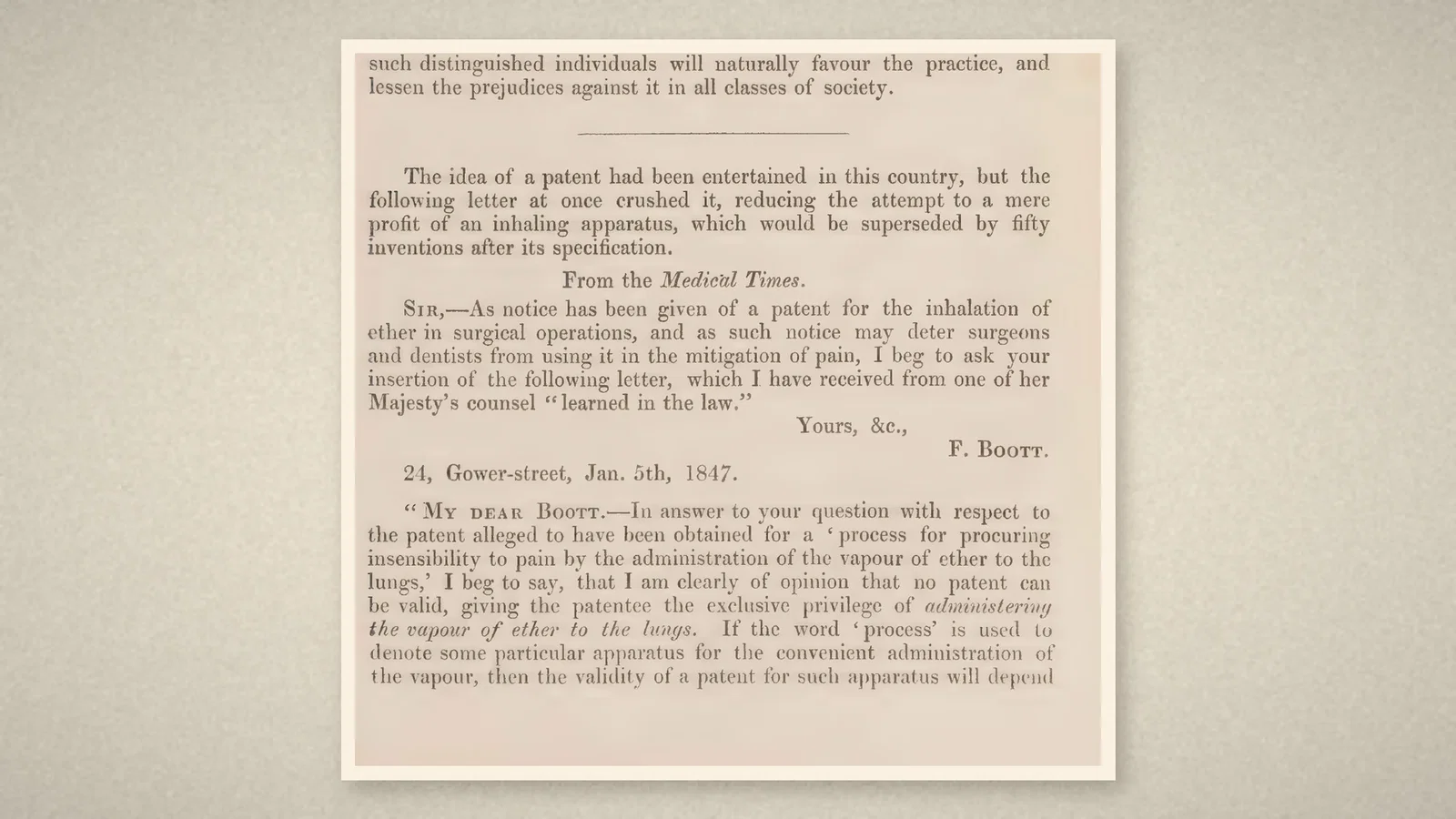
The idea of a patent had been entertained in Britain, the book says, but a letter "at once crushed it". Boott published it in the Medical Times on 5 January 1847: one of the Queen's counsel "learned in the law" was "clearly of opinion" that no patent could validly give an exclusive right to administer ether vapour; if "process" meant a particular apparatus, that was a question about the apparatus; and surgeons could go on using ether "without the slightest fear of legal consequences". The letter is signed with a single initial; the book does not name the counsel. [1, p. 23][1, p. 24]
The case collection
The second half of the book collects operations under ether across Britain, arranged by hospital and town: King's College, Westminster, Guy's, the London, St George's, Liverpool, Birmingham, Edinburgh, Bristol and others, with a few veterinary operations, each with the operator's name and most dated January or February 1847. [1, contents][1, pp. 25-63]
What the record shows
How a book fixed a method that had only just arrived: where the news came from, an honest record that the first apparatus failed, then the improved apparatus, a way of watching the patient, warnings about drinkers, a method for purifying ether and a legal opinion, and finally other people's cases, with names attached.
Sources and reading limits
Read: James Robinson, "A treatise on the inhalation of the vapour of ether, for the prevention of pain in surgical operations" (London: Webster and Co., 1847): the title page, dedication, contents and pp. 1-24 closely, and the case collection on pp. 25-63 for its arrangement and dates (Wellcome Library copy on the Internet Archive).
Not covered: Robinson's pieces in the Morning Chronicle; the original issues of The Lancet and the Medical Times, read here only as reprinted in the book; the Wood Library-Museum facsimile and its introduction; biographical sources on Robinson.
Limits: the book argues for Robinson's own apparatus and method and was written while priority and patent questions were still open. Most patients are anonymous or initialled. The counsel who wrote the patent opinion is not named. The month of publication is not stated; the latest letters printed are from early February 1847. Quantities of ether and specific gravities are not repeated. "The first trials in England" is Robinson's phrase.
Three illustrations are taken from the 1847 book (title page, p. 17 and p. 23); the apparatus engraving is the book's own.
- Robinson J. A treatise on the inhalation of the vapour of ether, for the prevention of pain in surgical operations. London: Webster and Co.; 1847. Internet Archive
Continue exploring
Related reading connects shared questions and contexts; it does not by itself establish historical influence.
- 1846: Hooper Builds an Ether Inhaler to Boott and Robinson's Design
- 1846: Squire Assembles an Ether Inhaler for Liston's Thigh Amputation
Anesthesia Epochs · The Source Room · About & Editorial Method
Published November 3, 2026. Sources and reading limits are stated above. Illustrations are labelled as original source images or AI-made. Historical accounts are educational; they are not current treatment instructions.