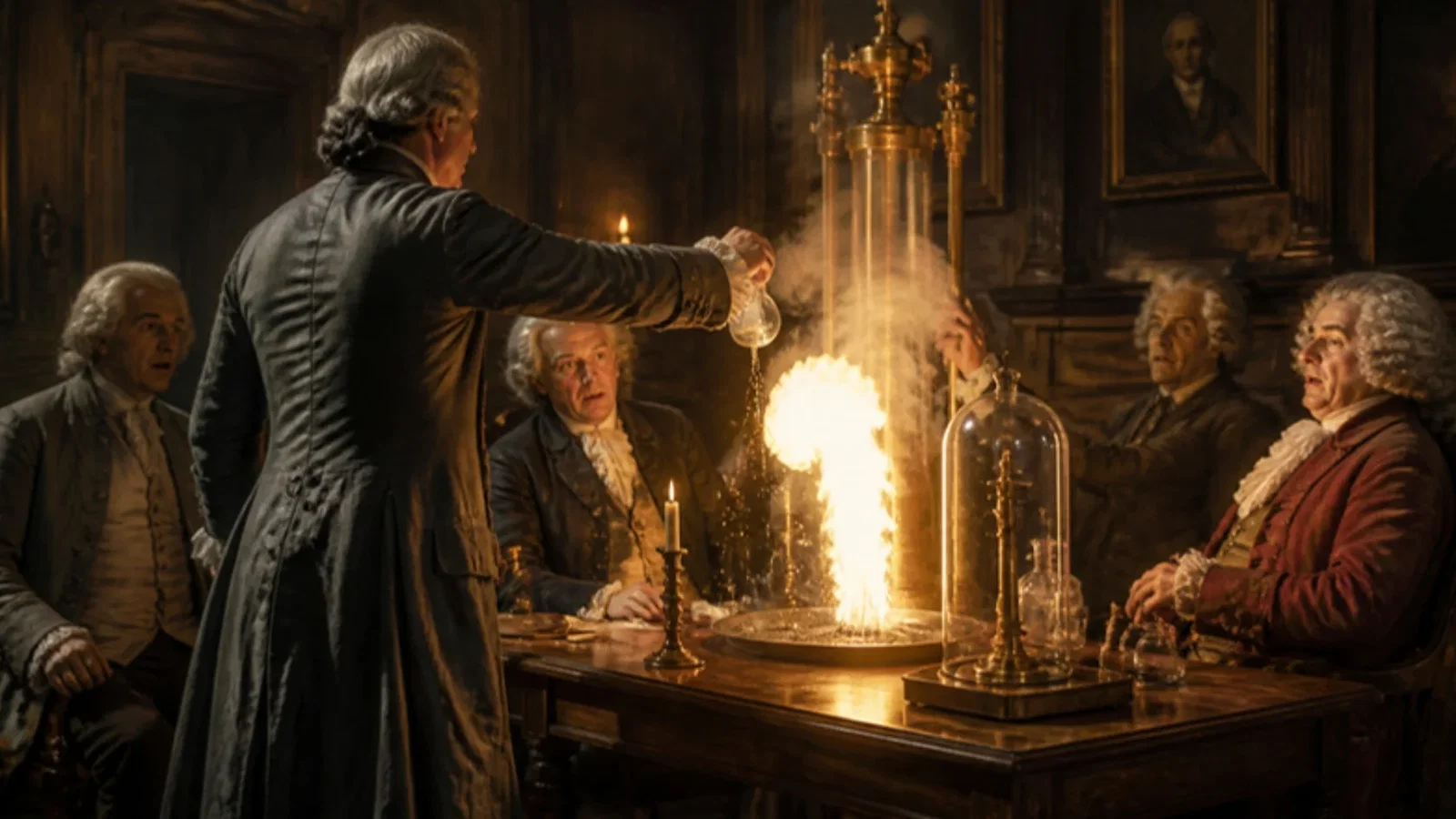
Frobenius's paper in the Philosophical Transactions described a cold, volatile, flammable liquid that dissolved fats, the ethereal spirit of wine, but left out the full recipe.
Reading Library · Anesthesia Epochs · 中文版
Watch the education video (for clinicians)
1730: Frobenius's Spiritus Vini Aethereus — Ether at the Royal Society · Anesthesia Epochs Education Series
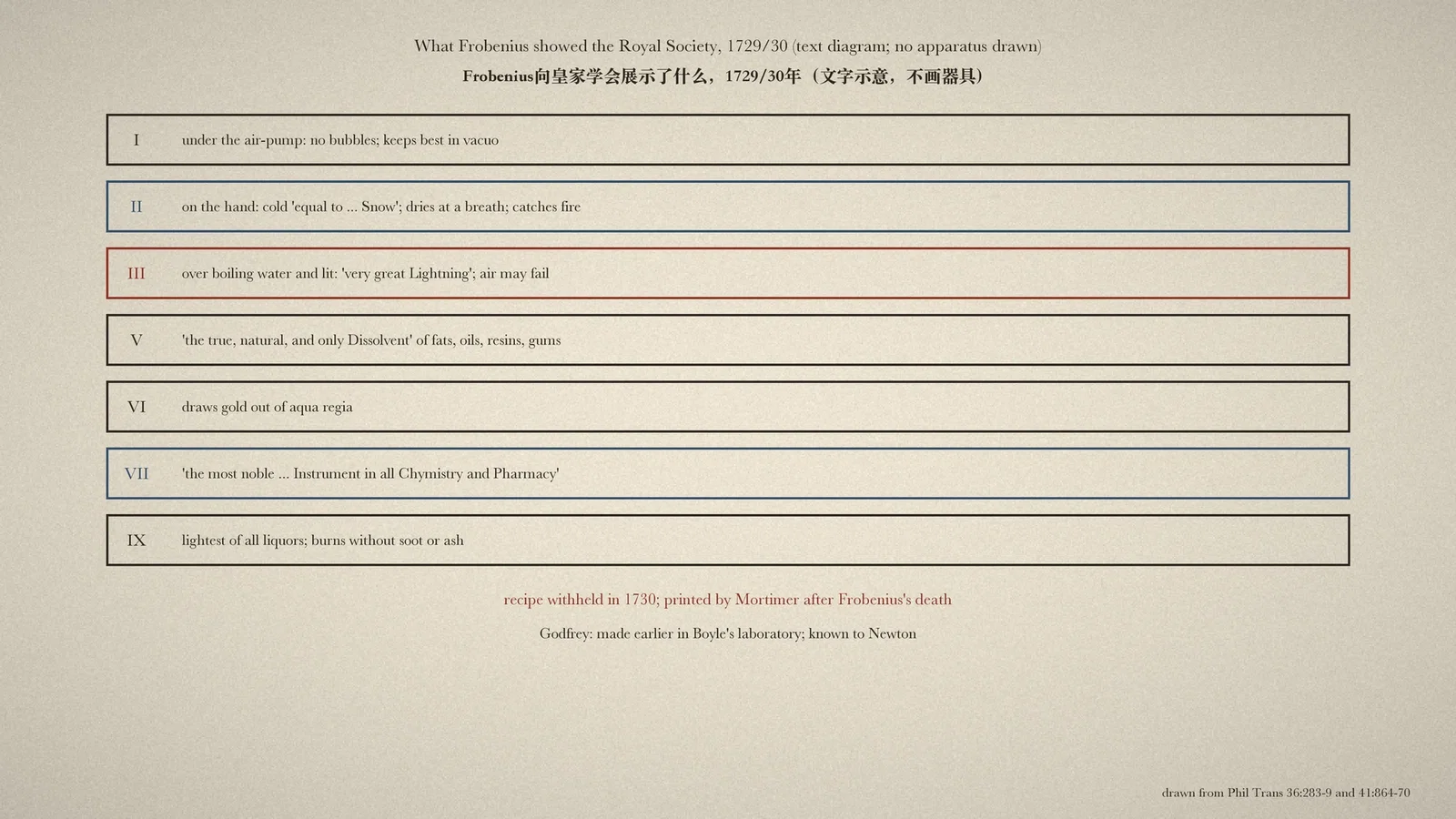
The ether later used for anaesthesia takes its name from the Latin aether, the upper air of the heavens. Around 1730 a chemist named Frobenius showed the Royal Society of London a liquid called "spiritus vini aethereus", the ethereal spirit of wine: as cold as snow, dry at a breath, alight at a spark. The Society's journal printed the experiments, and deliberately left out the full recipe. [1, p. 283][1, p. 289]
The paper
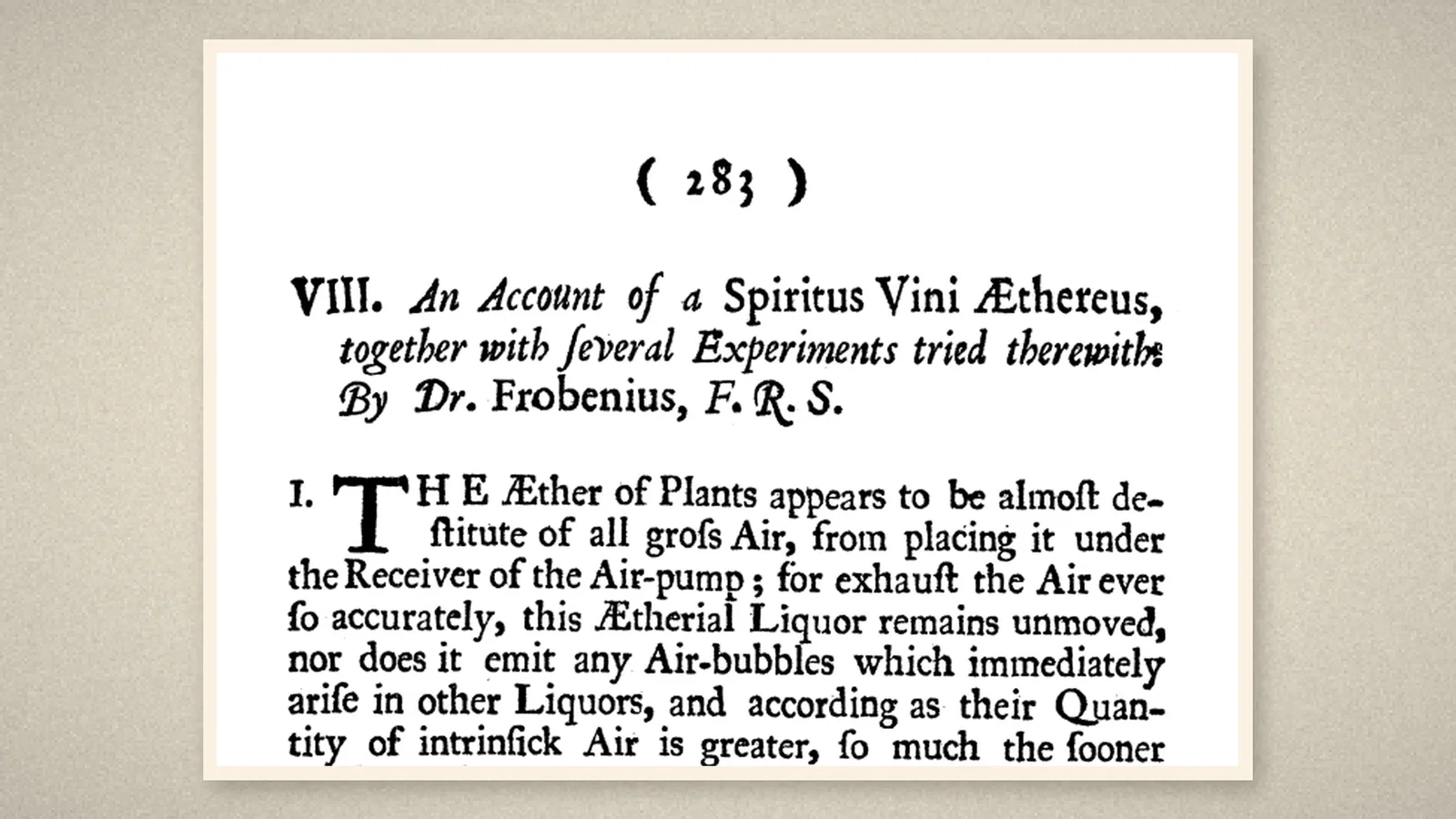
Volume 36 of the Philosophical Transactions (1729-1730), pp. 283-289, carried "An account of a spiritus vini aethereus, together with several experiments tried therewith: by Dr. Frobenius, F.R.S." It lists nine experiments, each marked as having "succeeded" when shown, or as "not shewed". [1, p. 283]
Cold, volatile, flammable
First, placed under the receiver of the air-pump and exhausted, the liquor stays unmoved and gives off none of the bubbles other liquids do; so it keeps best in a vacuum, while in the open air it soon evaporates. Second, a little poured on the hand "affects it with a Sense of Cold equal to that from the Contact of Snow", and one or two breaths dry the hand at once; but the wet hand must be kept away from a lighted candle, "lest it take Fire and burn you". [1, p. 283]
Third, poured on hot water it hisses like a piece of hot iron thrown in; a spoonful poured into a pot of boiling water and lit at once with a candle or paper throws up "very great Lightning". So there must be an assistant, or both hands, and a room where fresh air can readily be let in, since the flash so rarefies the air "as to endanger the Stoppage of Respiration". [1, p. 283][1, p. 284]
A solvent
The fifth experiment notes that the liquor has no oiliness to the touch, yet is "the true, natural, and only Dissolvent" of all fats, oils, resins and gums; the sixth, that it can draw gold out of a solution in aqua regia. Ether, the seventh declares, "is certainly the most noble, efficacious and useful Instrument in all Chymistry and Pharmacy", extracting essences and essential oils from woods, barks, roots, herbs, flowers, berries and seeds, and from animal materials, without fire or distillation. The ninth calls it the lightest of all liquids, burning without soot or ash. [1, p. 285][1, p. 286][1, p. 287]
A colleague's note
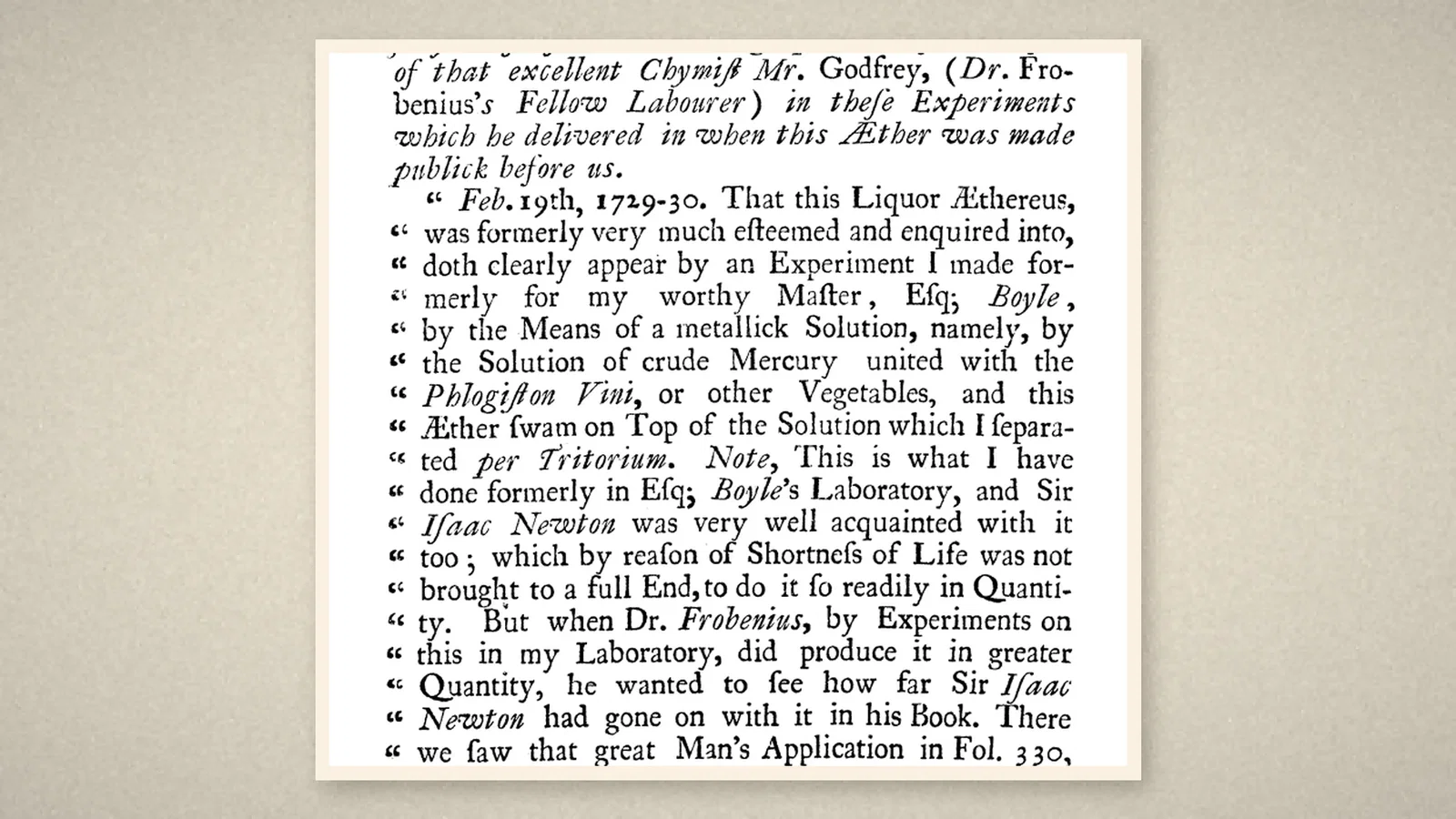
After the text the editor wrote "Thus far Dr. Frobenius", and added two paragraphs from a paper by the chemist Godfrey, Frobenius's "Fellow Labourer" in these experiments, handed in when the ether was made public, dated 19 February 1729/30. [1, p. 288]
The liquor, Godfrey wrote, had long been valued: Godfrey had made it formerly in Boyle's laboratory for Boyle, and Newton had known it well, though "by reason of Shortness of Life" it had not been brought to the point of making it readily in quantity. Frobenius, by experiments in Godfrey's laboratory, had produced it in greater quantity, and the two had looked up what Newton had recorded at folio 330 of Newton's book. [1, p. 288]
In a postscript the editor explained that he had purposely not given the recipe entire, so that readers would refer to the author for it; Godfrey's second paragraph, printed just before, sketches the process only in outline. [1, p. 289]
The recipe, printed after the author's death
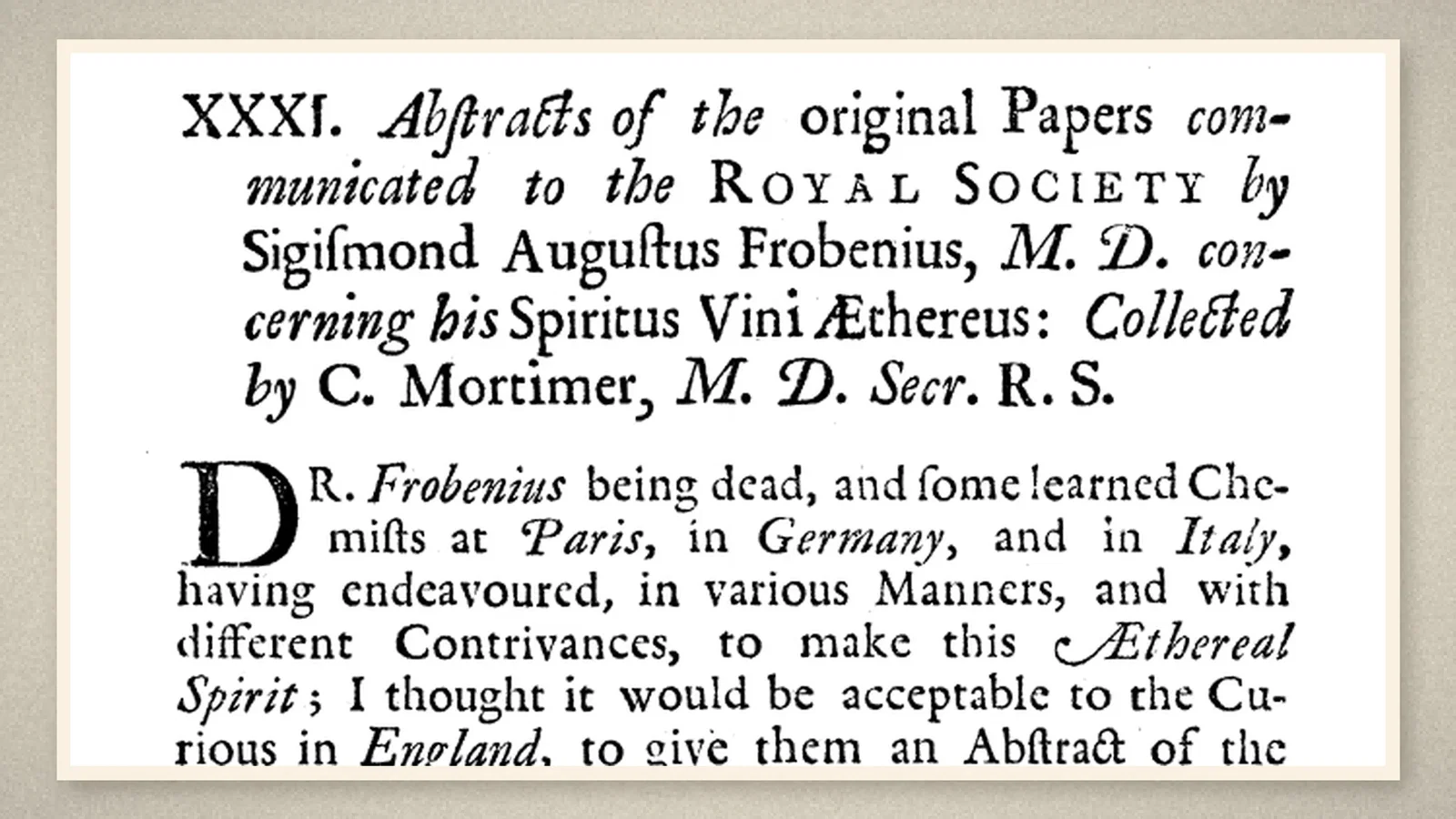
About ten years later the Society's secretary, Cromwell Mortimer, printed in volume 41, from p. 864, abstracts of the three papers Frobenius had given the Society. "Dr. Frobenius being dead," it begins, and chemists in Paris, Germany and Italy trying in various ways to make the ethereal spirit, Mortimer thought it useful to make the abstracts public. [2, p. 864]
The first paper was the one handed in on 19 February 1729/30, held back at the author's request. It named oil of vitriol and the most highly rectified spirit of wine, mixed and then distilled in a glass retort; it even contradicts Godfrey's 1730 paragraph on whether the two were to be measured by weight or by volume. The first part of the process, Frobenius wrote, had been mentioned by Caneparius, by Boyle and by Newton, and in Germany Stahl and Hoffmann were the first to know the first operation, though neither brought it to perfection. A footnote by Mortimer adds that Baron at Vienna knew the whole process and that Frobenius was said to have learned it from Baron. [2, p. 864][2, p. 865]
What the record shows
How a name later central to anaesthesia first appeared in a scientific journal: as a cold, light, highly volatile and flammable solvent, an "instrument" of chemistry and pharmacy rather than a medicine. The talk was of what it dissolved and how it burned; there was not a word about pain. Who made it first was already disputed in these two texts.
Sources and reading limits
Read: Frobenius, "An account of a spiritus vini aethereus, together with several experiments tried therewith", Philosophical Transactions 1729-30;36:283-9, in full with Godfrey's paragraphs and the editor's postscript; Mortimer, "Abstracts of the original papers communicated to the Royal Society by Sigismond Augustus Frobenius", Philosophical Transactions 1739-1741;41:864-70, in full.
Not covered: Frobenius's manuscripts and the Royal Society minutes of 19 February 1729/30 and later meetings; Mortimer's account of the experiments Frobenius later showed at the Society; the Newton notebook Godfrey cites; the texts of Caneparius and Boyle.
Limits: Frobenius's paper is a list of demonstrations, some marked as not shown; the claims about Boyle, Newton and earlier knowledge come from Godfrey and from Frobenius's later paper, and the story that Frobenius learned the process from Baron is no more than Mortimer's "it is said". The Old Style date is kept and not converted. The quantities and proportions of the recipe are not repeated. The substance is named as printed.
Three illustrations are crops of the Philosophical Transactions, vol. 36 (pp. 283 and 288) and vol. 41 (p. 864); one is a text diagram drawn from them, with no apparatus drawn and no quantities given.
- Frobenius. An account of a spiritus vini aethereus, together with several experiments tried therewith. Phil Trans R Soc Lond. 1729-30;36:283-9. Internet Archive
- Mortimer C. Abstracts of the original papers communicated to the Royal Society by Sigismond Augustus Frobenius, M.D. Phil Trans R Soc Lond. 1739-41;41:864-70. Internet Archive
Continue exploring
Related reading connects shared questions and contexts; it does not by itself establish historical influence.
- 1818: An Unsigned Note Says Ether Vapour Acts Like Nitrous Oxide
- 1561: Cordus's Account of Preparing Ether Reaches Print
Anesthesia Epochs · The Source Room · About & Editorial Method
Published November 3, 2026. Sources and reading limits are stated above. Illustrations are labelled as original source images or AI-made. Historical accounts are educational; they are not current treatment instructions.