Valerius Cordus's account of preparing sweet oil of vitriol, later read as ether, is conventionally dated to about 1540, but the version that can be inspected was printed after his death, in Strasbourg in 1561.
Reading Library · Anesthesia Epochs · 中文版
Watch the companion film
1561: Cordus and Ether · Watch on YouTube
Historical anchor: 1561. Date details and source qualifications are explained below.

A retrospective portrait of a chemical object. The retort is empty and disconnected. It is neither a surviving Cordus artifact nor a demonstration of preparation or anesthetic administration.[1–3]
A printed book offers a different kind of certainty from a remembered discovery date. The Freiburg copy of Cordus's collected works has a title page and a colophon that can be inspected. They place the volume in Strasbourg in 1561. Its author had died in 1544; Conrad Gesner helped bring his writings into print.[1–3]
The familiar timeline entry is shorter: Cordus, ether, 1540. Sometimes it adds “first.” Reading the sources does not erase that entry, but it changes what we can responsibly make it mean.
A conventional date and a visible imprint
Bause's Wood Library-Museum reflection presents Cordus's preparation under 1540. Tallmadge's introduction to his translation says approximately that date. There is a recognizable historical convention here.[3,4]
Leake's 1925 study is more tentative when it reaches the timing of the work. He places it conjecturally between 1535 and 1540, probably while Cordus was with his apothecary uncle in Leipzig. This is a reconstruction, not a laboratory entry that fixes an experiment to a particular year and address.[2]
The publication has firmer footing. The original title page gives 1561. The colophon names Strasbourg and the printer Josias Rihelius, with the same year. The inspected volume therefore supplies direct evidence for the appearance of the account in print, although it does not supply an exact date for its preparation experiments.[1]
This article uses 1561 as its main anchor and keeps the conventional date around 1540 as a prelude. Neither has to displace the other. They answer different questions.

Bringing an account into print. This is an original reconstruction of a printing workshop, not a record of the 1561 production. The imagined worker is not Cordus alive in 1561, or an authenticated likeness of Gesner or the printer.[1–3]
What does “first” actually identify?
Leake's article concerns the discovery of ether, yet he explicitly doubts that Cordus was the first person to discover and prepare it. He also praises the clarity and detail of Cordus's preparation account. Those are not contradictory positions.[2]
A clear description is something a reader can examine. Absolute priority requires a much wider argument about what others did before it. Replacing the former with the latter removes a distinction that Leake himself made.
Nor does his discussion give us a reason to hand the title of discoverer to someone else. His Paracelsus passage comes through a later quotation, and the suggested encounter or transfer of samples is conjectural. The earlier primary witnesses behind that discussion have not been independently examined for this article. One unresolved claim of priority should not be replaced with another.[2]
Cordus's contribution remains worth studying without the superlative: an account that could be collected, printed, read and eventually translated.
Read the old chemical categories before applying the modern name
The relevant third part occupies folios 226v–229r in the inspected 1561 copy. It distinguishes sour oil from what was called sweet oil of vitriol, discusses their properties and preparation, and proposes medicinal uses.[1,3]
These are not modern chemical categories. The explanation of the sweet oil still invokes sulphur. Later authors interpret the account through a different chemical vocabulary. Features such as volatility matter to that interpretation, but the description is not a modern certificate of composition or purity.[1–3]
It would also be wrong to say that the account has no medical purpose. Its proposed uses make that interest quite plain. What does not follow is that the proposed indications were validated. Historical assurances of safety are likewise statements made in a text, not recommendations for a present-day reader.[1–3]
For that reason, this article does not reproduce quantities, preparation steps, heating conditions or directions for taking the substance. Reading a historical procedure and inviting someone to repeat it are different activities.
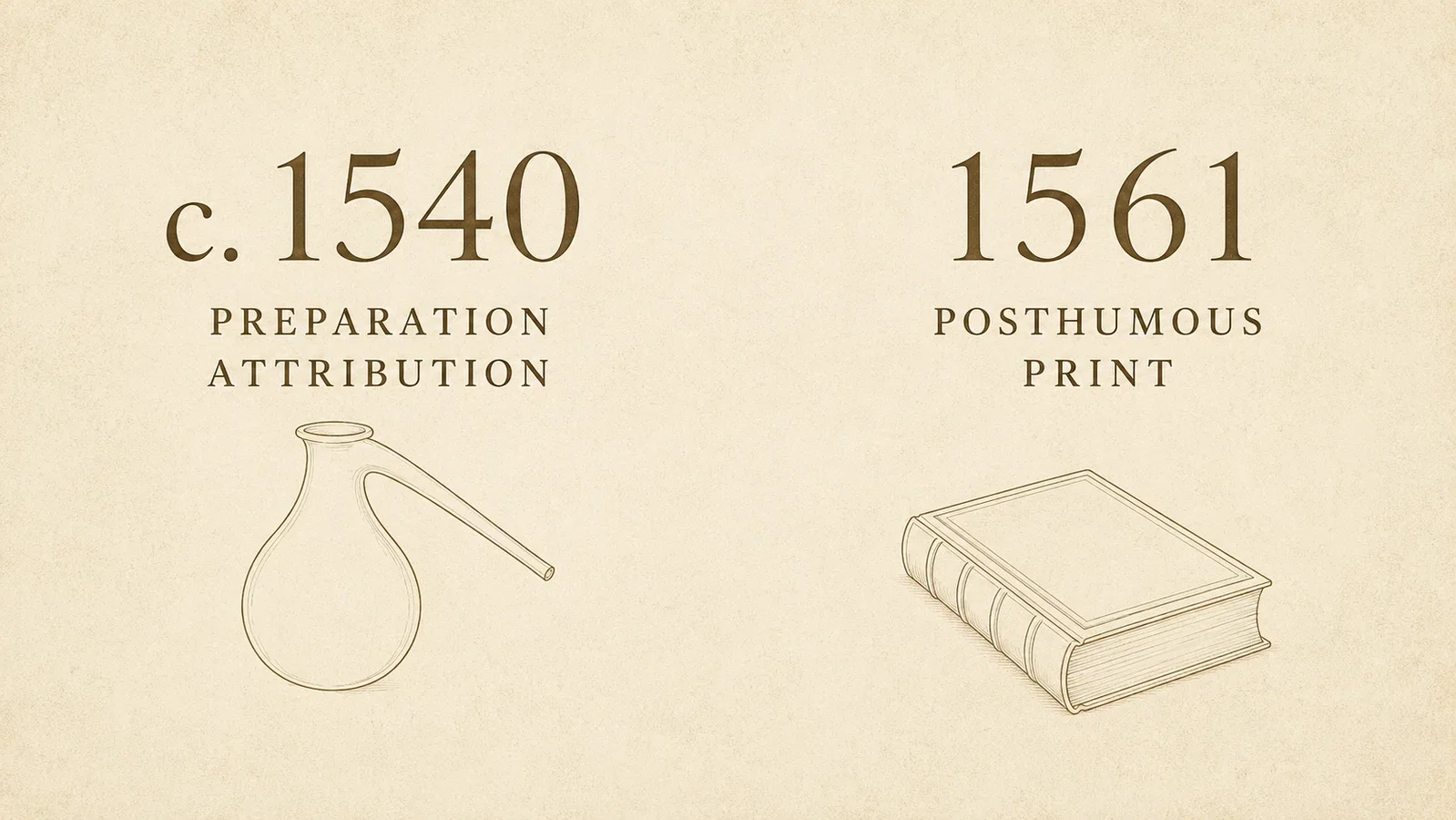
Two dates carry two kinds of statement. The left panel marks a conventional preparation attribution; the right marks the posthumous printing. Their juxtaposition is not a reconstructed experimental timeline.[1–4]
A translation is another historical witness
Tallmadge's 1925 article makes the text accessible through Latin and English. His introduction also tells us which text he used: Coudenberg's edition of 1571, not a direct translation of the 1561 Freiburg leaves.[3]
That distinction does not make the translation unhelpful. It makes its contribution more precise. One side of this reading is an original printed witness from 1561; the other is a scholarly translation based on a later edition. They help establish the chapter sequence and illuminate selected passages, without amounting to a new independent collation of the entire Latin work.
A small trap shows why context matters. Tallmadge's English includes a reference to numbness of the teeth. It appears in Chapter IX, in the discussion of the sour oil. Finding an anesthesia-related word is therefore not the same as finding evidence that the sweet oil was used for surgical anesthesia.[3]
The selected preparation and uses section is not a documented surgical anesthetic case. That is a statement about the inspected text, not a claim that every unrecorded or unexamined historical activity can be ruled out.[1,3]

Reading the account without supplying a patient. The book and empty flask form a modern editorial arrangement. The page texture does not reproduce a recipe or impersonate an identified page from 1561 or 1571.[1,3]
An anesthesia-history article need not contain an anesthetic
The 1561 volume preserves a chemical account whose explanations and therapeutic hopes were not identical to the meanings later readers gave it. Cordus supplied a description; Gesner helped transmit it; translators and historians continued to interpret it.[1–3]
There is no need to put an operating table beside the retort to make that history consequential. Preparing a substance, explaining what it is, and establishing how it can be used in a patient are separate achievements. A familiar modern drug name should not let us skip the distance between them.
Sources and reading limits
- Cordus V; Gesner C, compiler. Collected works, 1561. Strasbourg: Josias Rihelius; 1561. University Library Freiburg, T2429,f; VD16 C5109. Eight original leaves read: title, ff. 226v–229r and colophon f. 302v. Selected Latin passages and chapter sequence checked; not a whole-book reading or independent Latin collation.
- Leake CD. Valerius Cordus and the Discovery of Ether. Isis. 1925;7(1):14–24. Complete issue from the public archive; the eleven article pages and four plates read. The archive's 1924 container label does not override the verified 1925 volume year. Not a whole-issue reading.
- Tallmadge GK. The Third Part of the De Extractione of Valerius Cordus. Isis. 1925;7(3):394–411. Complete issue from the public archive; all eighteen article pages read. Translation based on 1571, not directly on the inspected 1561 copy. Not a whole-issue reading.
- Bause GS. Cordus' Synthesis of Ether · Archived copy. Anesthesiology. 2009;111(4):804. DOI:10.1097/01.anes.0000361292.45205.5e. Complete one-page text read online.
The main date, 1561, marks publication; about 1540 is the conventional date given for the preparation. Historical discussion, not laboratory or treatment guidance. Sources and reading limits are stated above. Illustrations are labelled as original source images or AI-made. Historical accounts are educational; they are not current treatment instructions.
Continue exploring
Related reading connects shared questions and contexts; it does not by itself establish historical influence.
- 1772–1774: Priestley's Nitrous Oxide, a Gas Before an Anesthetic
- 1846: The Ether Dome, a Breakthrough Without a Perfect Moment
Anesthesia Epochs · The Source Room · About & Editorial Method