
A note in the Royal Institution's journal said inhaled ether vapour acts much like nitrous oxide, and that one man stayed lethargic for thirty hours.
Reading Library · Anesthesia Epochs · 中文版
Watch the education video (for clinicians)
1818: An Unsigned Note on Ether Vapour — Royal Institution · Anesthesia Epochs Education Series
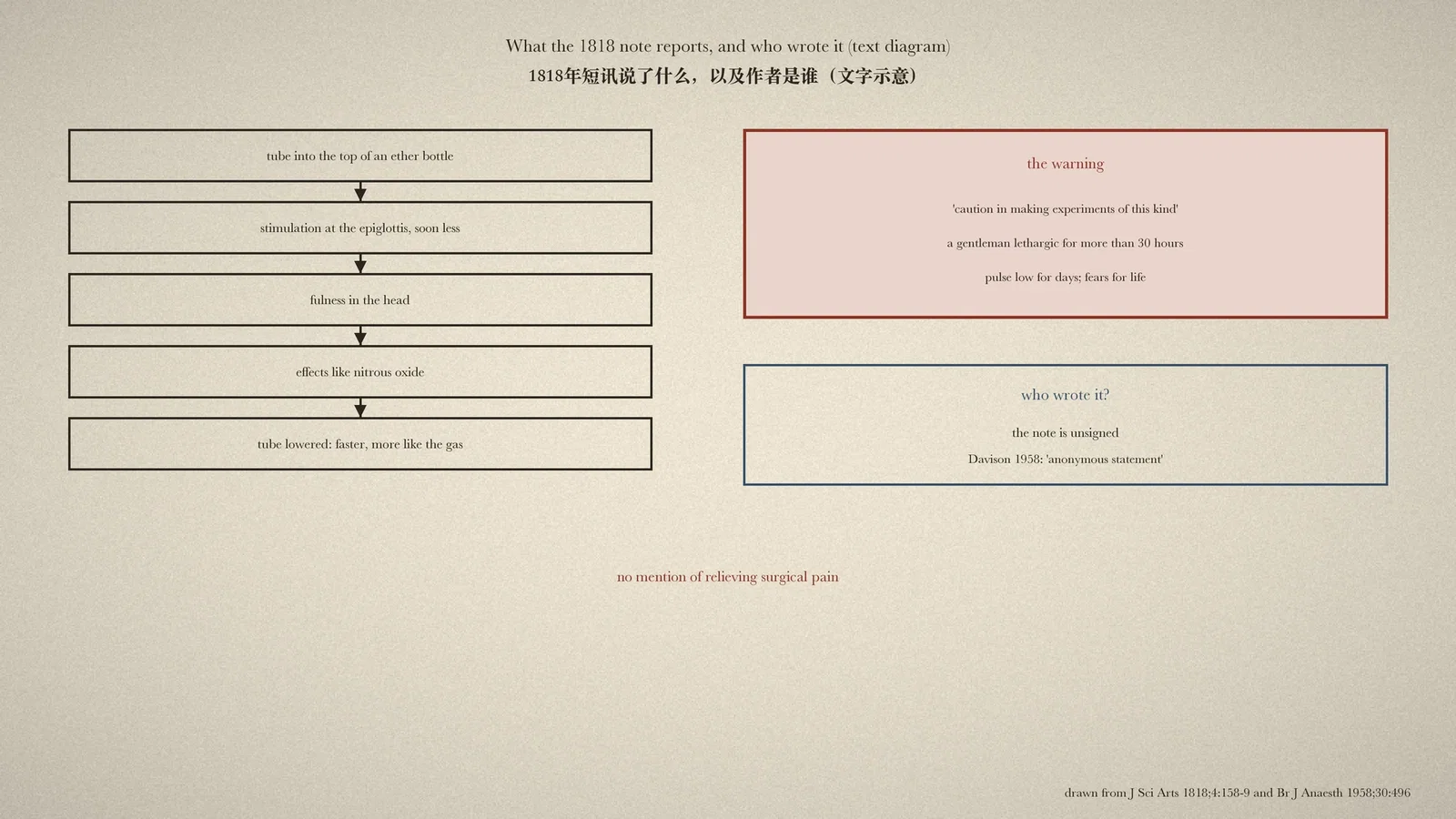
Almost thirty years before ether anaesthesia, a London scientific journal printed a short paragraph on breathing ether vapour. It compared the effect to laughing gas, described breathing it through a tube from a bottle, and warned that one man had nearly died. The paragraph has no name on it. [1, pp. 158-9]
The journal
The "Journal of Science and the Arts" was edited at the Royal Institution of Great Britain, published quarterly, and printed for John Murray in London. Volume 4 is dated 1818. Its "Miscellanea" section collected short notes, letters and extracts. [1, title page]
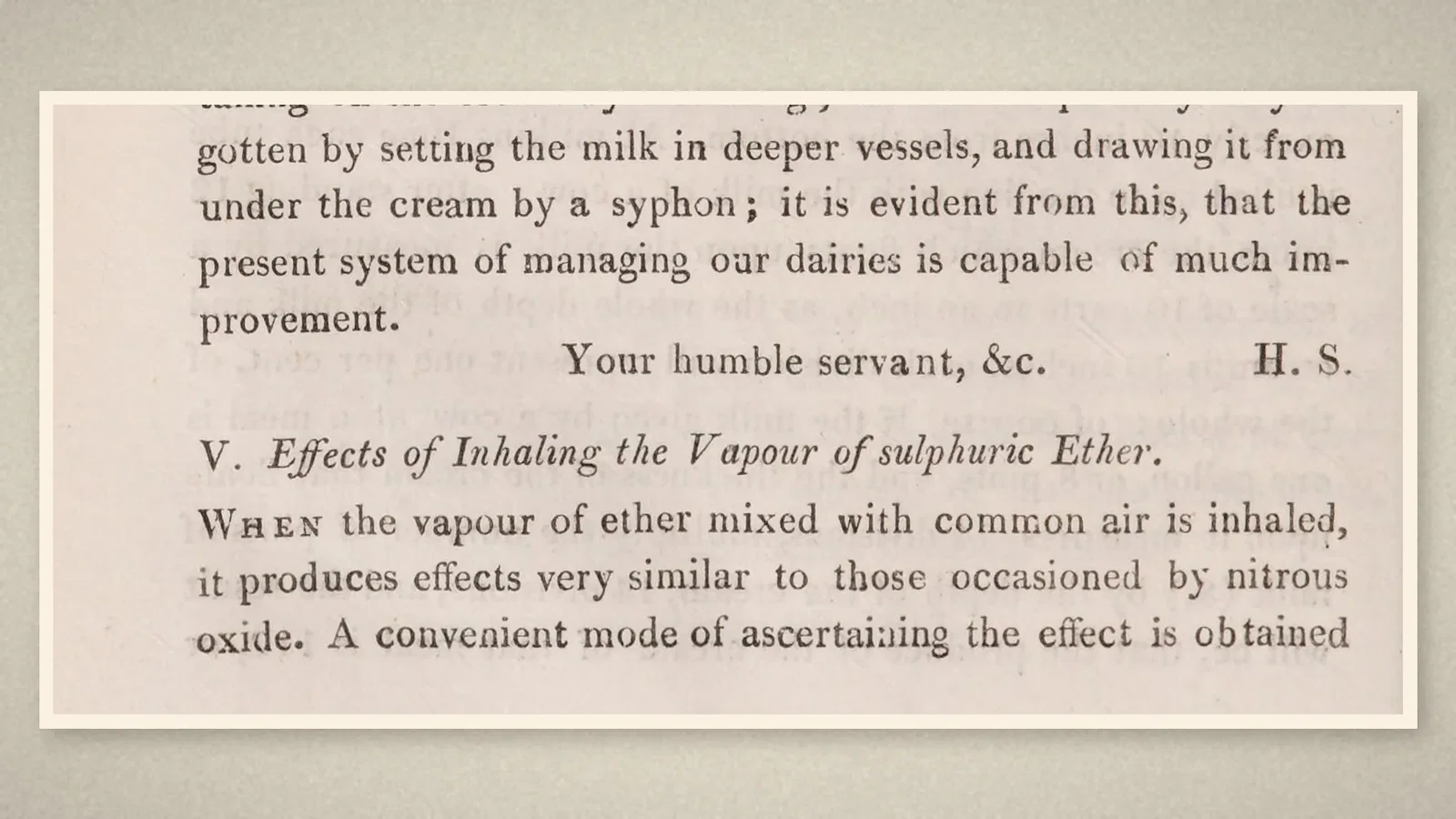
On p. 158, right after a reader's letter about the cream content of cows' milk signed "H. S.", comes item V: "Effects of Inhaling the Vapour of sulphuric Ether". There is no signature. [1, p. 158]
What the note says
The first sentence is the claim: "When the vapour of ether mixed with common air is inhaled, it produces effects very similar to those occasioned by nitrous oxide." [1, p. 158]
The note then described what someone breathing the vapour through a tube from a bottle would feel. At first there is a stimulating effect at the epiglottis, which soon fades; then a sensation of fulness in the head; then "a succession of effects similar to those produced by nitrous oxide". With more vapour, it said, the effect came faster and the sensations were "more perfect in their resemblance to those of the gas". [1, p. 159]
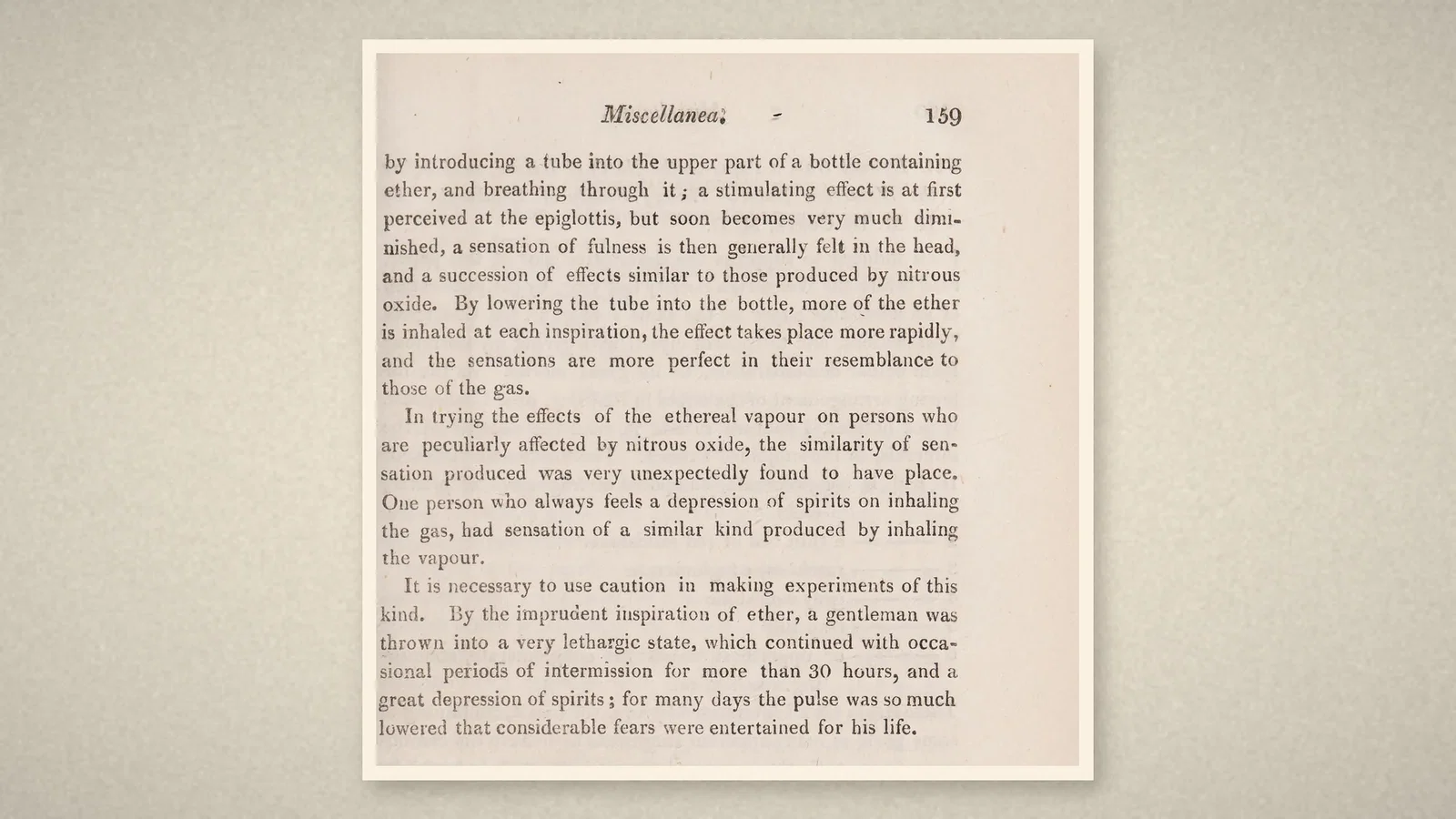
There was also a comparison between people. When the vapour was tried on people who were "peculiarly affected by nitrous oxide", the similarity "was very unexpectedly found to have place". One person who always felt depressed after inhaling the gas felt the same after inhaling ether. [1, p. 159]
And then the warning. "It is necessary to use caution in making experiments of this kind." A gentleman who had inhaled ether imprudently "was thrown into a very lethargic state", which lasted, on and off, for more than thirty hours, with great depression of spirits; for many days the pulse was so low that people feared for the man's life. [1, p. 159]
Who wrote it
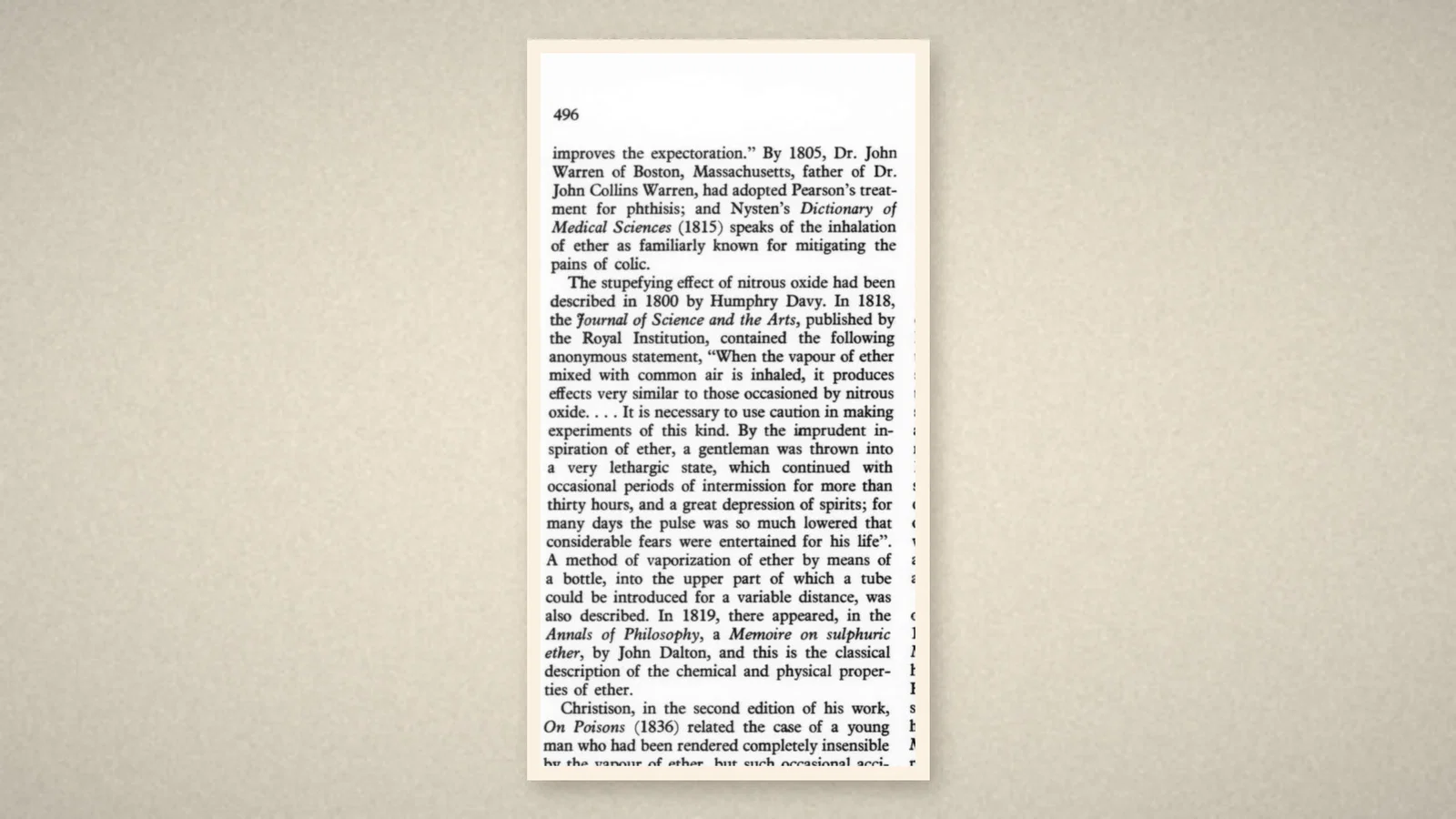
The topic is often listed as "Faraday's observations on ether inhalation". The note itself is unsigned. When M. H. Armstrong Davison quoted it in "The evolution of anaesthesia" in the British Journal of Anaesthesia in 1958, no author was named: it appears there as "the following anonymous statement" in the Journal of Science and the Arts, "published by the Royal Institution". [2, p. 496]
What the record shows
An early printed comparison of ether with nitrous oxide, based on people breathing both. It was written as a curiosity and a warning, not as a medical proposal: the note says nothing about using ether against pain. The question of authorship is left open here. The words on the page are clear; the name is not on it.
Sources and reading limits
Read: "Effects of inhaling the vapour of sulphuric ether", Journal of Science and the Arts, vol. 4 (1818), pp. 158-9, in full, with the volume's title page; Davison, "The evolution of anaesthesia", British Journal of Anaesthesia October 1958, the section on ether at pp. 495-6.
Not seen: any direct evidence for Faraday's authorship, such as notebooks, letters or Royal Institution records; the bibliographies that list the note under Faraday's name.
Limits: the note is unsigned and this article does not assign it to anyone; the Faraday attribution comes from later listings, and Davison calls the note anonymous. The people tested, including the gentleman who became lethargic, are not identified. Which issue of volume 4 the note appeared in is not established here.
Three illustrations are crops of the 1818 journal (pp. 158-9) and the 1958 review (p. 496); one is a text diagram drawn from them, with no people or apparatus drawn.
- Effects of inhaling the vapour of sulphuric ether. J Sci Arts. 1818;4:158-9. Internet Archive
- Davison MHA. The evolution of anaesthesia. Br J Anaesth. 1958;30(10):495-504. Internet Archive
Continue exploring
Related reading connects shared questions and contexts; it does not by itself establish historical influence.
- 1866: Richardson Publishes Ether-Spray Local Anaesthesia
- 1561: Cordus's Account of Preparing Ether Reaches Print
- 1800: Davy's Nitrous Oxide and Surgery in the Conditional
Anesthesia Epochs · The Source Room · About & Editorial Method
Published November 3, 2026. Sources and reading limits are stated above. Illustrations are labelled as original source images or AI-made. Historical accounts are educational; they are not current treatment instructions.