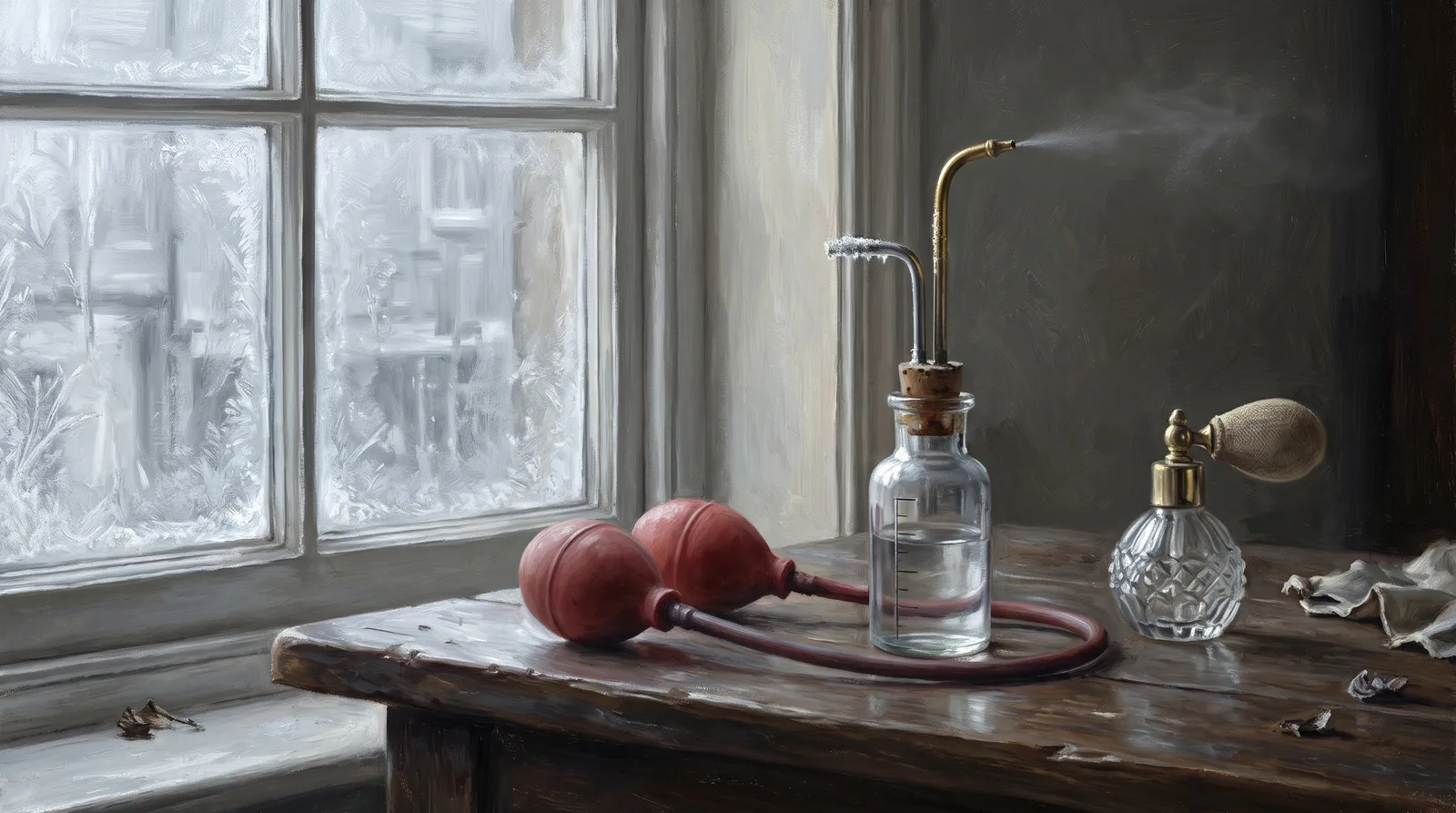
Richardson forced ether through a fine jet with hand bellows to freeze the skin for tooth extraction and incision, inspired by a toy perfume spray.
Reading Library · Anesthesia Epochs · 中文版
Watch the education video (for clinicians)
1866: Richardson's Ether Spray — Local Anaesthesia by Cold · Anesthesia Epochs Education Series
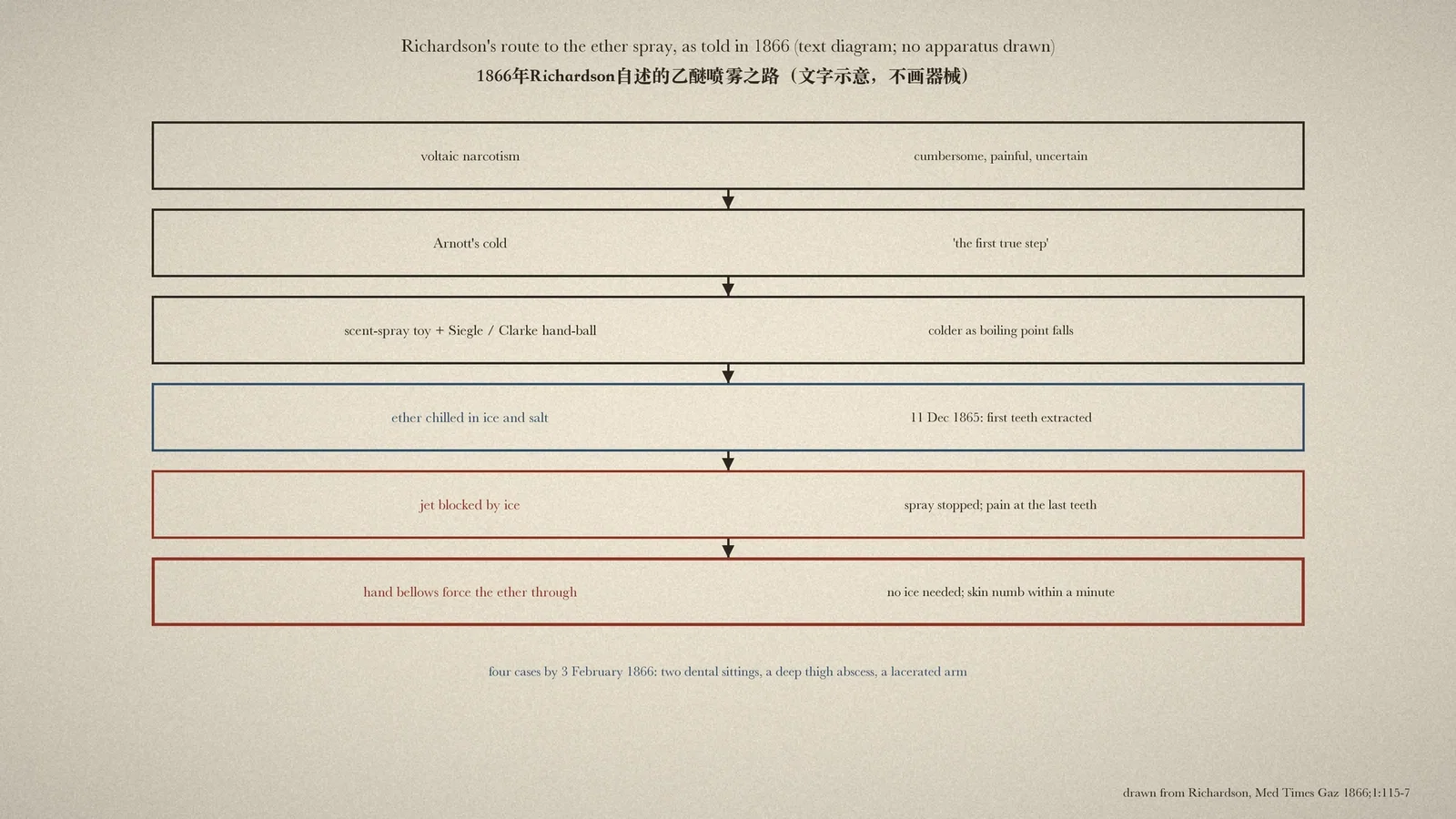
Twenty years after ether made patients unconscious, a London physician used it the other way round: sprayed on the skin, it numbed only one part of the body by cold. The idea came from a drawing-room toy for spraying scent. The method only worked once the inventor stopped trying to chill the ether with ice. [1, pp. 115-17]
The paper
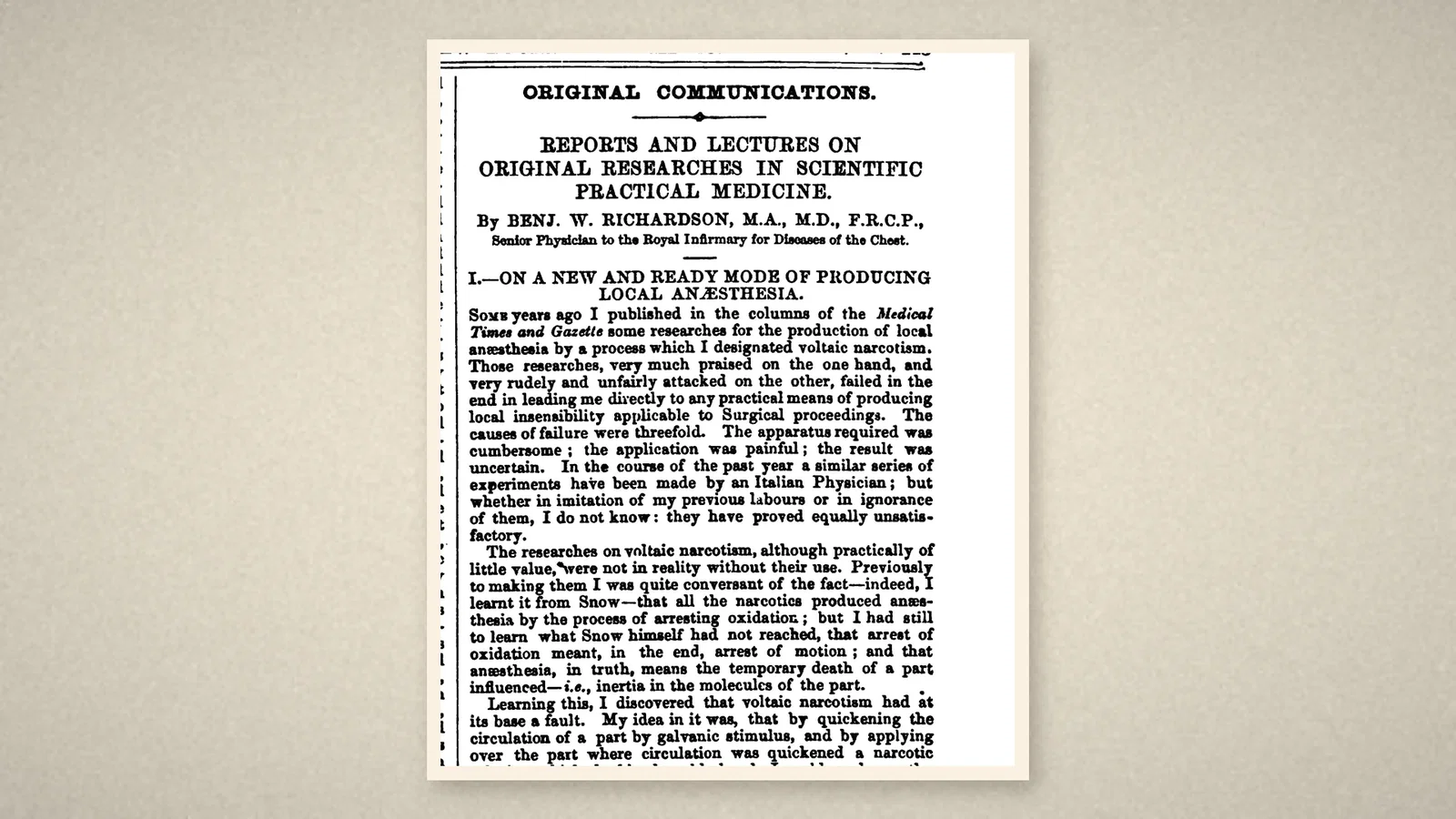
On 3 February 1866 the Medical Times and Gazette published the first of a series of "Reports and lectures on original researches in scientific practical medicine" by Benjamin W. Richardson, senior physician to the Royal Infirmary for Diseases of the Chest. Its title was "On a new and ready mode of producing local anaesthesia". [1, p. 115]
What came before
Richardson began with an earlier failure. Years before, Richardson had tried to produce local anaesthesia by "voltaic narcotism", using electric current to push a narcotic into the tissues. The causes of failure "were threefold. The apparatus required was cumbersome; the application was painful; the result was uncertain." From Snow, Richardson had learned that narcotics work by arresting oxidation, and came to see anaesthesia as a temporary inertia of the part. James Arnott's use of extreme cold seemed "the first true step", if only it could be made easier to apply and combined with a narcotic fluid. Four years of experiments with ice and salt followed by hypodermic injection never gave results worth publishing. [1, p. 115]
A scent spray
The turning point was "the toy for diffusing eau de cologne in fine vapour over the skin". Using Siegle's apparatus and the hand-ball spray producer of Dr Andrew Clarke, made by Krohne and Sesemann of Whitechapel Road, Richardson measured how much cold different volatile liquids produced, and found that "the intensity of the cold produced held a definite relationship to the boiling-point": the lower the boiling point, the greater the cold. Sprayed ether made the skin clearly less sensitive, but not enough for surgery. Krohne then built a metal cylinder packed with ice and salt to chill the ether first. The spray from it made the skin so numb that Richardson could "pass a needle through the part without sensation". [1, pp. 115-16]
On 11 December 1865 the method was used for an operation for the first time. The patient needed five front teeth extracted and had reacted badly to chloroform before; Peter Matthews did the extractions. After fifty seconds of spray the gum was as white as the tooth and insensible, and the teeth came out almost without pain and without bleeding. At a second sitting two days later, the first seven teeth went equally well, but then the spray stopped and the last two were very painful. Water from the air had condensed and frozen in the fine jet. A larger ice-and-salt apparatus failed in a perineal repair for Spencer Wells for the same reason, and was too cumbersome in any case. [1, p. 116]
Bellows instead of ice
Richardson decided "to dispense with ice and salt altogether". Instead, more ether would be driven through the same jet by mechanical force: with the ether pushed out under air pressure rather than drawn up by suction, the spray reached the required cold within thirty seconds. [1, p. 116]
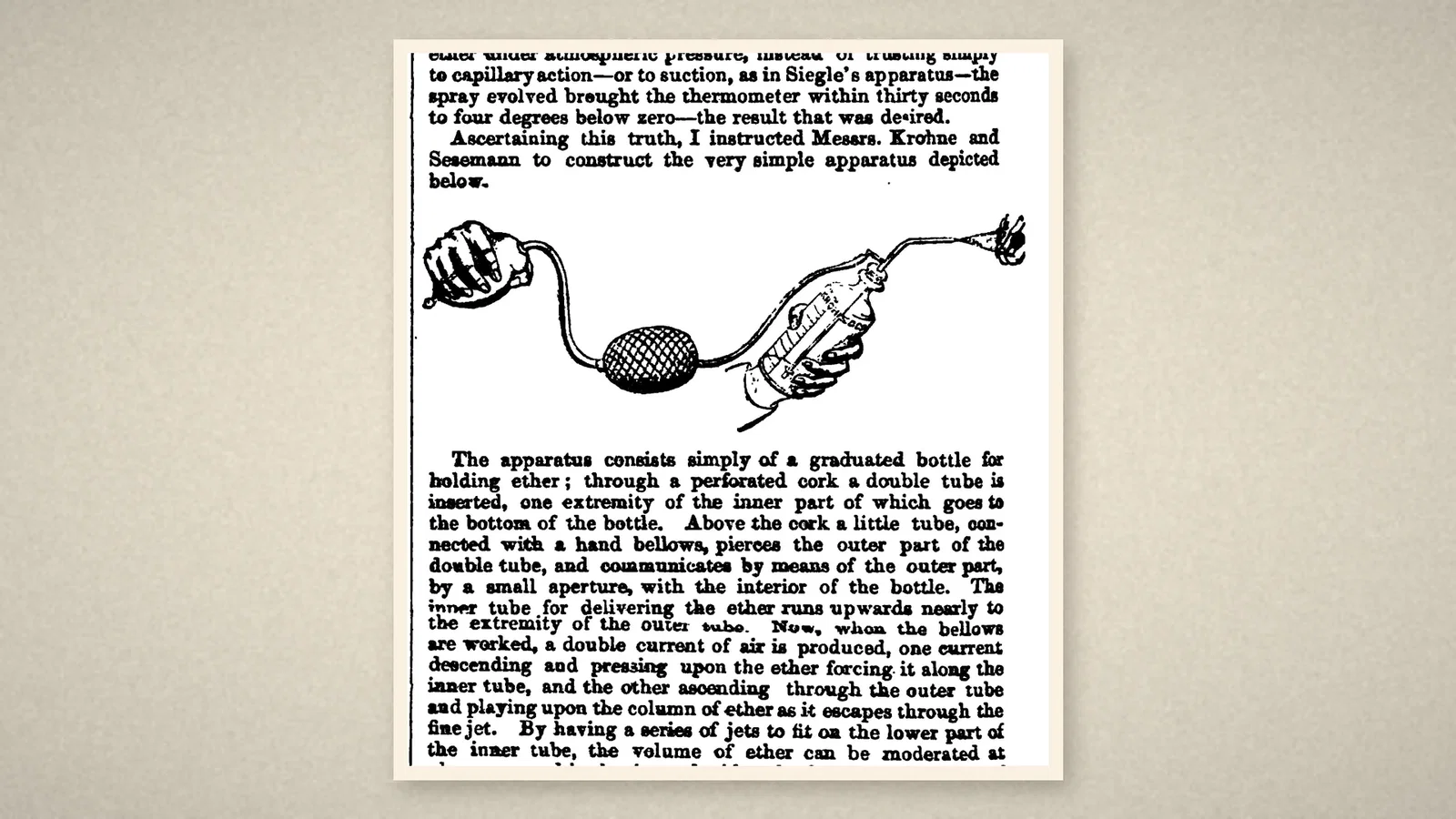
Krohne and Sesemann made the new apparatus. It "consists simply of a graduated bottle" for the ether, with a double tube through the cork. Working a hand bellows sent one current of air down to press on the ether and force it up the inner tube, and another up the outer tube to blow it into spray at the fine jet. Interchangeable jets controlled the flow, and spray catheters could take it into the bladder or the uterus. On the skin, the spray produced insensibility within a minute. Once the skin was cut, the ether acted on the nerves by "the double action of cold and of etherisation", so the numbness could be carried deeper. [1, pp. 116-17]
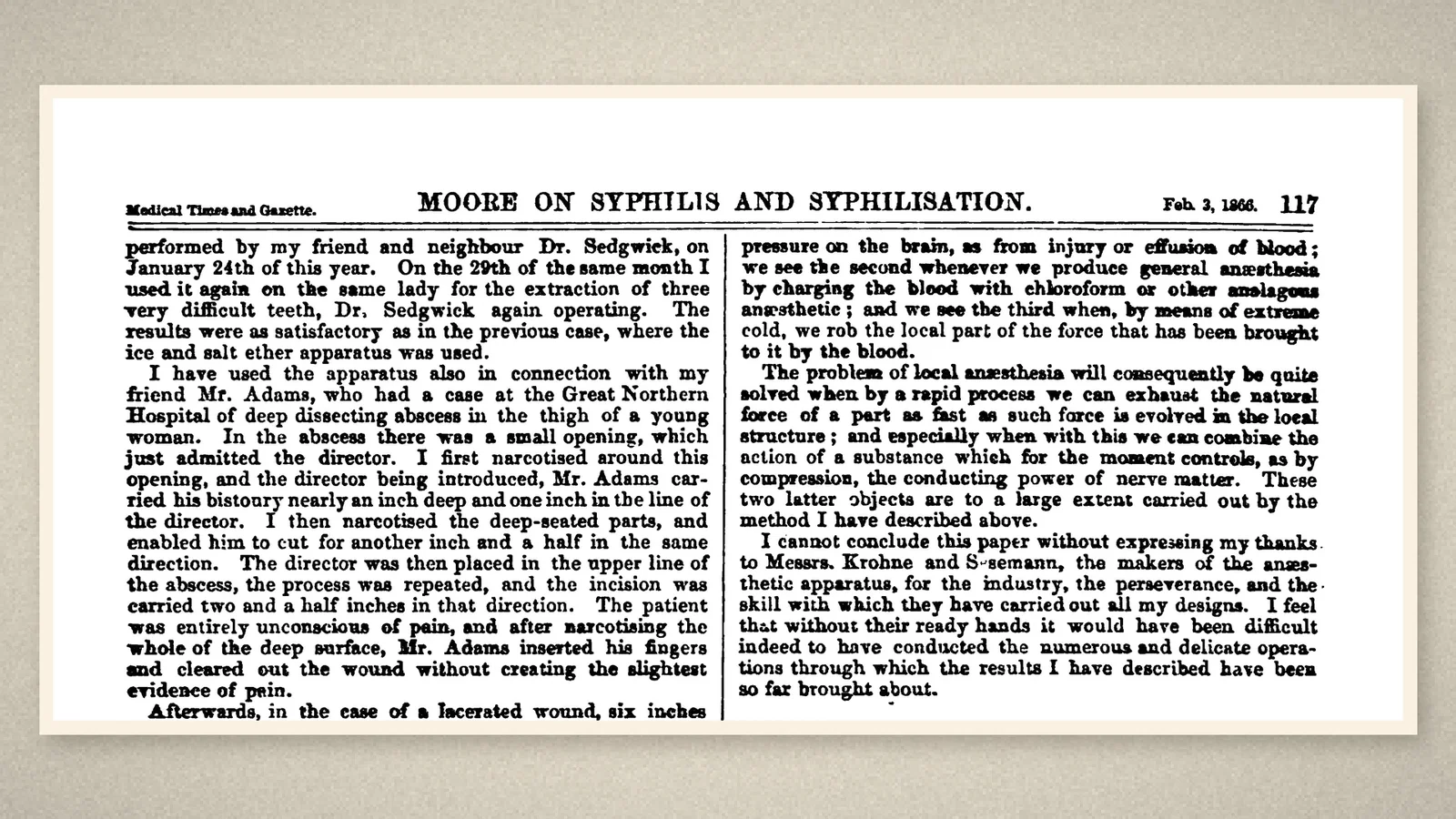
By publication the method had been used in four cases: two dental sittings for the same patient with Dr Sedgwick operating; a deep abscess of the thigh, which Mr Adams at the Great Northern Hospital opened in stages, numbing each layer in turn, without the patient feeling pain; and a lacerated arm. [1, p. 117]
What the record shows
A form of local anaesthesia found through physics rather than pharmacology: cold depended on the boiling point, and more ether through the jet meant more cold. The first apparatus failed because ice formed in it, and that failure is reported in full. The solution was simpler than the problem, a bottle and a hand bellows.
Sources and reading limits
Read: Richardson, "On a new and ready mode of producing local anaesthesia", Medical Times and Gazette 3 February 1866;1:115-17, in full.
Not covered: Richardson's earlier papers on voltaic narcotism; Arnott's work on cold; later reports on the ether spray.
Limits: the four cases are Richardson's own, without follow-up, and what the patients felt is given as Richardson reports it. "For the first time" refers to Richardson's own first operative use. Some timelines place this topic under 1801; the paper read here is from 1866 and reports first use in December 1865. Temperatures are given only as the paper describes them, and ether volumes are not repeated.
Three illustrations are crops of the Medical Times and Gazette (pp. 115-17); one is a text diagram drawn from the paper, with no apparatus drawn.
- Richardson BW. On a new and ready mode of producing local anaesthesia. Med Times Gaz. 1866;1:115-7. Internet Archive
Continue exploring
Related reading connects shared questions and contexts; it does not by itself establish historical influence.
- 1847: Charrière Prints an Illustrated Leaflet on Ether Inhalers
- 1847: Snow Makes Ether a Question of Observation and Control
Anesthesia Epochs · The Source Room · About & Editorial Method
Published November 3, 2026. Sources and reading limits are stated above. Illustrations are labelled as original source images or AI-made. Historical accounts are educational; they are not current treatment instructions.