Anesthesia Epochs
About this film
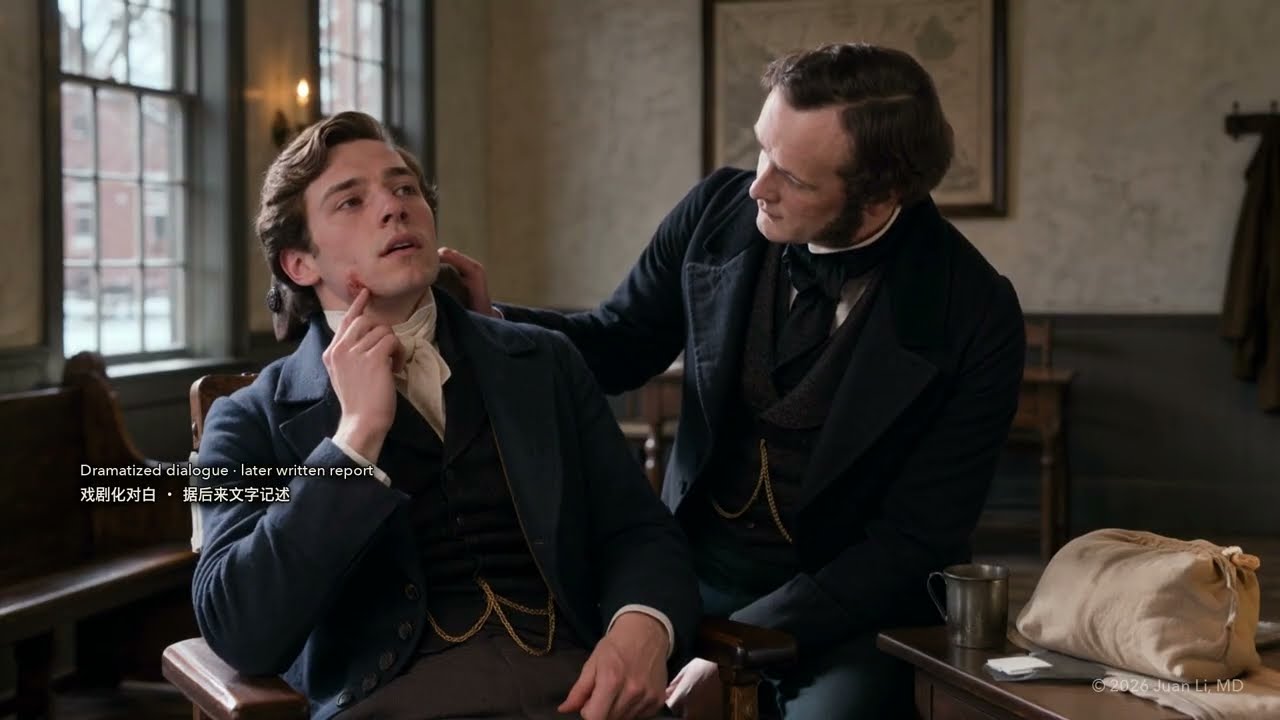
Boston, January 1845. Horace Wells demonstrated nitrous oxide during a tooth extraction. The extraction happened, but the patient's later pain report—transmitted by Wells—was qualified: some pain, less than usual. An observer could see the procedure without knowing exactly what the patient felt, while some in the audience judged the display harshly. The precise day and room remain unsettled in the surviving record.
Read the companion essay · 1845: Wells in Boston, One Demonstration and Three Kinds of Evidence
Scientific takeaway
A completed procedure, a patient's experience, an observer's inference, and a public verdict should be evaluated separately.
Sources
- Wells H. A History of the Discovery of the Application of Nitrous Oxide Gas, Ether, and Other Vapors, to Surgical Operations. Hartford; 1847, pp. 6–7, 15–17. Read the cited edition
- Archer WH, Wells H. The history of general anesthesia (Part I): 1846 Hartford Courant letter reprinted in J Am Dent Soc Anesthesiol. 1960;7(2):12–14. p. 12 · p. 13 · p. 14
- Haridas RP. Horace Wells' demonstration of nitrous oxide in Boston. Anesthesiology. 2013;119(5):1014–1022. doi:10.1097/ALN.0b013e3182a771ea. PubMed record
Notes on reconstruction
The hall and participants are reconstructed; the film does not claim the event took place in the Ether Dome or identify an exact apparatus.
Read beyond the film
1845: Wells in Boston, One Demonstration and Three Kinds of Evidence
Explore the longer account, original references, reading limitations and connected stories.