In US patent 4,848, dated 12 November 1846, Jackson and Morton claimed the combination of ether or its vapour with surgical operations to relieve pain, not the substance itself.
Reading Library · Anesthesia Epochs · 中文版
Watch the education video (for clinicians)
1846: Patent 4,848 — Jackson, Morton and the Letheon · Anesthesia Epochs Education Series
On the first page of United States patent 4,848, the title is Improvement in Surgical Operations. Charles T. Jackson and William T. G. Morton appear together, followed by a statement that Jackson assigned his interest to Morton. The document is dated November 12, 1846.[1] Its two pages turn a question about insensibility during surgery into a claim about an invention.
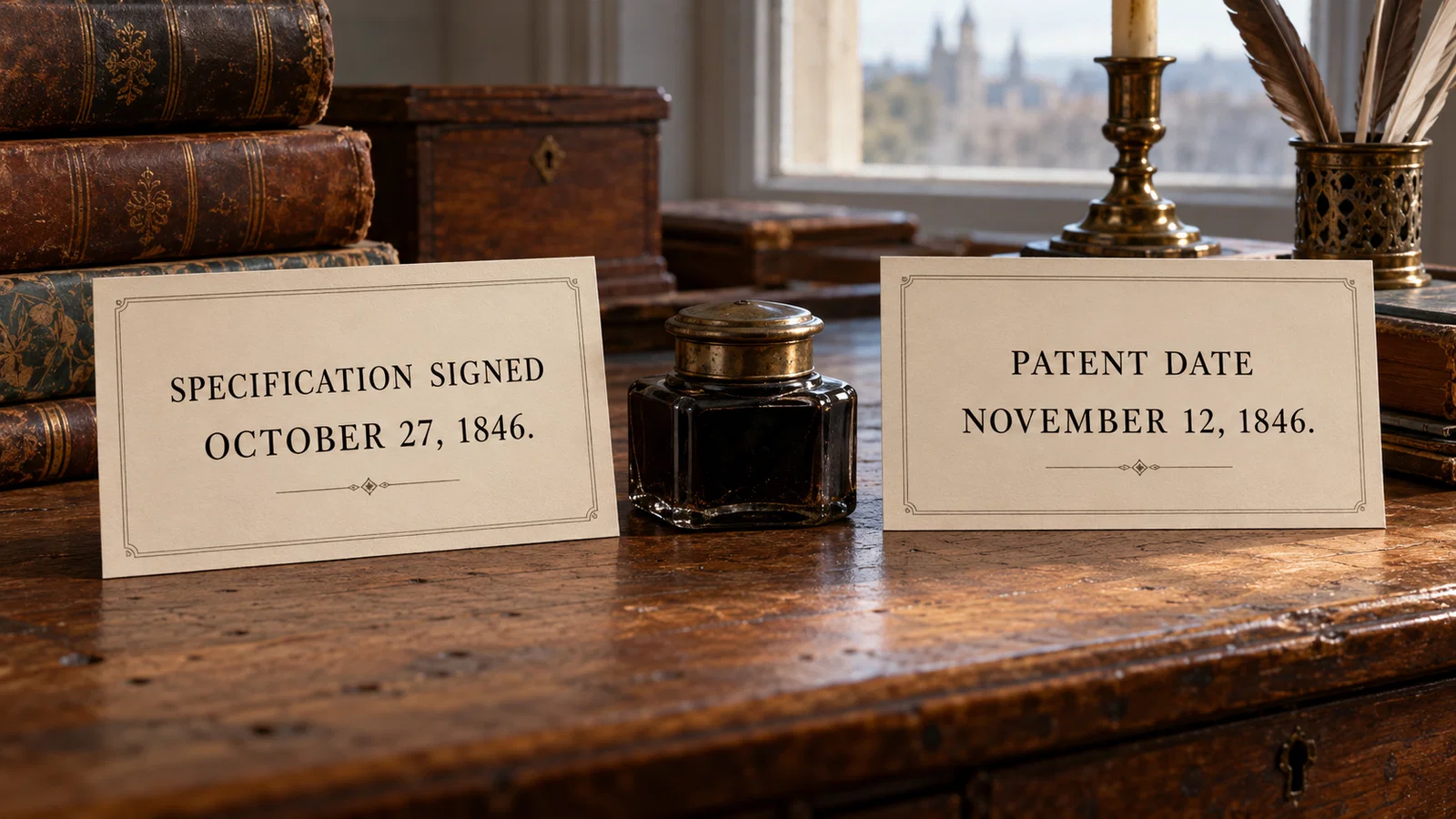
The dates carry different meanings. The specification was signed on October 27; the patent bears the later November date. Neither is the date of the October 16 hospital demonstration described in Henry Jacob Bigelow's report.[1,2] Demonstration, written claim and patent grant were separate events.
What the applicants claimed
The specification acknowledged that ether and effects of inhaling its vapor were already known. Its claim concerned combining ether, or its vapor, with surgical operations to reduce suffering. This was not a claim to have created the chemical substance itself.[1]
The applicants described ways of conveying vapor and asserted the usefulness of the resulting state. Those passages belong to an application explaining and defending an invention. They are not a comparative safety study, and their statements of novelty cannot, on their own, settle who deserves historical priority. The document reveals what its signers sought to protect; that is a narrower and more defensible historical question.
The word “Letheon” does not appear in the two-page specification examined here. Keeping the patent's actual title visible avoids substituting a familiar historical label for the document in front of us.
The contemporary report did not end at the operating table
Bigelow's 1846 article described surgical observations and then turned to the position of the invention in relation to the public. He recognized a claim to recompense for useful work, while questioning the restriction of a means of relieving human suffering. He also offered reasons that might defend the arrangement, including concern about misuse and the conventions of dentistry.[2, transcription pp.7–8]
His discussion is consequently more complicated than a simple denunciation of patents. Benefit, reward, responsibility and access appear in the same passage. It is also a contemporary author's argument, not a later court judgment. This article uses a modern transcription of his text and does not present that transcription as an original journal scan.
The National Archives' 2020 newsletter provides another view of the paperwork: it reproduces the petition associated with patent case 4,848 and identifies the record within the Patent and Trademark Office holdings.[3] That petition and the issued specification are related archival objects. Their dates and wording should be checked individually rather than collapsed into one generic “patent document.”
A second history beside the demonstration
This site's Ether Dome article concerns a public clinical demonstration. This companion concerns what followed when a useful medical application was described as property. Linking the two makes room for a history of documents and professional argument alongside the better-known scene in the operating theater.
These sources do not establish the patent's eventual legal fate, the income it produced, or a final verdict on the competing discovery claims. They do show that questions about who might control and benefit from pain relief accompanied its public introduction.
Image note: all three images are AI-generated editorial reconstructions or concepts. They are not portraits, authenticated instruments, original patent pages or evidence of a particular meeting. Date cards reproduce only dates verified in the specification.
Sources and reading limits
- Jackson CT, Morton WTG. Improvement in Surgical Operations. US patent 4,848, November 12, 1846. Catalogue and text; two-page original specification. Read: both pages; signature date October 27, 1846. The patent has no drawing.
- Bigelow HJ. Insensibility during surgical operations produced by inhalation. Boston Med Surg J. 1846;35:309–317. Read: the complete modern transcription prepared by RWD Nickalls in 2006 from AJ Wright's WLM HTML version. Transcription PDF. Not covered: the 1846 journal printing.
- National Archives at Kansas City. Health and Healing: Two 19th Century Inventions that Changed the World. August 2020 newsletter, pp.2–3. Read: text, continuation, and the petition image with its caption. The caption identifies Record Group 241, patent case 4,848, National Archives identifier 167821289. Broader priority and clinical-benefit claims in the newsletter are not adopted here.
Historical discussion, not present-day patent advice.
Continue exploring
Related reading connects shared questions and contexts; it does not by itself establish historical influence.
- 1846: The Ether Dome, a Breakthrough Without a Perfect Moment
- 1846: Morton Extracts a Tooth for Eben Frost Under an Ether Preparation
- 1846: Holmes Gives an Old Word a New Task
Anesthesia Epochs · The Source Room · About & Editorial Method
Updated October 30, 2026. Sources and reading limits are stated above. Illustrations are labelled as original source images or AI-made. Historical accounts are educational; they are not current treatment instructions.