Anesthesia Epochs
About this film
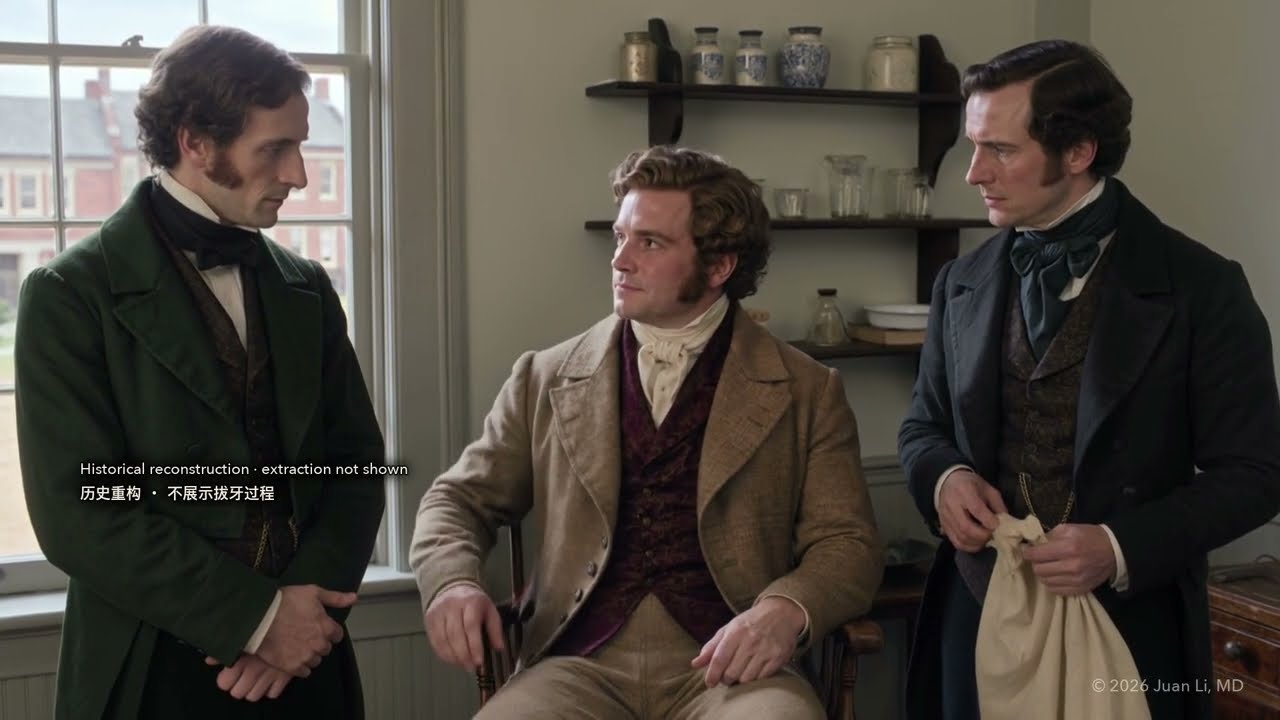
Hartford, 1844. After seeing an injury apparently unfelt during a nitrous-oxide exhibition, Horace Wells asked to have a tooth removed while under the gas. He later reported feeling no pain. The familiar 11 December date comes from later recollections, while John M. Riggs's printed 1847 testimony placed the consultation around early November. The film keeps that dating conflict visible rather than turning one retrospective account into a contemporaneous record.
Read the companion essay · 1844: Horace Wells, the Dentist Who Became the Patient
Scientific takeaway
A patient's later pain report, an observer's account, and the date assigned to an event have different levels of evidential support.
Sources
- Wells H. A History of the Discovery of the Application of Nitrous Oxide Gas, Ether, and Other Vapors, to Surgical Operations. Hartford; 1847, pp. 6, 21–23. Read the cited edition
- Colton GQ. Anaesthesia: Who Made and Developed This Great Discovery? New York; 1886, pp. 4–5. Read the cited edition
Notes on reconstruction
The people, equipment, and dialogue are illustrative reconstructions. The film does not identify an exact clinical technique or resolve the conflicting retrospective dates.
Read beyond the film
1844: Horace Wells, the Dentist Who Became the Patient
Explore the longer account, original references, reading limitations and connected stories.