The 1920 paper and the later circulation of its charts.
Reading Library · Anesthesia Epochs · 中文版
Watch the education video (for clinicians)
1920: Guedel's Ether Chart — Four Planes of the Third Stage · Anesthesia Epochs Education Series
Watch the companion film
1920: Guedel’s Third-Stage Ether Anesthesia
A record says that a patient has reached “surgical anesthesia.” What has it left unspecified?
Arthur E. Guedel's April 1920 paper asked a narrower question than the phrase “inventing the four stages” suggests. Its subject was third-stage ether anesthesia, with particular attention to the position and movements of the eyeball. At the outset, Guedel acknowledged that the literature already described four stages. His question concerned differences within the third.[1]
One chart, two levels
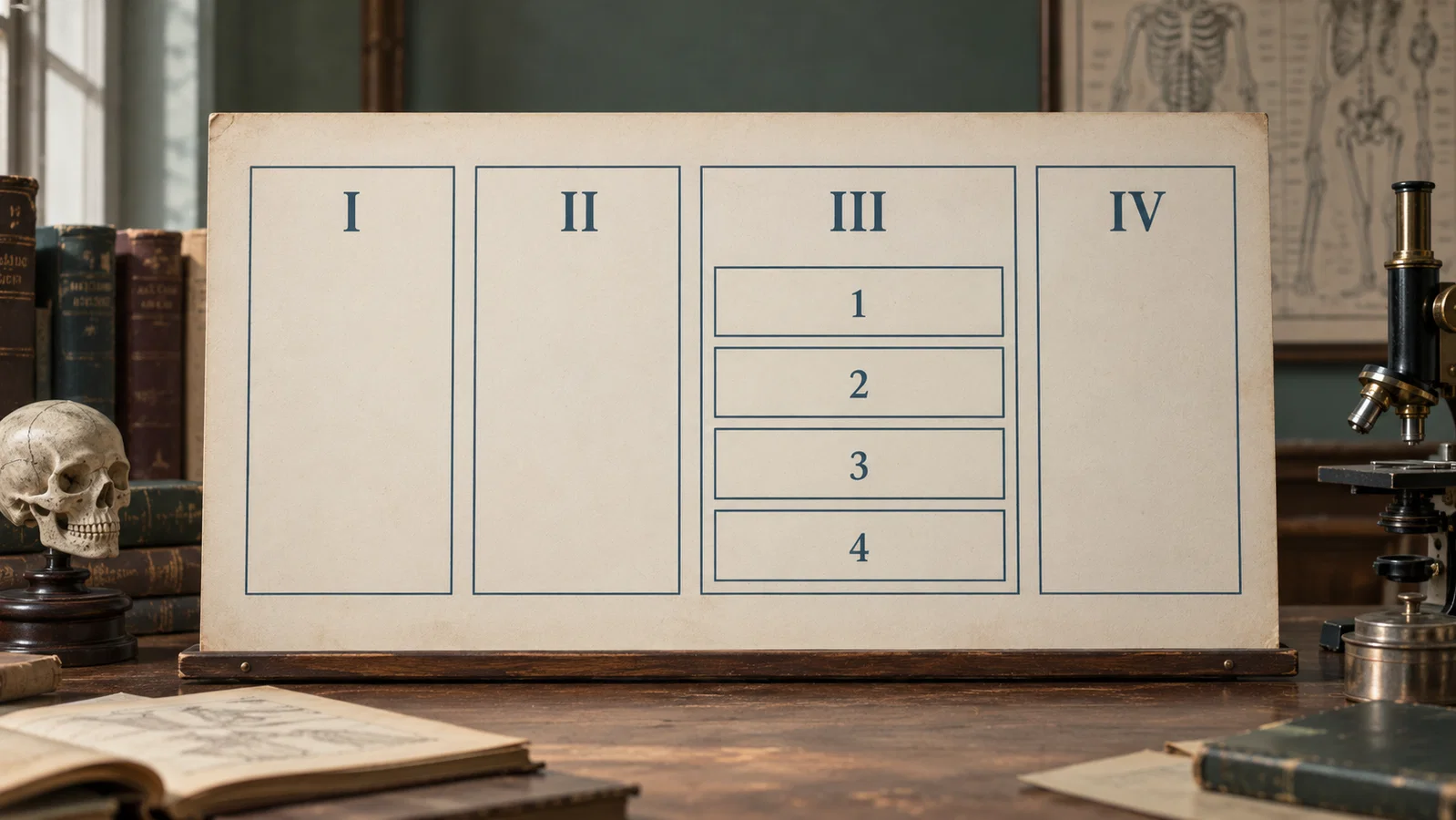
On page 54, Guedel divided the third stage into four “strata.” These were not four additional stages placed beside the existing four. They were subdivisions inside stage III. He explicitly restricted the paper's new discussion to that stage.[1]
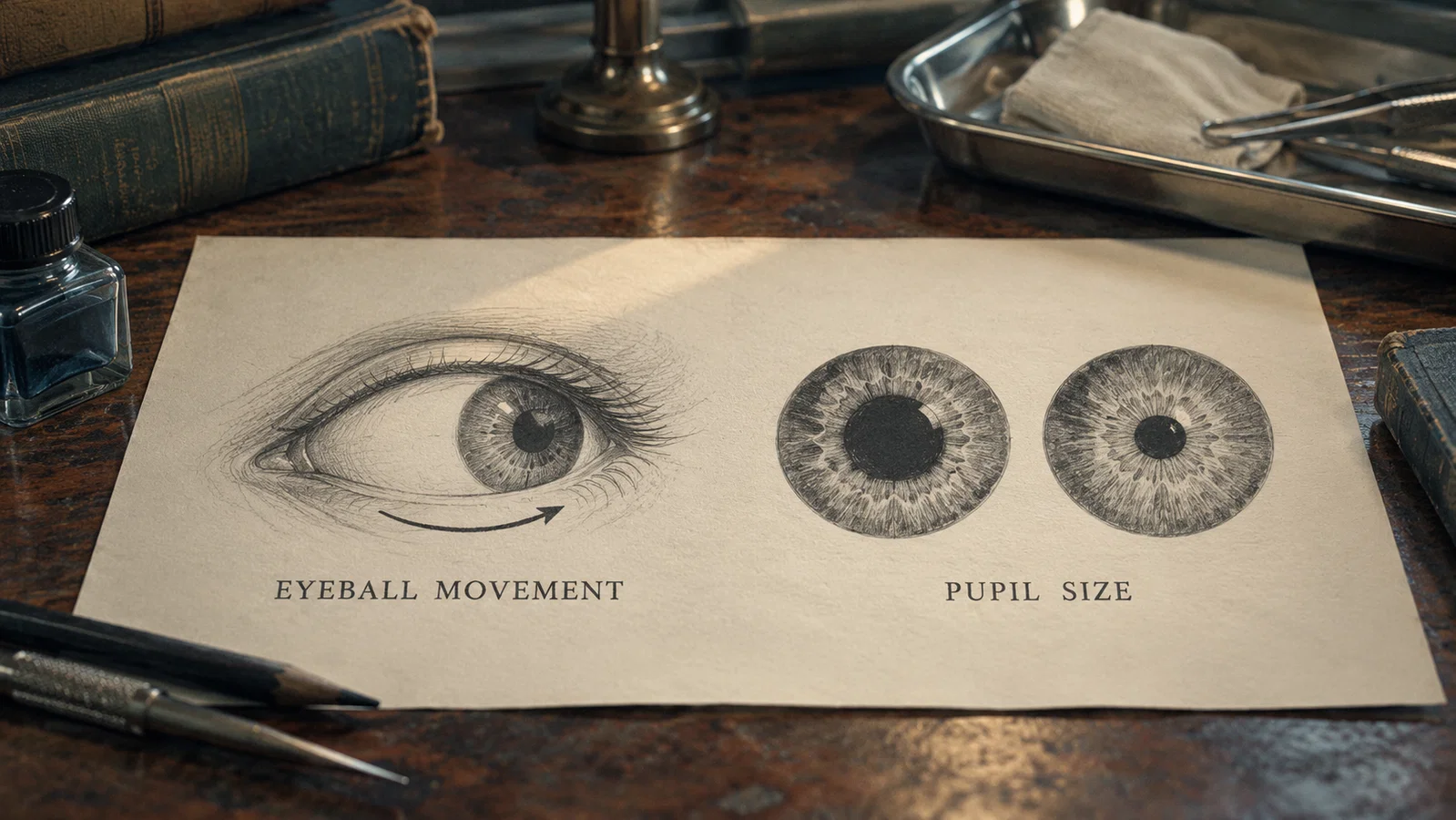
The chart contained six observational columns: respiration during deepening and recovery, the eyeball, the pupil without and with morphine, and laryngeal movement. Eyeball movement or position was distinct from pupil size. Reducing all these observations to “watching the pupils” would lose part of the argument.[1]
Observations that could be taught
Guedel began by saying that he had repeatedly used the paper and its illustrations to teach anesthesia with the American Expeditionary Forces in France. A footnote records presentations in 1919; the printed supplement is dated April 1920. Teaching, presentation and publication should not be compressed into one event.[1]
He set out two purposes: encouraging lighter, more even ether anesthesia and giving students something tangible to learn from. His chart organized clinical observations into a teaching scheme. It was not an automatically recorded instrument trace.[1]
He also referred to more than 10,000 anesthetics administered by himself and his assistants in France. That is the author's statement of experience, not a controlled study with comparison groups and tabulated outcomes. It neither describes cases performed entirely by Guedel alone nor supplies a measured reduction in mortality attributable to his classification.[1]
Read the qualifications beside the diagram
One simplification Guedel challenged was judging depth from the appearance of breathing alone. He described similar respiratory appearances arising in different parts of the course of anesthesia and interpreted them alongside eye signs.[1]
Yet the diagram was not presented without qualifications. Discussing its two pupil columns, he specifically warned that they could not be considered accurate for every case. That sentence belongs with the chart, not outside its history.[1]
Other passages make much broader assurances about safety, other anesthetic agents and postoperative effects. Those remain historical assertions. This article does not turn them into present-day clinical guarantees or reproduce the paper's administration instructions.
Beside Snow, without a forced line of descent
In 1847, John Snow divided the effects of ether into five stages or degrees. He immediately qualified the division as partly arbitrary: the degrees passed gradually into one another and were not always clearly distinguishable.[3]
The comparison is specific. Snow partitioned the overall effects of ether; Guedel subdivided an already recognized surgical stage. Their numbered categories cannot simply be matched one for one. Nor does a shared concern establish that Guedel directly borrowed Snow's text.[1,3]
This site records this as an undirected editorial relationship, not a claim of direct influence or causation. The useful comparison concerns what each author was classifying and how each described the limits of classification.
Do not send the later chart back in time
Calmes's 2002 historical article reproduces an early chart and discusses its subsequent development, including a 1937 version.[2] A familiar later “Guedel chart” should therefore not be assumed to reproduce the 1920 figure unchanged.
For this article, the complete five-page 1920 paper and Calmes's complete three-page history were obtained and read. The entire 1937 book was not. The Wood Library-Museum reprint catalogue also identifies the 1920 contribution as a separate item.[4]
A chart can travel farther than its attribution
Merlin Larson's 2008 history adds another episode. He described examining the chart in Jone J. Wu's 1959 Chinese textbook during a 2001 visit. With a translation by Patrick Sim, he traced it to Noel Gillespie's 1943 modification, which reorganized signs and gave greater attention to reflex responses.[5, pp.85–87]
Larson also reproduced extracts from correspondence in which Gillespie discussed his differences with Guedel and the name the revised chart should bear. Guedel's reply, as quoted by Larson, encouraged Gillespie to claim the modified chart as his own.[5, pp.87–88] The later article is the source read here: neither the original letters, the 1943 journal article nor Wu's complete 1959 textbook was separately obtained. The account should remain attributed to Larson rather than presented as a new inspection of those objects.
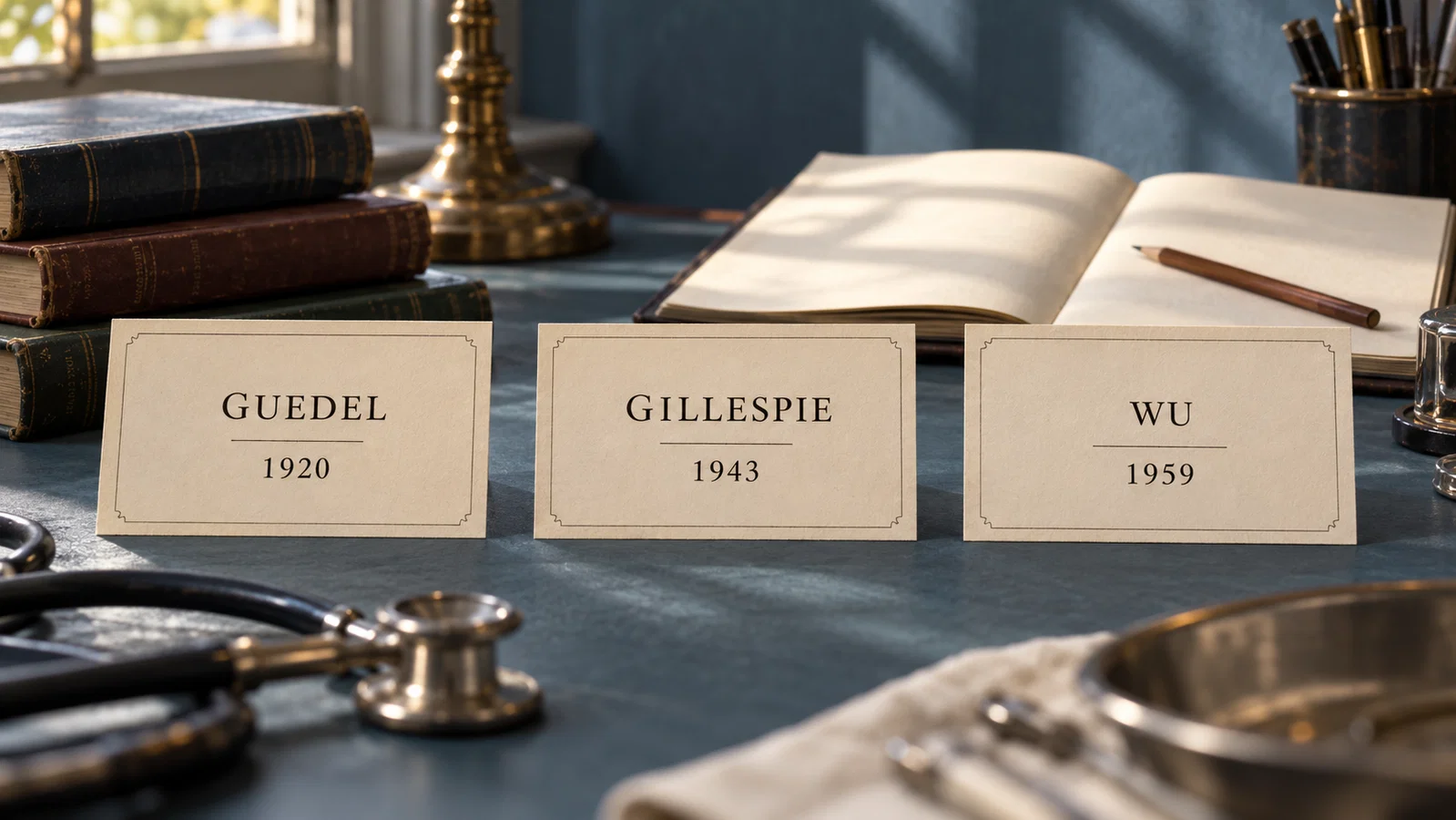
One qualification comes from returning to 1920. That early chart already named reflexes and discussed laryngeal movement. Gillespie's later emphasis should not be compressed into a claim that Guedel had ignored all reflexes.[1, pp.54,56] A chart's history includes changes in its contents, translation and the name attached to it; these are related questions, but they require different evidence.
Guedel's contribution here was a more differentiated vocabulary for observation and teaching within a broad category. That contribution can be described without claims of universal applicability, worldwide priority or a proven survival benefit.
Image note: All four images are AI-generated modern editorial illustrations or conceptual graphics. The desk, bottle, cards and symbols are not authenticated artifacts, original clinical charts, portraits or patient photographs. The hierarchy and chart-history graphics supply no clinical decision rule. The dates 1943 and 1959 follow Larson’s retrospective account. This is medical history, not a guide to ether administration or contemporary anesthesia monitoring.
Sources and reading limits
- Guedel AE. Third Stage Ether Anesthesia: A Sub-Classification Regarding the Significance of the Position and Movements of the Eyeball. American Journal of Surgery, Quarterly Supplement of Anesthesia & Analgesia. April 1920;34(4):53–57. WLM original-page reprint · Archived copy. The portfolio cover, supplement cover and all five article pages of the 52-page reprint were read. The preceding text at the left of page 53 and following article at the right of page 57 are not Guedel's. Other portfolio contributions were not fully read here.
- Calmes SH. Arthur Guedel, M.D., and the Eye Signs of Anesthesia. ASA Newsletter. 2002;66(9):17–19. Public composite mirror of original pages. All three Calmes pages of the 23-page file, with captions and references, were read. Other appended articles were not fully read. Its body names the 1920 journal as Anesthesiology, whereas reference 5 and the original headings support Am J Surg. This article follows the original. The 1937 book and cited 1972 study were not separately read in full.
- Snow J. On the Inhalation of the Vapour of Ether in Surgical Operations. London: John Churchill;1847:1–2. Wellcome original book. Printed pages 1–2 of the 105-page book were read for this comparison; the full book was not re-read.
- Wood Library-Museum. The History of Anesthesiology Reprint Series, Part 4: Signs and Stages of Anesthesia. 1974 reprint-series catalogue. Museum catalogue · Archived copy. Online description and portfolio cover read. The catalogue is not independent evidence of clinical benefit.
- Larson MD. Guedel’s Anesthetic Depth Chart, Jone J. Wu, and Noel A. Gillespie. CSA Bulletin. Fall 2008:85–89. Complete five-page scan. All five pages, figure captions, correspondence extracts and continuation read. This is a later historical account; the 1943 and 1959 originals and the quoted correspondence were not independently obtained.
Continue exploring
Related reading connects shared questions and contexts; it does not by itself establish historical influence.
Anesthesia Epochs · The Source Room · About & Editorial Method
Updated October 30, 2026. Sources and reading limits are stated above. Illustrations are labelled as original source images or AI-made. Historical accounts are educational; they are not current treatment instructions.