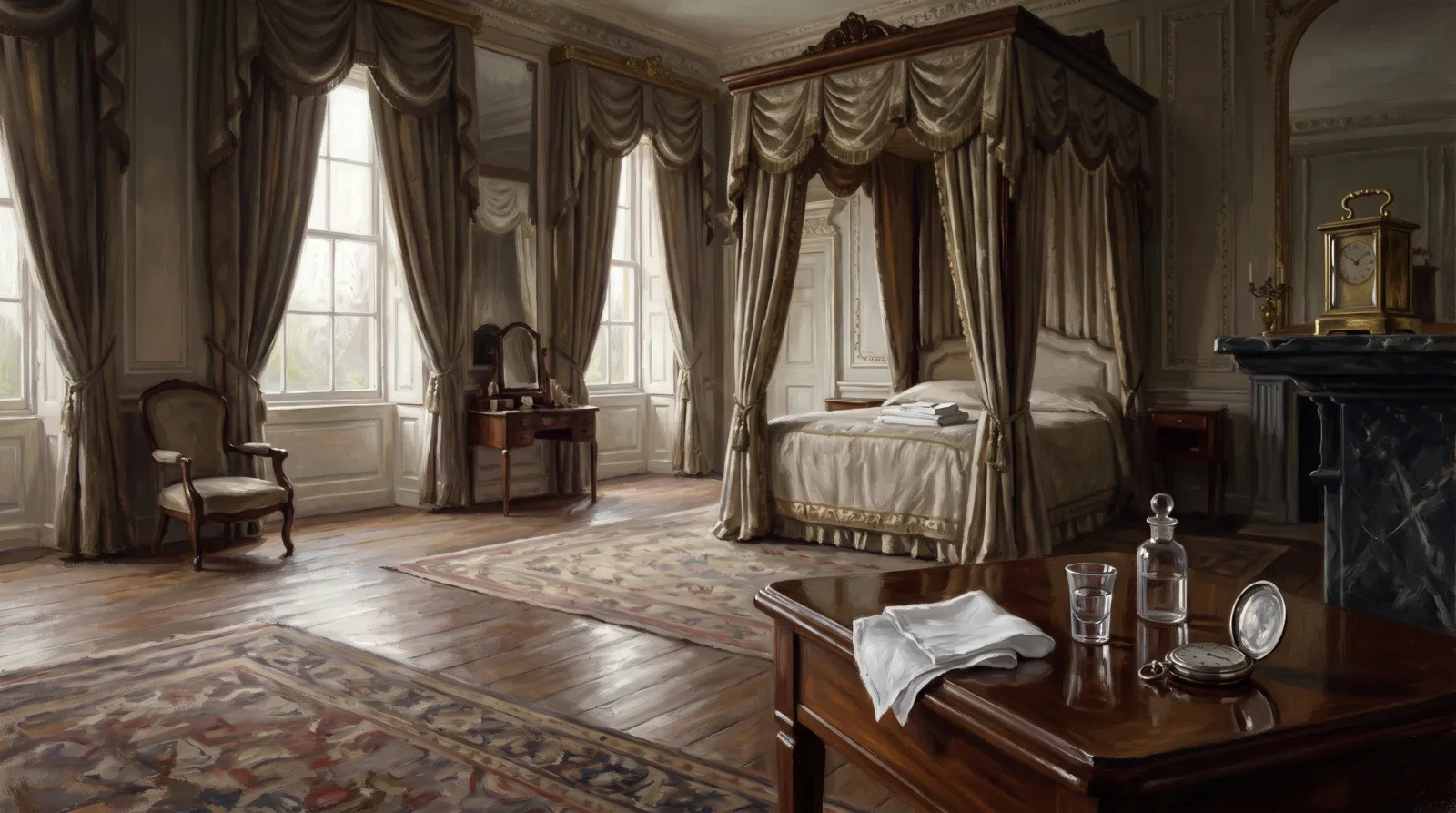
John Snow's case record of Queen Victoria's labour in April 1853 preserves both the relief chloroform gave and an observation that labour was somewhat slowed.
Reading Library · Anesthesia Epochs · 中文版
Watch the companion film
1853: Queen Victoria’s Chloroform · Watch on YouTube
The account of Queen Victoria's labor on 7 April 1853 contains more than a satisfied royal patient. John Snow recorded substantial relief with chloroform, and also recorded Charles Locock's impression that the intervals between contractions had lengthened and labor had been somewhat retarded.[1]
Neither observation needs to erase the other. Read together, they make this a clinical record rather than a certificate of uncomplicated triumph.
1. What fifty-three minutes can tell us
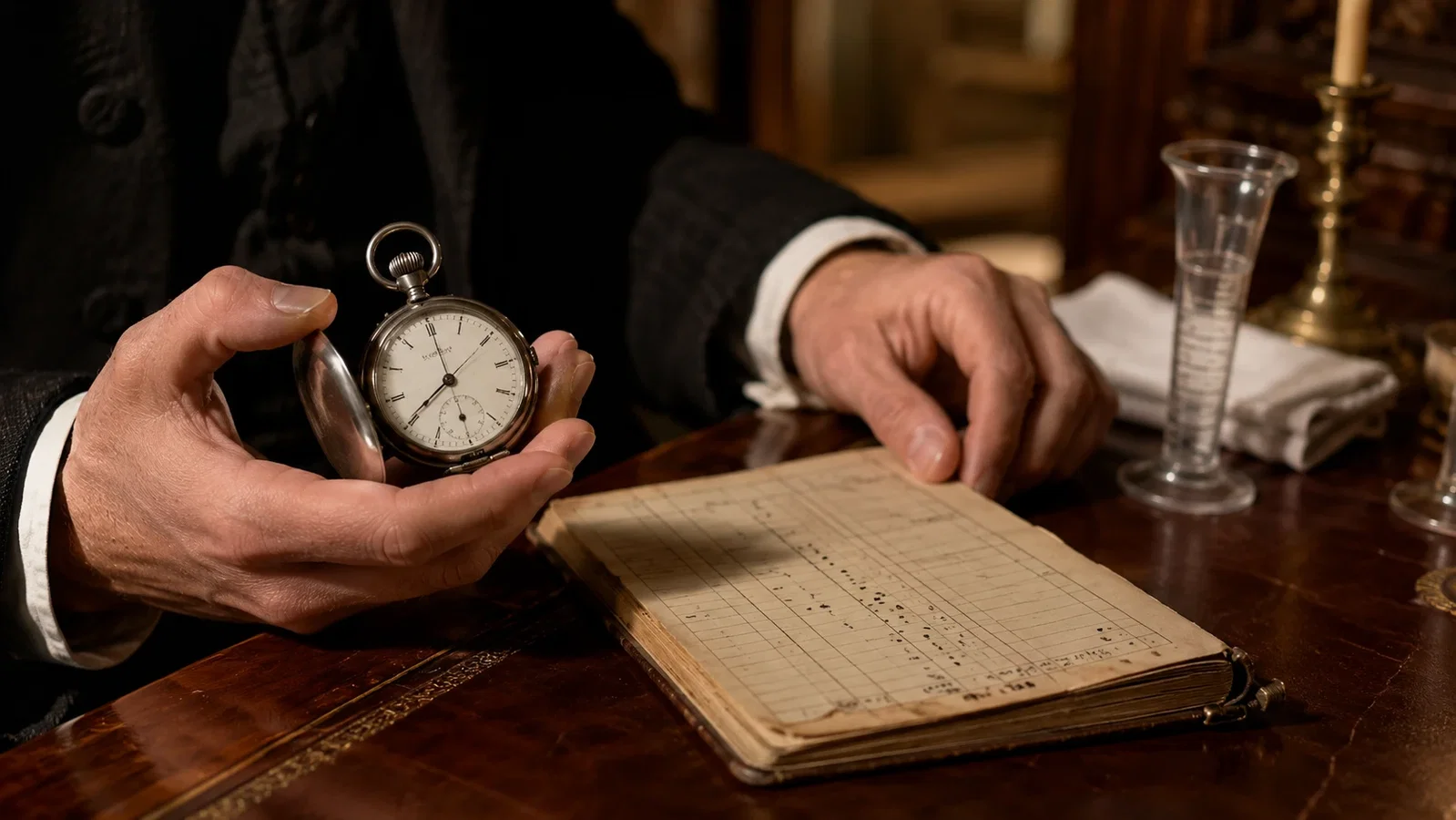
Snow recorded the room clock's readings and noted that the clock was inaccurate. The period of administration lasted fifty-three minutes.[1] There is little to gain by converting those observations into an apparently exact modern birth time.
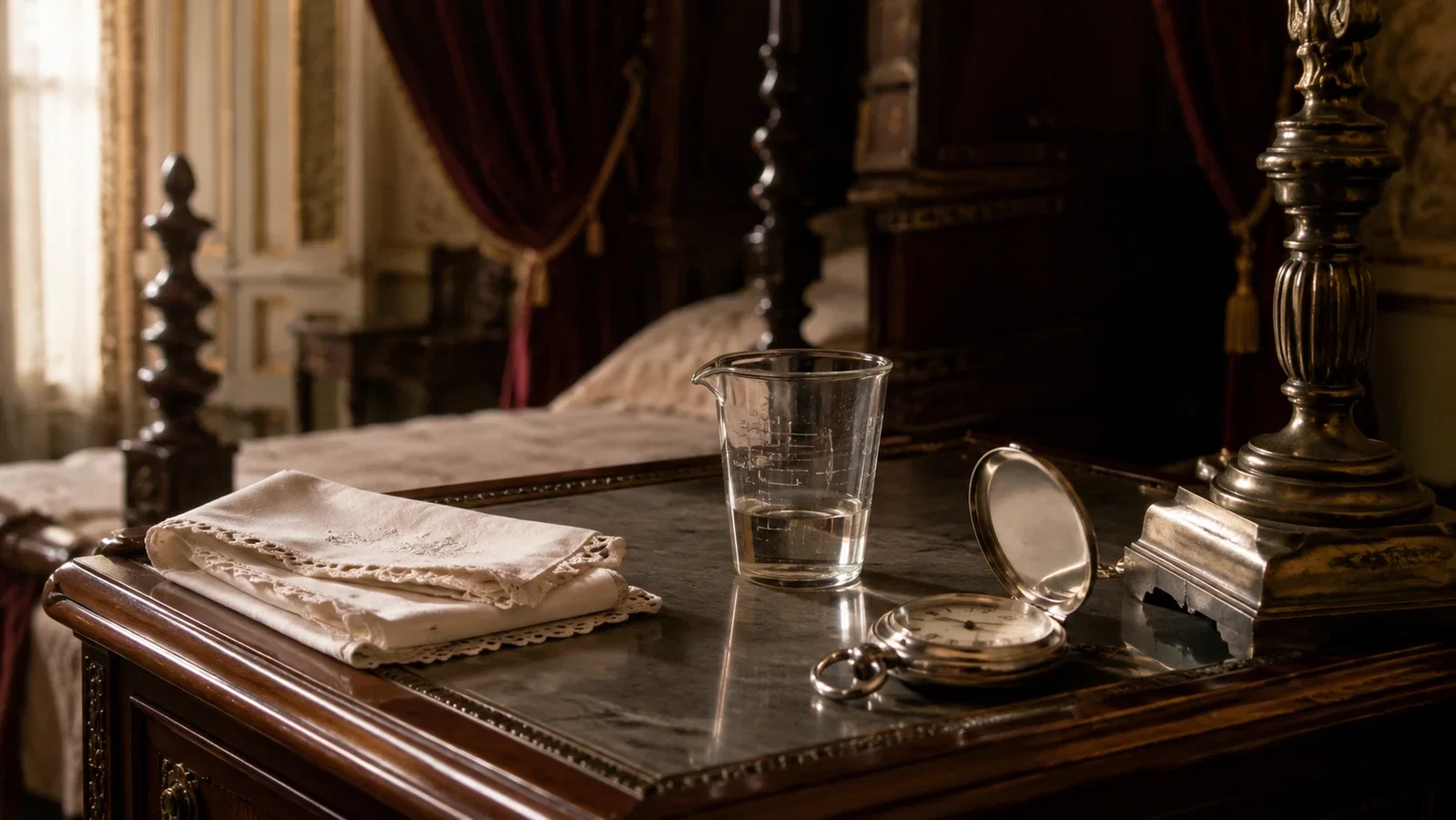
The account describes a folded handkerchief, measured liquid and administration with the pains. It does not establish a constant inspired vapor concentration. Nor does it document the pocket-watch choreography or all the bedside furnishings that a later illustration might supply.
Snow's statement that consciousness was never completely removed also requires care. It is not the same as documenting perfect alertness throughout. Relief, consciousness and uterine activity remained separate observations, not interchangeable meanings of “painless birth.”
Richardson's memoir in Snow's posthumous book repeated the duration and handkerchief method.[2, p.xxxi] That is useful for checking the published account, but it draws on the same case record rather than providing a second independent clinical witness.
2. A patient's benefit did not settle every question
Snow reported the Queen's satisfaction with the relief. Locock's impression of some retardation remained in the record alongside it.[1] Preserving both avoids turning a favorable experience into a claim of benefit without qualification.
This article does not reproduce the famous “blessed chloroform” phrase as a verified quotation from the Queen's 1853 journal. The relevant royal diary original was not read; the available institutional webpage associates the phrase with the later birth in 1857. Familiarity is not a substitute for checking its date and source.
The 1857 case is also a different episode. Its details of pain, sleep and interruptions cannot be borrowed to complete the earlier scene.[1]
3. Snow's obstetric chapter was more qualified than the legend
In On Chloroform and Other Anaesthetics, Snow discussed individual needs for relief and differing effects on contractions and the progress of labor.[2, pp.318–329]
Snow discussed both an inhaler, generally preferred, and handkerchief administration.[2, pp.322–324] These passages do not transform the royal handkerchief case into a demonstration of constant-concentration delivery. Measuring liquid and knowing exactly how much vapor a patient inhaled are different achievements.
The point is to preserve the precision the record actually offers, not to deny Snow's interest in observation and measurement. Historical descriptions here are not instructions for present-day care.
4. A royal patient did not close the debate
An editorial in The Lancet on 14 May 1853 objected to chloroform in ordinary childbirth and questioned reports of its royal use.[3]
One editorial cannot stand for all physicians. It does show why the royal case should not be narrated as an automatic end to medical opposition. Neither the speed of wider adoption nor safety in other patients can be established by this one confinement.
What survives is more useful than a royal seal of approval: evidence of relief accompanied by observations that still required interpretation. Keeping both is the essential task of telling this story.
Sources and reading limits
Read: Snow's case entries for 7 April 1853 and for 1857, in the UCLA transcription from Ellis's edition of the case books; Richardson's memoir (pp. xxx–xxxii) and the full obstetric chapter (pp. 318–329) of Snow's 1858 book; the Lancet editorial of 14 May 1853 in the UCLA transcription.
Not covered: the manuscript casebook; the Queen's diary; the rest of the 1858 book; the original Lancet page.
[1] Snow J. Case entry, 7 April 1853. UCLA transcription from Ellis RH, ed. The Case Books of Dr John Snow (1994), p.271.
[2] Snow J. On Chloroform and Other Anaesthetics: Their Action and Administration. London: John Churchill; 1858. Internet Archive.
[3] The Lancet, 14 May 1853, editorial, reproduced in full on the same UCLA page. This supports the position expressed there, not a claim about unanimous medical or public opinion.
Source-based revision: 7 September 2026. The illustrations are interpretations, not evidence of exact dosing, constant concentration or established universal safety.
Visual interpretations
These illustrations explore the setting and ideas. Depicted people, actions, instruments and documents are reconstructions, not evidence of their exact historical appearance.
Continue exploring
Related reading connects shared questions and contexts; it does not by itself establish historical influence.
- 1847: Snow Makes Ether a Question of Observation and Control
- 1847: Chloroform, from Self-Experiment to a Public Report
- 1847: Simpson Separates Labour Pain from Uterine Action
Anesthesia Epochs · The Source Room · About & Editorial Method
Sources and reading limits are stated above. Illustrations are labelled as original source images or AI-made. Historical accounts are educational; they are not current treatment instructions.