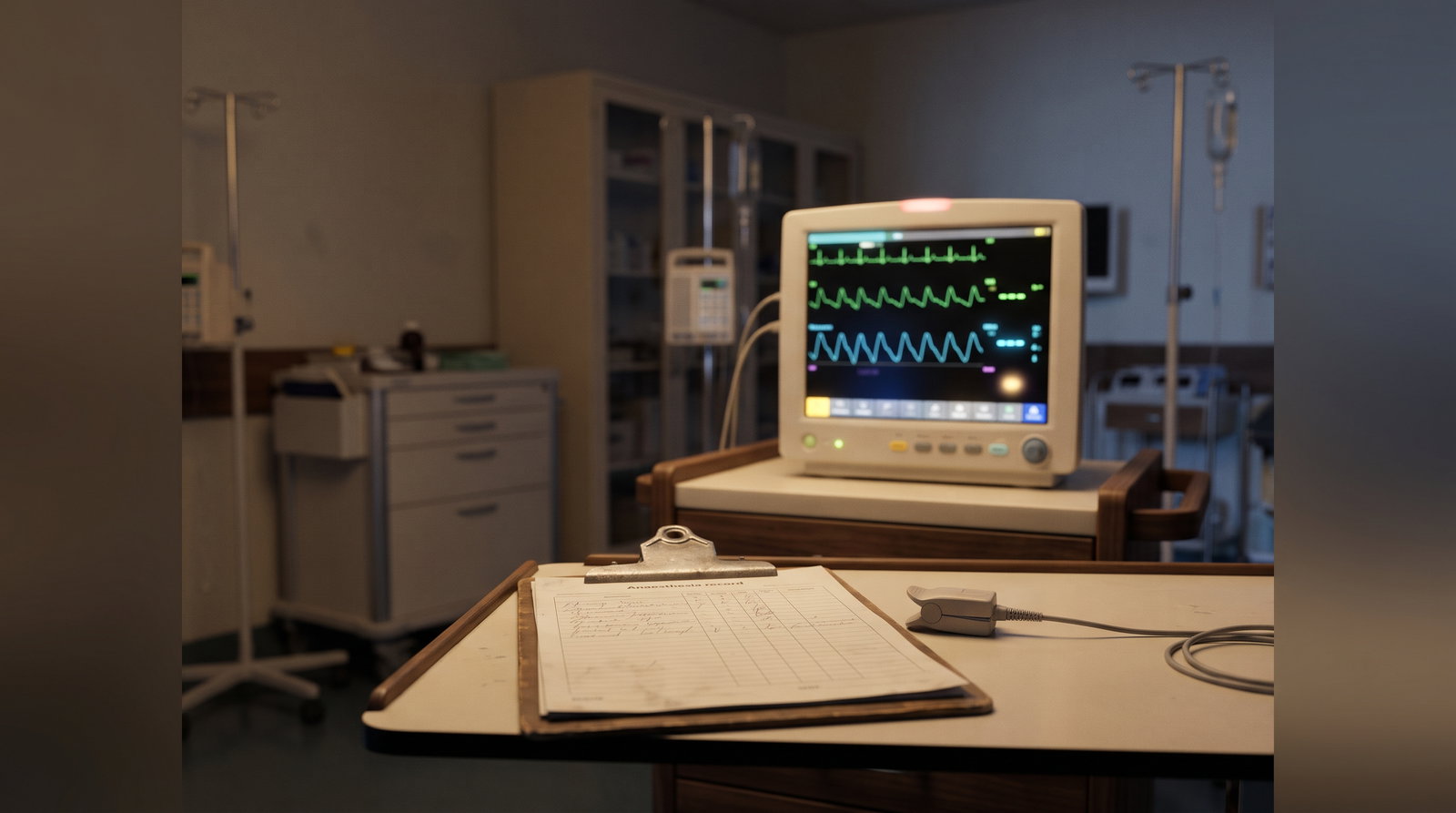
A sign at the bedside, a line on a chart and a number on a monitor each make a different part of an anesthetic visible. These seven readings follow how observations were described, recorded, repeated and built into shared practice. The later steps ask a further question: which patient outcome, and which comparison, can test the value of the care built around a signal? The route compares these problems without assigning safety gains to a single invention.
1. Observation: decide what a sign can tell you
Snow distinguished consciousness, recollection, voluntary action and other movements in his 1847 ether book. His categories had gradual boundaries, and he cautioned against using one movement or a later denial of pain as a complete verdict. Vapour supply and breathing informed the observation, while eventual surgical outcomes required a different accounting.
Begin with the limits of interpretation. The next step asks how observations might remain available after the moment has passed, so that another reader could examine their relation to events.
1847: Snow Makes Ether a Question of Observation and Control
2. Recording: put observations beside time and events
The surviving Cushing and Codman examples place recorded observations, times and annotations on forms. Their printed fields and actual entries need separate reading: an empty box is not a complete account of what happened, and a pulse plot must not be turned into a blood-pressure trace.
The article directly examines four published examples, rather than all surviving records. These charts make another reading possible; they do not supply a before-and-after estimate of deaths prevented. Carry that distinction from the record to a device designed for repeated observation.
1894: Cushing and Codman Put Anesthesia on the Record · 1894–1895: Cushing and Codman’s Anesthesia Records
3. Repetition: follow a response instead of remembering it
Katz’s report describes the difficulty of comparing an intermittent muscle response with one remembered from earlier. Block-Aid offered a practical way to repeat stimulation and follow change. Its main subject was muscle-relaxant action, and its role remained a tool for observation and teaching.
This step makes continuous attention more concrete without claiming that the device itself proved better outcomes. Its source boundary also matters: the complete published Spanish translation was read, while the original English full text was unavailable. Next, compare a repeatedly elicited response with a physiological signal extracted from pulsating light.
c. 1964: Block-Aid Makes Muscle-Relaxant Action Repeatedly Observable
4. A signal: make oxygenation visible
The pulse-oximetry article follows an insight through patent filing, presentation, device development and adoption. It explains how pulsation helps separate an arterial optical signal from its background. The resulting estimate concerns oxygen saturation; it does not, by itself, establish adequate ventilation or describe every aspect of the patient’s condition.
Read the technical story together with its outcome boundary. Better detection and changes in care do not independently prove that one monitor reduced mortality. The next article asks how an institution turns available observations into a shared obligation.
1974: Takuo Aoyagi Makes Hypoxia Visible · 1974: Aoyagi and Pulse Oximetry — Making Oxygenation Visible
5. A standard: specify who keeps watching
Harvard’s 1985 requirements brought personnel presence, continued observation, measurements and specified alarms into a common minimum. The text read in the article is the July revision reproduced in the 1986 publication. It retained bedside methods alongside instrument options; pulse oximetry was not a universal requirement in that table.
A document could state an obligation while practice still contained omissions. The reported checks on implementation therefore answer a different question from an outcome trial. Follow that separation into the next step, where regulatory clearance defines another kind of boundary.
1985: Harvard's Monitoring Standards Make Continuous Observation a Shared Requirement
6. An index: define the question it can assist
The 1996 FDA record identifies BIS as a processed EEG parameter intended to assist monitoring the effects of certain anesthetic agents. The linked article distinguishes that indication from later wording about awareness with recall, and separates regulatory clearance, algorithm integration and evidence of patient benefit.
The comparison with earlier steps is about the scope of information. A new display can help organize a signal without measuring every objective of anesthesia. The final step asks how a particular way of using that information can be tested against another active approach.
1996: The FDA Clears BIS to Aid Anesthetic Monitoring
7. A trial: compare the care built around the signal
B-Unaware and BAG-RECALL compared BIS-guided protocols with end-tidal anesthetic concentration protocols in higher-risk patients receiving predominantly inhaled anesthesia. Both sides involved organized monitoring and prompts. Their outcome was explicit postoperative recall, assessed through interviews and adjudication.
The trials did not demonstrate BIS superiority, but that finding does not establish equivalence or show that monitoring has no value. Read them after the clearance article to see the question change: from what an index is intended to assist, to whether a defined protocol improves a specified outcome against a defined comparator.
2008: B-Unaware and BAG-RECALL Compare Two Monitoring Protocols
As you return through the route, notice the work between information and an outcome: interpretation, recording, repeated attention, implementation and comparison. Each article makes one part of that work visible. Its references and reading limits remain attached to the full account, and the films are companion interpretations rather than additional independent evidence. These historical texts do not replace current monitoring standards or clinical guidance.
Explore the Connections · Reading Library
Updated October 30, 2026.