A processed EEG index and the scope of its intended use.
Reading Library · Anesthesia Epochs · 中文版
Watch the companion film
1996: BIS — FDA Clearance of the Bispectral Index Monitor · Watch on YouTube
Historical anchor: 1996. Date details and source qualifications are explained below.
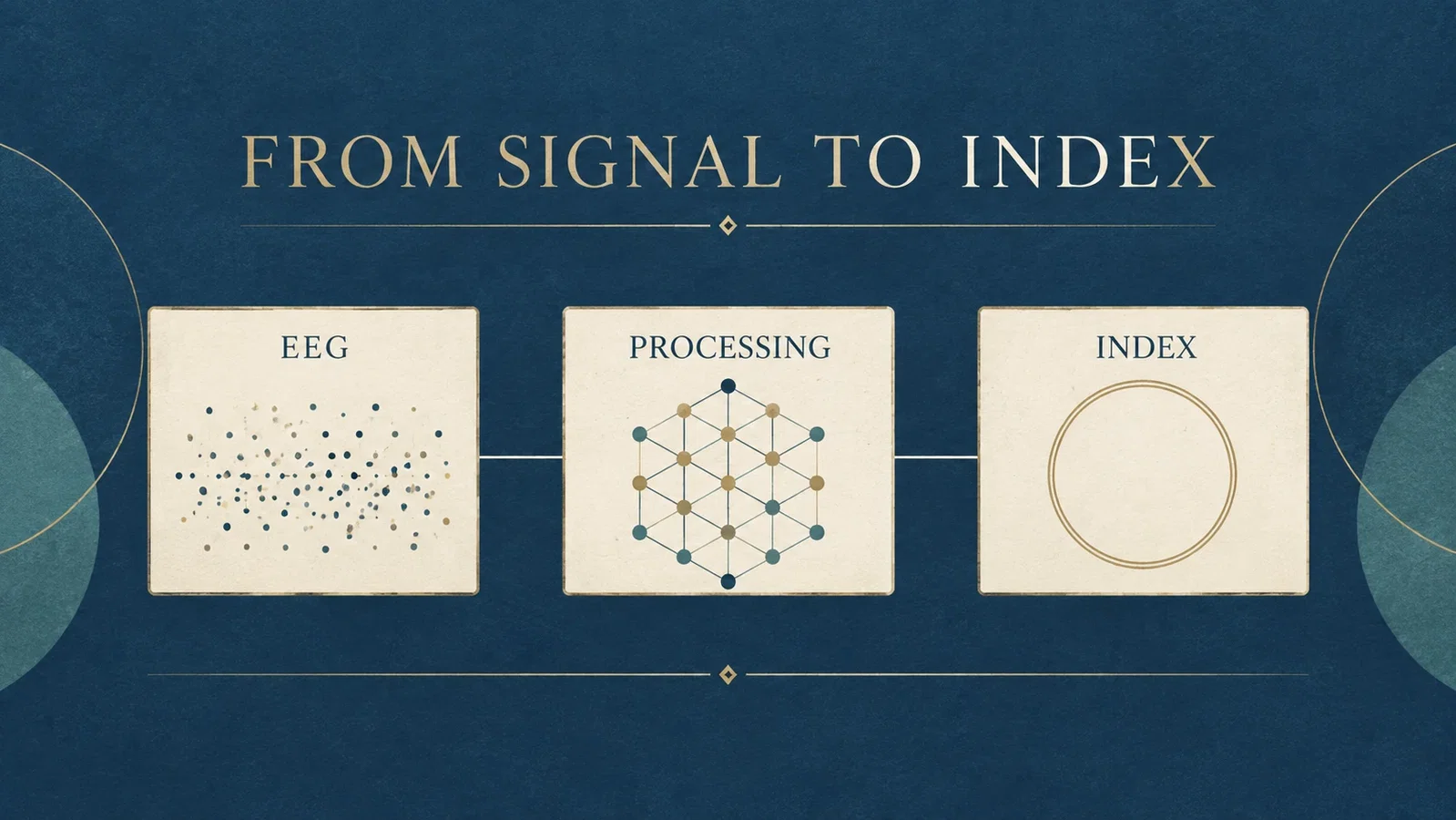
On October 8, 1996, the FDA issued a substantial-equivalence decision for Aspect Medical Systems’ A-1000 and A-1050 EEG monitors, under submission K963644. The documents identified BIS as a processed EEG parameter that could assist in monitoring the effects of certain anesthetic agents.[1, database and PDF pp. 1–3, 5] This provides a precise regulatory date, with a defined intended use, for the history of BIS.
The monitors acquired EEG signals and offered several processed outputs. The summary listed spectral displays, suppression ratio, spectral edge frequency, signal quality measures and BIS.[1, PDF pp. 1–2] These features allow a specific comparison with the earlier trend and frequency displays discussed in this site’s 1969–1984: Early Processed EEG with CFM, CFAM and Lifescan. Both address the problem of making changing signals interpretable. The comparison does not establish a single commercial or inventive lineage connecting CFM, CFAM, Lifescan and BIS.

BIS combined EEG features in its own way. Johansen’s 2006 review described contributions from several forms of analysis, including phase relationships between frequency components, and documented successive algorithm and software revisions.[2, pp. 82–83] The review helps explain the technical context. Its author disclosed educational grants and speaking honoraria from Aspect, however, so it should not be presented as an efficacy assessment wholly independent of the manufacturer. The article also stated that no grant support was used in its preparation.[2, p. 81]
The scope of a measurement matters as much as its name. Johansen distinguished monitoring related to hypnosis from analgesia and stated that BIS did not predict movement or hemodynamic responses to stimulation.[2, p. 85] The restriction to certain anesthetic agents also belongs to the 1996 indication itself.[1, PDF pp. 2, 5] Interpreting this information requires attention to the questions it can address; one index does not encompass every objective of anesthesia.
The regulatory decision has its own scope. A 510(k) clearance rests on substantial equivalence to a legally marketed predicate device and is distinct from the premarket approval, or PMA, pathway.[6; 1, PDF p. 3] K963644 therefore establishes the device’s regulatory identity and intended use. Its summary mentioned an emergence-related manuscript still in preparation. That reference alone cannot supply verified patient outcomes for a claim of benefit in 1996.[1, PDF p. 2]
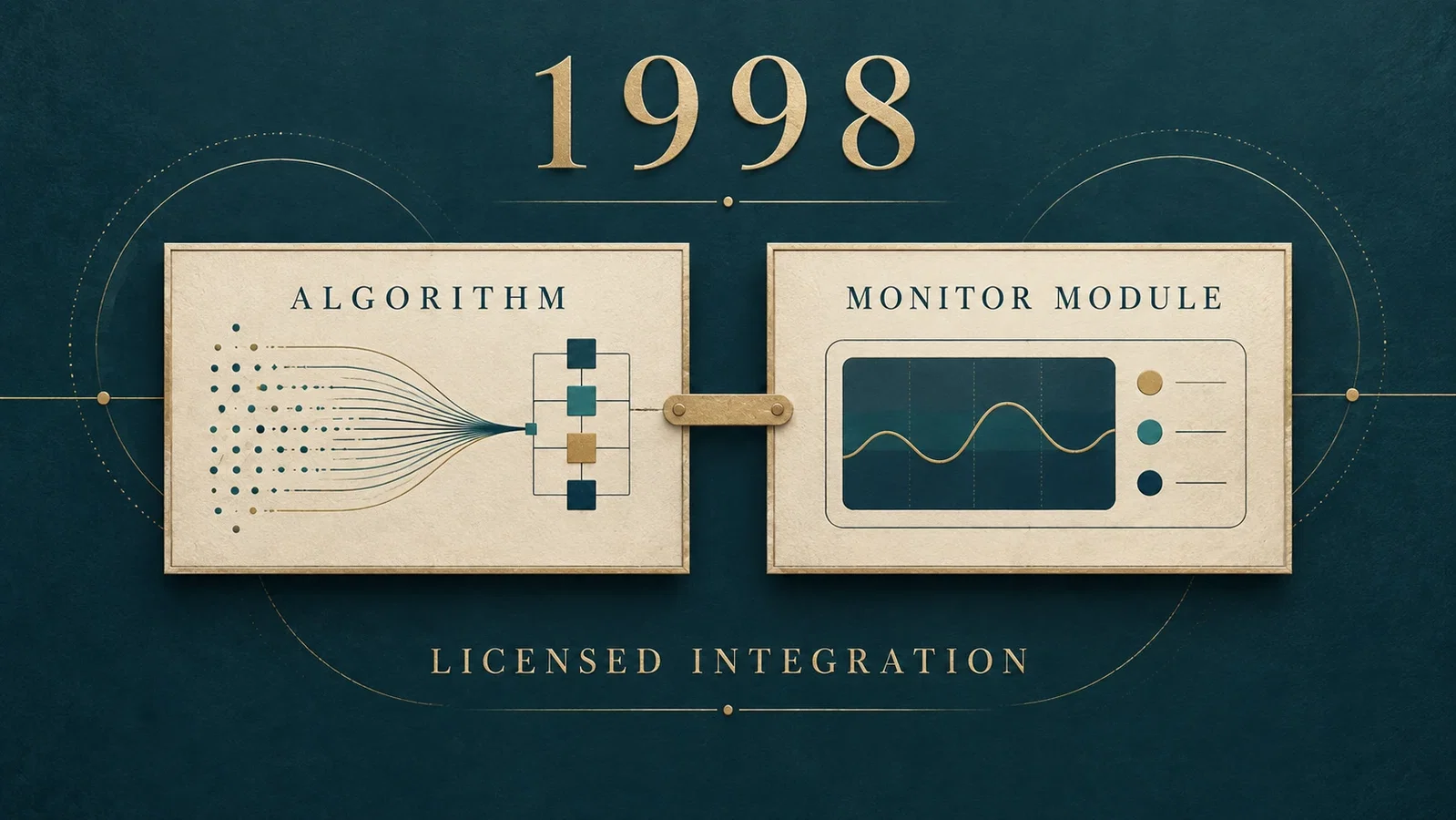
A concrete example of subsequent adoption appears in the Spacelabs 90482 BIS module, cleared on February 3, 1998. Its summary named K963644 as a predicate and described the same BIS algorithm, licensed from Aspect, packaged for integration into the Spacelabs patient-monitoring system.[3, database and PDF pp. 1–3] This records one route by which an algorithm entered another hardware platform. Compatibility and integration do not by themselves demonstrate identical benefits across patient groups.
Language about awareness with subsequent recall appeared in later A-2000 records. The 2003 K031694 file and K030267, cleared on January 15, 2004, described a possible association between BIS-guided anesthetic administration and reduced awareness with recall in adults during general anesthesia and sedation.[4, PDF pp. 2, 5; 5, PDF pp. 2, 6] This was a later, conditional statement. Its adult restriction must remain distinct from the broader population described for EEG monitoring in the same documents.
Submission numbers do not establish the order of decisions. The K030267 summary named K031694 as an already cleared predicate and described a software change adding a count of EEG bursts.[5, PDF pp. 1–2] The 2004 record therefore cannot establish the first appearance of the recall-related wording. The K031694 database entry and attached file also give different exact dates; this account retains that discrepancy and identifies the later record only by its year, 2003.[4, database and PDF p. 3; 5, PDF p. 1]
The documents distinguish a limited indication in 1996, a module integration in 1998, and later changes in the stated use.[1,3–5] Following these separately keeps the history tied to particular devices, records and populations. It also preserves the distinction between an EEG-derived index, its interpretation by a clinician and the patient outcomes that require their own evaluation.[2, pp. 85, 95]
Sources and reading limits
- FDA. K963644 original summary and corrected letter; database record · FDA device record. A-1000/A-1050, decision 1996-10-08. PDF, 5 pages, including 2012 correction.
- Johansen JW. Update on bispectral index monitoring. Best Pract Res Clin Anaesthesiol. 2006;20(1):81–99. DOI 10.1016/j.bpa.2005.08.004; PMID 16634416. Published review. Selected pages 81–83, 85, 95 read; declared Aspect support.
- FDA. K973596 original summary and corrected letter; database record · FDA device record. Spacelabs 90482 BIS module, decision 1998-02-03. PDF, 6 pages.
- FDA. K031694 original summary and corrected letter; database record · FDA device record. A-2000 modification, 2003. PDF, 5 pages. Exact-date discrepancy retained: database 2003-08-29; attached summary and corrected letter refer to 2003-10-10.
- FDA. K030267 original summary and corrected letter; database record · FDA device record. A-2000 software modification, decision 2004-01-15. PDF, 6 pages.
- FDA. Premarket Notification 510(k). Definition and substantial-equivalence sections; terminology only.
All 22 pages of the four FDA attachments were read. Five pages of the 19-page 2006 review were viewed; the full review and underlying trials were not individually verified. The FDA files include 2012 corrected letters, whose dates are distinct from the original decisions. Database entries and attachments are not independent sources; the review disclosed manufacturer support. The exact 2003 date discrepancy remains unresolved, so only the year is used in the narrative. The 1996 date agrees across its record and attachment. No historical effect size, clinical threshold or dose is offered as treatment advice. Images are modern editorial illustrations, not device reconstructions or original documents.
Continue exploring
Related reading connects shared questions and contexts; it does not by itself establish historical influence.
- 1969–1984: Early Processed EEG with CFM, CFAM and Lifescan
- 2008: McSleepy Connects Monitored Effects to Automated Drug Delivery
- 2008: B-Unaware and BAG-RECALL Compare Two Monitoring Protocols
- 2003: Beyond BIS, Four Ways to Display Anesthetic Effects
The Source Room · About & Editorial Method
Continue this reading route
Stop 6 of 7 · Back to route · Making Anesthesia Safer: From Observation to Continuous Monitoring
Previous · 1985: Harvard's Monitoring Standards Make Continuous Observation a Shared Requirement
Next · 2008: B-Unaware and BAG-RECALL Compare Two Monitoring Protocols
Device clearance and a comparison of clinical protocols answer different questions. Read the trials for the strategies compared and the outcomes measured.
Sources and reading limits are stated above. Illustrations are labelled as original source images or AI-made. Historical accounts are educational; they are not current treatment instructions.