Adopted and revised in 1985; development and implementation reported in 1986.
Reading Library · Anesthesia Epochs · 中文版
Watch the companion film
1985: Harvard — Standards for Patient Monitoring · Watch on YouTube
Historical anchor: 1985. Date details and source qualifications are explained below.
During general anesthesia, someone had to remain with the patient, and breathing and circulation had to stay under observation. Before putting such requirements on paper, Harvard’s anesthesia risk management committee examined incidents and malpractice claims. Its members judged many serious events potentially preventable through closer monitoring. The practical question was whether nine component teaching hospitals could agree on minimum requirements and put them into use. Eichhorn and colleagues described that work in JAMA in 1986.[1, pp.1017–1018]
Their article was not a trial comparing mortality rates. The authors acknowledged that experimental evidence did not provide an objective basis for an entire set of minimum standards. Incident review, clinical experience, discussion and practical judgment informed the requirements. The committee nevertheless chose mandatory standards rather than recommendations alone. Departments took part in the discussion, and their nine heads supported the result.[1, pp.1017–1018] The document addressed daily conduct: who was responsible for observation, and how it would continue.

Three dates locate the document. The reproduced table records adoption on 25 March 1985 and revision on 3 July. The JAMA issue carrying the paper is dated 22/29 August 1986.[1, p.1019 and issue footer] This article uses 1985 as its historical anchor. The text read here is the July revision printed in the paper; it does not establish that every word was present in the separate March version.
Seven provisions brought together personnel presence, timed blood pressure and heart rate measurements, ECG display, continuous monitoring of ventilation and circulation during general anesthesia, and alarms under specified equipment conditions. Continuous monitoring did not mean that only a new electronic instrument could qualify. The table retained bedside methods, including auscultation, alongside instrument options and defined exceptions.[1, p.1019] Monitoring still depended on anesthesia personnel attending to the information and responding appropriately.
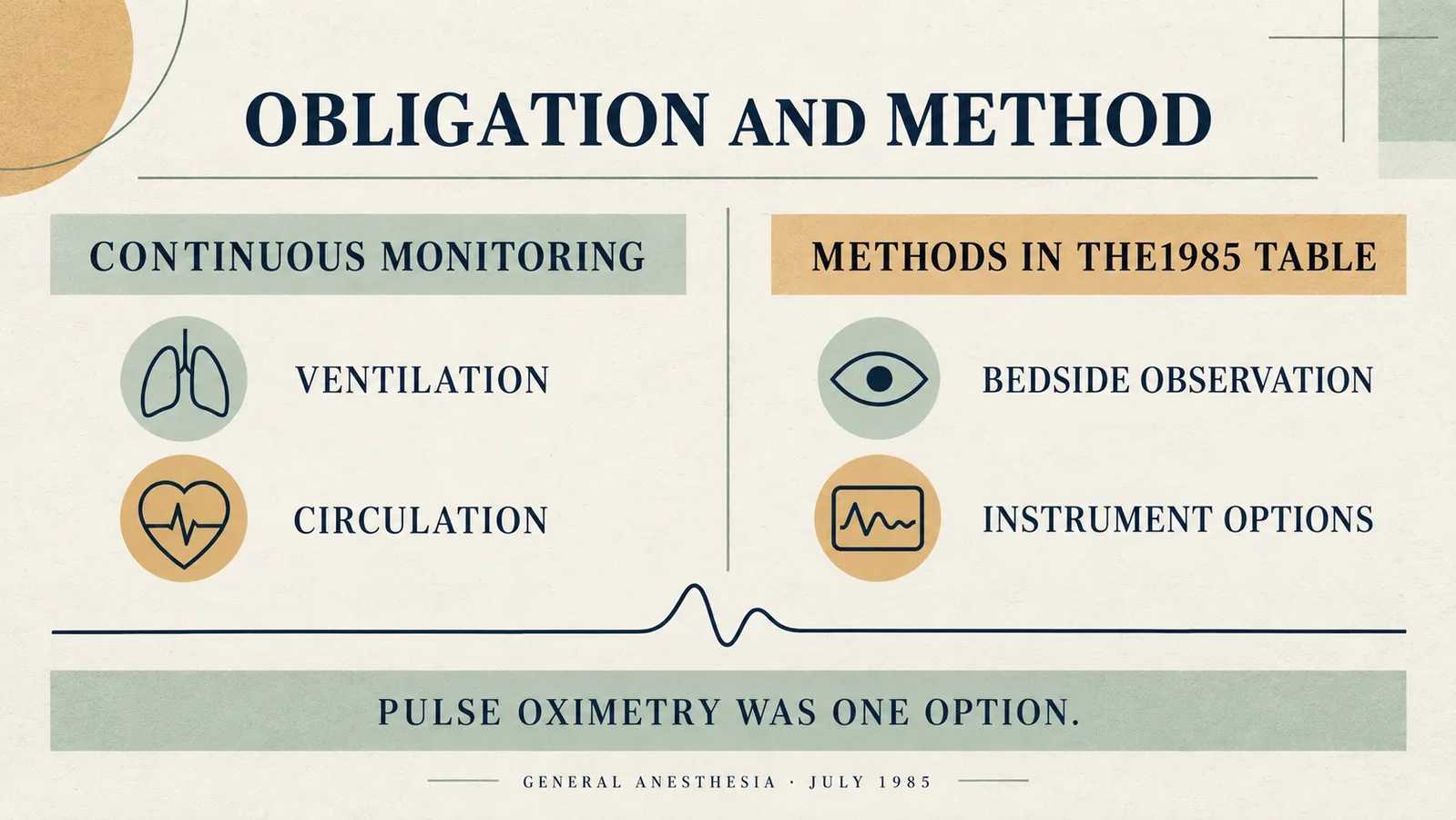
Pulse oximetry is particularly easy to read through later practice. In this 1985 table it was one option for observing circulation, not a requirement for every anesthetic. End-tidal carbon dioxide measurement was strongly preferred but was not the only acceptable method. A separate provision required a breathing-system oxygen analyzer with a low-limit alarm for general anesthesia using an anesthesia machine. That analyzer measured oxygen in breathing gas, not the patient’s oxygen saturation.[1, p.1019] This is the specific connection to this site’s pulse oximetry article: the availability of a monitoring technology and the institutional terms for using it require separate evidence.
The standards also had disputed boundaries. They excluded epidural analgesia for labor and pain management; a contemporary APSF review argued that minimum monitoring requirements deserved attention in those settings too.[1–2] That disagreement concerns the historical document’s scope, not present clinical instructions. The ASA then adopted its own intraoperative monitoring standards in 1986. A 1987 report still described pulse oximetry and end-tidal carbon dioxide monitoring as encouraged quantitative methods.[3] The later action belongs to its own date and text.
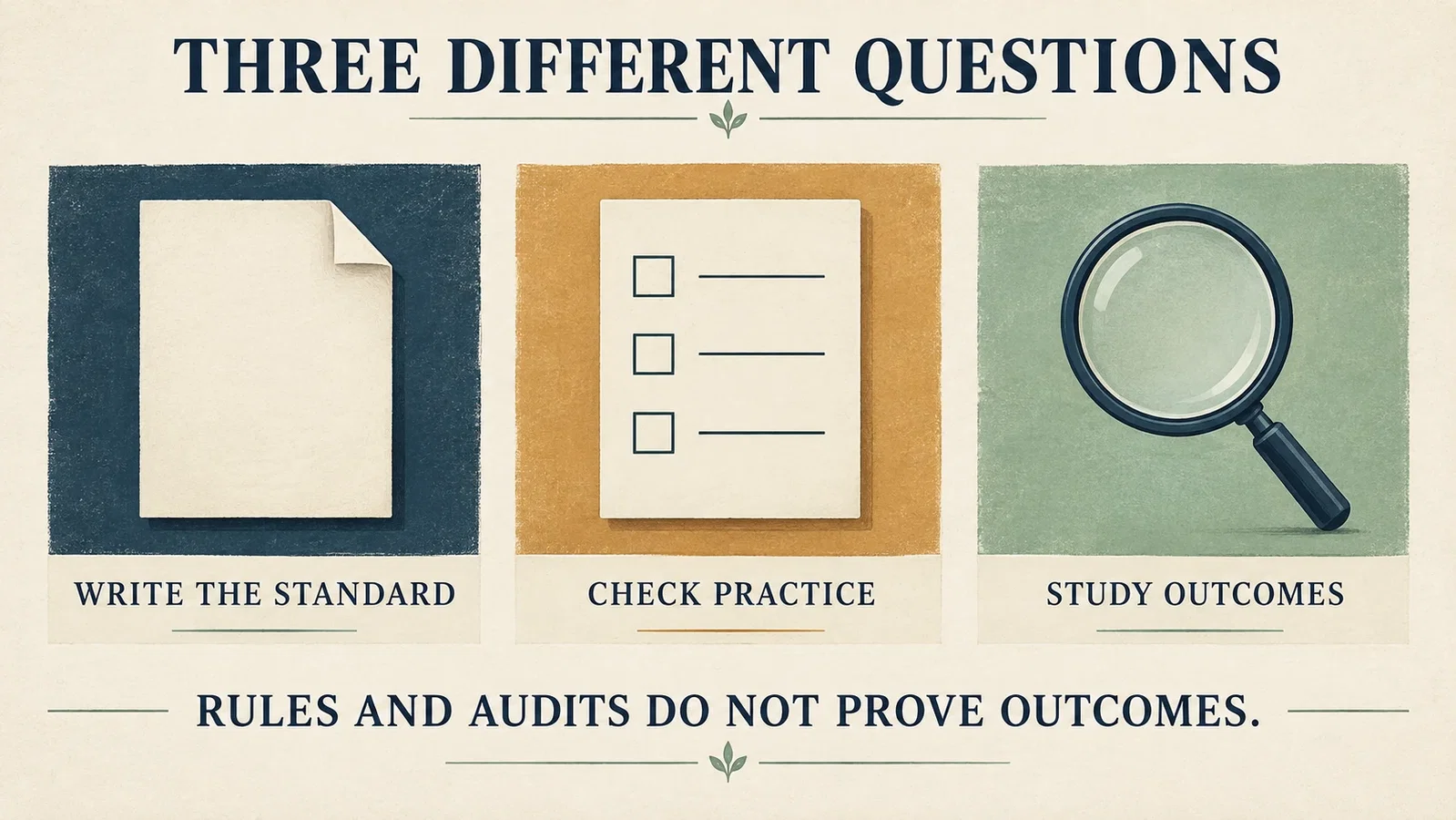
A written rule did not establish compliance. Surveys in two departments found remaining interruptions or omissions in monitoring; these were checks on practice, not proof of better patient outcomes. The authors left further assessment of standards and adverse events to subsequent work.[1, p.1020] Their paper records how a professional group agreed on minimum conduct, found gaps in implementation and prepared to test the consequences.
Image note: all four images are modern editorial concepts, not original 1985 documents or clinical instructions. The timeline distinguishes adoption, revision and publication. Method cards do not turn instrument options into universal mandates. The final image does not claim that the paper demonstrated reduced mortality.
Sources and reading limits
- Eichhorn JH, Cooper JB, Cullen DJ, Maier WR, Philip JH, Seeman RG. Standards for patient monitoring during anesthesia at Harvard Medical School. JAMA. 1986;256(8):1017–1020. DOI; PubMed record. All four original pages read from an archived access copy, including the table on p.1019. The table states adoption on 25 March 1985 and revision on 3 July 1985; the separate March text is not covered. The printed issue is dated 22/29 August 1986. Publisher metadata is not substituted for full-text reading.
- Anesthesia Patient Safety Foundation. From the Literature: Standards for Patient Monitoring During Anesthesia at Harvard Medical School. APSF Newsletter. 1987;2(1), Spring. Complete online review read and visible browser text archived, 16 September 2026. This contemporary commentary questions the exclusion of epidural analgesia. The webpage contains transcription errors in names and the JAMA volume; original article metadata follows reference 1.
- Eichhorn JH. ASA Adopts Basic Monitoring Standards. APSF Newsletter. 1987;2(1), Spring. Complete online report read and visible browser text archived, 16 September 2026. A participant’s report of the separate 1986 ASA adoption; it distinguishes encouraged quantitative monitoring from a universal instrument requirement. This is not an outcome trial.
Continue exploring
Related reading connects shared questions and contexts; it does not by itself establish historical influence.
- 1974: Takuo Aoyagi Makes Hypoxia Visible
- 1986: The ASA Adopts Monitoring Standards with Four Areas of Assessment
The Source Room · About & Editorial Method
Sources and reading limits are stated above. Illustrations are labelled as original source images or AI-made. Historical accounts are educational; they are not current treatment instructions.
Continue this reading route
Stop 5 of 7 · Back to route · Making Anesthesia Safer: From Observation to Continuous Monitoring
Previous · 1974: Takuo Aoyagi Makes Hypoxia Visible
Next · 1996: The FDA Clears BIS to Aid Anesthetic Monitoring
The Harvard standards set minimum expectations for observation. The BIS clearance concerned a particular device and its intended use.