Original adoption, amendment and implementation are distinct events.
Reading Library · Anesthesia Epochs · 中文版
Watch the companion film
1986: ASA — Standards for Basic Monitoring · Watch on YouTube
Historical anchor: 1986. Date details and source qualifications are explained below.
On 21 October 1986, the American Society of Anesthesiologists House of Delegates approved its Standards for Basic Intra-Operative Monitoring. The text republished by the APSF the following spring preserves that date, which also appears in the approval history on the current ASA document.[1; 5] The standards set shared expectations for observation during anesthesia. The 1987 republication and contemporary report are records of the earlier adoption, not a different adoption year.
Standard I began with personnel: qualified anesthesia personnel were to remain in the room during general anesthesia, regional anesthesia and monitored anesthesia care. Its objective section also addressed hazards to personnel, such as radiation, and responsibility during an emergency absence.[1, Standard I] Instruments supplied signals; someone had to interpret and act on them. The original wording retained provisions for exceptional circumstances.
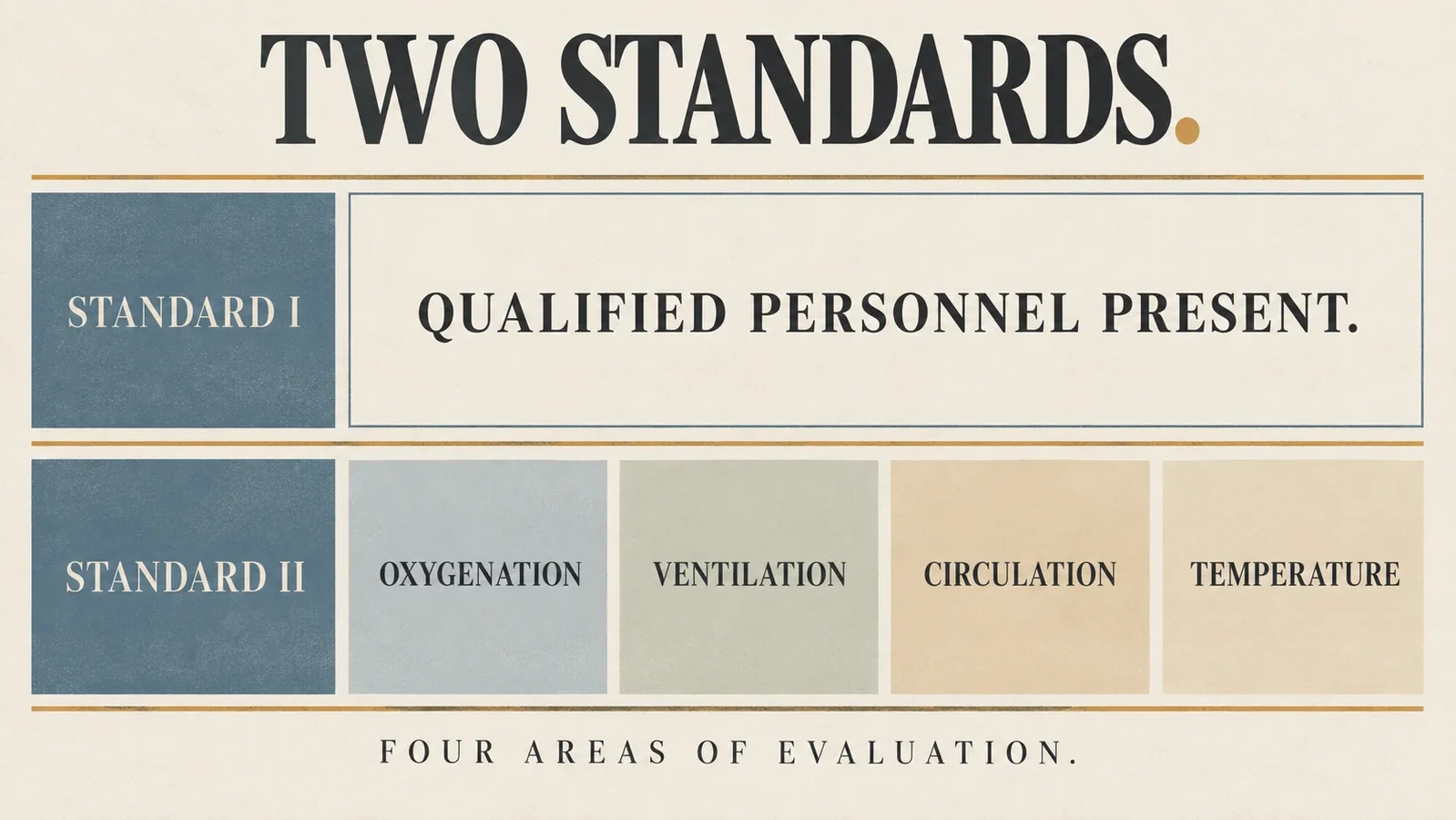
Standard II identified four areas for evaluation: oxygenation, ventilation, circulation and temperature. A definition distinguished continual, meaning regularly repeated, from continuous, meaning uninterrupted.[1, Standard II and definitions; 2] Four areas of assessment therefore did not mean four electronic devices recording without interruption throughout every anesthetic. Each area had its own objective and methods.
Those methods used different levels of obligation. General anesthesia delivered with an anesthesia machine required an oxygen analyzer with a low-concentration alarm in the breathing system. Mechanical ventilation required an audible disconnection warning. In contrast, quantitative oxygenation methods such as pulse oximetry were encouraged in 1986, as was quantitative assessment of expired gas. Tracheal tube position had to be verified, while end-tidal carbon dioxide analysis was still encouraged.[1, Oxygenation and Ventilation; 2] Inspired oxygen concentration and a patient’s SpO₂ were distinct measurements.
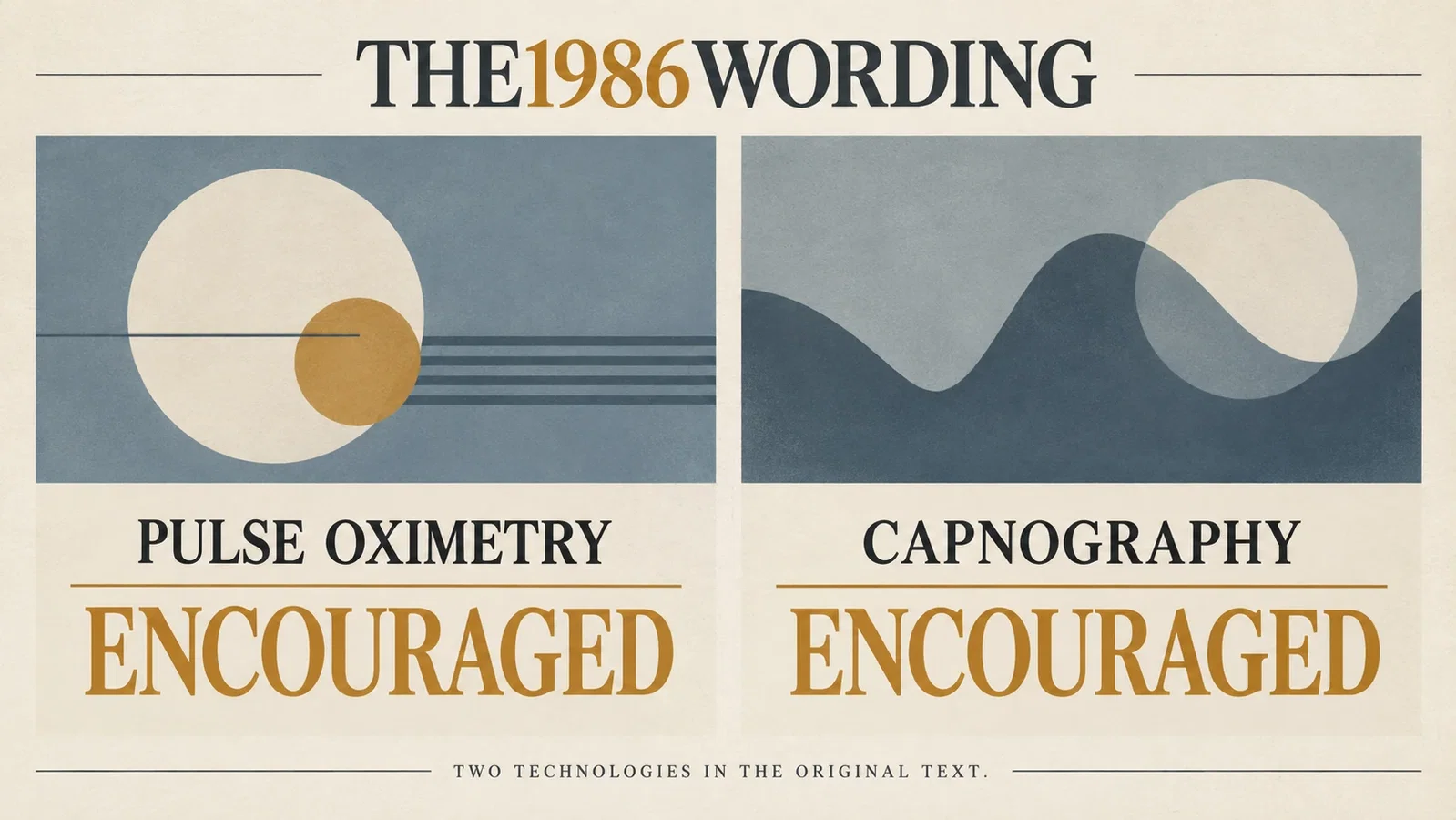
The contemporary report described debate over making pulse oximetry and capnography mandatory. Cost, instrument performance and availability were among the considerations.[2] This is the specific connection to this site’s Aoyagi pulse-oximetry article: a measurement technology entered professional standards in stages. The 1986 text named its role without yet using the later amendment’s wording.
There was also an institutional predecessor. Writing in 2020, committee secretary John H. Eichhorn recalled bringing the then-unpublished Harvard monitoring standards to the ASA committee as an example of an existing approach.[4, Genesis of the Standards] That account supports a connection between this site’s 1985 Harvard and 1986 ASA articles. It identifies a transfer of material described by a participant; it does not assign the entire standard or its effects to one person.
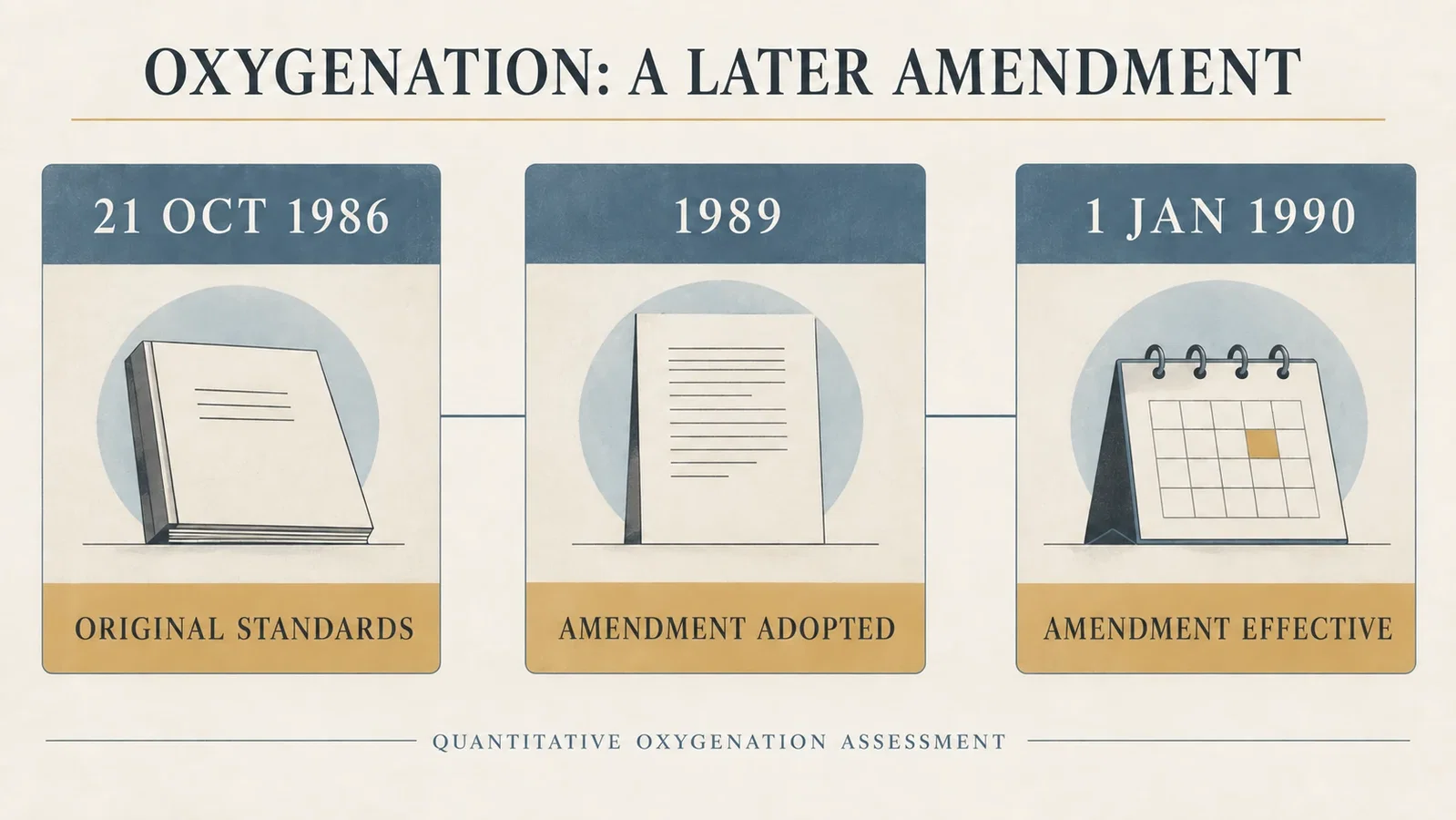
Later changes need separate dates. A contemporary report in 1990 recorded the House of Delegates’ 1989 vote to amend oxygenation monitoring and its implementation on 1 January 1990. The revised wording required a quantitative method of oxygenation assessment, such as pulse oximetry, during anesthesia.[3, Amendments Up for Vote] Adoption of the original standards, approval of an amendment and its effective date were different events. This oxygenation amendment does not establish the chronology of separate carbon dioxide requirements.
The 1986 preamble excluded obstetrical care during labor and pain management from its intended application. It also stated that compliance could not guarantee a particular patient outcome.[1, preamble] Those are boundaries of a historical document, not exemptions for present practice. The contemporary report expressed expectations of preventing injury; adopting the standards was not itself a mortality trial.[2] Their verbs, scope and revision dates show what this institutional decision actually required.
Image note: these are modern editorial concepts, not original documents or clinical photographs. The technology cards describe the 1986 wording. The last two dates in the timeline concern the oxygenation amendment alone.
Sources and reading limits
- American Society of Anesthesiologists. Standards for Basic Intra-Operative Monitoring. Approved 21 October 1986; republished in APSF Newsletter. Spring 1987;2(1):3. Complete official web republication read. The original printed page is not covered; transcription errors in the web copy were checked against the other accounts.
- Eichhorn JH. ASA adopts basic monitoring standards. APSF Newsletter. Spring 1987;2(1):1. Complete contemporary article read, including committee deliberations and the distinction between required assessment and encouraged technologies.
- Eichhorn JH. Further changes in basic monitoring standards proposed. APSF Newsletter. Fall 1990;5(3). Complete article read. The account of the enacted oxygenation amendment is distinguished from the article’s separate, still-proposed PACU and carbon dioxide changes.
- Eichhorn JH. ASA 1986 monitoring standards launched new era of care, improved patient safety. APSF Newsletter. October 2020;35(3). Complete article and reference list read. Used as an attributed participant’s account of the Harvard-to-ASA connection, not as independent outcome evidence. References 2–4 share an author and are not three independent studies.
- American Society of Anesthesiologists. Standards for Basic Anesthetic Monitoring. Current official document, last amended 15 October 2025, read 16 September 2026. Used only to cross-check the original approval date, 21 October 1986. Its later provisions are not treated as the original 1986 text.
Continue exploring
Related reading connects shared questions and contexts; it does not by itself establish historical influence.
- 1974: Takuo Aoyagi Makes Hypoxia Visible
- 1985: Harvard's Monitoring Standards Make Continuous Observation a Shared Requirement
The Source Room · About & Editorial Method
Sources and reading limits are stated above. Illustrations are labelled as original source images or AI-made. Historical accounts are educational; they are not current treatment instructions.