Measured feedback, automated adjustment and an attending clinician.
Reading Library · Anesthesia Epochs · 中文版
Watch the companion film
2008: McSleepy — Closed-Loop Anesthesia · Watch on YouTube
Historical anchor: 2008. Date details and source qualifications are explained below.
The 2008 announcement, with the 2013 trial and later technical account kept distinct.
On May 1, 2008, McGill University announced that its researchers had used McSleepy during a partial nephrectomy lasting three and a half hours. The university presented this as a world first in completely automated anesthetic administration. That is the developing institution's claim, rather than an independent judgment of priority. The announcement date is known; it does not identify the operation date. Nor does it establish the beginning of closed-loop anesthesia as a whole.[1]
The announcement described a computer linked to infusion equipment. A laptop controlled conventional infusion pumps using information about hypnosis from EEG analysis, nociception-related responses from Analgoscore, and muscle relaxation from phonomyography. Drug delivery produced a response that was measured and fed into subsequent adjustment. That returning signal is the defining feature of the loop.[1]
Developer Mohamad Wehbe's 2014 doctoral thesis makes the arrangement more concrete. Propofol, remifentanil and rocuronium served hypnosis, antinociception and neuromuscular-block control, respectively. That version used BIS, an Analgoscore derived from heart rate and mean arterial pressure, and muscle-response feedback. The thesis acknowledges that heart rate and pressure respond to influences other than analgesia. Turning a signal into a control input does not make it a direct account of the patient's whole experience.[3, pp. 79–84]
The design also specified human work. Clinicians entered patient information and surgical stages; the interface prompted them to provide mask ventilation, intubate or awaken the patient. Infusion limits, disconnection alarms and manual override were included. These later descriptions explain the division of work among software, equipment and clinicians. They should not become a component-by-component inventory of the 2008 prototype. The thesis's 15-patient technical study must also remain distinct from the randomized comparison published in 2013.[2; 3, pp. 85–90]
The randomized comparison published in the British Journal of Anaesthesia in 2013 analyzed 93 patients in each arm, with the same three drugs delivered automatically or manually. The authors reported longer periods within predefined BIS and Analgoscore ranges with automation. However, the flowchart also records exclusions from analysis for system, communication and data-file problems. Ninety-three per group must not be presented as complete retention of everyone randomized.[2, pp. 1032–1036]
The question was control of those indices, rather than validation of the indices themselves or demonstrated reductions in awareness or mortality. Attending anesthetists knew the allocation, and Hemmerling disclosed holding the McSleepy patent. The authors expressly required an anesthetist's presence and supervision, with manual override retained. That condition belongs beside any description of the system as automatic.[2, p. 1038]
Read alongside the 1996: The FDA Clears BIS to Aid Anesthetic Monitoring, McSleepy illustrates a change in what a measured index does. The earlier documentation describes processed EEG as an aid to monitoring certain anesthetic agents; the later technical account puts BIS into drug-delivery feedback. That specific connection does not make the earlier monitor's clearance a clearance for the complete automated system, or make the hardware generations identical.[3, p. 79; 4, PDF pp. 1–2, 5]
This history asks how an automated task is divided: which signals an algorithm can use, which clinical information a person supplies, and how control returns to that person. The 2008 announcement, 2013 comparison and 2014 technical account answer different parts of that question. Keeping their dates and purposes visible preserves both the achievement and the limits of the evidence.[1–3]
Illustrations
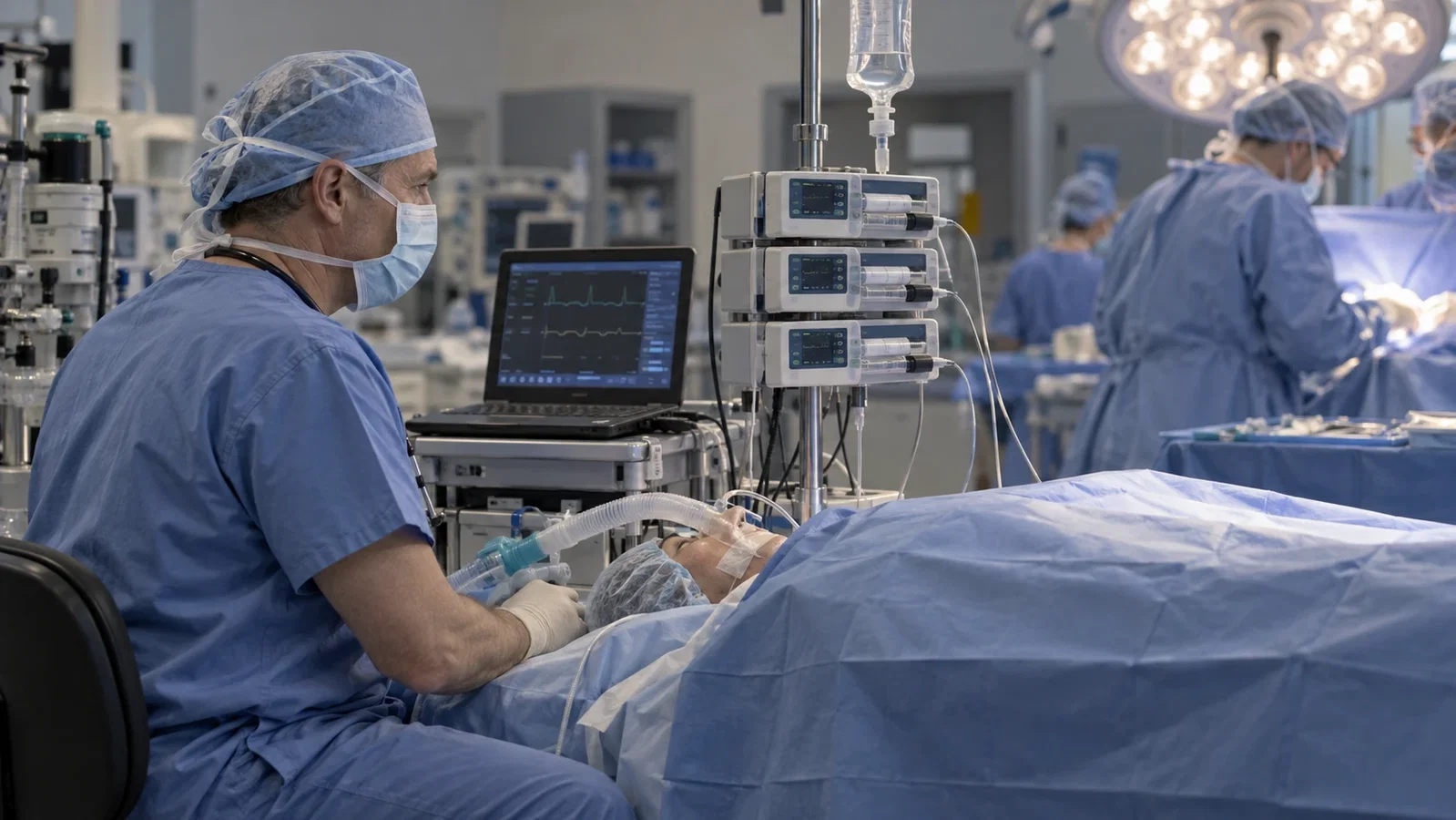
Editorial reconstruction based on the 2008 announcement: a laptop, infusion pumps and an attending clinician. This is neither a photograph of the operation nor an exact equipment reconstruction.
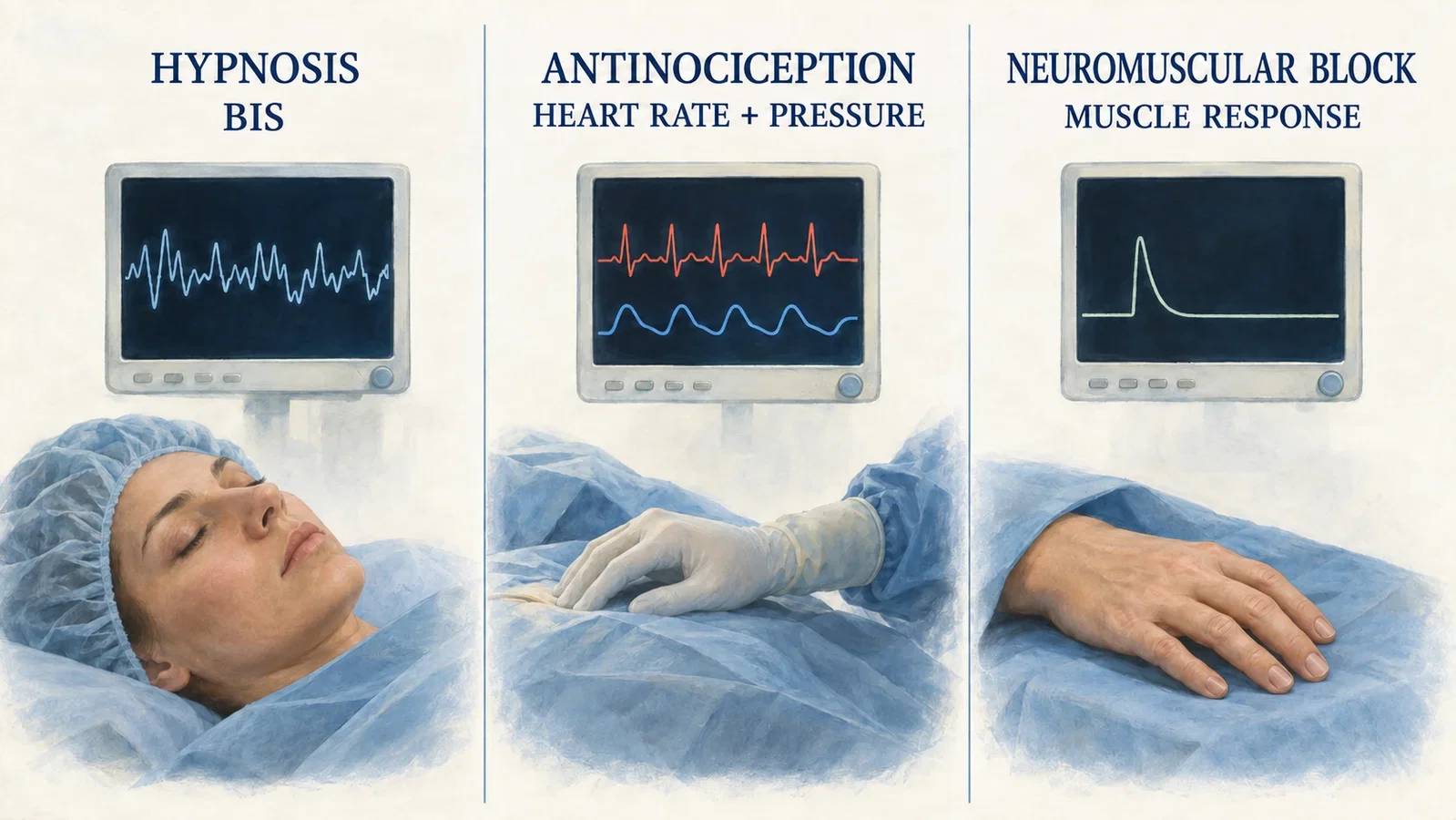
Conceptual illustration of three kinds of control information, based on later technical descriptions; no dosing thresholds or operating steps.
The 2008 announcement and 2013 comparative study mark different points in the evidence. This image does not compare treatment effects.
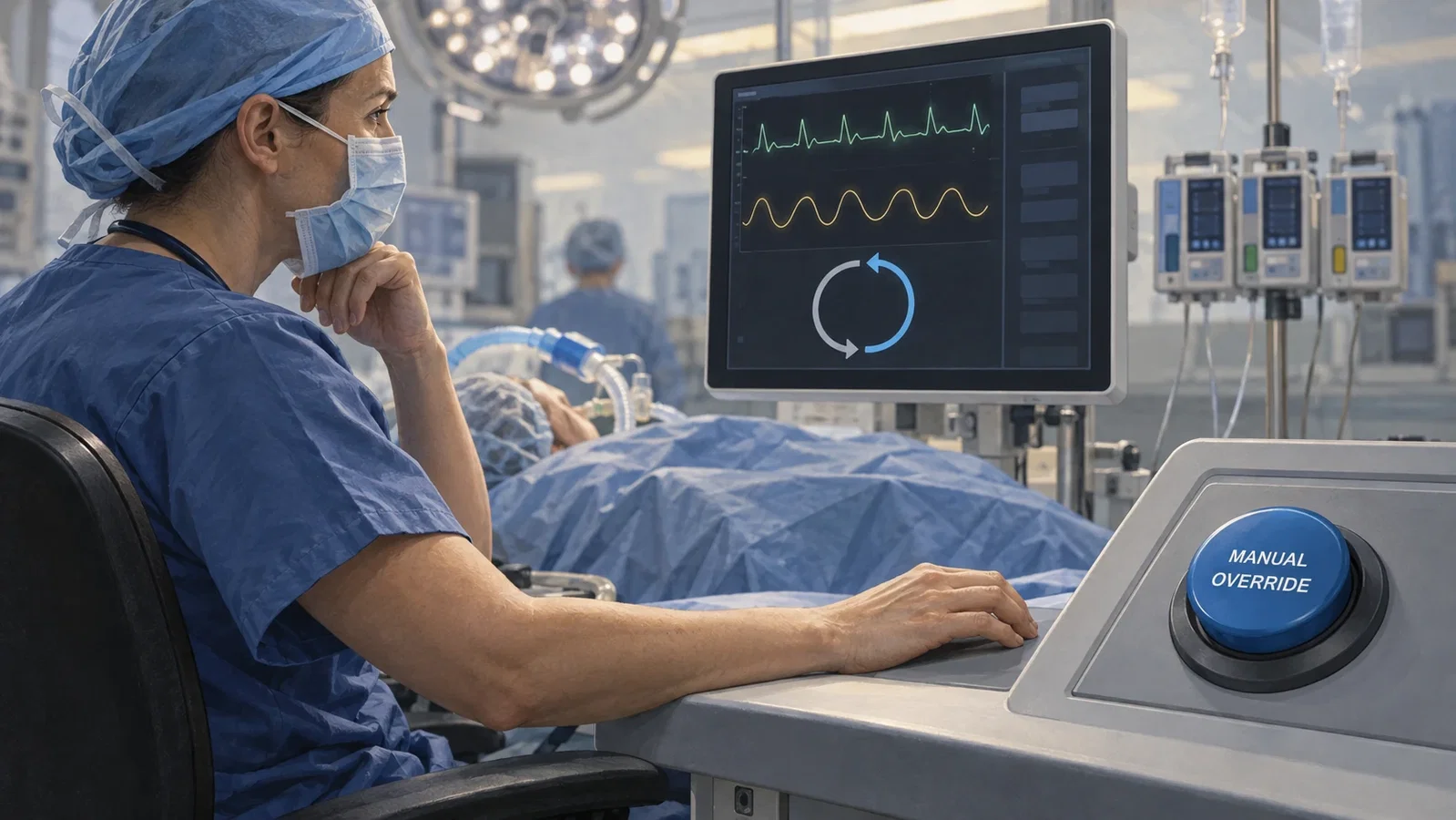
Editorial depiction of monitoring, automated adjustment and clinical supervision. The override control does not reproduce the original software interface.
Sources and reading limits
- McGill University. World first: researchers develop completely automated anesthesia system. May 1, 2008. Institutional announcement.
- Hemmerling TM, Arbeid E, Wehbe M, Cyr S, Taddei R, Zaouter C. Evaluation of a novel closed-loop total intravenous anaesthesia drug delivery system: a randomized controlled trial. Br J Anaesth. 2013;110(6):1031–1039. PMID 23427212. Published online February 20, 2013.
- Wehbe M. Robotic Anesthesia: a Novel Pharmacological Robot for General Anesthesia and Robot-assisted Intubation · McGill repository record. PhD thesis, McGill University, May 2014. Selected technical chapter, pp. 75–77, 79–94; original thesis pagination.
- FDA. K963644: Aspect EEG monitors with BIS. 1996 summary and indications; file also contains a 2012 correction letter.
Reading scope: the complete 2008 announcement, original 2013 article text and selected thesis passages were read. The figures of the 2013 article were not visually inspected; flowchart exclusions were read in the original text. Five FDA pages and eight thesis pages were visually inspected. Unverified figure effect sizes are not used.
Continue exploring
Related reading connects shared questions and contexts; it does not by itself establish historical influence.
The Source Room · About & Editorial Method
Sources and reading limits are stated above. Illustrations are labelled as original source images or AI-made. Historical accounts are educational; they are not current treatment instructions.