From 2003 the FDA cleared EEG monitors other than BIS, among them Entropy, Narcotrend and SedLine, and in 2014 a paper described qCON; each turns brain signals into its own index by its own rules.
Reading Library · Anesthesia Epochs · 中文版
Watch the companion film
2003: Beyond BIS — New Depth-of-Anesthesia Monitors · Watch on YouTube
Historical anchor: 2003, the year of the earliest FDA clearance read here (the Entropy module). Date details and source qualifications are explained below.
Examples from original documents, 2003–2014.
A number on a bedside screen depends on electrodes, signal processing and display rules. Entropy, Narcotrend, SedLine and qCON offered different implementations alongside BIS. Original regulatory records and papers from 2003–2014 allow these designs to be examined separately. They document particular devices and studies, rather than market shares or a shared invention date.[1–5]
The 2004 Entropy paper describes spectral entropy and time windows that vary with frequency. State Entropy, or SE, covers 0.8–32 Hz and is displayed from 0 to 91. Response Entropy, or RE, covers 0.8–47 Hz and runs from 0 to 100, incorporating more high-frequency muscle activity. A nonlinear transformation connects the mathematical entropy scale to the displayed integers. These numbers are not percentages of consciousness.[1, pp. 154–159; 4, PDF p. 2]
Muscle activity has an explicit role in this design. The paper treats EMG as a signal component, while describing separate rules for electrocautery, ECG and movement artifacts. An index therefore needs to be interpreted with its inputs and processing rules in mind. This developer-authored technical account explains computation; it does not itself test whether monitoring reduces a patient outcome such as awareness with recall.[1, pp. 154, 160]
The FDA record for Narcotrend Compact 4.0 describes one or two EEG channels and a display combining raw waveforms, a power spectrum, EEG stages and the Narcotrend Index. Its September 17, 2004 clearance concerns an aid to monitoring certain anesthetic agents. The archived packet includes a correction letter dated 2012, which must remain separate from the original clearance. Stages and indices appear alongside raw signals, rather than eliminating the need for them or for clinical context.[2, PDF pp. 1–4, 6]
The 2005 SEDLine submission describes four EEG channels together with EMG, artifact, suppression ratio and the Patient State Index, or PSI. It concerns the Frontal PSI monitor and SEDTrace electrode set. The stated change from existing devices was the electrode-to-cable connection. September 2, 2005 therefore dates this clearance, not the invention of PSI. Features of much later SedLine versions should not be assigned retrospectively to this model.[3, PDF pp. 1, 4–6]
The 2014 qCON paper describes an adaptive neuro-fuzzy inference system using frequency-band ratios, with burst suppression incorporated into the index. Sixty ambulatory surgical patients receiving propofol and remifentanil contributed observations. qCON and BIS were recorded together, and loss of eyelash reflex operationally defined loss of consciousness. The investigators also examined qNOX in relation to movement after stimulation. This study examined the indices against observed endpoints; it was not a randomized trial of improved patient outcomes.[5, early-view PDF pp. 2–3, 8–9]
For qNOX, values overlapped between patients who moved and those who did not. The authors discussed possible effects of frontal EMG and muscle relaxants and called for further validation. Movement, responsiveness and experienced pain are distinct endpoints. The paper also disclosed employment, equity and consulting relationships with the developer. These relationships inform appraisal of the evidence without automatically invalidating it.[5, early-view PDF pp. 5–6]
Read alongside the 1996: The FDA Clears BIS to Aid Anesthetic Monitoring, these documents show several ways to process and display EEG. Some submissions used BIS-equipped devices as predicates, and the qCON study recorded BIS concurrently. Neither practice makes their indices interchangeable. Technical descriptions, regulatory indications and clinical validation have different scopes; a broader choice of monitors does not turn anesthetic depth into one self-explanatory number.[1–5]
Illustrations
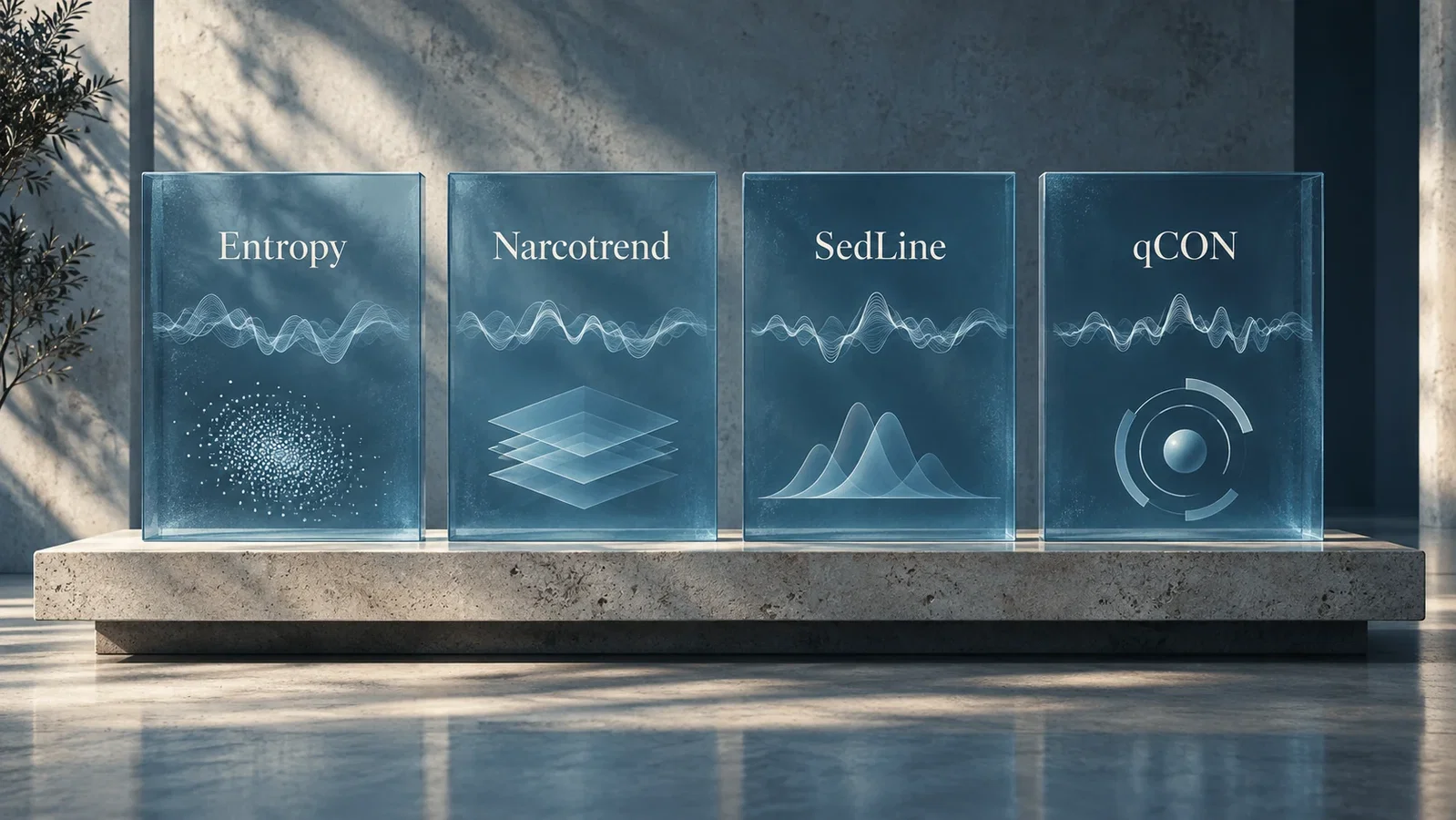
An original concept display of four approaches to EEG information, not product photography or a ranking of clinical efficacy.
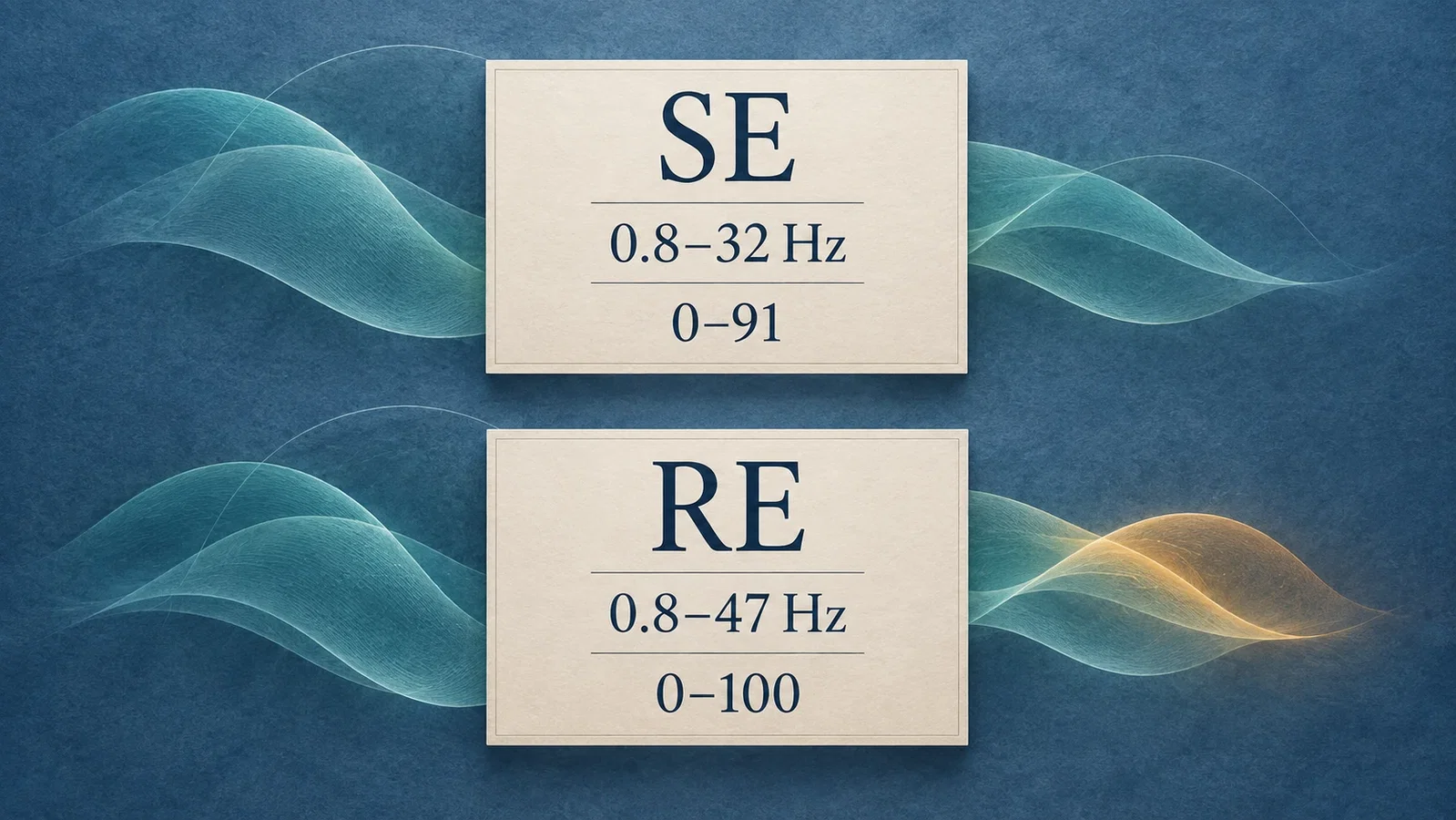
A schematic of the different frequency ranges used by SE and RE, not measured waveforms or dosing thresholds.
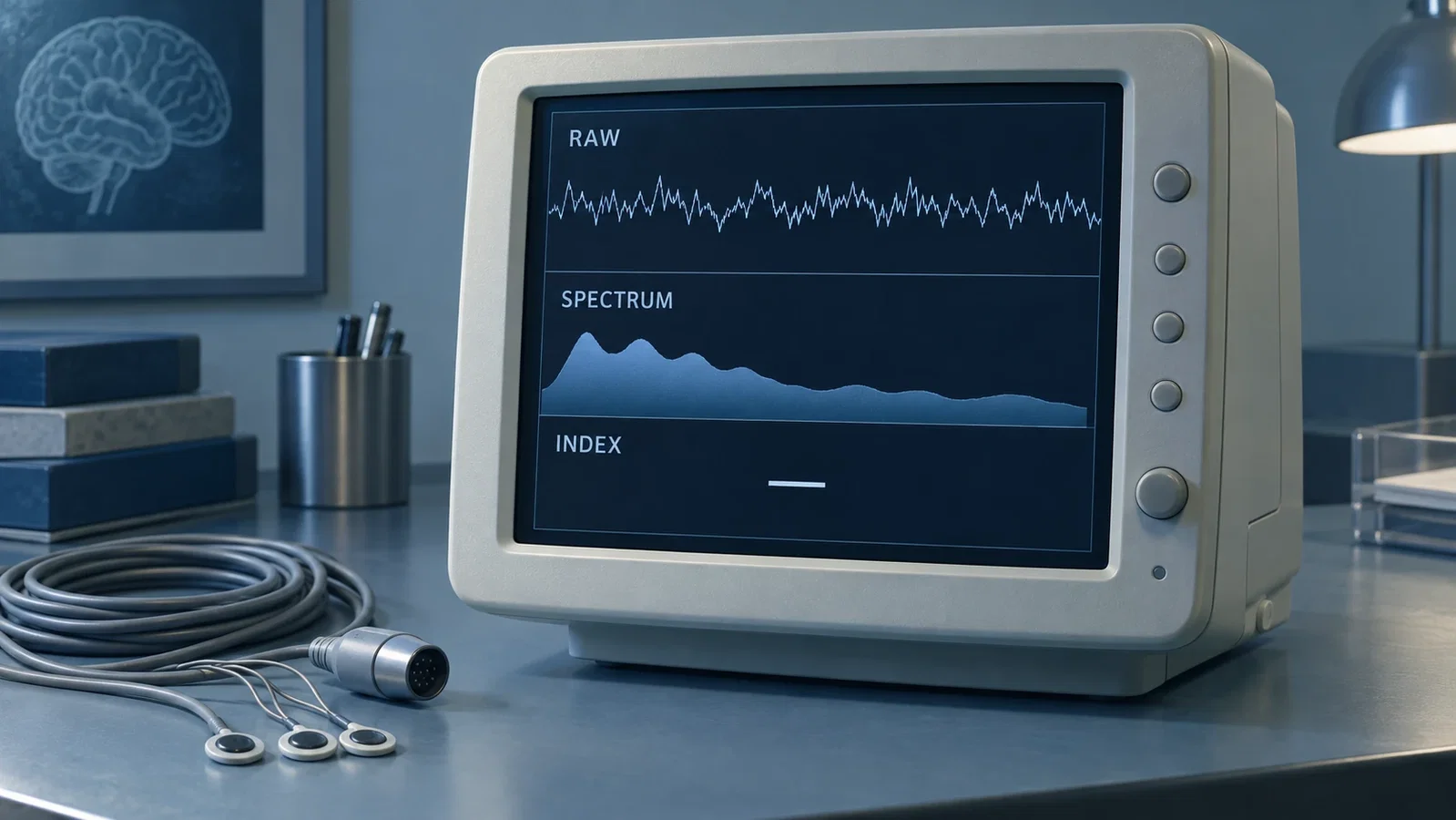
Raw traces, spectra and processed indices can appear together. The generic display does not reproduce a particular device model.

Technical description, intended use and clinical validation address different questions. These cards are not facsimiles of original documents.
Sources and reading limits
- Viertiö-Oja H, Maja V, Särkelä M, et al. Description of the Entropy algorithm as applied in the Datex-Ohmeda S/5 Entropy Module. Acta Anaesthesiol Scand. 2004;48(2):154–161. PMID 14995936. Aalto repository reprint: cover followed by eight journal pages.
- FDA. K033543: Narcotrend Compact 4.0. Six-page record; original clearance September 17, 2004, correction letter April 9, 2012.
- FDA. K051874: SEDLine Sedation Monitor with Frontal PSI and SEDTrace EEG Electrode Set. Six-page record; original clearance September 2, 2005, correction letter October 19, 2005.
- FDA. K023459: Datex-Ohmeda S/5 Entropy Module, M-ENTROPY and Accessories. Six-page record; original clearance January 13, 2003, correction letter April 9, 2012.
- Jensen EW, Valencia JF, López A, et al. Monitoring hypnotic effect and nociception with two EEG-derived indices, qCON and qNOX, during general anaesthesia. Acta Anaesthesiol Scand. 2014;58(8):933–941. PMID 24995461. Original early-view PDF uses pages 1–9; final volume and pages checked against NLM.
Reading scope: all eight journal pages of the Entropy paper and nine early-view pages of the qCON paper were read. All eighteen FDA pages were visually inspected. The account concerns the listed historical versions, not brand rankings or current purchasing advice. The timeline uses 2003, the date of the earliest document read, as a sorting anchor, not a shared invention date.
Continue exploring
Related reading connects shared questions and contexts; it does not by itself establish historical influence.
The Source Room · About & Editorial Method
Sources and reading limits are stated above. Illustrations are labelled as original source images or AI-made. Historical accounts are educational; they are not current treatment instructions.