An active comparator, explicit recall and a superiority test.
Reading Library · Anesthesia Epochs · 中文版
Watch the companion film
2008–2011: B-Unaware and BAG-RECALL — Testing BIS Against Awareness · Watch on YouTube
Historical anchor: 2008. Date details and source qualifications are explained below.
B-Unaware, 2008; BAG-RECALL, 2011.
Once a processed EEG index enters anesthesia monitoring, a further question follows: does care guided by that index improve an outcome that matters to patients? B-Unaware, published in 2008, and BAG-RECALL, published in 2011, examined intraoperative awareness with explicit postoperative recall. Both compared a BIS-guided protocol with an end-tidal anesthetic concentration protocol. The comparator included monitoring, alarms and reminders.[1–3]
B-Unaware randomized 1,000 higher-risk adults to each group at a hospital in St. Louis. They were receiving inhaled anesthesia. Both groups wore BIS sensors, but the gas-guided group's BIS display was concealed; clinicians in the BIS group could still see anesthetic gas concentrations. The comparison concerned how information was organized into care, rather than EEG monitoring versus an absence of monitoring.[1, pp. 1098–1100]
The final reported analysis included 967 patients in the BIS group and 974 in the gas-guided group, with two definite-awareness events in each. Equal event counts did not establish equivalence. The reported absolute risk difference was zero percentage points, with a 95% confidence interval from −0.56 to 0.57 percentage points. That interval still allowed differences in either direction. The investigators did not demonstrate BIS superiority and explicitly retained uncertainty about the effect.[1, pp. 1100, 1104, 1107]
BAG-RECALL subsequently randomized 6,041 higher-risk patients at three centers in the United States and Canada, in a setting predominantly using potent inhaled agents. The protocol published in 2009 and the results published in 2011 describe alarms, education and checklists in both arms. These prompted attention while leaving clinical decisions to practitioners. This was neither an automated drug-delivery study nor a comparison of two devices operating in isolation.[2, pp. 592–596; 3, pp. 5–7]
In the 2011 report, 5,713 patients completed at least one interview and entered the primary analysis. Definite awareness occurred in 7 of 2,861 BIS patients and 2 of 2,852 gas-guided patients. The BIS-minus-gas risk difference was 0.17 percentage points, with a 95% confidence interval from −0.03 to 0.38. The prespecified one-sided test asked whether BIS was superior. Its result did not support that hypothesis; it established neither equality nor a separately prespecified superiority claim in the opposite direction.[2, pp. 595–597]
In both trials, the outcome required postoperative interviews and expert adjudication. BAG-RECALL asked patients about their experiences within 72 hours after surgery and at 30 days after extubation, with adjudicators unaware of allocation. This pursued remembered experiences carefully, but did not continuously measure consciousness during surgery. Randomized and interviewed populations also have to remain separate: a patient who could not be interviewed cannot simply be counted as having no awareness.[1, pp. 1099–1100; 2, pp. 593–594; 3, Appendices 2–3]
The findings have a defined scope: higher-risk patients in predominantly inhaled-anesthesia settings. They cannot be transferred directly to total intravenous anesthesia or treated as a verdict on every EEG monitor. Failure to show that BIS guidance outperformed another actively implemented protocol does not establish that monitoring has no value. Nor does a value inside a target range guarantee the absence of awareness.[1, p. 1107; 2, pp. 597–599; 3, p. 6]
Read alongside the 1996: The FDA Clears BIS to Aid Anesthetic Monitoring, the trials show how the evidence question changed. Regulatory documentation described BIS as an aid to monitoring certain anesthetic agents; the trials asked whether a particular way of using it reduced a specified outcome. Intended use, care protocols and outcome evidence answer different questions. B-Unaware and BAG-RECALL advanced the history from what a monitor displays to which comparator and which patient outcome should test its value.[1–4]
Illustrations
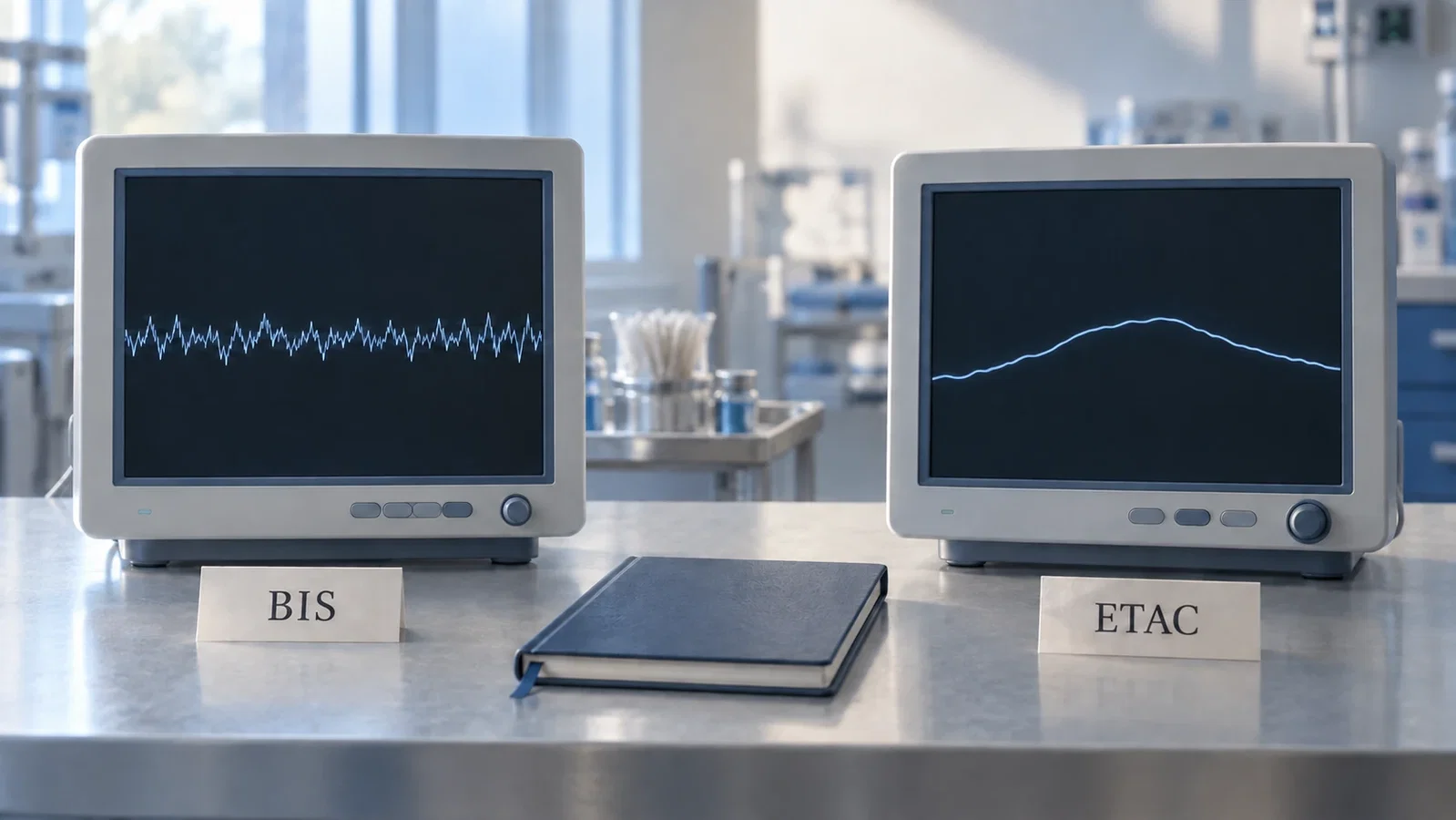
Editorial concept showing two sources of monitoring information in the 2008–2011 trial question. It does not reproduce a device model or identify a winning arm.

B-Unaware in 2008 and BAG-RECALL in 2011 were separate trial reports. These archive cards are not facsimiles of journal pages.

Anonymous editorial reconstruction of a postoperative interview, not a photograph of an actual participant or study site.
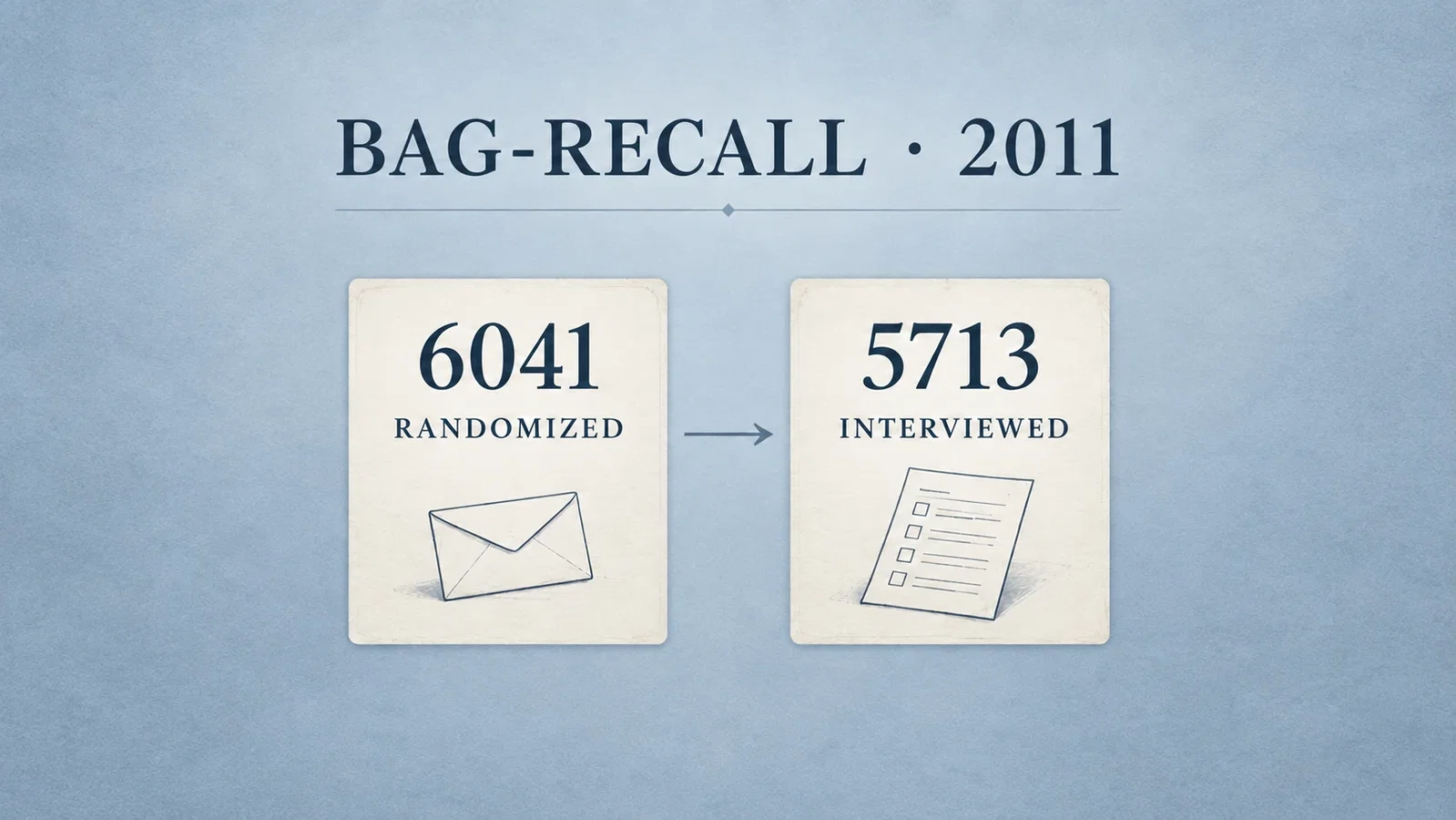
BAG-RECALL randomized 6,041 patients; 5,713 completed at least one interview. This illustration does not classify unassessed patients as having no awareness.
Sources and reading limits
- Avidan MS, Zhang L, Burnside BA, et al. Anesthesia Awareness and the Bispectral Index. N Engl J Med. 2008;358(11):1097–1108. March 13, 2008. PMID 18337600.
- Avidan MS, Jacobsohn E, Glick D, et al.; BAG-RECALL Research Group. Prevention of Intraoperative Awareness in a High-Risk Surgical Population. N Engl J Med. 2011;365(7):591–600. August 18, 2011. PMID 21848460.
- Avidan MS, Palanca BJ, Glick D, et al.; BAG-RECALL Study Group. Protocol for the BAG-RECALL clinical trial. BMC Anesthesiol. 2009;9:8. November 30, 2009. PMID 19948045. Selected body and Appendices 1–3.
- FDA. K963644: Aspect EEG monitors with BIS. 1996 indications for use.
Reading scope: all 22 pages of the two original trial texts were read, with eight key pages visually inspected. Selected protocol text and appendices were read, with three pages visually inspected, plus two FDA indication pages. The 2011 supplementary appendix was unavailable and supplies no unique claims here. The 2008 interview-frequency subtotal does not reconcile with the final denominator; the latter is not described as a complete-interview population.
Continue exploring
Related reading connects shared questions and contexts; it does not by itself establish historical influence.
Anesthesia Epochs · The Source Room · About & Editorial Method
Sources and reading limits are stated above. Illustrations are labelled as original source images or AI-made. Historical accounts are educational; they are not current treatment instructions.
Continue this reading route
Stop 7 of 7 · Back to route · Making Anesthesia Safer: From Observation to Continuous Monitoring
Previous · 1996: The FDA Clears BIS to Aid Anesthetic Monitoring