At the first ordinary meeting of London’s Society of Anaesthetists, held at 20 Hanover Square on 16 November 1893, George Oliver reported measurements of radial artery size under different anaesthetics, and colleagues questioned whether arterial diameter could stand for blood pressure.
Reading Library · Anesthesia Epochs · 中文版
Watch the companion film
1893: London’s Society of Anaesthetists · Watch on YouTube
A measurement can be precise without answering the question that matters. At the first ordinary meeting of London's Society of Anaesthetists, the relationship between an artery's size and the pressure within it became a subject for discussion.[1]
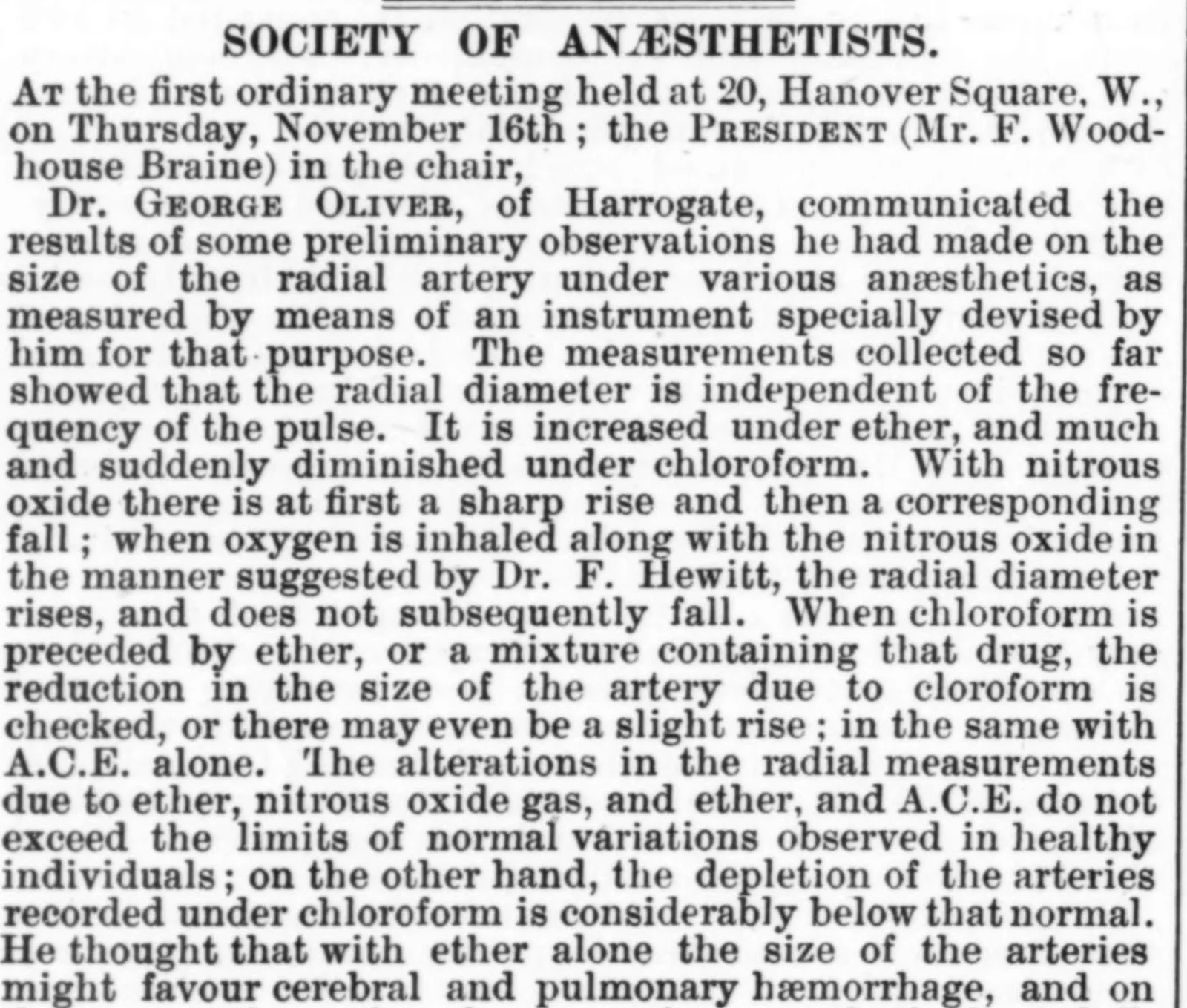
The meeting took place at 20 Hanover Square on November 16, 1893, with President F. Woodhouse Braine in the chair. George Oliver of Harrogate presented preliminary observations made with an instrument Oliver had devised to measure radial artery size under different anesthetics.[1]
Oliver’s colleagues did more than listen. They asked what the measurements meant and what else might have influenced them.
What did the instrument actually measure?
Oliver described differences in radial diameter with different agents and sequences of administration. But arterial diameter, pulse frequency and blood pressure are different quantities. The report should not be read as a modern continuous blood-pressure dataset.[1]
Dudley Buxton thought the investigation promising, while cautioning that arterial diameter might not measure blood pressure. Buxton wanted many more observations before definite practical conclusions could be drawn. Silk likewise questioned how the observations related to pressure inside the vessels.[1]
In reply, Oliver distinguished pressure from radial diameter. This was not merely a disagreement about which anesthetic to prefer. It was a question about the meaning of a measurement.[1]
The short report supplies no complete dataset, study denominator or instrument-validation protocol. We cannot add those retrospectively. What survives is evidence that the interpretation was being questioned, not proof that the instrument had passed a modern validation study.[1]
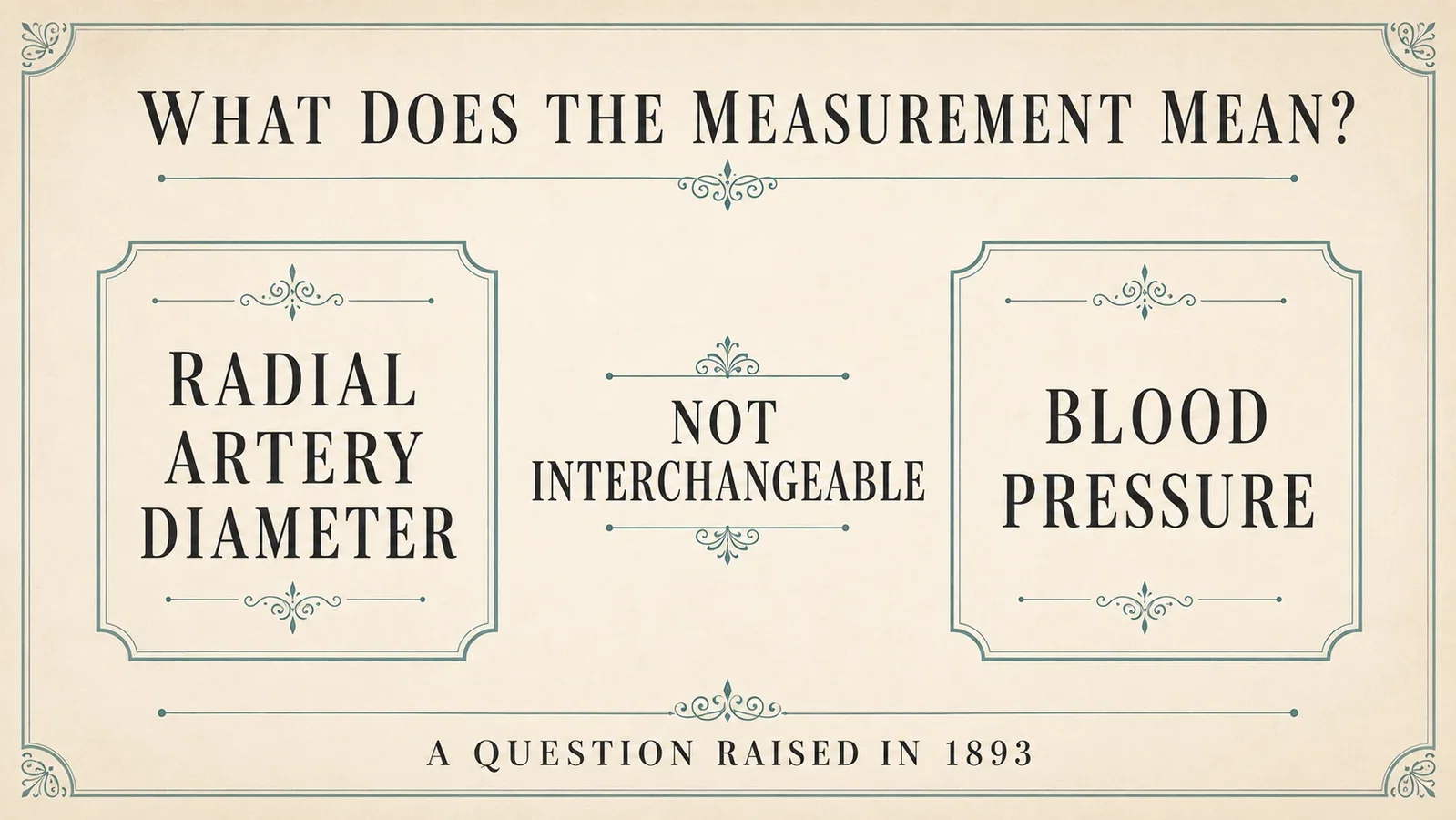
A modern reading guide to the discussion, not an instrument display or a clinical conversion rule. The distinction follows the reported exchange among Buxton, Silk and Oliver.[1]
Questions about method, timing and the patient
Other participants widened the discussion. Tyrrell suggested that the method of administering the anesthetic might explain some differences. Grant-Morris raised the nature of the operation and the patient's condition, including shock and blood loss. Hewitt wanted to know at what stage of administration the observations had been made.[1]
Oliver reported that cutting and traction could quickly affect the readings, although Oliver rejected some proposed explanations. That exchange did not settle every disagreement or produce a unanimous society recommendation.[1]
The account also contains opinions about drug choice and possible danger. Oliver speculated about hemorrhage; the President answered from clinical recollection. Those statements belong to a historical debate. They are neither a controlled comparison nor advice about present-day anesthetic practice.[1]
At the close, Oliver demonstrated a pulse-pressure gauge and an arteriometer. The report names two instruments but does not illustrate their construction.[1]
Three different kinds of date
The Society was founded in 1893. Its first ordinary meeting, as described in the contemporary report, occurred on November 16; the report appeared in the December 9 issue of the British Medical Journal.[1,3]
An ordinary scientific meeting is not necessarily a founding meeting. The year 1893 is used here as the founding year, without an exact foundation day. Nor should the publication date be mistaken for the date on which Oliver addressed the meeting.[1,3]
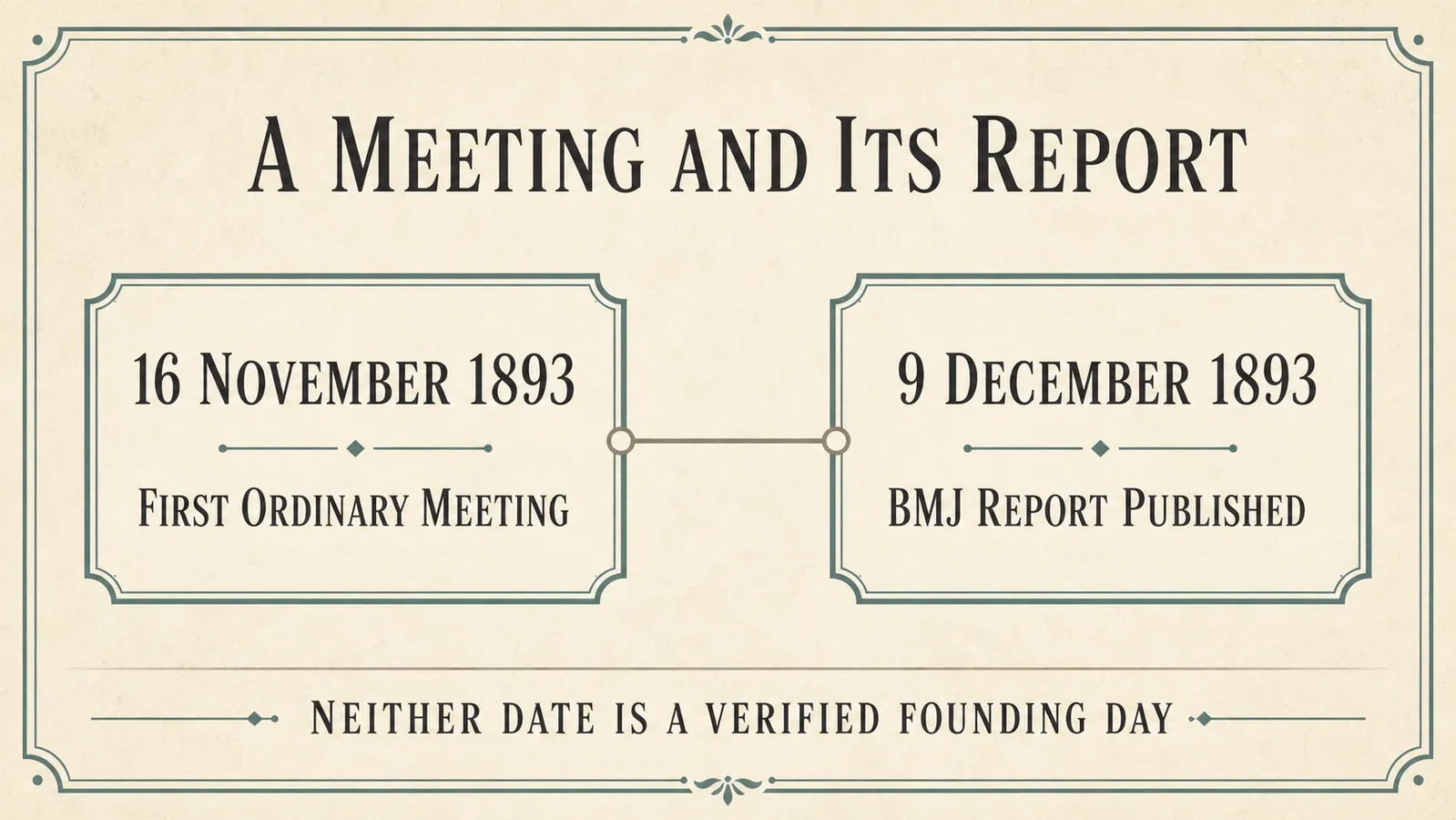
November 16, 1893: first ordinary meeting. December 9, 1893: publication of this report. Neither date is presented as a verified foundation ceremony.[1]
A recurring place to meet
In a history of 20 Hanover Square, Aileen Adams describes an annual £10 arrangement giving the Society rights to ten meetings in the North Room, an official address and a nameboard. Adams cites the Society’s minutes of June 15, 1893. Ten meetings describes a right, not verified attendance or an accomplished yearly total.[2, p. 243, ref. 9]
The Royal College of Anaesthetists' history places Silk among the organizers and describes the Society's purposes as study and collegial exchange through discussion and papers. It calls this the first body of anaesthetists in the world, an attribution, not the result of a worldwide priority survey.[3]
A society, a section and a later association
The detailed College account distinguishes the RSM's formation in 1907 from the Society's entry as its Section of Anaesthetics in 1908. The Association of Anaesthetists, established in 1932, was a separate organization with professional-representation concerns, not simply a new name for the 1893 Society. Shorter accounts sometimes compress these steps: one American newsletter history has the Society merging in 1907 with the British Medical Association, and a history of 20 Hanover Square dates the amalgamation that created the RSM to 1905. They should not be merged into one event.[2–5]
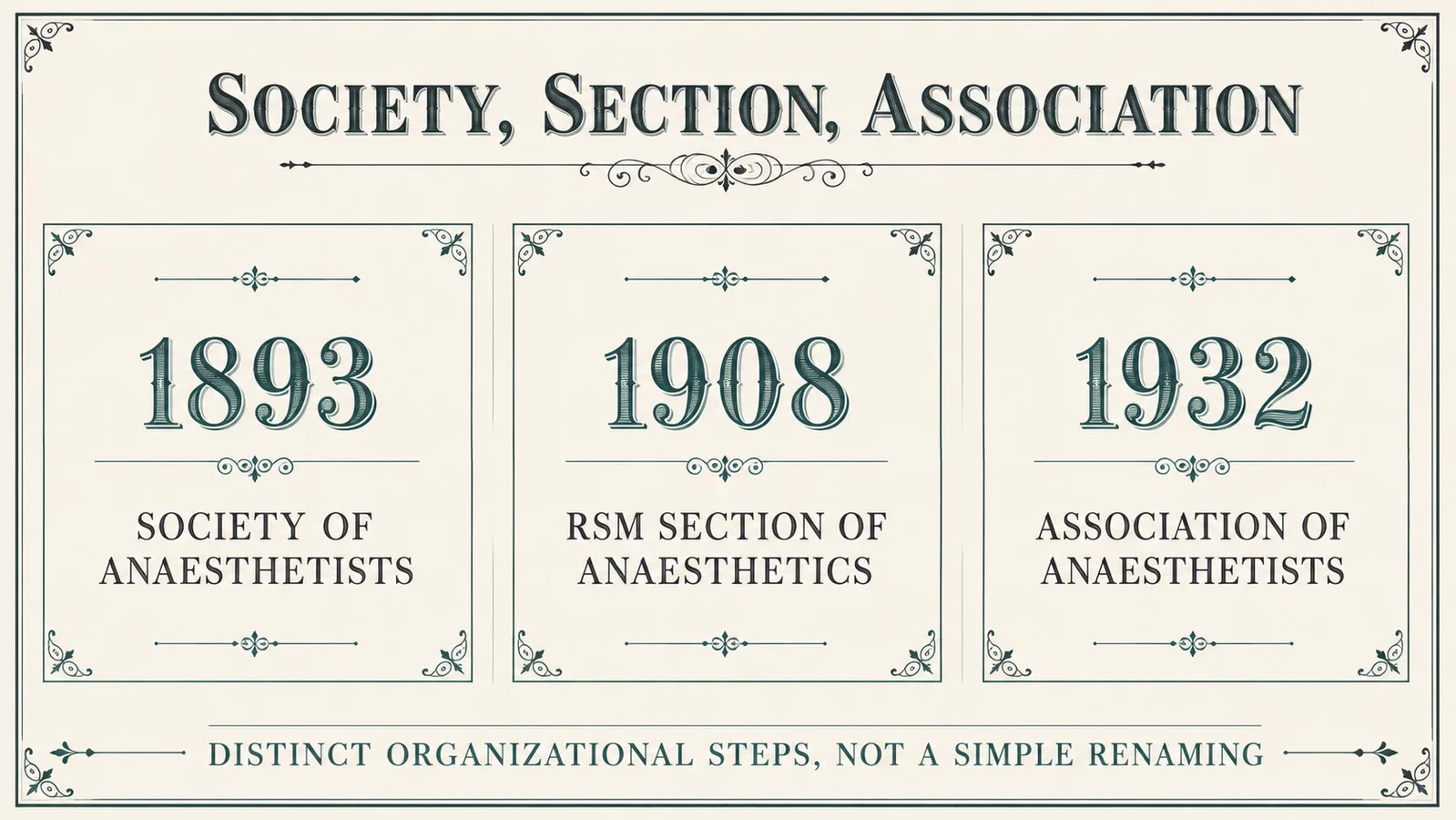
The 1893 Society, 1908 RSM section and 1932 Association are distinguished. This is not a claim that the early Society already possessed later representative or credentialing functions.[3]
None of this establishes an immediate improvement in patient outcomes. The contemporary report provides no such result. Its more modest contribution is visible in the exchange itself: individual observations could become shared questions, challenged by colleagues who brought different experience to the room.[1]
Sources and reading limits
Read: the complete one-page Society of Anaesthetists report in the British Medical Journal of 9 December 1893 (p. 1304); Adams’s 2003 article on 20 Hanover Square; the Royal College of Anaesthetists’ account of its origins; the Royal Society of Medicine’s history page; and the boxed note on page 3 of the October 2005 ASA Newsletter.
Not covered: the Society’s original minute book; the Young and Boulton books cited in the College account; any 1893 constitution or rules of the Society.
- Society of Anaesthetists. Br Med J. 1893 Dec 9;2(1719):1304. PMID 20754565; PMCID PMC2422514. Original scan.
- Adams AK. 20 Hanover Square, London W1: first home of The Royal Society of Medicine. J R Soc Med. 2003;96(5):241–244. DOI 10.1177/014107680309600514; PMID 12724440. Complete article.
- Wildsmith T. The Origins of the Royal College of Anaesthetists and its Fellowship.
- Royal Society of Medicine. History of the RSM.
- Bacon DR. From the Crow's Nest: Who we are at 100 — reflections of a historian. ASA Newsl. 2005;69(10):3–4.
Continue exploring
Related reading connects shared questions and contexts; it does not by itself establish historical influence.
- 1894: Cushing and Codman Put Anesthesia on the Record
- 1931: Hodgins Organizes NANA Around an Educational Program
- 1934: Mexico's Anesthesia Society Grows from Meetings to a Journal
- 1948: The RCS Faculty of Anaesthetists Holds Its Opening Meeting
Anesthesia Epochs · The Source Room · About & Editorial Method
Sources and reading limits are stated above. Illustrations are labelled as original source images or AI-made. Historical accounts are educational; they are not current treatment instructions.