Distinguishing a 1915 school, a 1930 educational proposal and a 1931 association.
Reading Library · Anesthesia Epochs · 中文版
Watch the companion film
1931: Agatha Hodgins and the Making of NANA · Watch on YouTube
Historical anchor: 1931. Date details and source qualifications are explained below.
On June 17, 1931, a meeting at Lakeside Hospital in Cleveland established the National Association of Nurse Anesthetists, or NANA. AANA's institutional history identifies Agatha C. Hodgins as chair, Gertrude Fife as the person who moved its formation, and Aida Allwein as the seconder.[3,4]
Nurse anesthetists were already working, and Hodgins's educational work was well established. The meeting gave previously articulated educational aims a national organizational setting.[1–4]
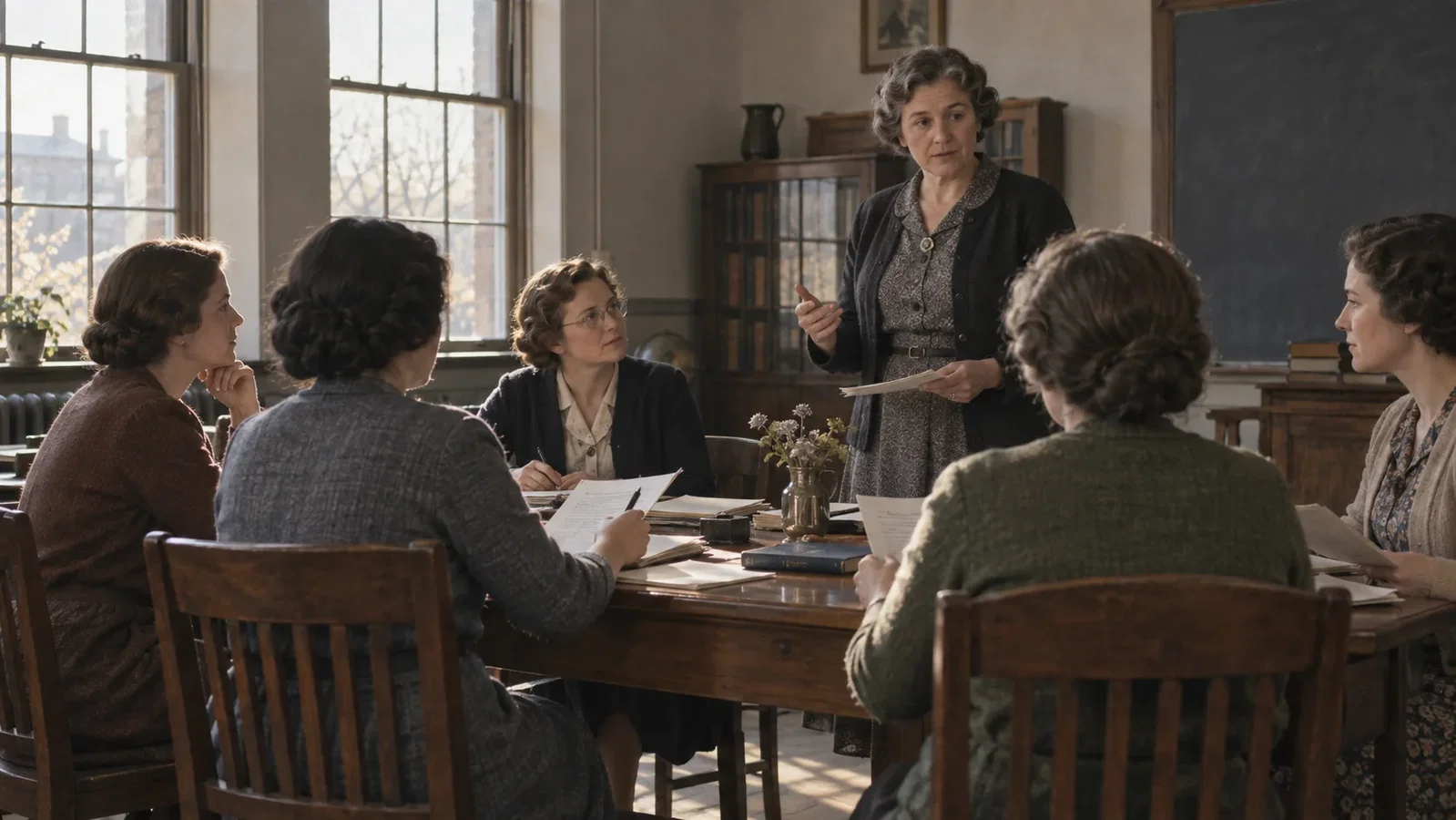
An editorial period scene, not a photograph of the meeting or an authenticated reconstruction of Hodgins, the participants, attendance or classroom.
Doing the work and understanding the patient
Hodgins set out the problem a year before the association was formed. Her paper, “The Nurse Anesthetist,” was presented at a Milwaukee round table on June 11, 1930, and published that July in the American Journal of Nursing, on pages 863–867.[1,p.863]
She began with continuity of hospital work. In her account, short rotations made it difficult for surgical interns to develop consistent technique, while a specialist in private practice might be occupied at another hospital when needed. Hospitals and surgeons had turned to nurses educated in anesthesia to provide continuing service. This was Hodgins's explanation of an institutional change, not a study comparing professional groups' patient outcomes.[1,p.864]
She also resisted the description of nurse anesthesia as mechanical practice. Her distinction was precise: some routine actions should be carried out consistently, but a patient's reactions to an anesthetic required interpretation. Repeating the steps did not replace knowledge of what the reactions meant.[1,p.865]
That distinction supported her educational argument. Nurses could teach as well as learn. Preparation should develop understanding through education, rather than being treated merely as apprenticeship or technical training.[1,p.865]

A conceptual teaching discussion. The people, papers and setting are invented editorial elements, not a reconstruction of a documented class or surviving lesson notes.
The school preceded the association
A contemporary profile published in September 1930 placed Hodgins's work to establish a definite educational basis and course of study for Lakeside's postgraduate school in 1915, after her return to America. Its priority claim was qualified: the first postgraduate school organized on that basis. This does not establish the world's first formal anesthesia school without qualification.[2,p.1164]
The profile reported more than 500 graduates by the end of June 1930. It also described teaching notes reproduced for the school's students and the hope of a future textbook. A hoped-for book should not become an accomplished publication in a later account.[2,p.1164]
The organizational effort of 1931 thus had an educational setting: a school, teaching experience and a network of graduates. AANA's profiles separately identify the school's formalization in 1915 and the association's organizational meeting in 1931.[2,3]
What she proposed still had to be built
In her 1930 paper, Hodgins proposed educational standards for schools, a certificate from a recognized school, then state board examination and state registration. She explicitly acknowledged the time and effort that carrying out the program would require.[1,p.866]
This was a proposal. The association's founding should not be made to imply that national certification, school accreditation or a uniform credentialing system sprang into operation on that day. Continuing study, research and the circulation of knowledge were also part of her program.[1,pp.866–867]
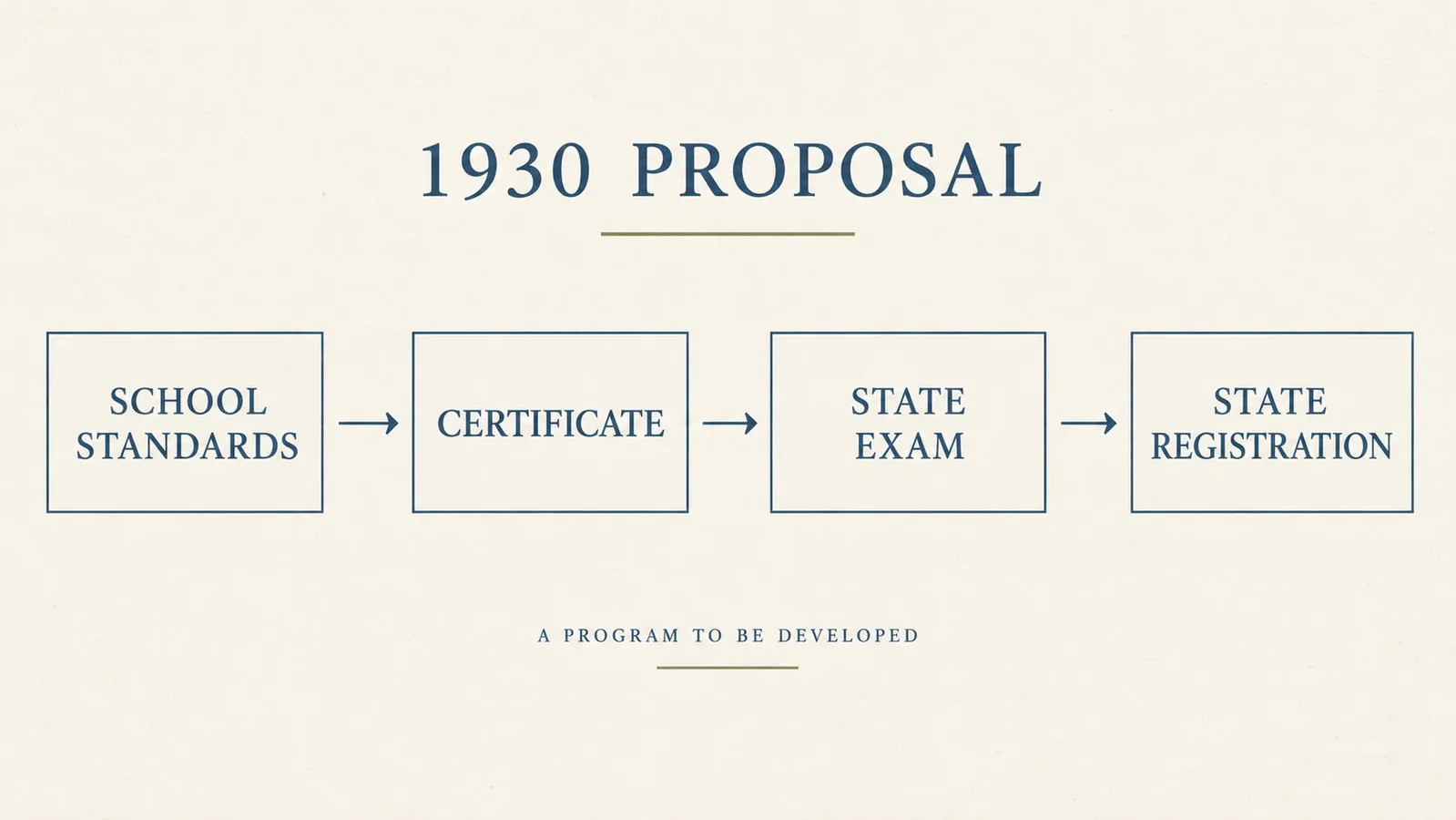
School standards, a school certificate, state examination and state registration. “1930 PROPOSAL” identifies a historical program, not four completed institutions or a present-day credentialing pathway.
Keep her historical boundaries in view
Hodgins's case for education and professional recognition remained framed around the surgeon's principal responsibility for the patient's care and safety. At the end of the paper, she explicitly excluded local, infiltration and regional anesthesia from the nurse anesthetist's province as she understood it.[1,pp.864,867]
These were the author's positions in 1930. Retaining only the passages demanding recognition would turn her into a spokesperson for a present-day practice model that the paper does not describe. Her discussion of remuneration and exploitation likewise belongs to its historical professional argument.[1,p.867]
She hoped education would protect patients. The contemporary profile also recorded her concern for the mental distress of people facing surgery. These passages show an educator's purposes; they do not provide a mortality estimate or establish an outcome benefit caused by founding the association.[1,p.867;2,p.1164]
A specific connection to an earlier society
Hodgins did not present professional organization as an entirely new idea. On her first page she named London's Society of Anaesthetists and recognized its efforts to establish anesthesia as a distinct study. Her date of 1897 was mistaken: a British Medical Journal report documents the Society's ordinary scientific meeting in 1893.[1,p.863;5]
This supplies a specific connection to the 1893: London's Society of Anaesthetists Brings Experience Before Peers: Hodgins actually referred to it. The connection is textual, not evidence that NANA descended from the London organization, or that a mentorship or direct causal chain joined them.[1,5]
Three dates, three different events
Hodgins served as the first president from 1931 to 1933. The association held its first annual meeting in 1933. In 1939, NANA became the American Association of Nurse Anesthetists, abbreviated AANA. That is the historical expansion of the name used here, without projecting today's name into 1939.[3]
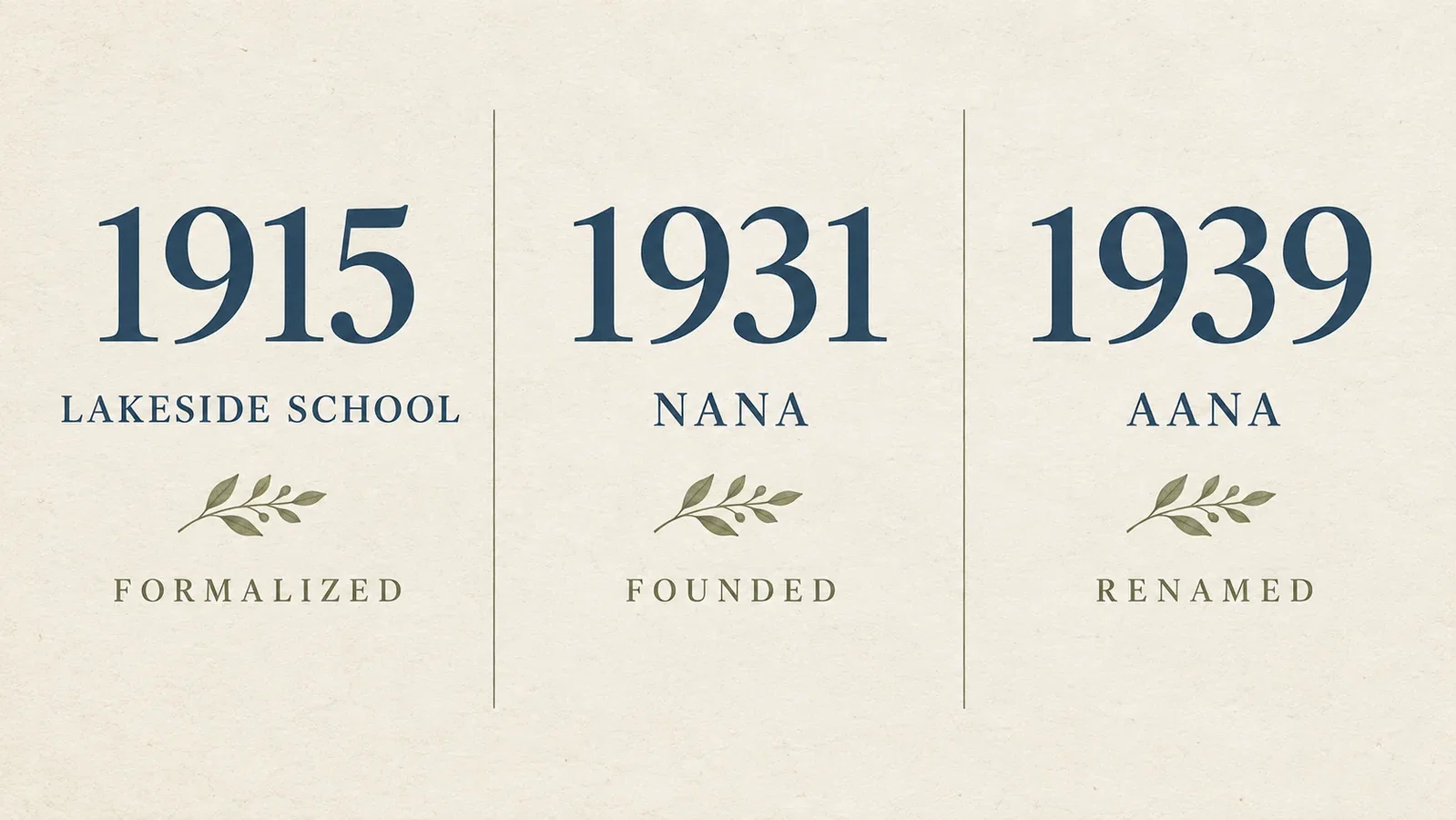
1915: formalization of Lakeside's educational program. 1931: NANA founded. 1939: renamed AANA. The abbreviations belong with the historical names in the text.[2,3]
Separating those dates clarifies what happened in 1931. Existing practice and school education needed a continuing forum for common requirements and organized action. NANA provided an organizational beginning. Defining and implementing standards and qualifications remained work to be done.[1,3,4]
Sources and reading limits
- Hodgins AC. The Nurse Anesthetist. Am J Nurs. 1930;30(7):863–867. DOI 10.2307/3410499. Original article. Six-page PDF includes a JSTOR cover; all five article pages read in full and individually checked visually. The AANA profile's 859–864 range was not adopted.
- Some Specialists: Agatha C. Hodgins, R.N. Am J Nurs. 1930;30(9):1163–1164. Original article. Unsigned contemporary profile; three-page PDF includes a cover. Both article pages, portrait and layout inspected.
- AANA. Profiles of Nurse Anesthetists/Nurse Anesthesiologists. Hodgins, Fife and Lamb sections read. Institutional retrospective evidence, not original minutes.
- Ciaramella J. AANA Celebrates 95 Years of Defining Standards in Nurse Anesthesiology. June 16, 2026. Complete article and source note read. Its account identifies the meeting roles. The minutes and historical books it cites were not directly acquired or read here.
- Society of Anaesthetists. Br Med J. 1893 Dec 9;2(1719):1304. PMID 20754565; PMCID PMC2422514. Original report. Text read; adjacent articles on the page excluded.
Continue exploring
Related reading connects shared questions and contexts; it does not by itself establish historical influence.
- 1893: London's Society of Anaesthetists Brings Experience Before Peers
- 1933: Helen Lamb Gives Anesthesia for a One-Stage Pneumonectomy
Anesthesia Epochs · The Source Room · About & Editorial Method
Sources and reading limits are stated above. Illustrations are labelled as original source images or AI-made. Historical accounts are educational; they are not current treatment instructions.