A one-stage cancer operation, intratracheal anesthesia and an educator in 1933.
Reading Library · Anesthesia Epochs · 中文版
Watch the companion film
1933: Helen Lamb and the Removal of an Entire Lung · Watch on YouTube
Historical anchor: 1933. Date details and source qualifications are explained below.
The operation at Barnes Hospital in St. Louis on April 5, 1933 began with a plan to remove the left upper lobe. The tumor's position prevented preservation of the lower-lobe bronchus, and the surgeons removed the entire left lung. Graham and Singer's case report states the anesthetic plainly: nitrous oxide and oxygen administered intratracheally.[1,p.240]
A later Washington University history identifies Helen Lamb as the anesthetist. Her presence gives us another way to read an operation usually remembered through its surgeons.[2,p.5;3,pp.48,50;4]
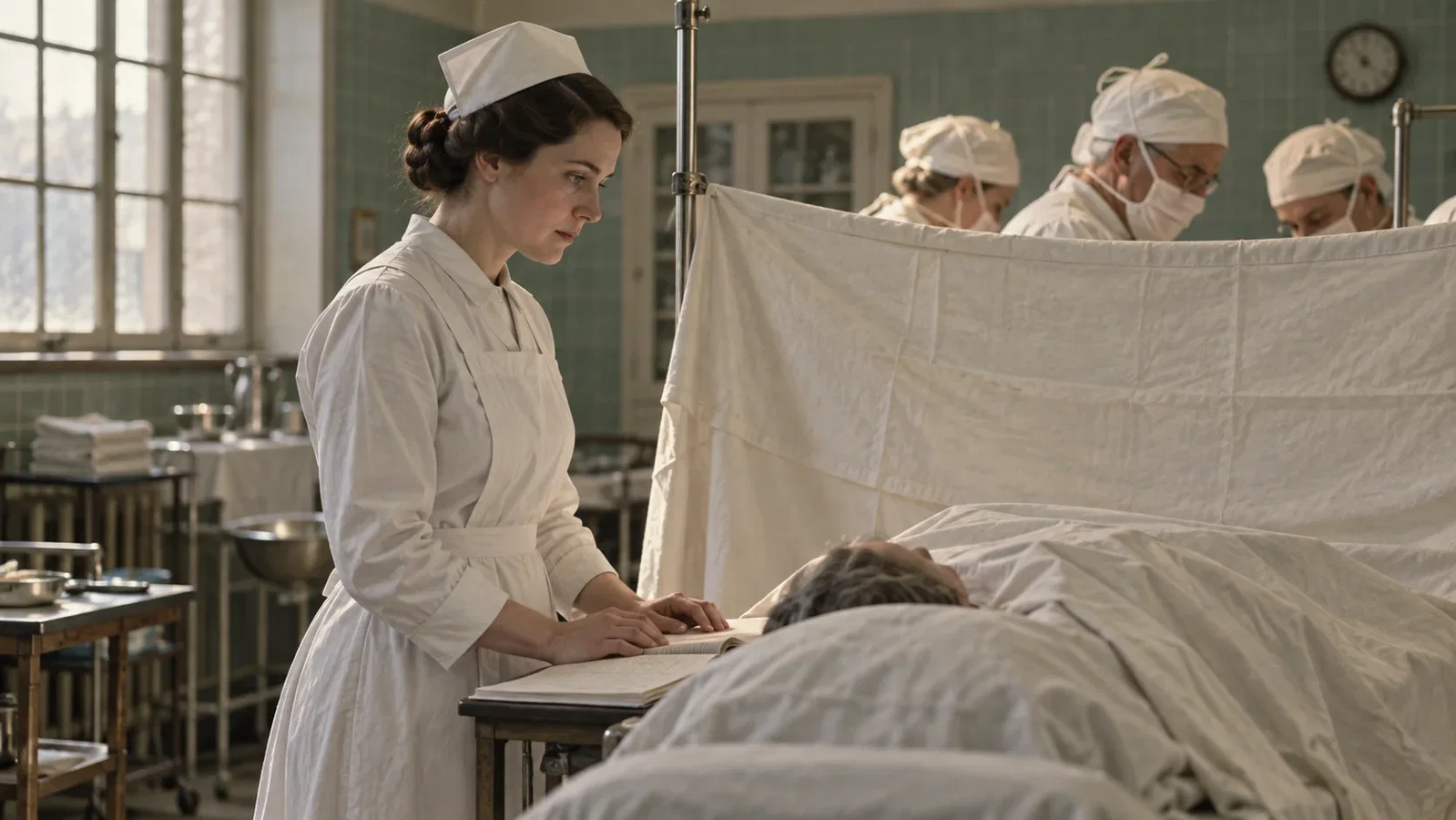
Historical concept illustration. The people, positions and room are editorial inventions, not a photograph of the operation or a reconstruction of its equipment.
The qualifications attached to a first
The original authors were more careful than a short commemorative caption can be. They described their case as apparently the first successful removal of an entire lung for carcinoma, and apparently the first deliberate removal of the whole lung in one stage. They also acknowledged Nissen and Haight's earlier removals for bronchiectasis, in which the lung had been allowed to slough after hilar ligation.[1,pp.238–239,242]
The disease, extent of resection and manner of completing it belong together: a successful one-stage removal of an entire lung for bronchial carcinoma. An unrestricted claim to the world's first pneumonectomy would erase precedents that the authors themselves discussed.[1,pp.238–239;2,p.5]
The case appeared in JAMA on October 28, 1933. The text read for this article is the authorized 1974 reprint in CA: A Cancer Journal for Clinicians, whose first page identifies the 1933 source. The operation, the original publication and the reprint have separate dates.[1,p.238;6]
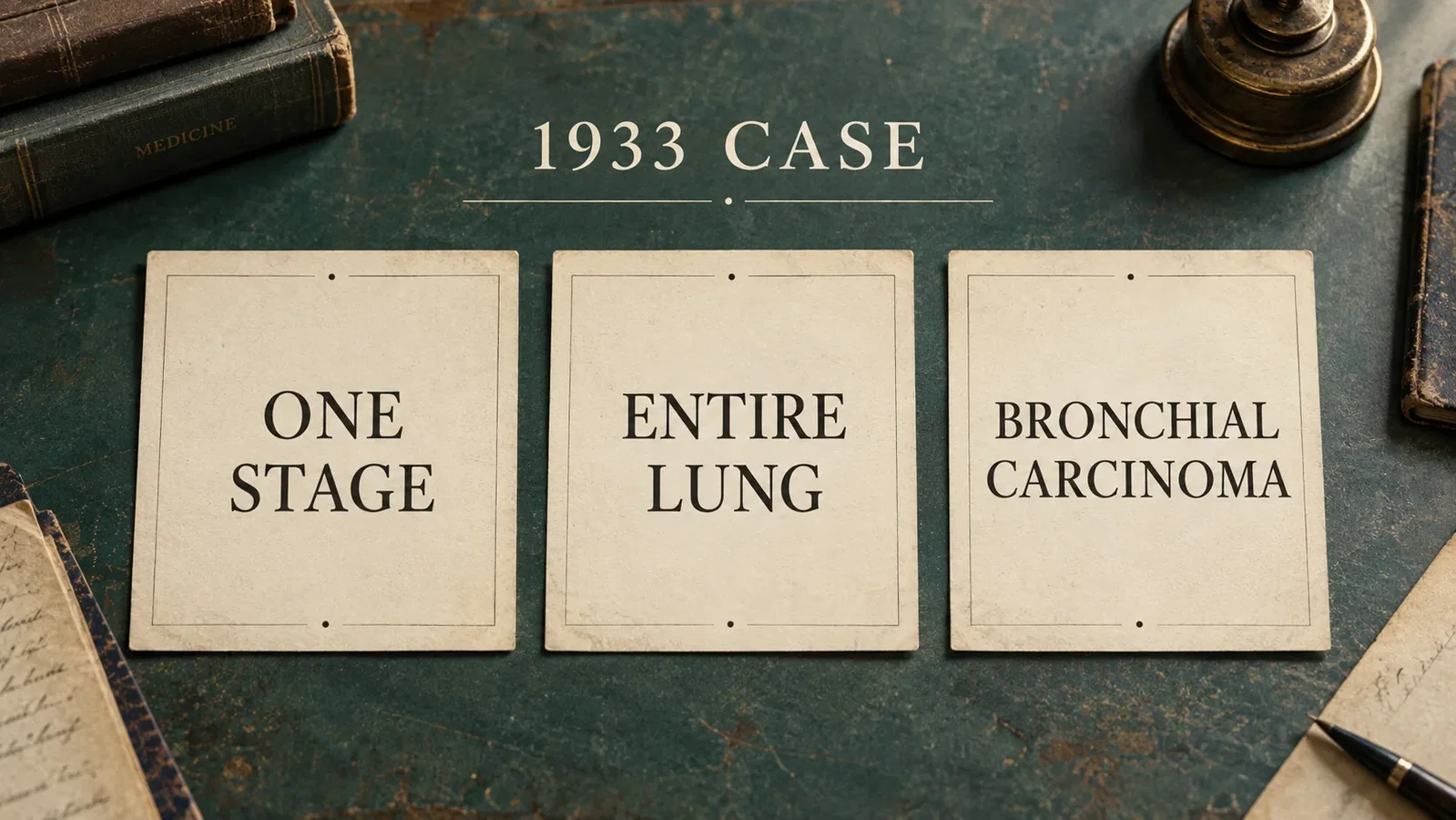
A modern editorial graphic explaining the scope of the priority claim. It does not represent three operations or three patients.
What the case report records about anesthesia
The report identifies the patient by the initials J. L. G., a 48-year-old physician. Repeated bronchoscopic examinations eventually yielded specimens showing squamous-cell carcinoma. At operation, the surgeons also faced nodules of uncertain nature in the lower lobe and an incomplete interlobar fissure. Examination after removal identified those nodules as small abscesses; the sampled lymph nodes showed no carcinoma.[1,pp.239–241]
Anesthesia occupies little space in this surgical report, but appears in both its description and discussion. The operative account records intratracheal nitrous oxide and oxygen. The discussion reports no immediately detectable change in the character of respiration after ligation of the hilus, then suggests that intratracheal anesthesia may have been important.[1,pp.240,242]
The observation and its proposed explanation have different evidential weight. A single case does not establish a general advantage of an anesthetic method. Nor does the report provide a complete breathing circuit, tube model or precise duration of manual ventilation from which to reconstruct the procedure.[1,pp.240,242]
Lamb is not named in the case text. Attribution rests on Ferguson's 1981 university history, Bankert's study of Lamb's papers, and the institutional biographies maintained by Becker Medical Library and AANA. These sources support her role, but do not amount to four independent records made in the operating room in 1933.[2–5]
One-stage removal and a complicated recovery
“One stage” describes the removal of the lung. The patient subsequently developed an empyema requiring drainage. Further rib resection followed on May 22, and he was discharged on June 18. The report also preserves later correspondence about his recovery of strength.[1,p.241]
Survival therefore belongs to a longer account that includes complications, another operation and convalescence. Ending the story at removal of the lung would omit a substantial part of the evidence the authors chose to report.[1,pp.240–242]
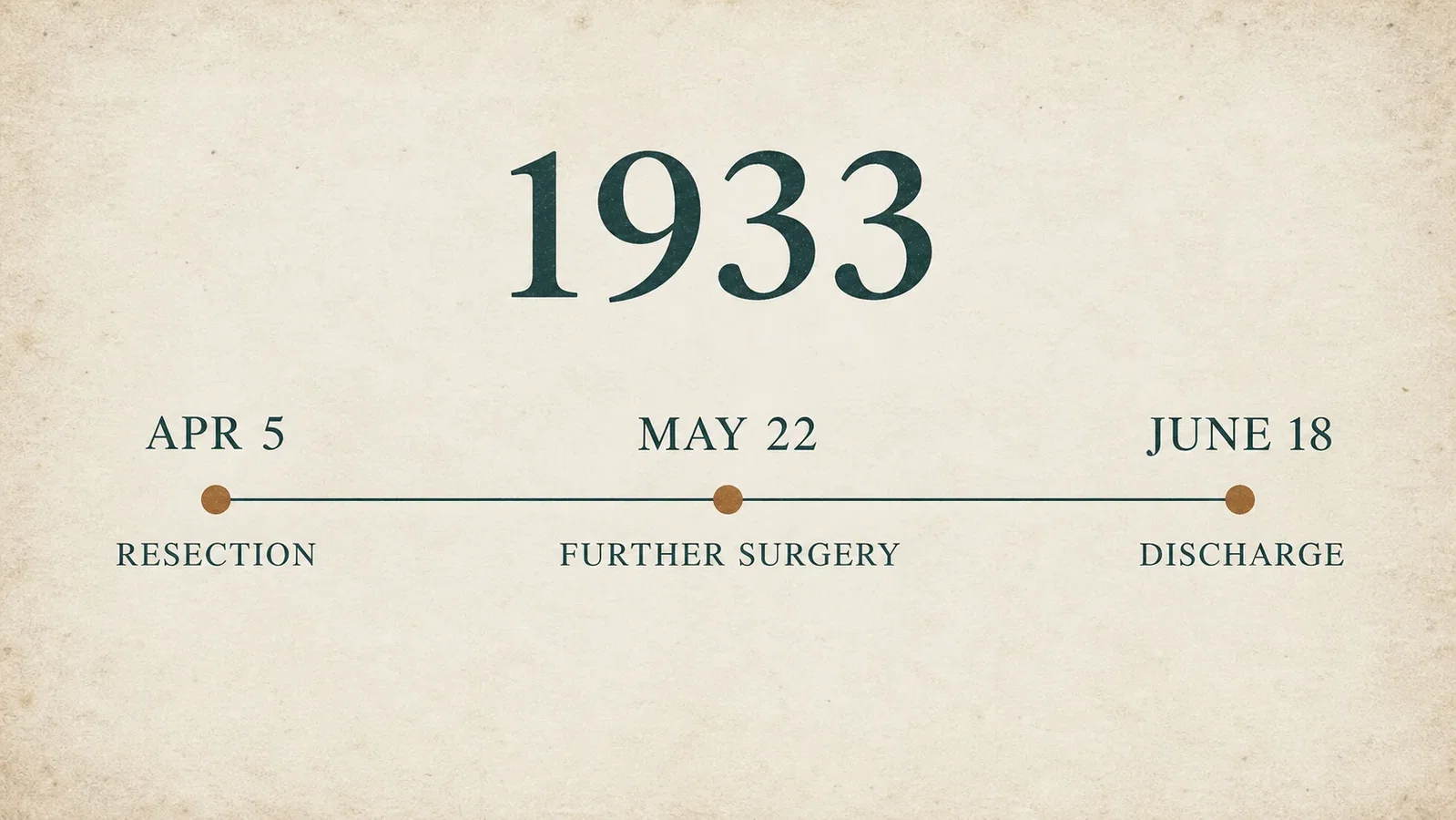
April 5: lung resection. May 22: further surgery. June 18: discharge. These are dates from one case, not a treatment pathway or a comparison of outcomes.[1,pp.240–241]
A career that also built teaching
Lamb had trained at the Lakeside School of Anesthesia. Bankert connects that education with Agatha Hodgins; the Becker and AANA biographies also describe her Lakeside background and subsequent work at Barnes. The accounts disagree about some dates in her career, but all place the establishment of the Barnes anesthesia school and Lamb's leadership there in 1929.[3,p.50;4;5]
She also participated in the organization of the National Association of Nurse Anesthetists, NANA, in 1931 and worked on its education committee to develop curricula and minimum educational standards. Clinical responsibility and the work of making anesthesia teachable ran alongside each other in her career.[3,p.50;4;5]
This provides a specific connection to the 1931: Hodgins Organizes NANA Around an Educational Program: Lamb's educational background and participation in the early association are documented. The connection concerns a person, a school and an organization; it does not establish that founding NANA caused the outcome of the 1933 case.[3–5]
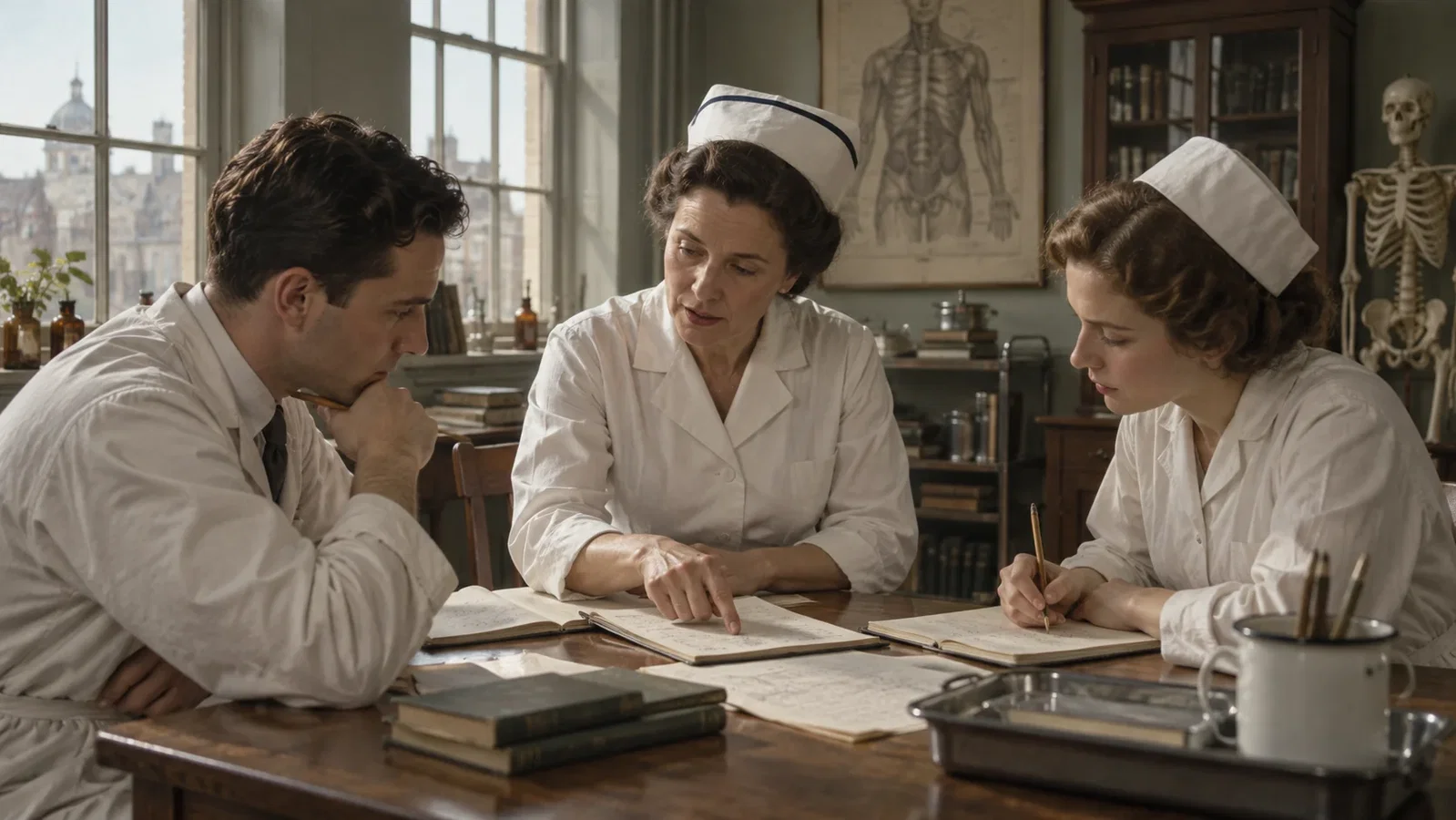
A conceptual 1930s teaching scene. The people, class size, notes and furnishings are not reconstructions of a documented lesson.
Read together, the case and the biographical sources preserve different kinds of work. The surgical report describes the operation, anesthetic method and recovery; later historical accounts identify Lamb and document her sustained involvement in education. Keeping those sources distinct allows her contribution to be described with the precision it deserves.[1–5]
Sources and reading limits
- Graham EA, Singer JJ. Successful removal of an entire lung for carcinoma of the bronchus. JAMA. 1933;101(18):1371–1374. Read in the authorized full reprint, CA Cancer J Clin. 1974;24(4):238–242. DOI 10.3322/canjclin.24.4.238. All five pages read and individually inspected. The reprint has local print damage; the original JAMA layout was not directly compared.
- Ferguson TB. Evarts A. Graham, M.D.: The Father of Chest Surgery. Outlook. Autumn 1981:2–9. University archive PDF. The eight-page article was read and each page viewed; the whole issue was not read. Its August date for the JAMA publication on p.6 was not adopted.
- Bankert M. The Papers of Helen Lamb: Insights into Relationships Between Pioneering Nurses and Physicians and Anesthesia. In: The History of Anesthesia: Third International Symposium Proceedings. 1992:48–52. WLM archive. Only the complete five-page chapter was read and visually inspected within the 490-page volume. The underlying original letters are not covered.
- Becker Medical Library. Helen Lamb (1899–1979). Complete biography and 1941 photograph caption read. Its internally inconsistent retirement dates are not used here.
- AANA. Profiles of Nurse Anesthetists/Nurse Anesthesiologists. Complete Lamb biography and bibliography read from the institutional page. Its broad intubation-priority claim and listed but unread works were not used as evidence for the case.
- JAMA. Original 1933 publication record. Used only for authorship, pagination and the October 28 publication date; it is not represented as an acquired original full text.
Medical history; the images are historical concept illustrations. Sources and reading limits are stated above. Illustrations are labelled as original source images or AI-made. Historical accounts are educational; they are not current treatment instructions.
Continue exploring
Related reading connects shared questions and contexts; it does not by itself establish historical influence.