The first meeting in 1948, distinct from later examinations, courses and the Royal Charter.
Reading Library · Anesthesia Epochs · 中文版
Watch the companion film
1948: Learning to Explain — The Faculty of Anaesthetists · Watch on YouTube
Historical anchor: 1948. Date details and source qualifications are explained below.
The new Faculty of Anaesthetists within the Royal College of Surgeons of England first met on 24 March 1948, according to the Royal College of Anaesthetists (RCoA) history. It names Archibald Marston as the first Dean; a contemporary examination report also identifies him as Dean. The meeting, revised examinations, teaching programme and later Royal College have separate dates.[1,World War 2 and anaesthesia;2,p.158]
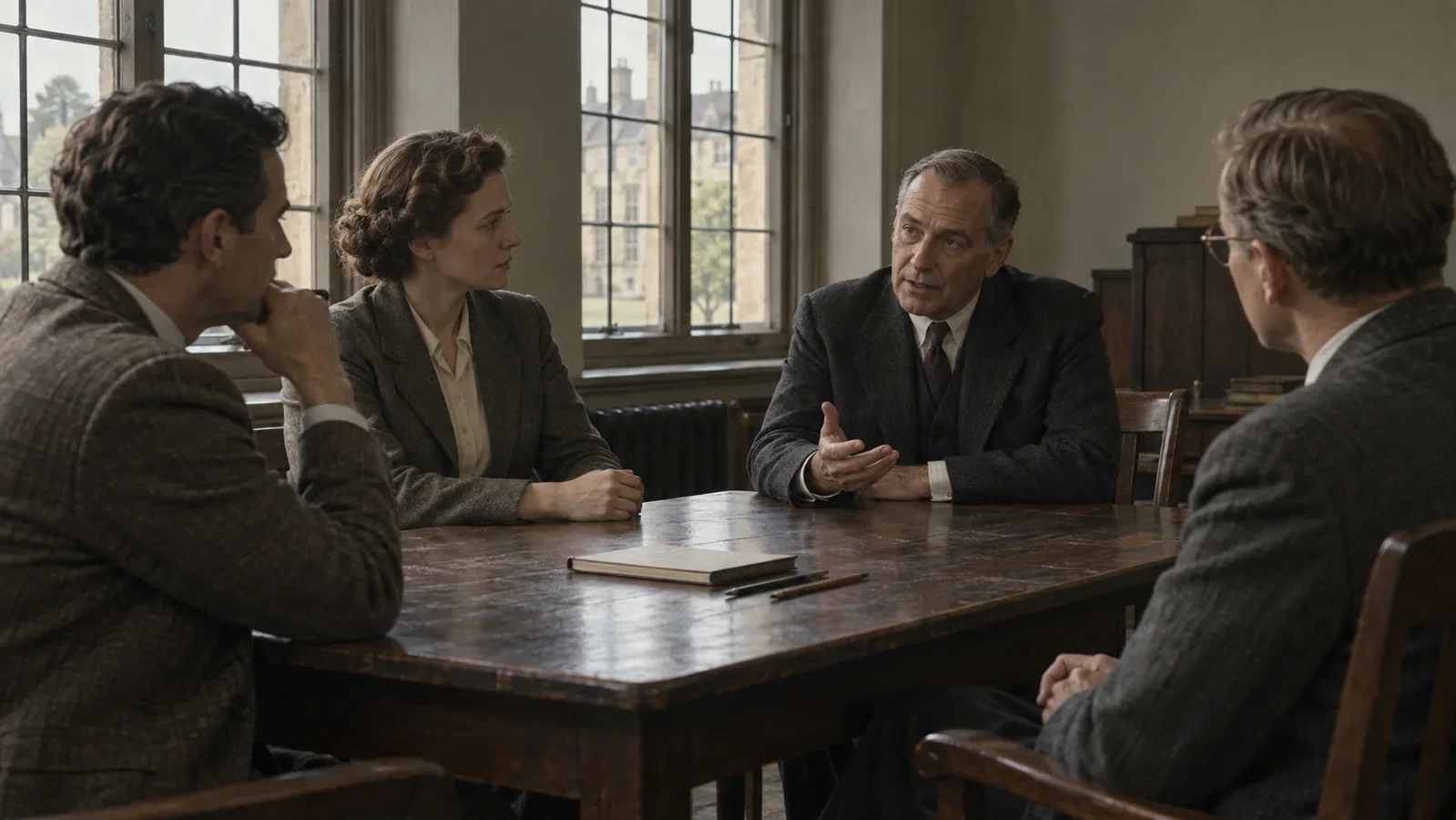
The people and room are editorial inventions, not a photograph, attendance list or reconstruction of the first meeting.
From discussion to qualification
A report in the 1893 British Medical Journal records the London Society of Anaesthetists questioning George Oliver's observations. The RCoA history identifies that society as an antecedent, tracing its incorporation into the Royal Society of Medicine in 1908, the formation of the Association of Anaesthetists of Great Britain and Ireland (AAGBI) by members of the Section in 1932, and the later petition for a Faculty. These intermediate organisations matter: the 1893 society and the 1948 Faculty were not simply the same body under different names.[5,p.1304;1,Working towards independence and the Royal Charter]
Preparations for the National Health Service (NHS) brought professional status and qualifications into negotiations. Wildsmith's archive-based account describes Alfred Webb-Johnson supporting an academic organisation and an examination of higher standard. The Diploma in Anaesthetics, or DA, was revised into two parts under regulations effective from 1 January 1948. The book distinguishes the AAGBI's proposals from the eventual arrangements; the Association's recommendations were not adopted unchanged.[4,pp.24–28]
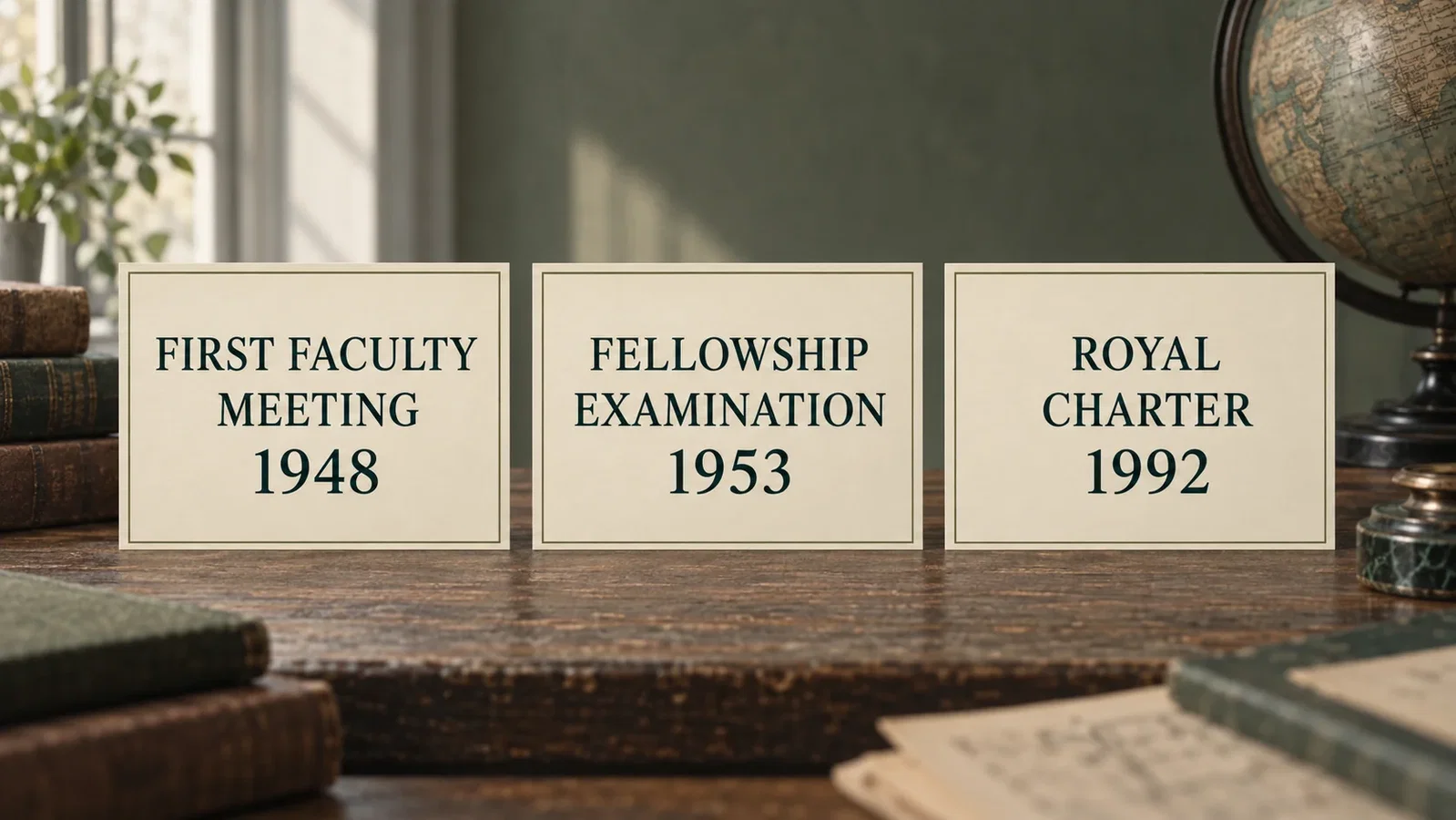
The years 1948, 1953 and 1992 identify separate institutional stages. These are editorial cards, not historical certificates.
Inside an examination report
The report published in 1949 describes a DA examination held in November 1948. Part I included two written papers covering applied physiology and pharmacology, and applied anatomy and pathology. Part II had another paper. Oral examinations addressed theory, equipment, care before and after surgery, and related medical questions. Anaesthetists shared the examining work with colleagues in pathology, pharmacology, medicine and surgery.[2,pp.158–159]
The observer also criticised candidates' preparation and reported entry and pass numbers for each part. The account records difficulties within the developing qualification system. Results from one sitting cannot establish a change in patient outcomes. The report describes an examination in November; it does not call that sitting the first.[2,p.159]
A teaching programme on paper
A spring 1950 notice announced 45 anaesthesia lectures between 12 April and 2 May, with ten one-hour tutorials during the same period. It also listed basic-science teaching and a separate pharmacology course. Applications were to go to the Faculty's secretary at Lincoln's Inn Fields, London. Subjects, times, fees and an application address made the proposed programme concrete.[3,pp.63–64]
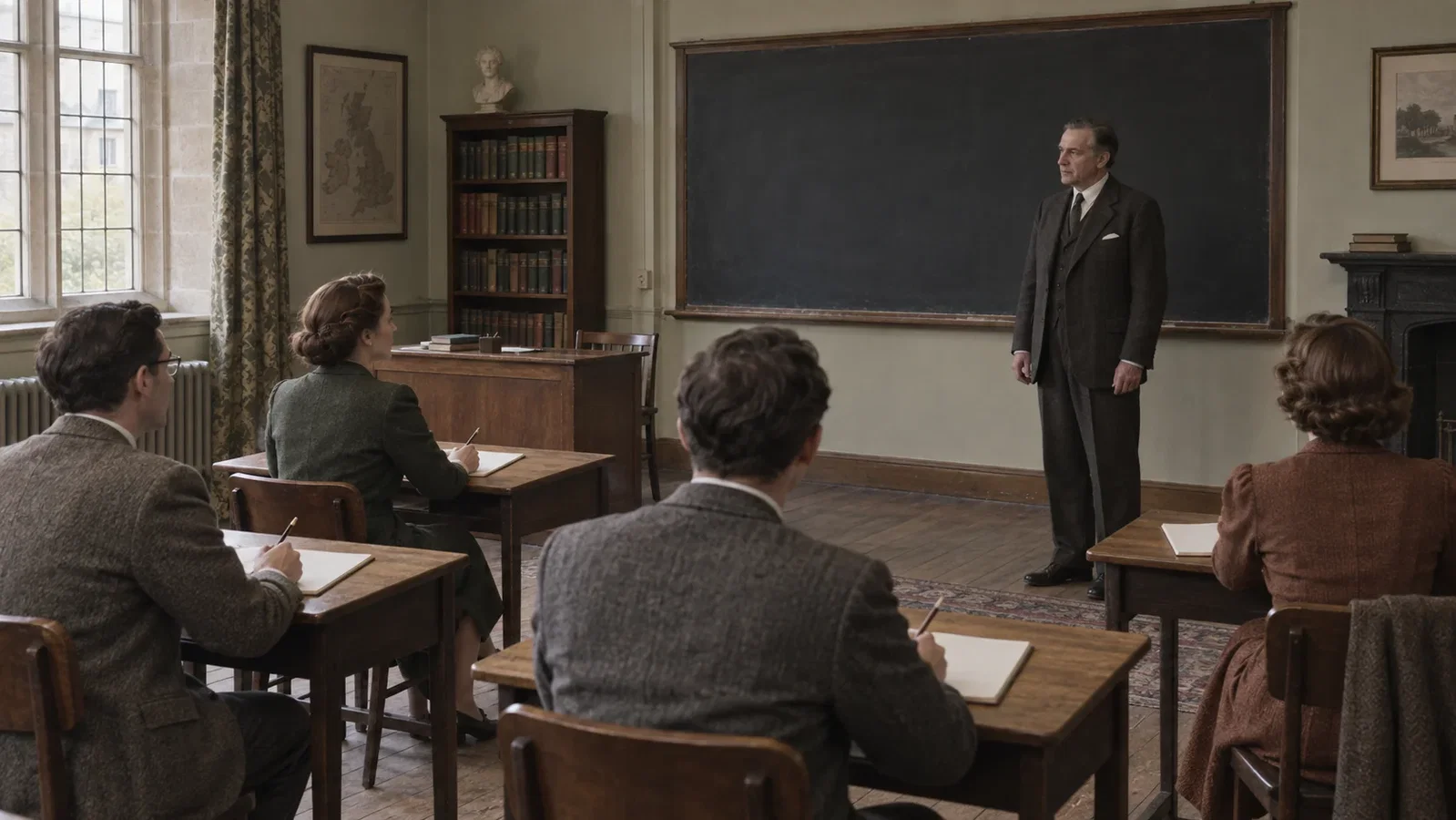
The classroom represents organised teaching. Its people and lesson are invented and do not reconstruct a particular advertised session.
The notice announced future courses. It cannot establish that every session took place, how many people attended, or whether examination results improved. Read with the examination report, it records specific forms of the Faculty's early work.[2–3]

The still life does not reproduce actual examination questions, textbooks, notices or qualification certificates.
Initially, fellowship (FFARCS) was awarded through nomination or election. FFARCS examinations followed in 1953; the Royal Charter came in 1992. The 1948 Faculty belongs within that longer institutional history, with later examination reform and independence still to come.[1,Working towards independence and the Royal Charter; From FFARCS to FRCA;4,pp.26,31–32]
Sources and reading limits
- Wildsmith T. The Origins of the Royal College of Anaesthetists and its Fellowship. Royal College of Anaesthetists, undated. Official history. Complete article text and eight reference entries read, accessed 9 September 2026. A retrospective account; the original first-meeting minutes are not covered. Embedded Charter image was not transcribed.
- Anonymous. The Examining Board in England: Diploma in Anaesthetics. Br J Anaesth. 1949;21(3):158–159. DOI: 10.1093/bja/21.3.158. Original report. Both report pages read in text and page images; the delivered third page is an unrelated ether advertisement, also inspected. Reports the November 1948 sitting without calling it the first.
- Faculty of Anaesthetists, Royal College of Surgeons of England. Postgraduate lectures and tutorials in anaesthetics. Br J Anaesth. 1950;22(1):63–64. DOI: 10.1093/bja/22.1.63. Original announcement. Both pages fully read. A prospective course notice, not an attendance or outcome report.
- Wildsmith JAW. The UK Diploma in Anaesthetics: A world first in the path to an independent specialty. London: Royal College of Anaesthetists; 2026. ISBN 978-1-900936-41-5. Current original book PDF. Read: cover, printed pp. 1–2, 4–5, 22, 24–32 and 77–78. Printed p. 23 additionally read as navigation text. The other pages and the underlying archive minutes are not covered. The preface dates the earlier web draft to November 2025; this copy's copyright page says 2026.
- Anonymous. Society of Anaesthetists. Br Med J. 1893;2(1719):1304. PMID: 20754565. Original meeting report. Original page read. The society report is distinguished from adjacent articles on the same page.
Continue exploring
Related reading connects shared questions and contexts; it does not by itself establish historical influence.
The Source Room · About & Editorial Method
Sources and reading limits are stated above. Illustrations are labelled as original source images or AI-made. Historical accounts are educational; they are not current treatment instructions.